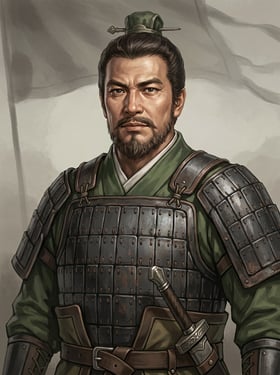
Historical Record
Wang Ping, styled Zijun, was a man of Dangqu in Baxi. His original surname was He, which he later changed back to Wang. At first, Wang Ping followed Du Huo and Pu Hu to Luoyang and was appointed a colonel. When Cao Cao campaigned against Hanzhong, Wang Ping followed the army; later he came over and surrendered to Liu Bei and was appointed Gate-Tower General and Subordinate General c:2759.
In the sixth year of Jianxing (228), during Zhuge Liang's Northern Expeditions, Wang Ping was attached to the army adviser Ma Su and served as vanguard. At the Battle of Jieting, Ma Su abandoned the water and went up the hill, and his deployments were in disarray; Wang Ping repeatedly remonstrated, but Ma Su would not heed him, and in the end suffered a great defeat. After the defeat the host scattered, and Wang Ping alone, leading his thousand-odd men, beat his drums and held fast, so that the Wei general Zhang He suspected an ambush and dared not press close. Wang Ping then slowly gathered up the scattered soldiers and stragglers of the various camps and led his troops safely back c:2759.
After the defeat at Jieting, Zhuge Liang executed Ma Su and the generals Zhang Xiu and Li Sheng, and stripped the generals Huang Xi and others of their commands, while Wang Ping for this reason received special commendation and promotion: he was additionally appointed army adviser, commanding the five divisions and concurrently managing camp affairs, advanced to General Who Chastises Bandits, and enfeoffed as a pavilion marquis c:2759.
In the ninth year of Jianxing (231), when Zhuge Liang besieged Mount Qi, Wang Ping alone held the southern perimeter. The Wei Grand General Sima Yi attacked Zhuge Liang, while Zhang He attacked Wang Ping. Wang Ping held his ground firmly, and Zhang He could not take it c:2759.
In the twelfth year of Jianxing (234), Zhuge Liang died at Wugong and the Shu army withdrew. During this time Wei Yan caused a disturbance, but it was soon put down, and Wang Ping rendered merit in the affair c:2761. Thereafter Wang Ping was transferred to Rear Army Director and General Who Pacifies the Han, and as deputy to the General of Chariots and Cavalry Wu Yi garrisoned Hanzhong, concurrently serving as Grand Administrator of Hanzhong. In the fifteenth year (237) he was advanced to Marquis of Anhan, and succeeded Wu Yi in supervising the affairs of Hanzhong c:2761.
In the first year of Yanxi (238), when the Grand General Jiang Wan was stationed at Mianyang, Wang Ping was transferred to Front Protector of the Army, in charge of the affairs of Jiang Wan's office. In the sixth year of Yanxi (243), when Jiang Wan moved to reside at Fu county, Wang Ping was appointed Front Army Supervisor and Grand General Who Guards the North, continuing to command Hanzhong c:2761.
In the spring of the seventh year of Yanxi (244), the Wei Grand General Cao Shuang led over a hundred thousand foot and horse to attack Hanchuan, his vanguard already reaching Luogu. At the time the Hanzhong garrison numbered fewer than thirty thousand, and the generals were aghast. Someone proposed: "Our troops now are too few to resist the enemy. Better to hold fast the two cities of Hancheng and Lecheng, let the enemy enter, and wait for the relief from Fucheng to arrive." Wang Ping, however, put forward a different view: "Not so. Hanzhong is nearly a thousand li from Fucheng. If the enemy seizes the passes, it will be a great calamity. We should now first send Protector of the Army Liu and Army Adviser Du to hold Mount Xingshi, with I, Wang Ping, as the rear support. If the enemy divides his forces toward Huangjin, I will personally lead a thousand men to resist them; in this way, by the time the relief from Fucheng arrives, this is the best policy." At the time only Protector of the Army Liu Min agreed with Wang Ping, and at once put it into effect. In the end the relief from Fucheng and Fei Yi from Chengdu arrived one after another, and the Wei army withdrew, just as Wang Ping had foreseen c:2762. At that time Deng Zhi was in the east, Ma Zhong in the south, and Wang Ping on the northern frontier, all of whom were thereby renowned and distinguished c:2762.
In the Novel
In the Romance of the Three Kingdoms, Wang Ping's entrance and career are endowed with more dramatic color. He first appears during Cao Cao's attack on Hanzhong, as a Gate-Tower General of the Cao army. In the Battle of Han River, Xu Huang wished to cross the Han River and form his battle line; Wang Ping bitterly remonstrated, pointing out that crossing the water to fight would leave them trapped if a sudden retreat were needed, and questioning whether Xu Huang could read the enemy with the foresight of Han Xin. Xu Huang would not listen and insisted on crossing. As a result Xu Huang was greatly defeated, while Wang Ping's troops suffered no loss c:5899. After his defeat, Xu Huang instead blamed Wang Ping for not coming to his rescue; Wang Ping retorted that he had warned against it in vain, and that had he gone to the rescue he could not even have held his own camp. Xu Huang, in a fury, wished to kill Wang Ping, whereupon that very night Wang Ping set fire to the camp, led his own troops and horses over to Zhao Yun, and was later introduced to Liu Bei. Learning that Wang Ping knew the geography of the Han River well, Liu Bei was overjoyed and said, "Having gained Wang Zijun, I have no doubt of taking Hanzhong," and appointed Wang Ping Lieutenant General and acting guide c:2763. This passage has no record in the historical facts and is a fiction of the novel.
When Zhuge Liang campaigned south against Meng Huo, Wang Ping followed the army as a deputy general c:5902. He took part in many encirclements and stratagems against Meng Huo; for instance, at the fourth capture of Meng Huo, Wang Ping together with Zhang Yi led troops to reach the Man stockade and took captive Lady Zhurong and her household c:2765.
During the Northern Expeditions, when attacking the city of Anding, Wang Ping coordinated with generals such as Guan Xing and Zhang Bao to capture alive the Wei general Xiahou Mao c:2766. When attacking the city of Jicheng, Wang Ping together with Zhang Yi attacked Jiang Wei from both sides, forcing Jiang Wei to flee in defeat c:5904.
The Battle of Jieting is one of Wang Ping's best-known episodes in the novel. Knowing Wang Ping to be prudent, Zhuge Liang specially entrusted the heavy task of guarding Jieting to him and Ma Su, and repeatedly enjoined Wang Ping to be careful and prudent, to make camp on the vital road, and not to take the enemy lightly c:2767. Ma Su, however, would not heed Wang Ping's remonstrance and insisted on encamping on the hill. After remonstrating again and again in vain, Wang Ping could only lead five thousand troops to set up a separate camp ten li below the hill, and sent men to report Ma Su's deployment to Zhuge Liang c:12680. When the Wei general Zhang He attacked, Wang Ping resisted with all his strength, but, outnumbered and weak, was forced to withdraw. After Jieting was lost, Wang Ping broke out together with Wei Yan and Gao Xiang, and in the end reported to Zhuge Liang how Ma Su's refusal to heed counsel had led to the loss of Jieting, winning Zhuge Liang's acknowledgment c:5906.
During Zhuge Liang's Second Northern Expedition, Wang Ping together with Jiang Wei volunteered to take the two commanderies of Wudu and Yinping, each leading ten thousand troops there c:12685. In one battle pursuing the Wei troops, when Kongming asked who would take the van, Wei Yan bowed his head and said nothing, while Wang Ping stepped forward and declared his willingness to take on the task c:2769. During Zhuge Liang's Fifth Northern Expedition, Wang Ping together with Ma Dai, Zhang Yi, and Ma Zhong issued from the Xie Valley and rendezvoused at Mount Qi c:5907. In the Battle of Beiyuan, Wang Ping and Zhang Ni were ordered to go to the Wei camp but ran into an ambush and suffered heavy losses c:12675.
Key Relationships
* Cao Wei (serves): Wang Ping in his early years served Cao Cao as a colonel c:2759. In the novel, he went into battle under Xu Huang as a Gate-Tower General, and later, when Xu Huang would not heed his remonstrance, went over to Liu Bei c:5899.
* Shu Han (commands_in): After coming over to Liu Bei, Wang Ping became an important Shu Han general, successively holding such offices as Gate-Tower General, Subordinate General, army adviser, General Who Chastises Bandits, Rear Army Director, General Who Pacifies the Han, and Grand General Who Guards the North, and once supervised Hanzhong c:2759, c:2761.
* Ma Su (advises_in): At the Battle of Jieting, Wang Ping repeatedly remonstrated with Ma Su, but Ma Su would not listen, leading to a great defeat c:2759. In the novel, Wang Ping's remonstrance with Ma Su is more detailed, and because Ma Su would not heed him, he encamped separately and in the end reported Ma Su's fault to Zhuge Liang c:12680, c:5906.
* Zhang He (fights_in): In history, Zhang He attacked the southern perimeter that Wang Ping guarded, but Wang Ping held fast and Zhang He could not take it c:2759. In the novel, Zhang He was one of the main Wei forces at the Battle of Jieting and once fought with Wang Ping c:2768.
* Zhuge Liang (subordinate_to): Wang Ping was an important general during Zhuge Liang's Northern Expeditions, deeply trusted and valued by Zhuge Liang. After the defeat at Jieting, Zhuge Liang specially commended Wang Ping c:2759. In the novel, Zhuge Liang well understood Wang Ping's prudent character and repeatedly entrusted him with heavy responsibilities, such as guarding Jieting, taking Wudu and Yinping, and serving as vanguard in the pursuit c:2767, c:12685, c:2769.
* Liu Bei (serves): After coming over to Liu Bei, Wang Ping won Liu Bei's deep trust. In the novel, after Wang Ping surrendered, Liu Bei, delighted that he knew the geography of Hanzhong, appointed him Lieutenant General c:2763.
* Xu Huang (advises_in): In the novel, Wang Ping once remonstrated with Xu Huang against crossing the Han River to form his battle line, but Xu Huang would not listen and was in the end greatly defeated. Xu Huang even wished to kill Wang Ping for it c:5899, c:2763 (unique to the novel).
* Zhao Yun (serves): In the novel, before surrendering to Liu Bei, Wang Ping first went over to Zhao Yun c:2763 (unique to the novel).
Iconic Scenes
* Holding fast and remonstrating at the Battle of Jieting: This is the most representative event in Wang Ping's career. In history, after Ma Su's great defeat, Wang Ping led a thousand men and held his drums, so that Zhang He dared not press close, and successfully gathered up the scattered soldiers and withdrew c:2759. In the novel, Wang Ping's repeated bitter remonstrances with Ma Su, and the episode in which Ma Su's refusal to heed counsel led to the loss of Jieting, all the more highlight Wang Ping's prudence and Ma Su's willful self-assurance c:12680, c:5906.
* The defense of Hanzhong: In the seventh year of Yanxi (244), faced with Cao Shuang's army of over a hundred thousand pressing upon him while the Hanzhong garrison numbered fewer than thirty thousand, Wang Ping overruled the counsel of the many and proposed the strategy of "holding Mount Xingshi, with Ping as the rear support," and in the end successfully repelled the Wei army and defended Hanzhong c:2762. This event fully displays Wang Ping's outstanding military talent and strategic vision.
* Going over to Liu Bei: In the novel, when Xu Huang's refusal to heed his remonstrance led to defeat and Xu Huang instead wished to kill Wang Ping, Wang Ping in indignation burned the camp and went over to Zhao Yun, and in the end came over to Liu Bei. Delighted that he knew the geography of Hanzhong, Liu Bei appointed him Lieutenant General c:2763 (unique to the novel). This scene shapes the image of Wang Ping as loyal, righteous, upright, and unafraid of power.
* The southern campaign against Meng Huo: In the novel, Wang Ping followed Zhuge Liang on the southern campaign as a deputy general, took part in many stratagems and encirclements against Meng Huo, and captured Lady Zhurong alive c:2765 (unique to the novel). This embodies the many-sided military talent of Wang Ping under Zhuge Liang.
* Vanguard and steadfast defense in the Northern Expeditions: During Zhuge Liang's Northern Expeditions, Wang Ping repeatedly played important roles. For instance, in the Second Northern Expedition he took Wudu and Yinping together with Jiang Wei c:12685. In one pursuit of the Wei troops, when Wei Yan bowed his head and said nothing, Wang Ping stepped forward and volunteered to take the van c:2769 (unique to the novel). These scenes display Wang Ping's valor and loyalty.
* Capturing Xiahou Mao alive: In the novel, when attacking the city of Anding, Wang Ping coordinated with generals such as Guan Xing and Zhang Bao to capture alive the Wei general Xiahou Mao c:2766 (unique to the novel). This episode further enriches Wang Ping's record of achievements.
Portrait file
Character profile
- Appearance
- Wang Ping grew up amid the campaigns of the army; his hand could not write, and the characters he knew numbered no more than ten.
- Character
- Wang Ping observed the law and the rules, spoke no jest, and would sit erect the whole day through; yet he was narrow and suspicious in temper, and held himself in low esteem. Cautious and steady, he did not lose his composure in the face of the enemy, could keep himself whole in adversity, and dared to offer remonstrance. Loyal and valiant, ready to give his life, he was praised by Kongming with a sigh as 'a truly loyal minister.'
- Manner of speech
- Wang Ping weighed the situation when facing the enemy, once saying, 'Could it be that Sima Yi has learned of it and made preparations in advance?'
- Life
- Wang Ping was a man of Dangqu in Baxi. Originally reared in his maternal family, the He clan, he later resumed the surname Wang. Together with Du Huo and Pu Hu he went to Luoyang and was made acting Colonel; he followed Cao Cao on the campaign into Hanzhong, and afterward surrendered to the Former Sovereign Liu Bei, being appointed General of the Standard Gate and Lieutenant General. Wang Ping successively served as Front Army Supervisor and Grand General Who Guards the North, in command of Hanzhong, and once quelled the revolt of Wei Yan. In the seventh year of Yanxi he held Mount Xingshi against Cao Shuang's host of more than a hundred thousand, compelling the Wei army to withdraw.
- Anecdotes
- When Wang Ping dictated letters, they were all sound in sense and reason, and when he had the biographies of the Shiji and the Hanshu read to him, his discussions of them never missed their import. He was Grand General Who Guards the North and Marquis of Anhan of Shu Han.
Relationships
9 relationships
Quotes
14 recorded lines · 3 featured
「參軍差矣:若屯兵當道,築起城垣,賊兵縱有十萬,不能偷過;今若棄此要路,屯兵於山上,倘魏兵驟至,四面圍定,將何策保之?」
These words embody Wang Ping's military foresight, forming a sharp contrast with Ma Su; it is the key dialogue of the Battle of Jieting.
「吾累隨丞相經陣,每到之處,丞相盡意指教。今觀此山,乃絕地也。若魏兵斷我汲水之道,軍士不戰自亂矣。」
Wang Ping's precise judgment of the terrain foreshadowed the inevitability of Jieting's fall, highlighting his military acumen.
「不然。漢中去涪垂千里。賊若得關,便為禍也。今宜先遣劉護軍、杜參軍據興勢,平為後拒。若賊分向黃金,平率千人下自臨之,比爾間,涪軍行至,此計之上也。」
Recorded in the official history, this displays Wang Ping's strategic vision and decisive resolve in the Battle of Xingshi.
Chapters15 回 ▸
- 史ch.33ch.43
- 演ch.71ch.72ch.87ch.89ch.90ch.92ch.93ch.95ch.96ch.98ch.99ch.100ch.102
Relationship timeline11 条 ▸
史 ch.43
- Ma Su§28
advises_in
属参军马谡先锋;连规谏谡不能用,遂大败于街亭
- Zhang He§28
fights_in
街亭后徐徐收合诸营遗迸;后亮围祁山时郃攻平,平坚守不动
- Wei Yan§29
fights_in
亮卒于武功,魏延作乱一战而败,平之功也
- Cao Shuang§30
fights_in
兴势御之,魏军退还
演 ch.72
- Xu Huang§1
enemy_of
王平苦谏徐晃勿渡汉水不听;徐晃责其不救、欲杀之,平反走
演 ch.89
commands_in
受密计入伏;后又为前部探路饮哑泉
演 ch.90
- Lady Zhurong§18
fights_in
与张翼引军入蛮寨活捉祝融夫人并一应老小
演 ch.92
- Xiahou Mao§18
enemy_of
交马只一合,生擒于马上
演 ch.95
演 ch.99
- Zhuge Liang§13
commands_in
自请舍身当伏兵之任,孔明嘉为"真忠臣"
Inner monologues · AI-generated3 段 ▸
- I am Wang Ping, courtesy name Zijun. Looking back on my life now, what mattered most was not the title of marquis, but h
- The wind howled at Jieting, banners facing one another in the distance. I am Wang Ping, courtesy name Zijun, a native of
- My name is Wang Ping, and my courtesy name is Zijun. I come from Dangqu in BaxI. There are few records on which I can re
Life events12 ▸
- 0219-01-01 · Han RiverBattle of Han River· Warrior
- 0225-01-01 · NanzhongZhuge Liang's Southern Campaign· Warrior
- 0228-01-01 · HanzhongExecution of Ma Su· Witness
- 0228-01-01 · Mount QiFirst Northern Expedition· Warrior
- 0228-01-01 · JietingBattle of Jieting· Warrior
- 0229-01-01 · WuduZhuge Liang's Third Northern Expedition· Warrior
- 0231-01-01 · Mount QiZhuge Liang's Fourth Northern Expedition· Warrior
- 0231-01-01 · Mount QiZhuge Liang's Fifth Northern Expedition· Warrior
- 0234-01-01 · Mount QiZhuge Liang's Northern Expeditions· Warrior
- 0234-01-01 · NanzhengRebellion of Wei Yan· Warrior
- 0244-01-01 · Mount XingshiBattle of Xingshi· Commander
- 0244-01-01 · Mount XingshiCao Shuang's Campaign Against Shu via Luogu· Commander