Background
Shezhanqunru is placed by the novel at the most critical suture point in the formation of the Chibi alliance. In the autumn of the thirteenth year of Jian'an, Cao Cao had newly taken Jingzhou and was driving his great army down the Yangtze; inside Jiangdong the split between hawks and doves was severe: the civil official faction headed by Zhang Zhao argued that "the natural barrier of the Yangtze River is now shared with us; the force cannot be opposed," advocating surrender to preserve the six commanderies; the hawks, centered on Lu Su and Zhou Yu, pushed strongly for a Liu-Sun alliance to resist Cao Cao. Lu Su privately laid out for Sun Quan the case that "any of the others may surrender to Cao Cao — only Your Lordship may not", but Lu Su's internal persuasion alone was not enough to reverse the dominant rhetoric of the surrender-faction. At this juncture the novel needed a scene that could directly shatter the surrender-faction's discursive authority and let readers watch the Jiangdong civil official bloc lose the argument — and so the Shezhanqunru episode was born. From a political-historical standpoint, the true function of this fictional debate was to supply the alliance with "intellectual legitimacy": the alliance was not reached because it was diplomatically persuaded into existence, but because the surrender-faction was defeated by rational argument and the alliance then naturally followed.
Principal Figures
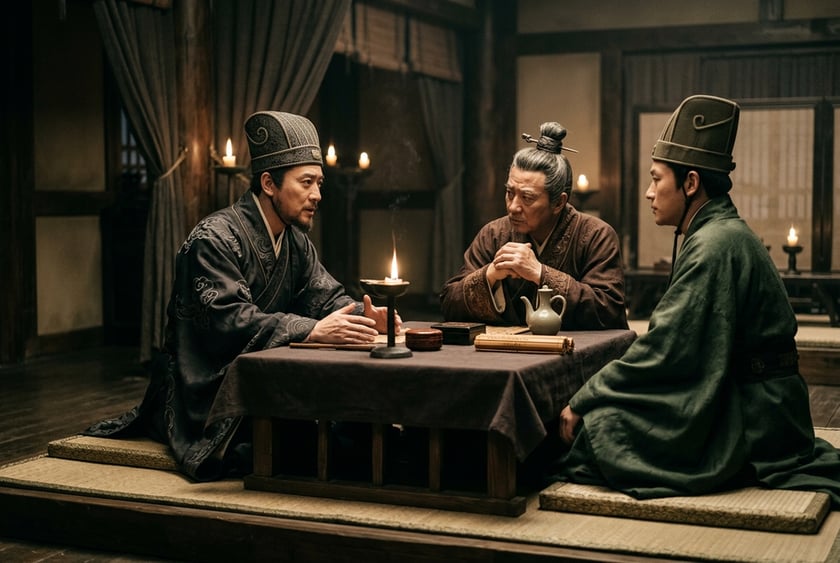
The argumentative weight on the Jiangdong side was carried first by Zhang Zhao. Zhang Zhao, as the foremost adviser of Jiangdong, opened the attack: "You, sir, compare yourself to Guan [Zhong] and Yue [Yi], yet now that Liu Yuzhou has obtained you, he fares worse than at the start" — the core thesis being "talent must be validated by results". This was a very hard-edged realist argument; it made no appeal to moral principle but only to performance. Zhuge Liang's response did not meet the performance argument head-on but instead introduced the concept of "biding one's time" — "Lord Liu of Yuzhou leads only a few thousand troops of righteous conduct; how could he oppose the million-strong horde of violence? Retreating to hold Xiakou — it is precisely to wait for the right moment" — redefining the short-term setbacks as one part of a long-term positioning. This rhetorical device subsequently became a canonical model for the "endure humiliation while bearing the load" narrative in Chinese political tradition. Yu Fan and Bu Zhi represented the "strategic realism" of the surrender faction: Yu Fan pressed with "Cao Cao has a million troops and a thousand commanders" to establish a sense of overwhelming force, while Bu Zhi disparaged Zhuge Liang as a mere persuader-envoy in the mold of Yi [Yi] and Qin [Zong]. Zhuge Liang's counter-moves shifted "realism" back to the "moral plane": Cao Cao's troops were "ant-swarming soldiers from Yuan Shao and a disorderly mob from Liu Biao", and Yi and Qin themselves were heroes of the type "who devised stratagems to support a state".
Xue Zong and Lu Ji represented the "mandate of heaven has shifted" argument — Xue Zong argued "the Han dynasty's mandate is approaching its end; Cao Cao already holds two-thirds of all under heaven", and Lu Ji argued that Liu Bei's background as a "mat-weaver and sandal-peddler" was insufficient to stand against Cao Cao. These two lines of argument were the most dangerous, as they directly denied the legitimacy of Liu Bei's camp. Zhuge Liang's rebuttals were devastatingly sharp: against Xue Zong he deployed the argument of "standing on loyalty and filial piety" to brand him as having "neither father nor ruler," inverting the mandate-of-heaven claim into a moral argument; against Lu Ji he deployed "Gaozu rose from the rank of a village head and ended with possession of all under heaven" to refute origin determinism. Yan Jun and Cheng Depu represented the "scholarly orthodoxy" argument — challenging Zhuge Liang on which classics he had studied and whether he was a "proper Confucian". Zhuge Liang with a single stroke — "the gentleman-scholar is loyal to the ruler and loves the state; the petty scholar does nothing but fuss over ornamental learning" — expelled them from the circle of qualifying as "true Confucians". The entire character configuration of the debate is carefully constructed: Zhang Zhao represents the performance argument, Yu Fan and Bu Zhi represent the power argument, Xue Zong and Lu Ji represent the mandate-of-heaven argument, Yan Jun and Cheng Depu represent the scholarly argument — the novel in effect typologized all the arguments of the "surrender faction" and then demolished them one by one.
Core Issues
What this debate was truly arguing was: "When faced with a seemingly insurmountable adversary, does the weaker side still possess a legitimate space for resistance?" This is a question that transcends any particular battle; its answer determines not only the diplomatic orientation on the eve of Chibi, but also the discursive foundation of the entire "pro-war faction" narrative in Chinese political tradition. By having Zhuge Liang hold his ground against six or seven distinct lines of attack, the novel in effect provided posterity with a complete arsenal of rhetorical ammunition for "resisting as the weak against the strong": when the opponent cites performance, respond with "biding time"; when they cite power, respond with "heroes"; when they cite the mandate of heaven, respond with "loyalty and filial piety"; when they cite origin, respond with "Gaozu rose from a village headman's post"; when they cite scholarly credentials, respond with "the distinction between the gentleman-scholar and the petty scholar." This rhetorical system has remained perennially vital because it reframes all forms of "realist surrender argument" as "moral disqualification."
Political Consequences
In the novel's narrative chain, after Shezhanqunru, Zhuge Liang meets Sun Quan and provokes him into resolution through a deliberate challenge; Zhou Yu then returns from Poyang to solidify the hawk faction; Sun Quan draws his sword and cuts the corner of the table, and the alliance is formed. This sequence renders "the formation of the alliance" as "the progressive victory of the hawks' discursive authority." What must be noted is that in actual history the core figures driving the alliance were Lu Su and Zhou Yu — Lu Su used the private argument of "where would Your Lordship go if you surrendered to Cao Cao?" to move Sun Quan, while Zhou Yu used military analysis to dispel Sun Quan's fear of Cao Cao's troop numbers. Zhuge Liang's actual role was to bring Liu Bei's sincerity and provide legitimacy for the alliance, not to defeat the entire Jiangdong civil official bloc in argument. The novel infinitely amplifies Zhuge Liang's role because it needed to find a "rhetorically coherent" spiritual founding moment for the Shuhan line.
Counterfactual Analysis
Were this fictional episode removed from the San Guo novel, the book's construction of Zhuge Liang's character would collapse by a substantial portion — between the thatched cottage scene and the burning of Chibi, there is no scene that directly showcases his "talent for debate," and the transition from the Longzhong plan to the formation of the alliance would feel rushed and unconvincing. From another angle: had this debate actually taken place in history, Sun Quan would very likely have felt guarded against Zhuge Liang's forceful argumentation — once the Jiangdong civil official bloc was defeated in open session by an outside envoy, Sun Quan would have faced the political pressure of "adopting an outsider's view and overruling his own senior ministers," which would actually have been detrimental to the alliance. So the novel's placement of Shezhanqunru in the guesthouse setting "before Zhuge Liang has yet met Sun Quan," with Huang Gai coming in to cut the scene short, is an artistic compromise: demonstrate Zhuge Liang's victory while avoiding damage to Sun Quan's face. Even from this detail one can see that the true value of Shezhanqunru lies not in the historical plane but in narrative politics — it is one of the most sophisticated "pro-war faction rhetorical training grounds" in Chinese popular-historical narrative.