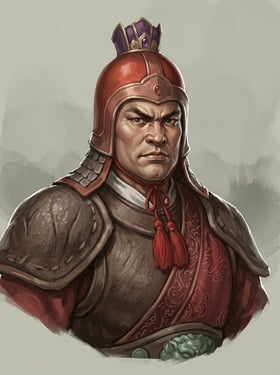
Historical Record
According to the surviving historical biographical materials, the record concerning Meng Huo is a blank. The official histories such as the Records of the Three Kingdoms contain no clear mention of Meng Huo or his deeds. Therefore, his actual historical existence, his life, and his interactions with Shu Han all cannot be verified.
In the Novel
In the Romance of the Three Kingdoms, Meng Huo is portrayed as the chieftain of the southern Man tribes, a figure who is arrogant and contemptuous of his enemies, who refuses to submit when captured and instead demands another fight. He first appears in the third year of the Jianxing era, when an urgent report arrived from Yi Province that the Man king Meng Huo had raised a hundred thousand Man troops and was invading and plundering the border. He joined forces in rebellion with Yong Kai, Administrator of Jianning, Zhu Bao, Administrator of Zangke Commandery, and Gao Ding, Administrator of Yuexi Commandery, attacking Yongchang Commandery, so that Wang Kang, Administrator of Yongchang, and his merit officer Lü Kai held the city in desperate defense, the situation perilous. Zhuge Liang considered the southern Man's refusal to submit a great threat to the state, and resolved to lead a great army personally on campaign against them.
After learning that Zhuge Liang had cleverly defeated Yong Kai and the others, Meng Huo summoned the three cave marshals Jinhuansanjie, Dongtuna, and A Huinan to confer, and divided his forces into three routes to meet the enemy. However, all three cave marshals were captured by Zhuge Liang. Meng Huo, enraged, led his army out to battle in person. He wore a tasseled robe of red brocade, a jade-worked lion belt at his waist, rode a curly-haired Red Hare horse, and bore two pine-grain jewel-inlaid swords, an imposing figure. But he despised the Shu army, considering Zhuge Liang's generalship to be nothing remarkable, and boasted that he would capture the Shu generals. After being captured the first time, Zhuge Liang released all the Man troops and said to Meng Huo: "Now that I have captured you, do you submit in your heart?" Meng Huo, however, would not submit, claiming that it was only because "the mountain paths were narrow and remote, and I fell into your hands by error," and demanded that Zhuge Liang release him to fight again.
This unyielding character of Meng Huo's runs through the entire story of the seven captures and seven releases. Time and again he was captured, time and again released, and each time he was captured he found some excuse to refuse submission—for example, claiming that his subordinates had turned upon one another, or that he had fallen for a trick. He even exploited Zhuge Liang's benevolence and righteousness, feigning surrender in an attempt to assassinate Zhuge Liang in the cave. After being captured the fifth time, he proposed that if Zhuge Liang could capture him at his ancestral home in the Silver Pit Mountains, then he and all his descendants would serve with wholehearted devotion.
In his many clashes with Zhuge Liang, Meng Huo also displayed a measure of military strategy—for example, using the natural barrier of the Lu River, impounding the boats and rafts, digging deep ditches and raising high ramparts, and waiting for the Shu troops to withdraw because of the fierce heat. He also once followed the counsel of his younger brother Meng You, using the terrain and poisoned springs to oppose the Shu army. However, all these schemes were ultimately seen through and dissolved by Zhuge Liang. After being captured the seventh time, Meng Huo at last submitted in heart and word, kneeling on the ground to beg pardon, declaring: "Seven captures and seven releases—such a thing has never been from ancient times. Though I am a man beyond the bounds of civilization, I know something of propriety and righteousness; how could I be so shameless as this?" And he promised that "the southern people will not rebel again". Thereafter, Meng Huo led the great and small cave chiefs and the various tribes in a circle of obeisance to send Zhuge Liang's army home, and explained to Zhuge Liang that the Lu River had a malevolent spirit working harm and required a sacrifice.
Key Relationships
* Shu Han (enemy_of): Meng Huo was the principal resisting force during Shu Han's southern campaign, repeatedly clashing with the Shu army led by Zhuge Liang, and was the greatest obstacle to Shu Han's unification of the Nanzhong region. He once raised a hundred thousand Man troops to invade and plunder Yi Province.
* The southern Man (lord_of): Meng Huo was the supreme chieftain of the southern Man, commanding the three cave marshals including Jinhuansanjie, Dongtuna, and A Huinan, as well as the later tribal chiefs King Duosi, King Mulu, Wutugu, and others. He held absolute authority and rallying power in the southern Man region.
* Zhuge Liang (serves): In the Romance of the Three Kingdoms, Meng Huo finally submitted with willing heart to Shu Han under Zhuge Liang's strategy of "seven captures and seven releases," declaring that "I and all my descendants feel the grace of being sustained and brought to life; how could we not submit!". Thereafter he became a loyal supporter of Shu Han in the Nanzhong region, ensuring the long-term stability of Nanzhong.
* Meng You (brother_of): Meng You was Meng Huo's own younger brother. After Meng Huo had been captured several times, he offered schemes and feigned surrender to Zhuge Liang, intending to coordinate an attack from within and without, but was ultimately seen through by Zhuge Liang.
* Lady Zhurong (wife_of): Lady Zhurong was Meng Huo's wife, skilled in throwing flying daggers with unerring accuracy, who once captured alive the two Shu generals Zhang Ni and Ma Zhong, displaying the valor of southern Man women (novel only).
* Dailai Dongzhu (brother_in_law_of): Dailai Dongzhu was Meng Huo's wife's brother, who recommended to Meng Huo the strange men King Mulu and Wutugu to aid in battle, (novel only).
Signature Scenes
* First capture and refusal, demanding another fight: After battling Wang Ping, Meng Huo was captured alive by Wei Yan and brought before Zhuge Liang's tent. When Zhuge Liang asked whether he submitted in his heart, Meng Huo claimed instead that "the mountain paths were narrow and remote, and I fell into your hands by error," and demanded that Zhuge Liang release him to fight again. This scene set the keynote of Meng Huo's unyielding character and his demands to fight again, and opened the prelude to the "seven captures and seven releases."
* Using the Lu River barrier and the poisoned springs: After his second capture, Meng Huo used the natural barrier of the Lu River, impounding all the boats and rafts on the south bank, building an earthen city, digging deep ditches and raising high ramparts, in an attempt to wear down the Shu army. Later, he followed King Duosi's counsel, using the Mute Spring, Death Spring, Black Spring, and Soft Spring poisoned springs of the Tulong Cave to deal with the Shu army, holding that "the waters of these four springs are enough to avenge the resentment of our defeats" (novel only). These scenes display Meng Huo's attempts at military strategy, even though they ultimately failed.
* King Mulu and the rattan-armor troops aid in battle: After repeated defeats, Meng Huo sought help in turn from King Mulu, chief of the Bana Cave, and Wutugu, ruler of the Wuge kingdom. King Mulu could summon wind and rain and drive tigers, leopards, and wolves, but was broken by Zhuge Liang's wooden beasts and devices of smoke and fire (novel only). Wutugu's rattan-armor troops could not be pierced by blade or arrow and did not sink when crossing rivers, causing the Shu army great difficulty, but were ultimately destroyed when Zhuge Liang burned the rattan-armor troops, (novel only). These scenes highlight Meng Huo's continual search for outside aid in adversity, and the unique sorceries and troop types of the southern Man region.
* Seven captures and seven releases, finally won over: After his seventh capture, Meng Huo was at last won over by Zhuge Liang's benevolence, righteousness, and wisdom. He wept and said: "Seven captures and seven releases—such a thing has never been from ancient times. Though I am a man beyond the bounds of civilization, I know something of propriety and righteousness; how could I be so shameless as this?" And, baring his flesh, he begged pardon, declaring that "the southern people will not rebel again". This scene is the apex of Meng Huo's character arc, marking his transformation from a stubborn rebel into a loyal subject of Shu Han, and embodying Zhuge Liang's strategic principle of "winning hearts above all."
* The Lu River sacrifice: As Zhuge Liang's army was returning home, the vanguard reached the Lu River but could not cross because of dark clouds and raging wind. Meng Huo informed them that this water had a malevolent spirit working harm and required forty-nine human heads as a sacrifice. Zhuge Liang, unwilling to take life, ultimately substituted molded heads of dough together with oxen and sheep for human heads in the sacrifice, the wind died and the waters calmed, and the Shu army was able to cross (novel only). This scene not only displays the customs and beliefs of the southern Man region, but once again emphasizes Zhuge Liang's benevolence and Meng Huo's reverence for Zhuge Liang.
Portrait file
Character profile
- Appearance
- On his head a purple-gold coronet set with gems, his body clad in a red brocade robe hung with tassels and beads, a jade-worked lion belt about his waist, hawk-beak green-trimmed boots on his feet, riding a curly-maned Red Hare horse; wearing rhinoceros-hide armor, a vermilion helmet on his head, a shield gripped in his left hand and a blade held in his right, riding a red-haired ox.
- Character
- Conceited and contemptuous of the enemy, he refused to submit when captured and demanded another battle; stubborn and unyielding, presuming upon his knowledge of strategy, he remained unresigned even when taken prisoner; defeated again and again, he still argued his case and kept borrowing troops; in the end he stripped to the waist to beg forgiveness and swore never to rebel again.
- Life
- He urged Kongming to follow the old custom and offer forty-nine human heads to the ferocious spirit of the Lu River; Kongming refused. He then went to Chengdu, and, weeping, bowed his farewell and returned to the south, obeying Kongming's charge to "govern diligently and rule his subordinates well."
- Anecdotes
- In this chapter he is captured for the second and third time; by the chapter's end the "seven captures and seven releases" are completed; he was the one to whom the Yi and Han peoples of Nanzhong submitted; the King of the Southern Man, one of the five routes, who raised troops to invade the four commanderies of Yi Province.
Relationships
22 relationships
Quotes
49 recorded lines · 3 featured
「汝第七次擒住,吾方傾心歸服,誓不反矣。」
The heart of the 'captured and released seven times' allusion, showing Meng Huo's unwillingness to admit defeat.
「七擒七縱,自古未嘗有也。吾雖化外之人,頗知禮義,直如此無羞恥乎?」
Meng Huo's appraisal of Zhuge Liang's 'captured and released seven times,' reflecting his understanding of propriety and righteousness.
「丞相天威,南人不復反矣!」
Meng Huo's iconic line of final submission, the conclusion of the 'captured and released seven times.'
Chapters7 回 ▸
- 史ch.35
- 演ch.86ch.87ch.88ch.89ch.90ch.91
Relationship timeline5 条 ▸
演 ch.88
- Dongtuna§9
betrayed_by
引百余人擒孟获献于孔明
演 ch.89
- Yang Feng§33
betrayed_by
宴上反执孟获、孟优解献孔明
演 ch.90
betrayed_by
与宗党擒孟获、祝融夫人献于孔明(实为孟获诈降之计)
- Zhuge Liang§20
serves
七擒之后肉袒谢罪,誓不再反;孔明令永为洞主,尽还所夺之地
演 ch.91
serves
率引诸洞主酋长罗拜相送;涕泣拜别
Inner monologues · AI-generated3 段 ▸
- I am Meng Huo; this account does not give my courtesy name. Now that I have been defeated in battle, this is the seventh
- I stood in the camp, still seeming to hear the clash of weapons in my ears, while before me stretched row upon row of pa
- I am Meng Huo. I was born in Nanzhong, and my family has lived there for generations. I have often reflected that this l
Life events4 ▸
- 0223-01-01 · ChengduFive-Route Invasion of Shu· Warrior
- 0223-01-01 · NanzhongNanzhong Rebellion· Commander
- 0225-01-01 · Dian LakeSeven Captures of Meng Huo· Warrior
- 0225-01-01 · NanzhongZhuge Liang's Southern Campaign· Warrior