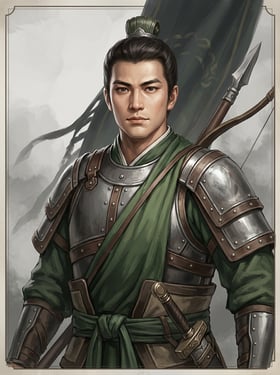
Historical Record
Jiang Wei, styled Boyue, was a man of Ji in Tianshui. He lost his father in his youth and depended on his mother, and was fond of studying the Confucian classics of the Zheng school. He first served as an Accounts Officer in the commandery, and was later recruited by the provincial office as an Attendant Officer. His father, Jiang Jiong, had served as Merit Officer of the commandery and died at his post protecting the commandery general during a rebellion of the Qiang and Rong; Jiang Wei was therefore granted the office of Gentleman of the Household and took part in the military affairs of his home commandery c:5058.
In the sixth year of Jianxing (228 CE), the Chancellor Zhuge Liang led his army on the Northern Expedition, advancing toward Mount Qi. At the time, the Grand Administrator of Tianshui, Ma Zun, was out on an inspection, and Jiang Wei, together with the Merit Officer Liang Xu, the Registrar Yin Shang, the Recorder Liang Qian, and others, accompanied him. When Ma Zun learned that the Shu army was approaching and that the various counties were responding in turn, he suspected that Jiang Wei and the others harbored disloyal intent, and fled by night to Shanggui. Jiang Wei and the others were unable to catch up, and the city gate was already shut, so they could not enter. They turned instead to Jixian, but Jixian also would not admit them. With no choice, Jiang Wei and the others together went over to Zhuge Liang c:5058.
Zhuge Liang greatly admired Jiang Wei's talent, recruited him as a Granary Officer, added the rank of General Who Upholds Righteousness, and enfeoffed him as Marquis of Dangyang Village; he was then twenty-seven years old. Zhuge Liang wrote to the resident Senior Clerk Zhang Yi and the Military Adviser Jiang Wan, praising Jiang Wei as "loyal and diligent in current affairs, careful and meticulous in thought," holding that his talent far surpassed that of Yongnan, Jichang, and the like, and that he was "a superior gentleman of Liang Province." He also pointed out that Jiang Wei was "quite acute in military affairs, possessed both courage and righteousness, and deeply understood the meaning of warfare," and that he "held the house of Han in his heart while his talent exceeded that of others," advising that he be earnestly taught military matters and recommended to the Later Sovereign Liu Shan c:5058.
After Zhuge Liang's death, Jiang Wei returned to Chengdu and served as Right Army Supervisor and General Who Upholds Han, commanding the various armies, and was advanced in fief to Marquis of Pingxiang. In the first year of Yanxi (238 CE), he stationed himself at Hanzhong with the Grand General Jiang Wan. After Jiang Wan was transferred to Grand Marshal, Jiang Wei was appointed his Marshal and repeatedly led detachments westward. In the sixth year of Yanxi (243 CE), Jiang Wei was promoted to General Who Guards the West, holding the post of Inspector of Liang Province. In the tenth year of Yanxi (247 CE), he was transferred to Guard General and, together with the Grand General Fei Yi, jointly handled the affairs of the Imperial Secretariat. That same year, the Yi people of Hanshan and Pingkang rebelled, and Jiang Wei led troops to suppress them. He also sent troops to the region of Longxi, Nan'an, and Jincheng, fought against the Wei Grand General Guo Huai, Xiahou Ba, and others at Taoxi; the tribes such as the Hu king Zhiwudai surrendered, and Jiang Wei settled them c:5060.
Jiang Wei reckoned that he was familiar with the customs of the west and possessed both talent and martial skill, and wished to recruit the Qiang and Hu tribes as his wings, in order to seize the lands west of Longxi. He repeatedly advocated raising troops on a large scale, but Fei Yi often restrained him, never giving him more than ten thousand troops c:5060.
In the spring of the nineteenth year of Yanxi (256 CE), Jiang Wei was promoted to Grand General, commanding the armies. He arranged to rendezvous with the General Who Guards the West, Hu Ji, at Shanggui, but Hu Ji failed to arrive on schedule. In the autumn, the eighth month, of that year, Jiang Wei was defeated by the Wei Grand General Deng Ai at Shanggui and withdrew his troops back to Chengdu c:1173.
In the second year of Jingyao (259 CE), Jiang Wei's deputy general Zhang Yi was promoted to Left General of Chariots and Cavalry, holding the post of Inspector of Jizhou. Jiang Wei and Zhang Yi differed over military strategy: Zhang Yi held that the state was exhausted and should not wage war frequently, but Jiang Wei would not heed him. In one campaign, Jiang Wei greatly defeated the Wei Inspector of Yongzhou, Wang Jing, at Didao, and tens of thousands of Wang Jing's men died in battle at the Tao River. Zhang Yi advised stopping while ahead and not advancing further deep, lest the achievement fall short at the last. Jiang Wei was greatly angered at this, holding that Zhang Yi was "drawing legs on a snake." He continued to besiege Didao, but was unable to take it c:9670.
In the sixth year of Jingyao (263 CE), Wei launched a large-scale invasion of Shu, and Jiang Wei, Zhang Yi, and others held firm at Jianmen Pass. Later the Shu sovereign Liu Shan surrendered, and Jiang Wei met Zhong Hui at Fucheng. In the first month of the following year, Zhong Hui intended to rebel at Chengdu, and Jiang Wei urged him to put the Wei generals to death, and secretly wrote to the Later Sovereign Liu Shan, declaring his willingness to endure humiliation and bear heavy burdens in order to restore Shu Han. However, Zhong Hui's plan was exposed, the Wei officers and soldiers mutinied, and Jiang Wei, leading Zhong Hui's personal guard, fought desperately, killing several men by his own hand, until he was finally killed together with Zhong Hui; Jiang Wei's wife and children were thereupon also put to death [c:1175, c:1172].
In the Novel
In Romance of the Three Kingdoms, Jiang Wei's appearance comes far earlier than in historical fact. He first appears in Chapter 92, portrayed as a subordinate of the Tianshui Grand Administrator Ma Zun, styled Boyue, his father Jiang Jiong having served as Merit Officer of Tianshui Commandery and died at his post when the Qiang rose in revolt. Jiang Wei from a young age read widely, was versed in military strategy and martial arts, and served his mother with utmost filial piety, being acclaimed "a hero of the age" c:1176.
In the novel, at his first appearance Jiang Wei displays extraordinary cunning and military talent. When Zhuge Liang launched the Northern Expedition and Ma Zun wished to send troops to relieve Xiahou Mao, Jiang Wei saw through the feigned-surrender scheme Zhuge Liang had laid, pointed out the doubtful points in Pei Xu and the Anding courier, and kept Ma Zun from falling into the trap c:9657. He then volunteered, laid an ambush, and intended to capture Zhuge Liang. In his clash with Zhao Yun, Jiang Wei's "spirit redoubled," and after fighting Zhao Yun for only a few bouts, he so startled Zhao Yun that he sighed, "Who would have thought there was such a man in this place!" c:1178.
Zhuge Liang greatly admired Jiang Wei's talent and sighed, "Troops lie not in numbers but in the man who deploys them; this man is truly a general's talent!" c:9662. To win Jiang Wei over, Zhuge Liang devised a scheme to take Jixian by deceit and had someone impersonate Jiang Wei in attacking the city, sowing discord between Jiang Wei and Ma Zun and Xiahou Mao c:9663. In the end, Jiang Wei, with nowhere to turn, was intercepted by Zhuge Liang in a dense wood and forced to surrender. Zhuge Liang personally alighted from his carriage to receive him, took his hand, and said, "Since I left my thatched hut, I have sought everywhere for the worthy, wishing to pass on the learning of my life, but regretted that I had not found the man. Now that I have met Boyue, my wish is fulfilled." c:5064.
After submitting to Shu Han, Jiang Wei became an important aide to Zhuge Liang. He repeatedly accompanied Zhuge Liang on the Northern Expeditions, and when breaking the Wei general Zhang He's iron-chariot formation, Jiang Wei saw through Zhuge Liang's scheme and was praised by Kongming with "you know my mind" c:9666. When Zhuge Liang was gravely ill, Jiang Wei was one of his most trusted generals, entrusted with the heavy task of the star-praying ritual to prolong his life c:1182. After Zhuge Liang's death, Jiang Wei, together with Yang Yi, Fei Yi, and others, followed his dying instructions and kept the death secret, and using the scheme Zhuge Liang had arranged in his lifetime, frightened off Sima Yi's pursuing troops, leaving behind the famous saying "a dead Zhuge frightens off a living Zhongda" c:9558.
After Zhuge Liang's death, Jiang Wei was appointed General Who Upholds Han and Marquis of Pingxiang, with supreme command of the troops in various places, and went out to station at Hanzhong together with Wu Yi to guard against Wei troops c:5069. He continued to carry on Zhuge Liang's dying will, repeatedly campaigning against the Central Plains and fighting Wei generals such as Guo Huai, Chen Tai, Deng Ai, and Sima Shi. In a conversation with Xiahou Ba, Jiang Wei thought little of the talents of Zhong Hui and Deng Ai, holding "what are these striplings worth talking about!" c:1184. However, in the latter part of the novel, Jiang Wei's Northern Expeditions repeatedly met setbacks, and in the end, during Zhong Hui's rebellion, he tried to take the opportunity to restore Shu Han but failed, and was killed together with Zhong Hui c:1175.
Key Relationships
* Zhuge Liang (mentor_of, admires): Zhuge Liang was Jiang Wei's discoverer and mentor. With a discerning eye he won Jiang Wei over and placed high hopes on him, calling him "loyal and diligent in current affairs, careful and meticulous in thought" and "acute in military affairs, possessing both courage and righteousness, deeply understanding the meaning of warfare" c:5058. Before his death, Zhuge Liang entrusted Jiang Wei with military authority and the dying will of the Northern Expedition, making Jiang Wei the heir to his mantle.
* Fei Yi (colleague_of, restrains): Fei Yi jointly handled the affairs of the Imperial Secretariat with Jiang Wei c:5060. However, Fei Yi held a reserved attitude toward Jiang Wei's frequent Northern Expeditions, believing that Shu's national strength was limited and that one should not act rashly, and he often restrained Jiang Wei's forces, allowing him no more than ten thousand troops c:5060.
* Wang Jing (enemy_of): Jiang Wei once fought the Wei Inspector of Yongzhou, Wang Jing, at Taoxi, greatly defeating him so that tens of thousands of his men died in battle at the Tao River [c:1169, c:9670].
* Chen Tai (enemy_of): Jiang Wei clashed with Chen Tai several times. While besieging Mount Qu, Chen Tai and Guo Huai joined forces to cut off Jiang Wei's supply route, forcing him to retreat c:1170. Later, Jiang Wei fought Chen Tai at Niutou Mountain; Chen Tai had laid an ambush, but Jiang Wei saw through it and repelled him c:9573 (novel only).
* Zhong Hui (fights_in, ally_of): After the fall of Shu Han, Jiang Wei cooperated with Zhong Hui, trying to use Zhong Hui's rebellion to restore Shu Han. He persuaded Zhong Hui to put the Wei generals to death and secretly wrote to Liu Shan to declare his intentions c:1175. However, Zhong Hui's plan failed, and Jiang Wei too was killed as a result.
* Deng Ai (enemy_of): Jiang Wei was once defeated by the Wei Grand General Deng Ai at Shanggui c:1173. Deng Ai was also a key figure in the final conquest of Shu.
* Shu Han (serves): Jiang Wei served Shu Han loyally all his life, carrying on Zhuge Liang's dying will, campaigning repeatedly against the Central Plains in an attempt to restore the house of Han. Even after the fall of Shu Han, he still tried to use Zhong Hui's strength to save Shu Han c:1175.
* Ma Zun (master_of): Jiang Wei initially served under the Tianshui Grand Administrator Ma Zun c:1176 (novel only).
* Xiahou Ba (ally_of): Xiahou Ba surrendered to Shu Han because Sima Yi monopolized power, and Jiang Wei received him and regarded him as a fellow in the cause of supporting the house of Han c:1184. Xiahou Ba also offered Jiang Wei counsel c:9570 (novel only).
* Wei Yan (rival_of): After Zhuge Liang's death, Wei Yan intended to cause a rebellion, and Jiang Wei, together with Yang Yi and others, following Zhuge Liang's bequeathed scheme, had Ma Dai behead Wei Yan c:9559 (novel only).
Signature Scenes
* First meeting Zhuge Liang and seeing through the feigned-surrender scheme: In Romance of the Three Kingdoms, at his first appearance Jiang Wei displays extraordinary insight, seeing through the feigned-surrender scheme Zhuge Liang had laid and saving Ma Zun from calamity c:9657 (novel only).
* Great victory over Wang Jing at Taoxi: Jiang Wei led his army against the Wei Inspector of Yongzhou, Wang Jing, at Taoxi, winning a great victory, with tens of thousands of Wang Jing's men dying in battle at the Tao River [c:1169, c:9670].
* Submitting to Shu Han and winning Kongming's esteem: Jiang Wei, with nowhere to turn, surrendered to Zhuge Liang, who greatly praised his talent, personally received him, and declared that gaining Jiang Wei was the wish of his life c:5064 (novel only).
* Carrying on the Chancellor's dying will and frightening off Sima Yi: After Zhuge Liang's death, Jiang Wei, together with Yang Yi and others, following his dying instructions, used the Empty Fort Strategy (in the novel, a stove-increasing ruse) Zhuge Liang had arranged in his lifetime to successfully frighten off the pursuing Sima Yi and preserve the Shu army [c:9558, c:9554] (novel only).
* Building walls at Mount Qu and retreating: Jiang Wei once sent Ju An and Li Xin to build two cities at Mount Qu, but they were besieged by Wei troops and their water supply cut off. On Xiahou Ba's advice, Jiang Wei turned to attack Yongzhou, forcing the Wei troops to return to its relief and thereby lifting the siege of Mount Qu [c:1170, c:9570] (novel only).
* Secretly plotting to restore Shu Han and dying at Chengdu: After the fall of Shu Han, Jiang Wei secretly plotted with Zhong Hui, trying to use Zhong Hui's rebellion to restore Shu Han. He persuaded Zhong Hui to put the Wei generals to death and secretly wrote to the Later Sovereign Liu Shan, declaring his willingness to endure humiliation and bear heavy burdens. However, the plan was exposed, and Jiang Wei was killed together with Zhong Hui, and his wife and children too were put to death [c:1175, c:1172].
Portrait file
Character profile
- Appearance
- Jiang Wei was a youthful general, leveling his spear and spurring his horse.
- Character
- Jiang Wei was eager to establish merit and fame, sharp in military matters, endowed with both daring and integrity, tireless in study, and pure and frugal. From boyhood he read widely, mastering both the art of war and the martial arts; he served his mother with utmost filial devotion, was fully furnished with wisdom and courage, deeply grasped Kongming's methods, was skilled in the variations of battle formations, unshaken in the face of change, undaunted through repeated campaigns, upright, loyal, and brave.
- Manner of speech
- Jiang Wei spoke with a grave, forthright manner, dissecting matters point by point, first tearing down and then building up; before the ranks he would announce his name and lineage and set out military reasoning cleanly. At times he was proud and composed, given to irony when discussing formations; at times he decided in clipped phrases, drew analogies in analyzing the enemy, sighed at Heaven's will in peril, was concise and firm, took responsibility gravely, was spirited and full of strategy, and cited ancient precedents in remonstrance.
- Life
- Jiang Wei was a native of Ji in Tianshui; his father Jiang Jiong had served as a commandery meritorious officer and died on the field of battle. He served as a Gentleman of the Palace and took part in his home commandery's military affairs, then submitted to Zhuge Liang, holding in succession the offices of Right Army Supervisor and General Who Assists the Han, Grand General Who Guards the West and concurrently Inspector of Liang Province, General of the Guard, and General-in-Chief, directing the western campaigns. After Shu fell, he sought to feign surrender to Zhong Hui in a scheme to restore the state; the plot failed and he was killed.
- Weapons
- Jiang Wei chiefly used the spear, also the bow and arrow, and once employed the repeating-crossbow method (with poisoned bolts) transmitted by the Marquis of Wu, as well as the sword.
- Anecdotes
- Jiang Wei was the chief commander of Shu Han's northern campaigns, directing military affairs until Shu's fall. He built the two forts of Qushan, repeatedly harassed the Wei frontier, later fell back to defend Jiange Pass, and in the end feigned submission to Zhong Hui in a bid to restore the Han.
Relationships
68 relationships
Family1
Lord & vassal5
Friends5
Enemies13
Teacher & student2
Other39
Quotes
117 recorded lines · 3 featured
「不然。昔丞相未出茅廬,已定三分天下,然且六出祁山以圖中原;不幸半途而喪,以致功業未成。今吾既受丞相遺命,當盡忠報國以繼其志,雖死而無恨也。今魏有隙可乘,不就此時伐之,更待何時?」
Jiang Wei carried on Zhuge Liang's unfinished will, launching northern campaigns into the Central Plains, reflecting his loyalty.
「望陛下忍數日之辱,維將使社稷危而復安,日月幽而復明,必不使漢室終滅也。」
Jiang Wei stayed composed in crisis, seeking to restore the House of Han, displaying his loyal courage and cunning.
「吾計不成,乃天命也!」
Jiang Wei, defeated and dying, laments the will of Heaven-a portrayal of his tragic end.
Chapters36 回 ▸
- 史ch.4ch.22ch.26ch.28ch.33ch.35ch.40ch.42ch.43ch.44ch.45
- 演ch.92ch.93ch.94ch.95ch.97ch.98ch.99ch.100ch.102ch.103ch.104ch.105ch.107ch.108ch.109ch.110ch.111ch.112ch.113ch.114ch.115ch.116ch.117ch.118ch.119
Relationship timeline33 条 ▸
史 ch.4
- Wang Jing§39
enemy_of
战洮西,经大败
史 ch.22
史 ch.28
- Zhong Hui§88
fights_in
与会左右战,手杀五六人,後为众所斩
史 ch.33
- Deng Ai§36
fights_in
延熙十九年姜维为邓艾所破于上邽
史 ch.40
- Liao Li§33
witnesses
后率偏军经汶山诣立,称其意气不衰,言论自若
史 ch.44
演 ch.92
- Jiang Jiong§20
kin_of
姜冏之子;维奉母至孝
演 ch.93
演 ch.99
- Zhuge Liang§15
commands_in
与廖化同领锦囊密计伏于前山,依计袭司马懿大寨
演 ch.100
- Zhuge Liang§14
commands_in
受密计引一彪军悄地杀来夹击司马懿;又问退兵之策
演 ch.103
- Zhuge Liang§28
student_of
受命引甲士四十九人各执皂旗皂衣环绕帐外;见魏延扑灭主灯拔剑欲斩之
演 ch.105
- Yang Yi§1
fights_in
同引兵抄槎山、合兵守南郑共御魏延
演 ch.107
演 ch.108
- Zhuge Ke§12
friend_of
诸葛恪遣书入蜀求姜维进兵共伐魏,许以平分天下
演 ch.109
演 ch.110
- Zhuge Liang§14
student_of
受丞相遗命,"当尽忠报国以继其志"
演 ch.111
- Deng Ai§3
rival_of
望祁山九寨叹邓艾"不在吾师之下";又称"必先取陇西"
student_of
自承师承——"止吾师诸葛丞相能之"
演 ch.113
- Deng Ai§13
rival_of
互为对垒之敌;阵前斗法,姜维以"长蛇卷地阵"困邓艾
- Zhuge Liang§14
student_of
受武侯密书所传阵法三百六十五变
演 ch.114
- Liu Shan§3
serves
入见后主问召回之故;自陈'"臣誓讨贼,以报国恩"'
演 ch.115
- Deng Ai§2
fights_in
两军交锋洮阳、侯河、祁山,互为劲敌
演 ch.116
- Liu Shan§5
advises_in
申表请遣张翼、廖化分守关险并使吴求救
演 ch.117
- Zhuge Xu§1
fights_in
引五千兵直撞魏阵大败诸葛绪
演 ch.118
- Zhong Hui§22
oath_brother
折箭为誓、结为兄弟;诈降以图复汉
Inner monologues · AI-generated3 段 ▸
- Tonight, the wind beyond Jianmen Pass sounds like the lament of the Han banners as they fall. Taipu Jiang Xian brought t
- I was appointed General-in-Chief and charged with command of the army. What occupied my thoughts was not the honor of th
- I was born in Jixian, Tianshui. My father, Jiang Jiong, once served as a merit officer in the commandery; he later died
Life events25 ▸
- 0228-01-01 · JixianTianshui Revolts· Warrior
- 0228-01-01 · Mount QiFirst Northern Expedition· Warrior
- 0229-01-01 · WuduZhuge Liang's Third Northern Expedition· Warrior
- 0231-01-01 · Mount QiZhuge Liang's Fourth Northern Expedition· Warrior
- 0231-01-01 · Mount QiZhuge Liang's Fifth Northern Expedition· Warrior
- 0234-01-01 · Wuzhang PlainsBattle of Wuzhang Plains· Warrior
- 0234-01-01 · Mount QiZhuge Liang's Six Expeditions to Mount Qi· Warrior
- 0234-01-01 · Mount QiZhuge Liang's Northern Expeditions· Warrior
- 0234-01-01 · NanzhengRebellion of Wei Yan· Commander
- 0234-01-01 · NanzhengDeath of Wei Yan· Commander
- 0249-01-01 · QushanBattle of Qucheng· Commander
- 0255-01-01 · LuoyangBattle of Taoxi· Commander
- 0255-01-01 · DidaoBattle of Didao· Commander
- 0256-01-01 · DuanguBattle of Duangu· Commander
- 0256-01-01 · DuanguDefeat at Duangu· Commander
- 0261-01-01 · Mount QiGreat Defeat of Deng Ai at Tanshan Valley· Commander
- 0262-01-01 · Mount QiJiang Wei's Later Northern Expeditions· Commander
- 0262-01-01 · DazhongJiang Wei's Agricultural Garrison at Tazhong to Avoid Trouble· Commander
- 0263-01-01 · Mount QiJiang Wei's Northern Expeditions· Commander
- 0263-01-01 · Jianmen PassJiang Wei's Retreat to Jiange· Commander
- 0263-01-01 · Jianmen PassJiang Wei Retreats to Defend Jiange Pass· Commander
- 0263-01-01 · YinpingDeng Ai's Surprise Attack Through Yinping· Commander
- 0264-01-01 · ChengduZhong Hui's Rebellion — Death of Zhong Hui and Jiang Wei in Chengdu· Instigator
- 0264-01-01 · ChengduZhong Hui's Rebellion· Instigator
- 0264-01-01 · ChengduRebellion of Zhong Hui and Jiang Wei· Instigator