Origins
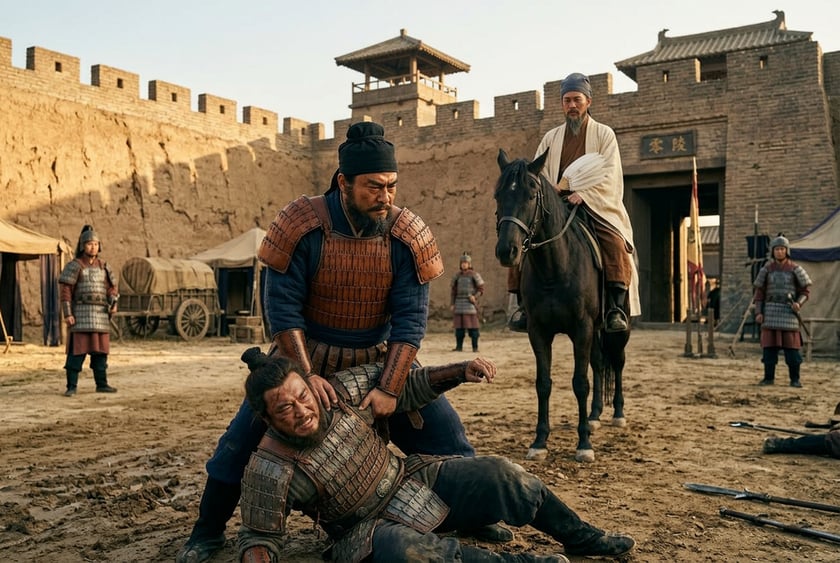
The root cause of the Nanzhong rebellions was the border vacuum created when Shuhan's national power plummeted after the Yiling defeat and its external deterrent capacity collapsed. In Jian'an year 26 (221), Liu Bei proclaimed himself emperor; the following year his eastern campaign was crushed by Lu Xun's fire attack, and Shuhan was left gravely weakened. In Zhangwu year 3 (223), Liu Bei died at Baidicheng; Liu Chan inherited the throne at sixteen, with Prime Minister Zhuge Liang holding the regency as head of the Board of Affairs. This was the most vulnerable moment since the founding of the Shuhan state: Caowei watching hungrily from the north, a fresh grudge unresolved with Wu to the east, and internally the four far southern commanderies of Nanzhong operating outside Chengdu's direct control, long dependent on the loose "indirect rule" (jimi) administrative structure inherited from the Liu Zhang era. The great local magnate clans of Nanzhong—represented by Yong Kai of Jianning, Gao Ding of Yuexi, and Zhu Bao of Zangke—observing the weakness at the center and encouraged by Sun Quan's distant instigation, each raised their forces in turn [c:16424]. Yong Kai first killed the Jianning administrator Zheng Ang, then detained the Shuhan-appointed administrator Zhang Yi and dispatched him to Sun Quan—formally breaking with Shuhan. This was the overt trigger of the rebellion, but the deeper structural cause was long-standing resentment among the Nanzhong magnate clans against the process of Han acculturation and tax extraction.
Participating Forces
The rebel coalition was a composite of "Han magnate families plus southern Yi tribes." Among the Han magnates, Yong Kai served as political leader—himself from a Jianning local gentry family, using Sun Quan's commission to designate himself "administrator of Yongchang" with the aim of drawing the entire southeast Yunnan region into an Wu-Shu buffer zone; Gao Ding held Yuexi; Zhu Bao held Zangke, each warlording a commandery [c:16424]. On the tribal side, chiefs of the Yi people (called "Nanman" in the Romance), represented by Meng Huo, accepted Yong Kai's mobilization and contributed mountain fighters and geographic advantage. The Romance dramatizes Meng Huo's image as a brave and unruly tribal chieftain, and arranges for his vanguard E Huan to be "nine feet tall, wielding a four-pointed halberd, and of ten-thousand-man valor" [c:16424]—the classic novelistic hero-rendering brush. On the Shuhan side, Zhuge Liang personally took command, accompanied by staff officers Ma Su, Wang Ping, Ma Zhong, Li Hui, and Lv Kai; forces were divided into three columns: the eastern under Ma Zhong against Zhu Bao, the western under Li Hui against Yong Kai, with Zhuge Liang personally leading the central column against Gao Ding.
The Critical Turning Point
The pivotal turn in the campaign was the chosen sequence: "eliminate Gao Ding first, then crush Yong Kai, finally win over Meng Huo." Zhuge Liang adopted Ma Su's strategic principle of "attack hearts as the priority, attack walls as secondary," aiming at subjugation rather than slaughter. In the first phase, the Shu forces in the central column broke Gao Ding's vanguard E Huan repeatedly; E Huan was captured and then turned, helping Shu lure and kill Yong Kai—the first crack in the rebel alliance's internal cohesion. In the second phase, Yong Kai died in the resulting factional split; the Nanzhong Han magnate power base was substantively dismantled, and Meng Huo became the sole remaining leader of resistance. The third phase is the famous "seven captures and seven releases": Zhuge Liang repeatedly captured and released Meng Huo, with the purpose not of military victory (already secured) but of establishing the political effect of "winning the heart's submission" among the Nanzhong tribal peoples. This sequence of decisions reflects Zhuge Liang's political foresight—he understood clearly that a single military suppression would not hold, and that the surrender had to be converted into the voluntary submission of tribal chieftains if post-war long-term stability was to be achieved.
Suppression and Outcome
By the autumn of Jianxing year 3 (225), the rebellions were fully pacified. In the aftermath, Zhuge Liang made three structural arrangements. First, he redrew the administrative boundaries, splitting the original four commanderies into seven—Jianning, Yunnan, Yongchang, Zangke, Yuexi, Xinggu, and Zhuti—weakening any single magnate family's ability to use a commandery as a base for renewed disorder. Second, he "employed their own chieftains to govern," incorporating Meng Huo and other tribal leaders into Shuhan's bureaucratic structure to bear real governing responsibilities, rather than dispatching large numbers of Han officials from outside. Third, he organized the "Flying Army"—an elite force composed primarily of Nanzhong Yi people—as an annual labor and military levy integrated into Shuhan's military system. The result was that Nanzhong maintained relative stability for approximately fifteen years afterward, providing rear-area resources and manpower for Zhuge Liang's Northern Expeditions; this was the indispensable link in the strategic chain of "pacify Nanzhong → launch Northern Expeditions."
Historical Resonance
From the standpoint of institutional history, the Nanzhong rebellions and their suppression represent an important experiment in the governance of southern China. The model of "attack hearts first; employ their own chieftains" was neither the Qin-Han model of direct commandery administration nor the extreme later form of "tusi jimi" (native-chieftain indirect rule), but a hybrid of "commandery subdivision + indirect governance + economic integration" midway between the two. This model exerted a lasting influence on later Southwest governance—particularly the Tang-Song jimi prefectures and the Ming-Qing tusi system. Culturally, the image of Meng Huo as rendered by San Guo Yanyi became one of the early Chinese imaginative archetypes for the southwestern minority peoples—simultaneously "untamably fierce" and "susceptible to moral transformation"—a narrative with both positive value (emphasis on ethnic reconciliation) and its own stereotyping limitations (the Yi-Xia binary, the reduction of complexity to individual heroism). From the perspective of Shuhan's own trajectory, the pacification of Nanzhong won Zhuge Liang a three-year recovery period, enabling him to present the Memorial on Sending Forth the Army (Chu Shi Biao) in Jianxing year 5 (227) and launch the Northern Expeditions—had Nanzhong not been pacified, the Northern Expeditions could never have been initiated, and Shuhan's destiny would have followed an entirely different arc.