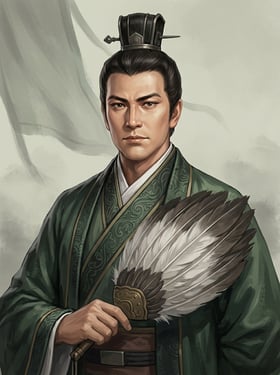
Historical Record
Sima Yi, styled Zhongda, a man of Wen in Henei, was a highly influential power-minister and military commander of the middle-to-late Cao Wei regime. In the official histories he was noted in his early years for talent and strategy; serving through the three reigns of Cao Cao, Cao Pi, and Cao Rui, his political career was marked above all by forbearance, adaptability, and far-sighted calculation. In military affairs, he not only put down the rebellion of Gongsun Yuan in Liaodong but also long held the northwestern frontier against the assaults of Shu Han, becoming the steadying anchor of Wei's western marches.
During Zhuge Liang's final Northern Expedition, Sima Yi was ordered to garrison Weinan and faced off against Zhuge Liang at the Wuzhang Plains by Mount Wugong. In the face of Zhuge Liang's provocations, Sima Yi—well aware of how difficult it was for the Shu army to transport grain and forage—adopted a strategy of holding firm and not coming out, even enduring the woman's headdress and garments the Shu army sent to provoke him into battle, yet remaining unmoved. According to the Chunqiu of the Han and Jin, Zhuge Liang once sent an envoy to observe Sima Yi's eating and daily routine; the envoy reported that Zhuge Liang "rose at dawn and slept late, and personally attended to every punishment of twenty strokes or more," from which Sima Yi judged that Zhuge Liang's life would not be long. In the end Zhuge Liang died of illness in the field and the Wei army withdrew. Sima Yi then entered the Shu Han camp to survey it and, sighing at the rigor of its military order, called him "a marvel of talent in all the realm." Though this appraisal seems objective, it also reflects Sima Yi's complex feelings toward this lifelong rival. After Zhuge Liang's death, Sima Yi pursued the Shu army, but because Jiang Wei had Yang Yi turn the banners and beat the drums in a show of force, Sima Yi suspected an ambush and withdrew, so that the folk saying arose: "The dead Zhuge drove off the living Zhongda."
In the Novel
In the literary narrative of Romance of the Three Kingdoms, Sima Yi's image is dramatized still further, his cunning and ambition revealed from the very start of Cao Pi's reign. The novel especially heightens Sima Yi's initiative and influence in political decisions, casting him as an indispensable strategist of the Cao Wei regime.
After Liu Bei died at Baidicheng, the ruler of Wei, Cao Pi, sought to take advantage of Shu's leaderless state and launch a five-route invasion of Shu. At this Sima Yi sprang forth from the ranks and offered his own plan, advising not to rely solely on the manpower of the Central Plains but to adopt a strategy of "five great armies attacking from four sides," so that Zhuge Liang could not protect head and tail at once. This episode has no clear basis in history and is Luo Guanzhong's artistic embellishment. Sima Yi laid out the five routes of attack in detail: first, ally with the Xianbei king of Liaodong, Kebineng, to raise a hundred thousand Qiang troops to take Xiping Pass; second, have the Southern Man king Meng Huo raise a hundred thousand troops to attack south of Yi Province; third, mend relations with Eastern Wu and offer ceded land so that Sun Quan would attack the mouth where the Two Riverlands meet; fourth, use the surrendered general Meng Da to raise a hundred thousand Shangyong troops to attack Hanzhong; fifth, order Cao Zhen as Grand Commander to lead a hundred thousand troops out of Yangping Pass. Although Cao Pi did historically plan a multi-route invasion of Shu, the official histories do not so thoroughly attribute the specific design and details of the "five-route invasion of Shu" to Sima Yi alone; through this episode the novel greatly elevates Sima Yi's strategic standing in the Cao Wei court, highlighting his image as a counselor "without a flaw in his calculations," while also foreshadowing the political capital for his later swelling power.
Key Relationships
Zhuge Liang: Sima Yi and Zhuge Liang form the most classic rivalry of the Three Kingdoms period. In history, the two faced off for a long while at the Wuzhang Plains, and Sima Yi appraised Zhuge Liang most highly, calling him "a marvel of talent in all the realm." This appraisal contains both recognition of a rival's military gifts and an implicit political respect. In Romance of the Three Kingdoms, this relationship is given more of the color of psychological contest, and the tale of "the dead Zhuge drove off the living Zhongda" both shows Sima Yi's caution and suspicion and indirectly sets off the legendary aura of a Zhuge Liang who could still strike fear even after death.
Cao Pi: Sima Yi's relationship with Cao Pi is the classic one of sovereign-and-subject and political ally. In the novel, Cao Pi trusted Sima Yi greatly, especially after Liu Bei's death, when he adopted Sima Yi's proposed strategy of the five-route invasion of Shu. Though this episode has no clear basis in the histories, it reflects Sima Yi's position as a core advisor within Cao Pi's circle. Cao Pi's reliance laid the foundation for Sima Yi's later accumulation of power within the Cao Wei regime and foreshadowed the eventual historical course of the Sima clan supplanting Wei.
Iconic Scenes
The standoff at the Wuzhang Plains and the sigh of "a marvel of talent in all the realm"
This is one of the most crucial scenes of Sima Yi's military career. In 234 CE, Zhuge Liang led a great army out of the Xie Valley and took up position at the Wuzhang Plains by Mount Wugong, facing Sima Yi across Weinan. The two sides held their ground for more than a hundred days; Zhuge Liang, his grain and forage failing, divided his troops to farm the land, attempting a prolonged stay. Sima Yi adopted a strategy of firm defense, refusing battle even in the face of the Shu army's challenges and insults. When Zhuge Liang died of illness, Sima Yi led his army in pursuit and, after surveying the Shu camp, gave the sigh of "a marvel of talent in all the realm." This scene marks both the end of the Northern Expedition war and the confirmation of Sima Yi's standing as a top-rank military commander of Wei. It is worth noting that, as to Zhuge Liang's death, the official histories record that he died of illness in the field, whereas the Book of Wei and other apocryphal or unofficial sources record that he "vomited blood" or "fell ill upon entering the valley road"; Sima Yi's sigh stems more from admiration for a rival's rigorous discipline than from the mere posture of a victor.
Offering the plan of the five-route invasion of Shu (novel only)
This scene appears only in Chapter 85 of Romance of the Three Kingdoms. With Liu Bei just dead and Shu without a leader, Cao Pi wished to send troops against Shu, and Sima Yi took the initiative to offer a plan—a five-route assault allying with the Xianbei, the Southern Man, and Eastern Wu and using Meng Da. Though not historical, this episode is dramatically charged, displaying Sima Yi's keen insight and strategic coordination amid political crisis. Through this scene, the author successfully elevates Sima Yi from a mere general to a strategist able to sway the fate of the state, laying the groundwork for his later political rise. This episode is clearly marked as novel-only, meant to highlight Sima Yi's resourceful image and to contrast with his relatively conservative military style in history.
Portrait file
Character profile
- Appearance
- The Grand Progenitor once remarked on his 'hawk's gaze and wolf's backward glance.'
- Character
- Sima Yi held authority and had cunning, his merits covering all within the seas, deeply strategic while both loyalty and fear coexisted in him. Adaptable and profound, he anticipated the enemy in advance, was cautious and suspicious, skilled at calculating the initiative beforehand, and waged war matching man against man.
- Manner of speech
- Sima Yi's manner of speech was terse, weighty, and decisive; he often resolved matters by rhetorical questions and was skilled at using maxims of the art of war to analyze routes and his opponents' psychology. He commonly began with 'I reckon...,' and, full of suspicion, would exclaim, sighing, 'Strange indeed! Strange indeed!' at marvelous troop movements.
- Life
- Sima Yi was the grandson of Sima Jun, Grand Administrator of Yingchuan, the son of Sima Fang, Intendant of the Capital, and the younger brother of the Registrar Sima Lang. He held the posts of Supervisor of the Imperial Secretariat and Grand General Who Nurtures the Army, and later was promoted to Grand Commandant and Grand Tutor, and was entrusted with the orphaned heir by Cao Pi. In the third year of Jingchu he was promoted from Grand Commandant to Grand Tutor; in the first year of Jiaping he launched the Incident at the Gaoping Tombs and executed Cao Shuang's faction; and in the third year of Jiaping, after an eastern campaign against Wang Ling, he died of illness.
- Anecdotes
- Sima Yi was the military mainstay of the Wei side. He defeated Zhuge Jin and Zhang Ba at Xiangyang, campaigned against Meng Da, held off Zhuge Liang at Mount Qi and the Wuzhang Plains, and campaigned against Gongsun Yuan. He once advised Cao Cao to grant Sun Quan office and rank in order to resist Liu Bei, and saw through Eastern Wu's stratagem of shifting the disaster.
Relationships
84 relationships
Family4
Lord & vassal15
Friends10
Enemies11
Teacher & student4
Other33
Quotes
177 recorded lines · 3 featured
「孔明食少事煩,其能久乎!」
This line precisely captures the image of Zhuge Liang giving his utmost to the very end, widely renowned and become a classic.
「吾能料其生,不能料其死也!」
This line displays Sima Yi's admiration for Zhuge Liang's military genius, and is likewise an expression of his own wisdom.
「吾病的耳聾了。此去保重。」
This line is the key to Sima Yi's feigning illness to deceive Cao Shuang, reflecting his forbearance and political cunning.
Chapters48 回 ▸
- 史ch.2ch.3ch.4ch.8ch.9ch.12ch.14ch.15ch.17ch.22ch.23ch.24ch.25ch.26ch.27ch.28ch.30ch.33ch.35ch.41ch.43ch.64
- 演ch.39ch.67ch.69ch.73ch.75ch.77ch.78ch.80ch.85ch.86ch.91ch.94ch.95ch.96ch.97ch.98ch.99ch.100ch.101ch.102ch.103ch.104ch.105ch.106ch.107ch.108
Relationship timeline42 条 ▸
史 ch.3
- Meng Da§4
fights_in
诏骠骑将军司马宣王讨之;二年正月攻破新城,斩达,传其首
- Zhuge Liang§13
fights_in
太和五年诏大将军司马宣王拒之
- Zhuge Liang§22
fights_in
青龙二年率诸军拒诸葛亮出斜谷屯渭南;连围积日,会亮卒其军退还
- Gongsun Yuan§40
fights_in
司马宣王围公孙渊于襄平大破之,传渊首于京都
- Cao Rui§43
advises_in
帝执其手以后事属君,与爽辅少子
史 ch.4
- Cao Shuang§20
enemy_of
高平陵之变奏免大将军及爽弟羲、训、彦
- Wang Ling§23
enemy_of
东征王凌,淩自杀
史 ch.8
- Gongsun Yuan§56
enemy_of
景初二年遣司马宣王征淵,斩淵父子
史 ch.12
史 ch.17
- Zhang He§23
commands_in
与击孙权别将刘阿等于祁口;治水军于荆州,诏郃督关中诸军受节度
史 ch.22
- Lu Yu§82
friend_of
太傅司马宣王使卢毓行司隶校尉,治曹爽狱
史 ch.25
- Xin Pi§10
rival_of
数请战诸葛亮,明帝以毗节度禁之
史 ch.28
enemy_of
诛之
enemy_of
将中军讨之,下赦书,受其归命
- Deng Ai§39
mentor_of
因使见太尉宣王,奇之,辟为掾
史 ch.30
- Gongsun Yuan§38
enemy_of
景初二年率众讨之
史 ch.41
- Meng Da§44
enemy_of
魏遣征之即斩灭达
史 ch.64
- Zhuge Ke§9
enemy_of
谋欲攻恪
演 ch.39
- Sima Lang§13
kin_of
司马朗之弟
演 ch.75
- Cao Cao§8
advises_in
谏曹操勿迁都,献结连东吴之策
演 ch.77
- Cao Cao§25
advises_in
识破东吴移祸;献以香木刻躯、以大臣之礼葬关公之策
演 ch.80
- Cao Pi§11
advises_in
谏曹丕上表谦辞以绝天下之谤
演 ch.85
- Cao Pi§22
进献五路伐蜀之策
演 ch.86
- Cao Pi§11
advises_in
进献亲征自蔡颍入淮取广陵之策
演 ch.95
- Wei Yan§8
fights_in
与司马昭抄魏延背后,三路兵合围
演 ch.96
- Hao Zhao§13
mentor_of
推举其守陈仓道口当诸葛亮入寇
演 ch.99
- Cao Rui§25
serves
被拜大将军征西副都督,与曹真同伐蜀
演 ch.100
- Zhuge Liang§21
rival_of
自承"其谋略吾不如之";先以"赌赛"立约,后斗阵法被擒三将而败退
演 ch.101
- Zhang He§3
commands_in
命张郃为先锋;事后悲叹"张俊乂身死,吾之过也"
演 ch.103
- Lü Meng§10
also_known_as
以"放归本寨令说魏将寬厚仁慈,释彼战心"自比吕蒙取荆州之计
- Zhuge Liang§11
enemy_of
见蜀兵屡败心中欢喜;问俘料孔明在上方谷,分兵攻祁山以诱孔明救援、自取上方谷烧粮
- Sima Shi§14
kin_of
上方谷遇火,下马抱二子大哭"我父子三人皆死于此处矣"
- Sima Zhao§14
kin_of
上方谷遇火,下马抱二子大哭
演 ch.106
enemy_of
围擒于襄平东南,父子下马纳降,懿传令斩之;又尽屠其宗族同谋官僚七十余口;封贾范、伦直之墓而荣其子孙
- Cao Rui§11
serves
受持节诏归朝至许昌见之;明帝执手托孤幼子曹芳
- Cao Fang§11
serves
受先帝托孤,明帝以"仲達與朕一體,爾宜敬禮之"嘱其敬之;曹芳"抱懿頸不放"
- Cao Shuang§12
rival_of
与爽同受托孤;爽议加懿太傅夺其兵权;懿乃推病不出,二子皆退职闲居;末诈病惑李胜以图爽
- Li Sheng§15
betrayed_by
诈病——去冠散发、二婢扶策、湯流滿襟、错应"并州""青州"、佯耳聋——以欺李胜回报曹爽
演 ch.107
enemy_of
突袭夺权、佯许指洛水为誓而终诛之三族
witnesses
闻而贤之,听使乞子自养为曹氏后
- Deng Ai§25
mentor_of
独奇其才,令参赞军机
Inner monologues · AI-generated3 段 ▸
- Looking back on my life, the hardest part was not marching troops or arranging battle formations, but contending with ri
- I am Sima Yi, courtesy name Zhongda. At this moment, our forces are at the height of their strength, and all the armies
- My courtesy name was Zhongda, and I was from Wen County in Henei. In my youth, my family’s inheritance included both my
Life events28 ▸
- 0208-01-01 · XuchangCao Cao Abolishes the Three Excellencies and Appoints Himself Chancellor· Advisor
- 0220-01-01 · XuchangCao Pi Supplants the Han· Advisor
- 0220-01-01 · YeCao Cao Dies and Emperor Wen of Wei Ascends the Throne· Witness
- 0223-01-01 · ChengduFive-Route Invasion of Shu· Advisor
- 0228-01-01 · ShangyongXincheng Rebellion· Commander
- 0228-01-01 · XichengEmpty Fort Strategy· Commander
- 0228-01-01 · Mount QiFirst Northern Expedition· Commander
- 0228-01-01 · ChencangZhuge Liang's Second Northern Expedition· Advisor
- 0228-01-01 · ChencangBattle for Chencang· Advisor
- 0231-01-01 · Mumen RoadZhang He Shot Dead at Mumendao· Witness
- 0231-01-01 · Mount QiZhuge Liang's Fourth Northern Expedition· Commander
- 0231-01-01 · Mount QiZhuge Liang's Fifth Northern Expedition· Commander
- 0234-01-01 · Shangfang ValleyFire Attack at Shangfang Valley· Commander
- 0234-01-01 · Wuzhang PlainsBattle of Wuzhang Plains· Commander
- 0234-01-01 · Wuzhang PlainsKongming Sends a Woman's Headdress to Sima Yi· Commander
- 0234-01-01 · Shangfang ValleyWooden Ox and Flowing Horse· Witness
- 0234-01-01 · Mount QiZhuge Liang's Six Expeditions to Mount Qi· Commander
- 0234-01-01 · Mount QiZhuge Liang's Northern Expeditions· Commander
- 0238-01-01 · XiangpingSima Yi's Liaodong Campaign· Commander
- 0238-01-01 · XiangpingGongsun Clan's Autonomous Rule of Liaodong· Commander
- 0239-01-01 · LuoyangEmperor Ming of Wei Entrusts the Regency on His Deathbed· Advisor
- 0244-01-01 · Mount XingshiCao Shuang's Campaign Against Shu via Luogu· Witness
- 0245-01-01 · ShouchunDeng Ai's Military Farming in Huainan· Commander
- 0249-01-01 · LuoyangIncident at the Gaoping Tombs· Instigator
- 0251-01-01 · ShouchunWang Ling's Rebellion· Commander
- 0253-01-01 · Hefei XinchengZhuge Ke's Siege of Hefei Xincheng· Witness
- 0258-01-01 · ShouchunThree Rebellions in Shouchun· Commander
- 0266-01-01 · LuoyangThe Sima Clan's Seizure of Power· Instigator