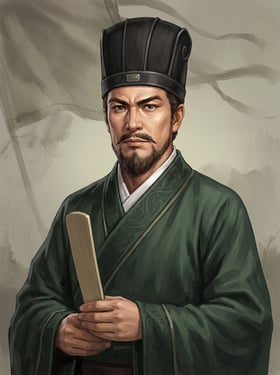
Historical Record
Yang Yi, styled Weigong, was a man of Xiangyang. During the Jian'an era, he served as Registrar to Fu Qun, the Inspector of Jing Province, then abandoned Fu Qun and turned to Guan Yu, the Grand Administrator of Xiangyang. Guan Yu valued him and appointed him Officer of Merit, and sent him as an envoy to call upon the Former Sovereign Liu Bei. After conversing with Yang Yi, Liu Bei greatly admired his views on military and state strategy and on the gains and losses of governance, and so appointed him Military Affairs Clerk to the General of the Left. After Liu Bei proclaimed himself King of Hanzhong, he promoted Yang Yi to Master of Writing. When Liu Bei proclaimed himself Emperor and campaigned east against Eastern Wu, Yang Yi, being on bad terms with the Master of Writing Liu Ba, was demoted to nominal Grand Administrator of Hongnong c:2501.
In the third year of Jianxing (225), the Chancellor Zhuge Liang summoned Yang Yi as Adviser to the Army and put him in charge of the affairs of his office, and he accompanied the army southward. In the fifth year of Jianxing (227), Yang Yi again followed Zhuge Liang on the northern expedition to Hanzhong. By the eighth year of Jianxing (230), he was promoted to Chief Clerk and additionally granted the title General Who Pacifies the Army. As Zhuge Liang launched his northern expeditions again and again, Yang Yi played an important role in them. He was responsible for planning the affairs of the various units and arranging provisions, quick in thought and always swift to complete his tasks. The matters of regulating the army were mostly handled by Yang Yi c:2501.
Zhuge Liang well knew Yang Yi's ability and also relied on Wei Yan's valor, but was often troubled by the discord between the two, yet could not bear to favor or discard either one. In the twelfth year of Jianxing (234), Yang Yi accompanied Zhuge Liang on campaign and encamped at Gukou. That autumn, in the eighth month, Zhuge Liang fell ill and died on the banks of the Wei. Before his death, he secretly consulted with Yang Yi, Fei Yi, Jiang Wei, and others on the order of withdrawal, arranging for Wei Yan to bring up the rear and Jiang Wei to follow, and that if Wei Yan would not obey the order, the army should withdraw on its own c:12359.
After Zhuge Liang's death, Yang Yi kept the death secret and sent Fei Yi to probe Wei Yan's intentions. Wei Yan held that, though the Chancellor had died, he himself was still alive, and that the army should not abandon the great affairs of the realm because of one man's death, and he was unwilling to be regulated by Yang Yi. He discussed with Fei Yi the matters of advancing and remaining, and demanded that Fei Yi write out a joint declaration in their two names to instruct the generals. Fei Yi feigned agreement, but once out of the camp galloped away. Wei Yan regretted it too late, and sent men to investigate, learning that Yang Yi and the others were withdrawing the army in succession according to Zhuge Liang's prior arrangement. Wei Yan was furious and, before Yang Yi could move, led his own troops straight back south, burning the plank roads along the way c:12359.
Wei Yan and Yang Yi each submitted memorials accusing the other of treason, and within a single day their urgent dispatches arrived one after another. The Later Sovereign Liu Shan asked the Attendant Dong Yun and the Chief Clerk of the Resident Office Jiang Wan, and both vouched for Yang Yi and doubted Wei Yan. Yang Yi and his men opened roads through the mountains, traveling day and night, following close behind Wei Yan. Wei Yan reached the southern valley mouth first and sent troops to strike back at Yang Yi. Yang Yi ordered He Ping to resist him in front, and He Ping rebuked Wei Yan. When Wei Yan's soldiers learned the truth, most were unwilling to fight for him, and the army scattered. Wei Yan could only flee toward Hanzhong with a few of his own sons. Yang Yi sent Ma Dai to pursue and behead Wei Yan and bring back his head. Yang Yi personally trod on Wei Yan's head and cursed: "Worthless slave! Can you still do evil now?" Then he exterminated Wei Yan's three branches of kin c:12359.
Yang Yi considered his merit outstanding and believed he ought to govern in Zhuge Liang's place; he even had the Commandant Zhao Zheng divine by the Book of Changes and obtained the hexagram "Family," at which he fell silent and was displeased. However, Zhuge Liang had already secretly intended for Jiang Wan to succeed him, considering Yang Yi narrow and impatient in temperament. Therefore Jiang Wan was appointed Master of Writing and Inspector of Yi Province. After Yang Yi returned to Chengdu, he was appointed Military Master of the Central Army, but had no real command and sat idle at home c:2501.
In earlier years, when Yang Yi was Master of Writing under the Former Sovereign, Jiang Wan was a Gentleman of Writing. Later, though the two both served as Adviser and Chief Clerk to the Chancellor, Yang Yi felt that in seniority, rank, and talent he surpassed Jiang Wan, yet was placed beneath him, and so harbored resentment that showed in his voice and looks, sighing without end. People of the time, finding his speech unrestrained, dared not approach him; only the Rear Military Master Fei Yi went to console him. Yang Yi poured out his grievances to Fei Yi, even saying: "When the Chancellor died, had I led the whole army to surrender to Cao Wei, how would I have come to such a pass!" Fei Yi secretly reported these words. In the thirteenth year of Jianxing (235), Yang Yi was reduced to commoner and banished to Hanjia commandery. In his place of exile Yang Yi still submitted slanderous memorials, fierce in their words, and so was arrested by the commandery office. In the end Yang Yi took his own life, and his wife and children were sent back to Shu c:2503.
In the Novel
In Romance of the Three Kingdoms, Yang Yi is shaped into a chancellor's aide who is loyal and devoted, exceptional in stratagem, yet narrow-minded and envious of the worthy. He first appears during Zhuge Liang's northern expeditions: after Ma Su lost Jieting, Yang Yi volunteered, offering to go in Ma Su's place c:5742. This differs from the historical fact that he was mainly responsible for logistics and coordination; the novel gives him greater military involvement.
In the novel Yang Yi appears repeatedly as Zhuge Liang's order-bearer and important assistant. For instance, he once, by Zhuge Liang's command, carried the Memorial on Sending Out the Army to an audience with the Later Sovereign Liu Shan c:2504. During Zhuge Liang's northern expeditions, Yang Yi also took part in many military decisions. When Zhuge Liang faced the Wei army holding fast and refusing to come out, Yang Yi expressed bafflement at Zhuge Liang's decision to withdraw, and Zhuge Liang explained to him the stratagem of "adding and reducing cooking-stoves" to deceive Sima Yi c:12351. During the standoff at Lucheng, Yang Yi reported to Zhuge Liang the difficulty of transporting provisions, which led to Zhuge Liang's ingenious invention of the "Wooden Ox and Flowing Horse" c:12352. These episodes all highlight Yang Yi's role as an important brain trust at Zhuge Liang's side, though some of these specific events have no clear basis in the histories.
The novel depicts the conflict between Yang Yi and Wei Yan more dramatically. Before his death, Zhuge Liang foresaw that Wei Yan would certainly rebel and secretly told Yang Yi the stratagem for slaying Wei Yan. When Wei Yan did indeed rebel, burning the plank roads to block the Shu army's route home, Yang Yi was greatly alarmed, but Jiang Wei reminded him that Zhuge Liang had left a clever plan in a brocade pouch c:2506. In the end Yang Yi acted according to the plan, provoking Wei Yan before the lines to shout "Who dares to kill me?", whereupon Ma Dai took the chance to cut Wei Yan down c:12354. This episode greatly amplifies Yang Yi's central role in quelling Wei Yan's rebellion and portrays him as a loyal servitor who fully carried out Zhuge Liang's posthumous plan, differing from the historical account in which Yang Yi struggled with Wei Yan for power and finally pursued and beheaded him; in the novel Yang Yi's stratagem and execution are magnified.
Yet the novel also faithfully depicts Yang Yi's narrow-mindedness. After quelling Wei Yan's rebellion, Yang Yi thought his merit great but received no rich reward, and was instead placed beneath Jiang Wan, so he harbored resentful words, saying to Fei Yi: "In the past, when the Chancellor had just died, had I led the whole army to Wei, would I be left so neglected as this!" c:12356 Fei Yi secretly reported these words to the Later Sovereign, and Yang Yi was reduced to commoner and finally, in shame, cut his own throat. This ending is essentially consistent with the historical facts, both emphasizing the tragic fate brought on by Yang Yi's flaws of character.
Key Relationships
* Wei Yan (enemy_of): The conflict between Yang Yi and Wei Yan was the most central and fatal relationship of his life. The histories record that the two struggled for power and were at odds; Zhuge Liang well knew of their discord but could not bear to favor either c:2501. After Zhuge Liang's death, their conflict erupted; Wei Yan, unwilling to be regulated by Yang Yi, rebelled and went back south, and was finally pursued and beheaded by Ma Dai whom Yang Yi sent, his three branches of kin exterminated c:12359. In the novel, before his death Zhuge Liang foresaw that Wei Yan would rebel and entrusted the stratagem for slaying him to Yang Yi, who acted on the plan and successfully quelled Wei Yan's rebellion c:12354.
* Guan Yu (serves): In earlier years Yang Yi abandoned Fu Qun and turned to Guan Yu, who appointed him Officer of Merit c:2501. This was the starting point of Yang Yi's career and a key step in his entering the Shu Han political system.
* Shu Han (serves): Yang Yi served the Shu Han regime all his life, being valued from Liu Bei's time and later becoming an important aide in Zhuge Liang's northern expeditions, responsible for military coordination and the provisioning of grain c:2501. Though his end was tragic, his contributions to Shu Han cannot be erased.
* Liu Ba (rival_of): The histories record that Yang Yi was on bad terms with the Master of Writing Liu Ba, which led to his demotion to nominal Grand Administrator of Hongnong c:2501. This was a setback in Yang Yi's career and reflects his strained relations with colleagues.
* Zhuge Liang (superior): Zhuge Liang deeply valued Yang Yi's ability and entrusted him with important tasks during the northern expeditions, putting him in charge of such key matters as regulating the army and arranging provisions c:2501. At the same time, Zhuge Liang discerned that Yang Yi was narrow and impatient in temperament, foresaw his conflict with Wei Yan, and made arrangements accordingly before his death (the histories record that Zhuge Liang, knowing his narrow temperament, intended Jiang Wan to succeed him) c:2501.
* Jiang Wan (rival_of): Yang Yi believed his seniority and talent both surpassed Jiang Wan's, yet he was finally placed beneath him, and so harbored resentment that showed in his voice and looks c:2503. Zhuge Liang had already secretly intended Jiang Wan to succeed to his post, which deepened Yang Yi's resentment and ultimately led to his tragic end.
* Fei Yi (confidant/messenger): After Yang Yi was demoted, only Fei Yi went to console him. Yang Yi poured out his grievances before Fei Yi, even uttering the resentful words about "leading the army to join the Wei clan"; Fei Yi secretly reported them, hastening Yang Yi's destruction c:2503. In the novel, Fei Yi also acted as Zhuge Liang's envoy, going to probe Wei Yan's intentions and reporting Wei Yan's rebellious aim to Yang Yi c:5744.
* Ma Dai (executor): The histories record that Yang Yi sent Ma Dai to pursue and behead Wei Yan c:12359. In the novel, Ma Dai is even more the key figure in Zhuge Liang's posthumous plan to slay Wei Yan, cutting Wei Yan down before the lines at Yang Yi's direction c:12354.
Iconic Scenes
* Turning to Guan Yu and first showing his edge: During the Jian'an era, Yang Yi abandoned Fu Qun and turned to Guan Yu, who appointed him Officer of Merit and sent him as an envoy to Liu Bei. Liu Bei discussed military and state strategy with him and, greatly pleased, recruited him as Military Affairs Clerk to the General of the Left. This marked Yang Yi's formal entry onto the political stage of Shu Han and displayed his early political talent c:2501.
* Strategizing in the northern expeditions: During Zhuge Liang's several northern expeditions, Yang Yi regularly planned the affairs of the various units and arranged provisions, quick in thought, and the regulating of the army was mostly handled by him. As an important aide of Zhuge Liang, he played a key role in logistical support and military coordination c:2501.
* Quelling Wei Yan's rebellion: After Zhuge Liang's death, the conflict between Yang Yi and Wei Yan intensified. Wei Yan led his army back south, burning the plank roads. Yang Yi led his army in pursuit and finally sent Ma Dai to pursue and behead Wei Yan, exterminating his three branches of kin. This event was the most controversial and influential moment of Yang Yi's life, consolidating his standing in the Shu Han regime but also exposing his narrow-mindedness c:12359. In the novel, Yang Yi, following Zhuge Liang's posthumous plan, cleverly used Ma Dai to slay Wei Yan, displaying his stratagem and execution c:12354.
* Ruining his own prospects through resentment: After quelling Wei Yan's rebellion, Yang Yi thought his merit great but received no rich reward and was placed beneath Jiang Wan, breeding resentment and unrestrained speech. He uttered to Fei Yi the complaint about "leading the army to join the Wei clan," which Fei Yi secretly reported to the Later Sovereign, finally leading to his being reduced to commoner, banished to Hanjia commandery, and at last to his suicide c:2503. This scene profoundly reveals the flaws in Yang Yi's character and his tragic end.
Portrait file
Character profile
- Character
- Yang Yi was hot-tempered and intolerant, quick at planning and organizing the disposition of forces, but his rancor and indignation often showed in his voice and expression. Deeply versed in strategy, he presumed upon his own great merit, could not abide others, and, because Jiang Wan had held office and rank before him yet now stood above him, gave voice to resentful words.
- Manner of speech
- His memorials were concise and well-ordered, but in private his complaints were extreme and vehement; he once said, "Had I taken the whole army over to Wei, would I be as forlorn as this?" He was also attentive to the army's provisions, once asking, "With laborers, oxen, and horses, transport is difficult—what is to be done?"
- Life
- Yang Yi, styled Weigong, was a native of Xiangyang. He was once chief clerk to Fu Qun, Inspector of Jing Province, then went over to Guan Yu, and afterward was sent west as an envoy to the Former Ruler, who recruited him as an army officer of the General of the Left and later promoted him to Master of Writing. Because of his discord with Liu Ba he was demoted, but was later appointed by the Prime Minister, Liang, as an army adviser managing the affairs of his office, and accompanied Liang on campaign, regularly planning the disposition of the forces and calculating the grain supply. After Liang's death, he led the army back and executed Wei Yan; regarding his own merit as supreme, he expected to succeed Liang in governing, but Liang had secretly noted his hot and narrow temperament and intended the post for Jiang Wan. He was appointed Central Army Adviser with no forces under his command, and afterward, his rancor and indignation showing in voice and expression, he was reduced to commoner and banished to Hanjia commandery, where at last, having submitted a memorial of slanderous and vehement wording, he took his own life.
- Anecdotes
- He proposed the plan of dividing the troops into two rotations, exchanged every hundred days, and urged Kongming to retain the rotating troops to repel the Wei army. Before his death Kongming secretly handed him a brocade pouch with the words, "Wei Yan will surely rebel; open this only when he does," and entrusted to him all major affairs.
Relationships
10 relationships
Lord & vassal1
Enemies2
Teacher & student1
Other5
Quotes
11 recorded lines · 3 featured
「丞相在日,知汝久後必反,教我隄備,今果應其言。汝敢在馬上連叫三聲『誰敢殺我』,便是真大丈夫;吾就獻漢中城池與汝。」
This line is the key to Yang Yi's clever destruction of Wei Yan, displaying his cunning.
「庸奴!復能作惡不?」
This line is Yang Yi's taunt of Wei Yan, reflecting his caustic personality, and it is recorded in the official history.
「往者丞相亡沒之際,吾若舉軍以就魏氏,處世寧當落度如此邪!令人追悔不可複及。」
This line is Yang Yi's remorse before his death, revealing his inner resentment and political ambition.
Chapters11 回 ▸
- 史ch.33ch.40ch.44
- 演ch.95ch.97ch.98ch.100ch.101ch.102ch.104ch.105
Relationship timeline5 条 ▸
史 ch.33
- Wei Yan§15
enemy_of
建兴十二年争权斩延首
史 ch.40
- Guan Yu§55
serves
建安中为荆州刺史傅群主簿,背群诣襄阳太守关羽
演 ch.97
advises_in
奉丞相令赍出师表至成都
演 ch.100
- Zhuge Liang§18
advises_in
长史;谏勿斩苟安;又问退兵增灶之疑
演 ch.105
student_of
受孔明临终大事,依锦囊计斩魏延、护灵柩归成都
Inner monologues · AI-generated3 段 ▸
- After the Chancellor died, I led the army back. In the past, I had handled many of the army’s affairs, organizing its di
- When the Prime Minister was gravely ill, he secretly discussed with me, Fei Yi, Jiang Wei, and others how to direct the
- I am Yang Yi, courtesy name Weigong. Looking back on my early years now, all I can rely on are traces left by my later d
Life events9 ▸
- 0228-01-01 · ChengduLatter Memorial on Sending Out the Troops· Advisor
- 0231-01-01 · Mumen RoadZhang He Shot Dead at Mumendao· Advisor
- 0231-01-01 · Mount QiZhuge Liang's Fourth Northern Expedition· Advisor
- 0234-01-01 · Wuzhang PlainsBattle of Wuzhang Plains· Advisor
- 0234-01-01 · Mount QiGrain Transport by Wooden Ox and Flowing Horse· Advisor
- 0234-01-01 · Mount QiZhuge Liang's Six Expeditions to Mount Qi· Advisor
- 0234-01-01 · Mount QiZhuge Liang's Northern Expeditions· Advisor
- 0234-01-01 · NanzhengRebellion of Wei Yan· Instigator
- 0234-01-01 · NanzhengDeath of Wei Yan· Instigator