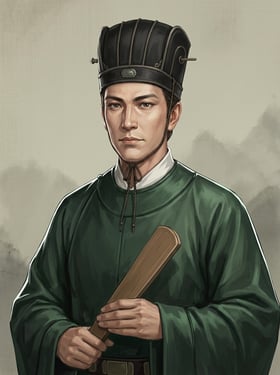
Historical Record
Zhuge Jin, styled Ziyu, was a native of Yangdu in Langya and an important strategist and general of Eastern Wu. In his early years he was already renowned for his learning and virtue. In the fourth year of Jian'an (199 CE), when Sun Ce campaigned against Liu Xun, Grand Administrator of Lujiang, Zhuge Jin was already in attendance at his side. After Sun Ce died, Zhuge Jin, together with Lu Su and others, became a guest of Sun Quan, devising plans for Sun Quan to recruit men of distinction, pacify the Shanyue, and campaign against those who would not obey orders.
During the contest between Sun Quan and Liu Bei over Jing Province, Zhuge Jin played an important role. When Liu Bei marched east against Wu, Sun Quan sought peace, and Zhuge Jin wrote to Liu Bei, urging him to weigh the relative importance of matters and to put the larger situation first, and not to fall out with Eastern Wu over his grudge for Guan Yu. Although at the time someone secretly reported that Zhuge Jin was privately in communication with Liu Bei, Sun Quan trusted him deeply, declaring, "Ziyu and I have a vow of life and death that will not change; Ziyu will no more betray me than I will betray Ziyu," showing his trust in Zhuge Jin.
In the first year of Huangwu (222 CE), Zhuge Jin was promoted to General of the Left, Director at Gong'an, granted the staff of office, and enfeoffed as Marquis of Wanling. When Cao Zhen, Xiahou Shang, and others besieged Zhu Ran at Jiangling, Zhuge Jin led a great army to the rescue. His nature was broad and unhurried, relying on reason and planning; though he lacked the art of meeting sudden contingencies, in the end, when the spring waters rose, he coordinated with Pan Zhang and other units to force Cao Zhen and the others to withdraw, preserving the army and the frontier.
In the fifth year of Jiahe (236 CE), Sun Quan campaigned north and ordered Lu Xun and Zhuge Jin to attack Xiangyang. In this campaign, Zhuge Jin once grew anxious because military intelligence had leaked, but Lu Xun responded calmly and ultimately withdrew successfully, seizing the chance to raid Jiangxia, Anlu, and other places.
After Sun Quan proclaimed himself Emperor, Zhuge Jin was appointed General-in-Chief and Protector-General of the Left, concurrently Governor of Yu Province. He was sincere and prudent in conduct; after his wife died he did not remarry, and though he had a favored concubine, he did not raise the son she bore. His son Zhuge Ke was illustrious in talent and fame, but Zhuge Jin often worried that he was "not a son to protect the family," sensing that he would bring disaster upon the clan. In the fourth year of Chiwu (241 CE), Zhuge Jin died, aged sixty-eight. Before his death he left instructions to be buried plainly, in a plain coffin and in ordinary seasonal clothes, everything kept simple.
In the Novel
In the Romance of the Three Kingdoms, Zhuge Jin's image is given literary elaboration on the basis of historical fact, especially highlighting his identity as the elder brother of Zhuge Liang, and several episodes unfold from this. He first appears when Sun Quan was recruiting worthy men, and Lu Su recommended Zhuge Jin to Sun Quan, calling him "broadly learned and of many talents, serving his mother with utmost filial piety".
In the novel, Zhuge Jin several times went to Shu Han as an Eastern Wu envoy, attempting to persuade Liu Bei or Guan Yu to return Jing Province. Before the Battle of Red Cliffs, Zhuge Jin once met with Zhuge Liang and tried to persuade Zhuge Liang to leave Liu Bei and turn to Eastern Wu, but Zhuge Liang instead urged him to submit to Liu Bei; the brothers each served his own lord, and the conflict between personal affection and the greater cause is embodied here.
When Liu Bei attacked Eastern Wu to avenge Guan Yu, Zhuge Jin was again sent as an envoy to Shu Han. He set out the advantages and disadvantages to Liu Bei and tried to persuade him to halt his troops, pointing out that Liu Bei should make restoring the House of Han his priority rather than attacking an ally for a private grudge. However, Liu Bei, burning with rage over Guan Yu's death, would not heed the advice and even threatened to behead Zhuge Jin.
The novel also depicts Zhuge Jin, during the period when Guan Yu guarded Jing Province, going on Sun Quan's orders to propose a marriage, wishing to betroth Sun Quan's son to Guan Yu's daughter. However, Guan Yu flew into a rage at this, refused the match in fierce terms, and wished to behead Zhuge Jin, only being stopped by Guan Ping.
In addition, the novel uses Zhuge Jin's own words to foreshadow the end of his son Zhuge Ke. Zhuge Jin once lamented that Zhuge Ke was "not a lord to protect the family," hinting at Zhuge Ke's eventual tragic fate, which accords with the historical record.
Key Relationships
* Sun Quan (serves): Zhuge Jin was Sun Quan's trusted strategist and an important general, deeply trusted by Sun Quan. Sun Quan once said, "Ziyu and I have a vow of life and death that will not change," expressing the deep bond of lord and minister between them.
* Zhuge Liang (brother_of): Zhuge Jin was the elder brother of Zhuge Liang; the brothers each served his own lord, opposed in political stance yet still bound by personal affection. The novel several times depicts scenes of the brothers meeting, full of the conflict between emotion and reason.
* Zhuge Ke (parent_of): Zhuge Jin's son Zhuge Ke was brimming with talent, yet Zhuge Jin was full of worry about his future, considering him "not a son to protect the family".
* Guan Yu (fights_in): In the contest between Eastern Wu and Shu Han over Jing Province, Zhuge Jin negotiated with Guan Yu many times, trying to persuade him to return Jing Province or to bring about a marriage alliance, but all to no avail, and he was even nearly beheaded by Guan Yu.
* Sima Yi (fights_in): In the novel, Zhuge Jin was once ordered to hold Jiangling to resist the advance of Sima Yi (novel-only).
Iconic Scenes
* Sun Quan's vow of trust: When Liu Bei marched east against Wu, someone secretly reported that Zhuge Jin was privately in league with Liu Bei, yet Sun Quan firmly believed in Zhuge Jin's loyalty and spoke the moving words, "Ziyu and I have a vow of life and death that will not change," displaying the deep trust between lord and minister.
* Calm response in the Xiangyang campaign: In the attack on Xiangyang in the fifth year of Jiahe, Zhuge Jin grew anxious because military intelligence had leaked, but Lu Xun showed extraordinary composure, steadying the army's morale through such means as planting beans and shooting games, and ultimately withdrawing successfully, displaying the difference in character and the tacit cooperation between Zhuge Jin and Lu Xun.
* Conflict between brotherly affection and the greater cause: Before the Battle of Red Cliffs, Zhuge Jin, on Zhou Yu's orders, urged Zhuge Liang to submit to Eastern Wu, but Zhuge Liang instead urged him to submit to Liu Bei; the brothers each set out the greater cause but failed to persuade the other, embodying the dilemma between personal affection and political stance in a chaotic age.
* Guan Yu's refusal of the marriage: Zhuge Jin, on Sun Quan's orders, went to Jing Province to propose a marriage to Guan Yu, wishing to win Guan Yu's daughter for Sun Quan's son, but was met with Guan Yu's stern refusal, "How could my tiger daughter be married to a dog's son?" and was nearly killed; this episode vividly displays Guan Yu's arrogance and Zhuge Jin's helplessness.
* Persuading Liu Bei to halt his troops: When Liu Bei attacked Eastern Wu to avenge Guan Yu, Zhuge Jin went as an envoy to Shu Han, trying to persuade Liu Bei to put the larger situation first and abandon his private grudge, but Liu Bei, in uncontrollable rage, would not heed the advice and even threatened to behead Zhuge Jin, highlighting Liu Bei's resolve for vengeance and Zhuge Jin's loyal courage.
* Foretelling Zhuge Ke's end: In his lifetime, Zhuge Jin was full of worry about the future of his son Zhuge Ke, considering him "not a son to protect the family"; this prediction was ultimately borne out after Zhuge Ke was killed by Sun Jun, adding a tragic color to the figure.
Portrait file
Character profile
- Appearance
- Zhuge Jin had a dignified appearance and thoughtful bearing; the men of his time admired his broad-minded refinement, and his face was long.
- Character
- He was broad-minded and unhurried by nature, pursuing reason and following his plans, without any knack for meeting sudden turns of fortune. He was cautious and shunned suspicion, once counseling his younger brother with the parable of Boyi and Shuqi.
- Manner of speech
- He cited the ancients to convey feeling, mild and roundabout; at times he would provoke Kongming through family matters, and he would also argue by invoking the principle of weighing the light against the heavy, the great against the small.
- Life
- At the end of the Han he fled the turmoil to the region east of the Yangtze. After Sun Ce's death, Hong Zi—the husband of Sun Quan's elder sister—recommended him to Sun Quan, and he was received as an honored guest alongside Lu Su and others. Learned and versatile, he served his mother with the utmost filial devotion.
- Anecdotes
- He was the elder brother of Zhuge Liang and a senior minister of Eastern Wu, serving as Grand General, Left Protector, and acting Governor of Yu Province. Lu Su once said, 'Day by day I look forward to meeting you, sir.'
Relationships
26 relationships
Family5
Friends4
Enemies5
Other10
Quotes
31 recorded lines · 3 featured
「夷、齊雖至餓死首陽山下,兄弟二人亦在一處。我今與你同胞共乳,乃各事其主,不能旦暮相聚,視夷、齊之為人,能無愧乎?」
This line reveals the deep brotherly bond between Zhuge Jin and Zhuge Liang, who nonetheless each serve their own lord—a helpless and conflicted state of mind.
「臣請以輕重大小之事,與陛下論之。陛下乃漢朝皇叔,今漢帝已被曹丕篡奪,不思剿除,卻為異姓之親,而屈萬乘之尊,是舍大義而就小義也。中原乃海內之地,兩都皆大漢創業之方,陛下不取,而但爭荊州,是棄重而取輕也。天下皆知陛下即位,必興漢室,恢復山河;今陛下置魏不問,反欲伐吳,竊為陛下不取。」
This line shows Zhuge Jin placing the greater good first, urging Liu Bei to forsake lesser loyalty for the greater cause—a display of strategic vision.
「此子非保家之主也!」
This line is Zhuge Jin's precise prediction about Sun Quan's heirs, reflecting his discernment of character.
Chapters25 回 ▸
- 史ch.3ch.17ch.35ch.47ch.51ch.52ch.53ch.54ch.58ch.64
- 演ch.29ch.37ch.42ch.43ch.44ch.53ch.66ch.73ch.76ch.81ch.82ch.96ch.98ch.103ch.108
Relationship timeline19 条 ▸
史 ch.3
- Sima Yi§3
fights_in
瑾、霸寇襄阳,宣王讨破之斩霸
史 ch.35
- Zhuge Ke§46
parent_of
父子(恪为瑾长子,元逊)
史 ch.52
史 ch.54
- Zhou Yin§15
advises_in
与步骘连名上疏为周胤求恕
史 ch.64
- Zhuge Ke§3
parent_of
父子;瑾长子恪
演 ch.29
- Sun Quan§38
advises_in
劝权勿通袁绍而顺曹操
演 ch.37
- Zhuge Liang§66
kin_of
长兄
演 ch.43
- Zhuge Liang§18
询问私礼未至
演 ch.44
- Zhou Yu§4
advises_in
引舍弟来意,专候都督决议
- Zhuge Liang§45
sibling_of
同胞共乳,奉周瑜命来说弟事吴;引伯夷叔齐之喻;反被孔明所说
演 ch.53
- Taishi Ci§25
advises_in
「張遼多謀,恐有準備」,谏勿造次
演 ch.66
sibling_of
兄弟同胞之情;段1张昭设计倚此
演 ch.73
- Guan Yu§15
enemy_of
奉孙权命赴荆州为吴侯世子求关羽女,被叱辱逐出
演 ch.76
演 ch.82
- Liu Bei§1
advises_in
以孙权使节身份赴白帝乞和,劝先主舍小义就大义、伐魏不伐吴
演 ch.108
- Zhuge Ke§19
parent_of
父子;瑾尝叹"此子非保家之主也"
Inner monologues · AI-generated3 段 ▸
- When the fighting was over and I looked back on my life, what I remembered most was not the gain or loss of a city or a
- I received my commission from Wu and stood between two states. The hardest part was not finding the right words, but hol
- I recall that when I was young, my family lived in Langya. The times grew increasingly chaotic, and our home district wa
Life events7 ▸
- 0208-01-01 · ChaisangZhuge Liang's Mission to Eastern Wu· Witness
- 0222-01-01 · JianglingThree-Pronged Campaign against Wu· Commander
- 0223-01-01 · WuchangWu and Shu Renew Their Alliance· Witness
- 0229-01-01 · WuchangSun Quan Proclaims Himself Emperor and Founds Wu· Advisor
- 0234-01-01 · Danyang Commandery (seat at Wanling)Zhuge Ke Pacifies the Shanyue of Danyang· Witness
- 0236-01-01 · XiangyangWu's Attack on Xiangyang in the Fifth Year of Jiahe· Commander
- 0253-01-01 · Hefei XinchengZhuge Ke's Siege of Hefei Xincheng· Witness