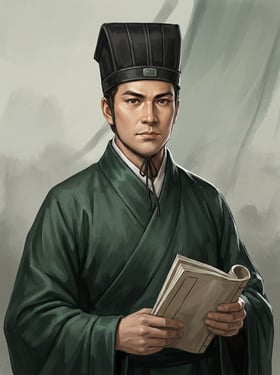
Historical Record
Ma Su, styled Youchang, was a native of Yicheng in Xiangyang and the younger brother of Ma Liang, who served Shu Han as Palace Attendant. In his early years he followed the Former Lord Liu Bei into Shu, and he held such posts as magistrate of Mianzhu and Chengdu, and Administrator of Yuesui. Ma Su's talents surpassed those of ordinary men; he was especially fond of discussing military strategy, and he won the high regard and affection of the Chancellor Zhuge Liang. Zhuge Liang often talked with him through the night, exploring great matters of state and war. c:4258
However, before his death, the Former Lord Liu Bei left an admonition to Zhuge Liang, judging that Ma Su's words exceeded his substance and that he should not be entrusted with heavy responsibility, urging Zhuge Liang to examine him carefully. c:4258 Despite this, Zhuge Liang did not entirely heed the Former Lord's warning and continued to hold the highest expectations of Ma Su. In the third year of Jianxing (225), during Zhuge Liang's Southern Campaign, Ma Su offered him the strategy that "winning hearts is paramount, assaulting cities is secondary," advising Zhuge Liang to subdue people through virtue and to pardon Meng Huo, so as to secure lasting peace in the south. Zhuge Liang adopted this advice and successfully won the heartfelt submission of the southern peoples, who never rebelled again during his lifetime. c:4258
In the sixth year of Jianxing (228), Zhuge Liang launched his first Northern Expedition, marching out to Mount Qi. At the time the Shu Han army did not lack experienced veteran generals, such as Wei Yan and Wu Yi, and many believed one of them should serve as vanguard. Yet Zhuge Liang overruled the consensus and promoted Ma Su as commander, sending him to lead the main force against the Wei general Zhang He at Jieting. c:4258 In this crucial battle, Ma Su failed to follow Zhuge Liang's dispositions and orders; his actions were ill-judged, and he was finally routed by Zhang He, causing the Shu soldiers to scatter. Zhuge Liang thereby lost his foothold and was forced to withdraw to Hanzhong. c:6758
After the defeat at Jieting, Ma Su was thrown into prison. In the end, to uphold military discipline, Zhuge Liang executed Ma Su in tears, to make amends before his generals. Ma Su died in prison, only thirty-nine years old. Zhuge Liang grieved deeply over this and personally submitted a memorial requesting that he himself be demoted three ranks, taking responsibility for his error in employing men. c:6758 Before his death, Ma Su had written a letter to Zhuge Liang expressing the bond of father and son between them, and hoping that Zhuge Liang would follow the principle of Emperor Shun, who executed Gun yet employed Yu, so that this matter would not affect the friendship of their lives. c:4258 Zhuge Liang also cared for Ma Su's orphaned children as he had during his life. Later historians such as Xi Zuochi, however, commented on this affair, holding that Zhuge Liang's killing of a man of wit and counsel—his failure to balance talent and virtue—was one reason he could not unify the realm. c:4258
In the Novel
In Romance of the Three Kingdoms, Ma Su's image is given greater literary color and dramatic flair, especially in his relationship with Zhuge Liang and in the details of the Battle of Jieting, with additions and deviations from the historical record.
In the novel, Ma Su first appears during Zhuge Liang's Southern Campaign. Dressed in plain white robes, he was in mourning for his elder brother Ma Liang. When Zhuge Liang sought his counsel on subduing the barbarians, Ma Su proposed the strategy that "winning hearts is paramount, assaulting cities is secondary; psychological warfare is paramount, armed warfare is secondary," which won Zhuge Liang's deep admiration, and he was thereby appointed Army Advisor. c:4259 During the campaign, Ma Su displayed his cleverness on several occasions—for instance, when Meng Huo sent his younger brother Meng You to feign surrender, Ma Su, by secretly writing a note, was of one mind with Zhuge Liang in seeing through Meng You's ruse. c:4260
On the eve of the Northern Expeditions, Ma Su also offered Zhuge Liang a plan to exploit the suspicion between Sima Yi and Cao Rui, spreading rumors so that Cao Rui would remove Sima Yi himself, thereby weakening the strength of Wei. c:9161 When Meng Da wished to turn against Wei and join Shu, Ma Su also advised Zhuge Liang to write urgently to warn Meng Da to guard against Sima Yi, though Zhuge Liang foresaw that Sima Yi would act swiftly and that Meng Da would likely fail. c:6761 These episodes further reinforce Ma Su's novelistic image as one "fond of discussing military schemes," but some of the details—such as removing Sima Yi by rumor—have no clear record in the histories.
The Battle of Jieting is the most heavily inked chapter of Ma Su in the novel. The novel describes in detail how Ma Su, relying on his thorough reading of military treatises, ignored the remonstrance of his deputy Wang Ping and insisted on stationing the main force atop a hill rather than holding the road junction at the key passage. c:15561 He even mocked Wang Ping for holding "a woman's view," and cited the military maxim "place them in a fatal position and then they will live" to justify his decision. c:15561 When Sima Yi saw through Ma Su's disposition and cut off the Shu army's water supply, the Shu troops fell into disorder without a fight. From the hilltop Ma Su watched the Wei army cover the hills and plains; his soldiers lost their nerve, and none dared charge down. c:4263 In the end Jieting fell, and Ma Su returned in utter defeat.
Before he was beheaded, the novel shows Ma Su binding himself and kneeling before the tent, while Kongming sternly rebuked him for violating military orders and bringing about the great defeat. Weeping, Ma Su begged Zhuge Liang, for the sake of their father-and-son bond, to follow the principle of Emperor Shun, who executed Gun yet employed Yu, and declared that he would die without regret. c:6763 The scene of Zhuge Liang executing Ma Su in tears pushes the allusion of "executing Ma Su in tears" to its climax, profoundly displaying Zhuge Liang's conflicted feelings of strict enforcement of the law and his love and cherishing of talent. Through these details, the novel renders Ma Su's "words exceeding substance" and self-conceit to the fullest, and lends the defeat at Jieting an even greater tragic cast.
Key Relationships
* Shu Han (serves): Ma Su was an important official of Shu Han, holding such posts as magistrate of Mianzhu and Chengdu and Administrator of Yuesui, and serving as Army Advisor during Zhuge Liang's Northern Expeditions. c:4258
* Zhang He (enemy_of): At the Battle of Jieting, the Shu army led by Ma Su fought the forces of the Wei general Zhang He and was finally routed by him. c:6758
* Ma Liang (sibling_of): Ma Su was the younger brother of Ma Liang, who served Shu Han as Palace Attendant. c:4258 In the novel, when Ma Su first appears, he is in mourning for the recently deceased Ma Liang. c:4259
* Zhuge Liang (advises_in): Zhuge Liang held Ma Su in deep regard and often discussed military schemes with him through the night. Ma Su also offered Zhuge Liang the "winning hearts is paramount" strategy during the Southern Campaign. c:4258 In the end, however, Zhuge Liang executed Ma Su in tears over the defeat at Jieting, and their relationship ended in tragedy. c:6763
* Liu Bei (advises_in): Before his death, Liu Bei warned Zhuge Liang that Ma Su's words exceeded his substance and that he should not be greatly employed. c:4258
* Wang Ping (advises_in): In the novel, Wang Ping was Ma Su's deputy and repeatedly remonstrated against stationing the troops on the hill, but Ma Su would not listen. c:15561 (unique to the novel)
* Sima Yi (enemy_of): In the novel, Ma Su offered a plan to remove Sima Yi and faced him in the Battle of Jieting. c:9161 c:4262 (unique to the novel)
Iconic Scenes
* Offering the "winning hearts is paramount" strategy in the Southern Campaign: During Zhuge Liang's Southern Campaign, Ma Su proposed the strategy that "winning hearts is paramount, assaulting cities is secondary; psychological warfare is paramount, armed warfare is secondary," advising Zhuge Liang to pardon Meng Huo to subdue the south; this plan won Zhuge Liang's deep admiration and was adopted. c:4258 In the novel, this scene is depicted as Ma Su first displaying his cleverness, by which he was appointed Army Advisor. c:4259
* Disobeying orders and losing Jieting: During Zhuge Liang's Northern Expedition, Ma Su was charged with commanding the defense of Jieting. But he violated Zhuge Liang's orders, ignored the remonstrance of his deputy Wang Ping, and insisted on stationing the troops on a hill, finally being routed by the Wei general Zhang He (Sima Yi in the novel), causing Jieting to fall and the Shu army to withdraw to Hanzhong. c:6758 c:15561 This was the most crucial and most controversial event of Ma Su's life.
* Executing Ma Su in tears: After Jieting fell, Ma Su was imprisoned. To uphold military discipline, Zhuge Liang—though grieved at heart—finally ordered Ma Su's execution and personally submitted a memorial confessing his fault. This event became the allusion "executing Ma Su in tears," profoundly embodying Zhuge Liang's conflict between strict enforcement of the law and his love and cherishing of talent. c:6758 c:6763
* The deathbed letter: Before his death, Ma Su wrote to Zhuge Liang, expressing the bond of father and son between them, and hoping that Zhuge Liang would follow the principle of Emperor Shun, who executed Gun yet employed Yu, so that this matter would not affect the friendship of their lives. c:4258 This detail is recorded in both the histories and the novel, showing Ma Su's deep affection for Zhuge Liang.
* Offering a plan to sow discord between Sima Yi and Cao Rui: In the novel, Ma Su offered Zhuge Liang a plan to spread rumors so that Cao Rui would grow suspicious and kill Sima Yi, thereby weakening the strength of Wei. c:9161 (unique to the novel)
Portrait file
Character profile
- Character
- Ma Su was of exceptional talent and capacity, fond of discussing military strategy, yet his words outran his substance; conceited and rashly headstrong, he would not heed his colleagues' counsel. Skilled in stratagem, he once offered a plan of sowing discord that made Cao Rui distrust Sima Yi, and he regarded Zhuge Liang as a father.
- Manner of speech
- He loved to discourse on military strategy from dawn till dusk, fond of quoting maxims of the art of war, such as "Subduing the heart is best, assaulting the city is inferior" and "Cast troops into a place of death and they will fight to live."
- Life
- Ma Su was the younger brother of Ma Liang. As a Jing Province administrator he followed the Former Lord into Shu, and served as Prefect of Mianzhu and Chengdu and Grand Administrator of Yuexi. Esteemed by Zhuge Liang, he was made an Army Adviser. In the sixth year of Jianxing, Zhuge Liang marched his army to Mount Qi and, against the general opinion, promoted Ma Su to command the vanguard host. He fought the Wei general Zhang He at Jieting and was routed by him; his soldiers scattered, and Zhuge Liang withdrew his army back to Hanzhong. Ma Su died in prison, aged thirty-nine.
- Anecdotes
- On his deathbed, Liu Bei warned Zhuge Liang that Ma Su's words exceeded his substance and that he should not be given great responsibility, but Zhuge Liang did not agree. At the Battle of Jieting, Ma Su fled in rout at the mere sight of the enemy's banners, causing the loss of Jieting.
Relationships
13 relationships
Family1
Lord & vassal1
Friends1
Enemies2
Teacher & student1
Other5
Quotes
20 recorded lines · 3 featured
「愚有片言,望丞相察之;南蠻恃其地遠山險,不服久矣;雖今日破之,明日復叛。丞相大軍到彼,必然平服;但班師之日,必用北伐曹丕;蠻兵若知內虛,其反必速。夫用兵之道:『攻心為上,攻城為下;心戰為上,兵戰為下。』願丞相但服其心足矣。」
This line puts forward the principle that 'winning hearts is paramount, assaulting cities is secondary,' which became a piece of military thought handed down through the ages.
「某自幼熟讀兵書,頗知兵法。豈一街亭不能守耶?」
Ma Su's pride in his mastery of the military classics is a textbook instance of his arrogant self-regard and detachment from reality.
「汝莫亂道!孫子云:『置之死地而後生。』若魏兵絕我汲水之道,蜀兵豈不死戰?以一可當百也。吾素讀兵書,丞相諸事尚問於我,汝奈何相阻耶?」
His distortion of the maxim 'place them in a desperate spot and they will fight to survive' is a portrait of his armchair theorizing and obstinate self-will.
Chapters13 回 ▸
- 史ch.17ch.35ch.39ch.41ch.43
- 演ch.52ch.85ch.87ch.88ch.91ch.94ch.95ch.96
Relationship timeline6 条 ▸
史 ch.39
- Zhang He§16
enemy_of
与魏将张郃战于街亭为郃所破
演 ch.87
- Ma Liang§12
sibling_of
马良之弟,为兄新亡素袍挂孝
演 ch.88
- Zhuge Liang§13
advises_in
暗书所见以呈,与孔明谋同
演 ch.91
- Zhuge Liang§12
advises_in
献反间计离间魏君臣
演 ch.95
serves
自请守街亭,立军令状
- Ma Liang§7
sibling_of
兄弟("乃馬良之弟馬謖也")
Inner monologues · AI-generated3 段 ▸
- From childhood, I was fond of discussing military strategy. The Chancellor thought highly of me and often drew me into d
- From childhood, I had read the military classics closely and often prided myself on my strategic insight. When the Chanc
- My courtesy name was Youchang. In my youth, I could not always recall every detail of what I had heard and seen; now, wh
Life events6 ▸
- 0223-01-01 · BaidichengLiu Bei's Deathbed Entrustment at Baidi· Witness
- 0225-01-01 · Dian LakeSeven Captures of Meng Huo· Advisor
- 0225-01-01 · NanzhongZhuge Liang's Southern Campaign· Advisor
- 0228-01-01 · HanzhongExecution of Ma Su· Killed in action
- 0228-01-01 · Mount QiFirst Northern Expedition· Warrior
- 0228-01-01 · JietingBattle of Jieting· Commander