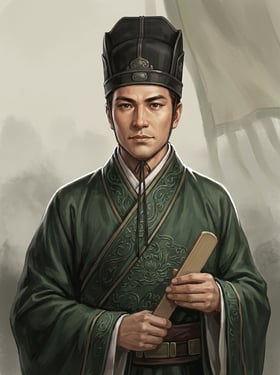
Historical Record
Fei Yi, courtesy name Wenwei, was a man of Meng in Jiangxia. In his early years he followed his uncle into Shu. When Liu Bei established his heir apparent, Fei Yi and Dong Yun together served as Retainers, and later he was promoted to Concubine's Son. After Liu Shan succeeded to the throne, he served as Gentleman of the Yellow Gate. When the Chancellor Zhuge Liang returned from his Southern Campaign, most of the officials went out tens of li to welcome him, but Zhuge Liang deliberately had Fei Yi ride in the same carriage, and thereafter everyone regarded Fei Yi with new respect.
Because Fei Yi had just returned from the south, Zhuge Liang appointed him Colonel Who Manifests Trust and sent him as envoy to Eastern Wu. Sun Quan was witty and sharp of tongue, and able rhetoricians such as Zhuge Ke and Yang Dao took turns pressing him with difficult questions; yet Fei Yi answered them with smooth words and firm principle, reasoning his case so that they could not refute him in the end. Sun Quan therefore esteemed him greatly, praising him as "a man of fine virtue in the realm" and predicting that he would become a pillar minister of Shu Han. After Fei Yi returned to Shu, he was promoted to Palace Attendant. When Zhuge Liang stationed his troops at Hanzhong, he again requested Fei Yi as Army Adviser. Because his missions met with approval, he traveled repeatedly between Shu and Wu.
In the eighth year of Jianxing, Fei Yi was transferred to Central Protector of the Army, and later became Major. During Zhuge Liang's Northern Expeditions, Wei Yan and Yang Yi had always been at odds and often quarreled in front of Zhuge Liang; Wei Yan even once drew his blade to threaten Yang Yi, while Yang Yi wept without cease. Fei Yi often mediated between them, so that each could be put to good use, right up until Zhuge Liang's death. When Zhuge Liang was gravely ill, he secretly conferred with the Chief Clerk Yang Yi, the Major Fei Yi, the Protector of the Army Jiang Wei, and others on the order of withdrawing the troops, and had Fei Yi go to sound out Wei Yan's intentions.
After Zhuge Liang died, Fei Yi was appointed Army Adviser of the Rear. Soon afterward he succeeded Jiang Wan as Prefect of the Masters of Writing. At the time the affairs of state and army were many and official duties pressing, but Fei Yi's discernment surpassed others, and he handled affairs with great efficiency while still attending to guests and amusements, so that nothing was neglected. After Jiang Wan returned from Hanzhong to Fu County, Fei Yi was promoted to General-in-Chief and took charge of the affairs of the Masters of Writing. In the seventh year of Yanxi, when the Wei army pressed upon Mount Xingshi, Fei Yi was commissioned with the staff of authority and led troops to resist them. At the time the military situation was urgent and feathered dispatches flew back and forth, yet he could still play go calmly with the Imperial Household Grandee Lai Min without the least sign of weariness. Lai Min therefore praised him, certain that he could drive back the enemy. After Fei Yi reached the front, the enemy did indeed withdraw, and he was enfeoffed as Marquis of Chengxiang.
When Jiang Wan firmly declined the post of Inspector of Yi Province, Fei Yi took it up concurrently. His achievements while governing the state were a match for Jiang Wan's. Fei Yi was modest and plain by nature; his household accumulated no wealth, his sons and daughters all wore plain cloth and ate simple fare, and they came and went without riding in carriages, no different from ordinary people. In the eleventh year of Yanxi, he went out to garrison Hanzhong. From Jiang Wan to Fei Yi, even while stationed abroad, all great matters of reward, punishment, and authority were first referred to them for decision from afar before being carried out, a measure of how deeply they were trusted. Later, because the cloud-watchers of Chengdu said the capital had no place for a chancellor, he returned to Chengdu in the summer of the fourteenth year, and that winter again garrisoned Hanshou. In the first month of spring of the sixteenth year of Yanxi, Fei Yi was killed at Hanshou by the Wei defector Guo Xun.
While Fei Yi lived, Jiang Wei repeatedly proposed raising troops for Northern Expeditions, but Fei Yi often restrained him, limiting his forces to no more than ten thousand men. He held that Shu Han was no match for Zhuge Liang, and that since even Zhuge Liang could not pacify the Central Plains, how much less could they; it was better to preserve the state and govern the people, awaiting one of greater ability.
In the Novel
In the Romance of the Three Kingdoms, Fei Yi's image accords in the main with the historical record but is given more literary color and concrete episodes. He first appears before Zhuge Liang's Southern Campaign against Meng Huo, when he was appointed Chief Clerk and went on campaign with the army. After the southern barbarians were pacified, Fei Yi offered Zhuge Liang the counsel of installing officials in the south to govern alongside Meng Huo. Zhuge Liang replied with the principle of the "three difficulties," and Fei Yi and the others were all convinced.
After Zhuge Liang's first Northern Expedition failed and he demoted himself to General of the Right while acting as Chancellor, Fei Yi went by edict to Hanzhong to proclaim the order, and had an exchange with Zhuge Liang. Fei Yi tried to console Zhuge Liang, saying the people of Shu rejoiced that he had recovered four commanderies, but Zhuge Liang blamed himself, saying that to gain and then lose again was the same as never having gained. Fei Yi also mentioned Jiang Wei's surrender, but Zhuge Liang held that "to have the army defeated and brought home without taking an inch of land is my great offense. What is the gain of one Jiang Wei? What harm to Wei?". This reflects Zhuge Liang's high demands upon himself and his deep concern for the larger interests of the state.
During Zhuge Liang's fourth Northern Expedition, Fei Yi again went by edict to the army to convey Liu Shan's command. When Zhuge Liang firmly declined the post of Chancellor, Fei Yi urged him to "accept it provisionally" to set the hearts of the officers and men at ease. Zhuge Liang then sent Fei Yi as envoy to Eastern Wu to persuade Sun Quan to join forces in attacking Wei. Fei Yi successfully completed his mission, and Sun Quan declared he would raise three hundred thousand troops and advance along three routes. At the banquet, Sun Quan remarked to Fei Yi of Wei Yan that he was "more than brave enough, but his heart is not upright. Should Kongming one day be gone, he will surely become a source of disaster." Fei Yi relayed these words to Zhuge Liang, who sighed, "Truly a wise lord! It is not that I do not know this man. It is because I value his courage that I employ him". This foreshadowed Wei Yan's later rebellion.
When Zhuge Liang was gravely ill, Fei Yi again came to the army to report the news of Eastern Wu's failed attack on Wei. On hearing this, Zhuge Liang's old illness flared up, he collapsed to the ground, and he sensed that his end was near. After Zhuge Liang's death, Fei Yi played a key role in handling Wei Yan's rebellion. On Yang Yi's orders, he went to Wei Yan's camp and feigned persuading Wei Yan to reconcile with Yang Yi, while in fact buying time for Yang Yi to move his troops. Once Wei Yan had fallen for the ruse, Fei Yi swiftly slipped away and reported to Yang Yi, helping to bring about the campaign of Yang Yi and Jiang Wei against Wei Yan.
After Zhuge Liang's death, Liu Shan, following his last words, appointed Jiang Wan as Chancellor and General-in-Chief with charge of the affairs of the Masters of Writing, and Fei Yi as Prefect of the Masters of Writing, jointly managing the chancellor's affairs. When Jiang Wei undertook his Northern Expeditions, Fei Yi offered remonstrance, holding that the talent of Shu Han had withered and that it was unwise to act rashly, and citing how even Zhuge Liang could not restore the Central Plains to dissuade Jiang Wei. Jiang Wei rebutted with the words "life is like a white colt glimpsed through a crack," and proposed the strategy of allying with the Qiang peoples to seize Longxi. In the novel, the cause of Fei Yi's death agrees with the historical record—he was killed by the Wei defector Guo Xun—but the specific episode is not developed in detail.
Key Relationships
* Shu Han: Fei Yi served Shu Han all his life, rising from Gentleman of the Yellow Gate, Colonel Who Manifests Trust, Palace Attendant, Army Adviser, Central Protector of the Army, Major, and Army Adviser of the Rear to Prefect of the Masters of Writing, and finally General-in-Chief with charge of the affairs of the Masters of Writing—a key pillar minister of Shu Han in its later years,,.
* Zhuge Liang: Zhuge Liang esteemed Fei Yi highly, not only deliberately having him ride in the same carriage on returning from the Southern Campaign but also repeatedly sending him as envoy to Eastern Wu and regarding him as an important military adviser,. In the novel, Fei Yi is Zhuge Liang's important subordinate and messenger, repeatedly bidden to convey edicts or to serve as envoy to Eastern Wu,.
* Jiang Wan: Fei Yi ranked alongside Jiang Wan as a governing minister of Shu Han after Zhuge Liang, the two roughly matching Zhuge Liang in renown. Fei Yi succeeded Jiang Wan as Prefect of the Masters of Writing and later took over his post as Inspector of Yi Province,.
* Yang Yi: While Zhuge Liang lived, Fei Yi repeatedly mediated the conflict between Wei Yan and Yang Yi, enabling each to be put to good use. After Zhuge Liang's death, Fei Yi deftly maneuvered between the two in the struggle of Yang Yi and Wei Yan, ultimately helping Yang Yi quell Wei Yan's revolt, (unique to the novel).
* Wei Yan: Fei Yi reconciled the conflict between Wei Yan and Yang Yi. In the novel, after Zhuge Liang's death, Fei Yi, on Yang Yi's orders, outwitted Wei Yan and brought about his downfall (unique to the novel).
* Jiang Wei: While Fei Yi lived, he took a cautious attitude toward Jiang Wei's Northern Expedition strategy, often restraining him and limiting his forces, holding that it was unwise to act rashly. In the novel, Fei Yi also repeatedly sought to dissuade Jiang Wei from his Northern Expedition plans.
* Sun Quan: Fei Yi served repeatedly as envoy to Eastern Wu, and his outstanding diplomatic skill won Sun Quan's admiration, Sun Quan once praising him as "a man of fine virtue in the realm". In the novel, Sun Quan also expressed to Fei Yi his concern over Wei Yan (unique to the novel).
* Guo Xun: Fei Yi was finally killed by the Wei defector Guo Xun.
* Chen Zhi: Fei Yi greatly esteemed Chen Zhi, regarding him as talented and promoting him, so that he was able to leap ahead of Dong Yun's succession at court.
Signature Scenes
* Riding in the same carriage on the return from the Southern Campaign: When Zhuge Liang returned from the Southern Campaign, he deliberately had Fei Yi ride in the same carriage with him, so that everyone regarded Fei Yi with new respect—a display of Fei Yi's important place in Zhuge Liang's esteem.
* Serving as envoy to Eastern Wu and debating the assembled scholars: Fei Yi served repeatedly as envoy to Eastern Wu, and facing the difficult questions of Sun Quan, Zhuge Ke, Yang Dao, and others, he answered with smooth words and firm principle and could not be subdued in the end, displaying his outstanding diplomatic skill and rhetorical talent.
* Mediating the dispute between Wei Yan and Yang Yi: During Zhuge Liang's Northern Expeditions, when the conflict between Wei Yan and Yang Yi grew sharp, Fei Yi often mediated between them, enabling each to be put to good use and averting the outbreak of internal conflict—an embodiment of his political wisdom and his ability to coordinate.
* Calmly playing go while resisting the enemy at Mount Xingshi: When the Wei army invaded Mount Xingshi and the military situation was urgent, Fei Yi could still play go calmly with Lai Min without the least sign of panic, displaying the bearing of a great commander unruffled in crisis and his uncommon composure of mind.
* Outwitting Wei Yan: In the novel, after Zhuge Liang's death, Fei Yi, on Yang Yi's orders, went to Wei Yan's camp and feigned persuading Wei Yan to reconcile with Yang Yi while in fact buying time for Yang Yi to move his troops, ultimately bringing about Wei Yan's downfall—a display of his resourcefulness and daring (unique to the novel).
* Dissuading Jiang Wei from his Northern Expeditions: While he lived, Fei Yi repeatedly took a cautious attitude toward Jiang Wei's Northern Expedition strategy, holding that Shu Han's strength was limited and that it was unwise to act rashly—an embodiment of his steady philosophy of governance,.
* Assassinated by Guo Xun: Fei Yi was finally killed at Hanshou by the Wei defector Guo Xun, ending a life of devoting himself wholly to Shu Han.
Portrait file
Character profile
- Character
- Fei Yi was humble, tolerant, and broadly loving, quick and perceptive in handling affairs. His words were smooth and conciliatory, he was skilled at mediation, and he was discreet, not lightly divulging information.
- Manner of speech
- Fei Yi's speech flowed smoothly and rested on solid principle, and he could answer with sound reasoning. When submitting memorials and stating his case he would stress the primacy of upholding the law, and he assented with modesty and care.
- Life
- Fei Yi was a native of Meng in Jiangxia. Orphaned of his father in childhood, he entered Shu following his clan-uncle Boren. In Shu Han he held in succession the offices of Gentleman of the Yellow Gate, Colonel Who Manifests Trust, Palace Attendant, Army Adviser, Prefect of the Masters of Writing, and General-in-Chief, and opened his own office. At the New Year's grand assembly in the sixteenth year of Yanxi he was assassinated at Hanshou by Guo Xun, a defector from Wei, and was given the posthumous title Jing (the Respectful Marquis).
- Anecdotes
- Fei Yi was once ordered by the Later Lord into Hanzhong to inquire into the reasons for withdrawing the army, and urged Kongming to pardon Li Yan. He served as an envoy of Shu Han to Eastern Wu, and on imperial command went to Hanzhong to proclaim the edict restoring Zhuge Liang to the office of Chancellor. Zhuge Liang designated him as the man who could succeed to power after Jiang Wan.
Relationships
14 relationships
Family1
Lord & vassal1
Friends1
Enemies2
Teacher & student2
Other7
Quotes
22 recorded lines · 3 featured
「孫子云:『知彼知己,百戰百勝。』我等皆不如丞相遠甚,丞相尚不能恢復中原,何況我等?」
This line reflects Fei Yi's esteem for Zhuge Liang's military talent, as well as his own prudent strategic thinking.
「臣聞治國者,必以奉法為重。法若不行,何以服人?丞相敗績,自行貶降,正其宜也。」
This line stresses the importance of upholding the law, showing Fei Yi's rule-of-law outlook as a statesman.
「當爲君還解楊長史,長史文吏,稀更軍事,必不違命也。」
Drawn from the official histories, this line is Fei Yi's key exchange in trying to placate Wei Yan during the Rebellion of Wei Yan, and carries historical significance.
Chapters14 回 ▸
- 史ch.33ch.39ch.40ch.42ch.44
- 演ch.87ch.90ch.96ch.99ch.102ch.103ch.104ch.105ch.107
Relationship timeline11 条 ▸
史 ch.39
- Chen Zhi§34
mentor_of
费祎甚异之,故超继允内侍
史 ch.40
- Yang Yi§56
betrayed_by
对费祎恨望,言"往者举军就魏氏"等语;费祎密表其言
史 ch.44
演 ch.90
- Zhuge Liang§24
advises_in
入谏问何不置官同守;孔明以"三不易"答之
演 ch.99
- Liu Shan§7
commands_in
奉天子诏入营宣读,复孔明丞相之职
演 ch.102
- Sun Quan§14
advises_in
持孔明书赴建业约同伐魏,复命于祁山
演 ch.103
- Zhuge Liang§28
serves
自东吴归报魏阻吴师之事;引发孔明长叹昏倒、旧病复发
演 ch.104
- Yang Yi§28
advises_in
自魏延寨返报杨仪,备述其异志
演 ch.107
- Jiang Wei§26
advises_in
谏维待时勿轻动
Inner monologues · AI-generated3 段 ▸
- Urgent military dispatches were flying back and forth through the camp. The troops were already assembled, and the carts
- I am Fei Yi; my courtesy name is unknown. I recall that when I was young, the Former Lord appointed a crown prince, and
- My name is Fei Yi, and my courtesy name was Wenwei. The historical records have little to say about my early years; I da
Life events8 ▸
- 0227-01-01 · ChengduFormer Memorial on Sending Out the Troops· Advisor
- 0234-01-01 · Mount QiZhuge Liang's Six Expeditions to Mount Qi· Advisor
- 0234-01-01 · NanzhengRebellion of Wei Yan· Witness
- 0234-01-01 · NanzhengDeath of Wei Yan· Advisor
- 0244-01-01 · Mount XingshiBattle of Xingshi· Commander
- 0253-01-01 · FuchengAssassination of Fei Yi· Victim
- 0253-01-01 · HanshouGuo Xiu Assassinates Fei Yi· Victim
- 0263-01-01 · Mount QiJiang Wei's Northern Expeditions· Advisor