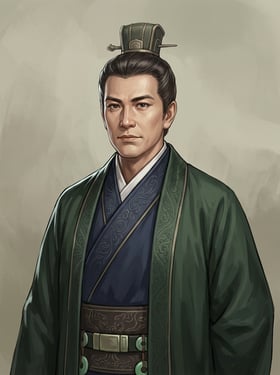
Historical Record
Jiang Wan, courtesy name Gongyan, was a native of Xiangxiang in Lingling. In his youth he won equal renown with his cousin Liu Min. When Liu Bei entered Shu, Jiang Wan accompanied him in the capacity of a provincial clerk, and was later appointed Chief of Guangdu. However, on one occasion when Liu Bei was touring Guangdu, he found that Jiang Wan had neglected his administrative duties and was at that moment drunk; Liu Bei flew into a rage and meant to punish him. It was thanks to the intercession of the Military Adviser General Zhuge Liang, who called Jiang Wan "a vessel for the altars of state, not a talent fit for a mere hundred li," and pointed out that in governing he took the security of the people as his foundation and did not put outward embellishment first, urging Liu Bei to look into the matter more carefully. Liu Bei, who had always esteemed Zhuge Liang, therefore imposed no heavy punishment, merely dismissing Jiang Wan from office c:3208.
Not long after his dismissal, Jiang Wan dreamed at night of an ox's head streaming with blood, and was greatly disturbed by it. The dream-diviner Zhao Zhi interpreted it: "To see blood is for matters to be made clear. The ox's horns and nose form the shape of the character 'gong' (lord); your rank will surely reach the highest—a most auspicious sign." Before long, Jiang Wan was appointed Magistrate of Shifang. After Liu Bei styled himself King of Hanzhong, Jiang Wan entered the court as a Gentleman of the Masters of Writing c:3208.
In the first year of Jianxing, when Zhuge Liang opened his own office to govern affairs, he recruited Jiang Wan as Officer of the Eastern Bureau. When Jiang Wan was recommended as a Flourishing Talent, he firmly tried to yield the honor to Liu Yong, Yin Hua, Pang Yan, Liao Chun, and others; Zhuge Liang instructed him: "To turn one's back on kin and forsake virtue, and so harm the people—this others do not conceal in their hearts, and it would truly leave far and near unable to understand the meaning. Therefore you ought to make plain your merits and standing, so as to show the purity and gravity of this selection." Afterward Jiang Wan was promoted to Adviser to the Army. In the fifth year of Jianxing, when Zhuge Liang was stationed at Hanzhong, Jiang Wan, together with the Chief Clerk Zhang Yi, jointly took charge of the affairs of the rear office. In the eighth year, Jiang Wan succeeded Zhang Yi as Chief Clerk, with the added title of General Who Comforts the Army. On Zhuge Liang's repeated campaigns, Jiang Wan was always able to supply ample food and troops to meet his needs. Zhuge Liang often said: "Gongyan is devoted, loyal, and refined; he is one fit to aid me in the kingly enterprise." He even secretly memorialized the Latter Sovereign Liu Shan, saying, "Should I meet with misfortune, the affairs that follow should be entrusted to Jiang Wan" c:6177.
After Zhuge Liang's death, Jiang Wan was appointed Master of Writing and Director, and before long was further given the titles of Acting Protector of the Capital, Bearer of the Imperial Credentials, and Inspector of Yi Province, then promoted to General-in-Chief and Manager of the Affairs of the Masters of Writing, and enfeoffed as Marquis of Anyang Precinct c:6178. At that time Shu Han had just lost its commander, and within and without the court all felt fear and danger. Jiang Wan, however, "stood out from the crowd, holding the foremost place among the assembled officials, with neither a grieving countenance nor a joyful expression, his bearing and manner just as on ordinary days," and so gradually won the trust of all c:6178.
In the first year of Yanxi, Liu Shan issued an edict commanding Jiang Wan to lead all the armies and encamp at Hanzhong, to await Eastern Wu's movements and form, east and west, a pincer of horns, so as to take advantage of any change in the state of Wei. He further ordered Jiang Wan to open his own office, and the next year added the title of Grand Marshal. Jiang Wan once submitted a memorial reporting that he was unwell in body, yet still set forth a strategic conception, holding that Liang Province was a key frontier region against the Hu where one could advance or retreat with resources, and that the Qiang and Hu thirsted for Han like the thirsty for water; he advised that Jiang Wei be made Inspector of Liang Province, while he himself would lead troops as Jiang Wei's backing, so as to respond to operations in the northeast c:6179.
In the Novel
In *Romance of the Three Kingdoms*, Jiang Wan's image broadly matches the histories, but he is portrayed more as an important aide and successor to Zhuge Liang, his character traits and strategic vision further heightened in the novel. He first appears in chapter 63, introduced as "a famous scholar of Jingxiang," then serving as a secretary, accompanying Kongming into Shu c:3209.
In the novel, Jiang Wan repeatedly accompanied Zhuge Liang on campaign, especially in the southern campaign against Meng Huo, where as an Adviser to the Army he showed a certain anxiety and doubt over Zhuge Liang's military dispositions. For example, at the battle of the Lu River, Jiang Wan felt uneasy about the layout of the camp built by Lü Kai, believing it repeated the error by which Liu Bei was defeated at the Battle of Xiaoting, and fearing the Man troops would attack with fire. Zhuge Liang, however, smiled and said, "Do not be so suspicious; I have my own marvelous calculation," showing that Jiang Wan fell short of Zhuge Liang in military strategy, while also setting off Zhuge Liang's resourcefulness c:13423. When Meng Huo withdrew to hold the Tulong Cave, Jiang Wan once advised withdrawing the army home, holding that "Meng Huo has been captured four times and is already cowed—how would he dare come out again? Moreover the weather is now scorching, the men and horses weary, and to campaign against him is of no benefit," but Zhuge Liang did not heed him, again highlighting his military caution and Zhuge Liang's foresight c:3210.
When Ma Su lost Jieting and was beheaded, Jiang Wan hurried from Chengdu and tried to plead for Ma Su, holding that "with the realm not yet settled, to slay a man of wisdom and strategy—is it not a pity?" c:6181 Zhuge Liang refused on the grounds of strict military law, and recalled the late sovereign Liu Bei's appraisal of Ma Su, which further reinforces Jiang Wan's generous and benevolent character (novel only).
After Zhuge Liang's death, Jiang Wan's standing rose markedly. In chapter 105, he was given the added titles of Chancellor and General-in-Chief and Manager of the Affairs of the Masters of Writing, inheriting Zhuge Liang's legacy and becoming the actual holder of power in Shu Han c:6182. The novel also depicts Yang Yi, who, presuming on his great merit and believing his seniority above Jiang Wan's, yet ranked beneath him, harbored resentment and even uttered the wild words: "In the old days, when the Chancellor had just died, had I taken the whole army over to Wei, would I be left in such obscurity as this!" Fei Yi secretly memorialized these words, and Liu Shan in fury wished to behead Yang Yi. Jiang Wan, however, petitioned Liu Shan, recalling that Yang Yi had accompanied the Chancellor and won many merits, and advised reducing him to a commoner. Liu Shan followed this, and Yang Yi in the end cut his own throat in shame and died c:13422. This episode shows not only Jiang Wan's generosity but also his steadiness and grasp of the larger situation as Zhuge Liang's successor.
Key Relationships
* Shu Han (serves): Jiang Wan served Shu Han throughout his life, from Liu Bei's entry into Shu to his holding of power after Zhuge Liang's death, remaining always an important pillar of the Shu Han regime c:6178.
* Zhuge Liang (mentor/predecessor): Zhuge Liang was Jiang Wan's discoverer and mentor. He not only interceded for Jiang Wan when Liu Bei meant to punish him, but in his lifetime prized Jiang Wan's talent, calling him "a vessel for the altars of state," and secretly memorialized the Latter Sovereign recommending Jiang Wan as his successor c:6177. In the novel, Zhuge Liang's trust in and cultivation of Jiang Wan runs throughout.
* Dong Yun (friend_of/colleague): Dong Yun and Jiang Wan were both important assisting ministers of Shu Han's later period. The histories record that Jiang Wan once submitted a memorial yielding place to Fei Yi and Dong Yun, and memorialized that "Dong Yun has served within for years, aiding the royal house, and ought to be granted rank and land to reward his merit and toil," which shows the two were close and held each other in mutual esteem c:3205.
* Fei Yi (colleague): Fei Yi, together with Jiang Wan and Dong Yun, was called one of the "Four Heroes," a core figure of the Shu Han regime after Zhuge Liang's death. Jiang Wan once submitted a memorial wishing to yield the office of Inspector of Yi Province to Fei Yi c:3205. In the novel, Fei Yi also assisted the Latter Sovereign together with Jiang Wan and jointly handled the affair of Yang Yi c:13422.
* Yang Yi (rival/subordinate): In history, Yang Yi vied for power with Wei Yan, and after Zhuge Liang's death Yang Yi was demoted for his insolent words. In the novel, Yang Yi, presuming on his great merit, was discontented at being ranked below Jiang Wan, and in the end was reduced to a commoner for his resentful words and cut his own throat in shame c:13422 (novel only; in history Yang Yi killed himself after being exiled, though for reasons somewhat different from the novel).
* Wei Yan (commands_in): Wei Yan was an important general of Shu Han, at odds with Yang Yi. After Zhuge Liang's death, Wei Yan vied for power with Yang Yi and was in the end killed c:6174. In the novel, in dealing with Wei Yan's revolt, Jiang Wan showed trust in Zhuge Liang's posthumous plan and judged Wei Yan more accurately c:13419 (novel only).
* Qiao Zhou (commands_in): After Jiang Wan took charge of government, he appointed Qiao Zhou as Attendant Clerk for Education, placing him in overall charge of the province's scholars, showing his regard for education and talent c:3207.
* Ma Su (commands_in): In the novel, Jiang Wan once pleaded for Ma Su, embodying his generosity and benevolence c:6181 (novel only).
Iconic Scenes
* Dismissal at Guangdu and Zhuge Liang's intercession: When Jiang Wan first served as Chief of Guangdu, his neglect of administration and his drunkenness angered Liu Bei, who meant to punish him. Zhuge Liang overruled the others, calling him "a vessel for the altars of state" and interceding for him, so that Jiang Wan escaped heavy punishment, and foretold his future achievements. This event was both a turning point in Jiang Wan's career and a display of Zhuge Liang's discernment of men c:3208.
* Zhuge Liang's secret memorial of recommendation: In his lifetime Zhuge Liang placed high hopes in Jiang Wan, secretly memorializing the Latter Sovereign Liu Shan and clearly stating, "Should I meet with misfortune, the affairs that follow should be entrusted to Jiang Wan," regarding him as his own successor. This embodies Zhuge Liang's high recognition of Jiang Wan's ability and loyalty, and laid the foundation for Jiang Wan's smooth assumption of power after Zhuge Liang's death c:6177.
* "His bearing and manner just as on ordinary days" after Zhuge Liang's death: When Zhuge Liang died, all of Shu Han was shaken and hearts were full of dread. At this time Jiang Wan "stood out from the crowd, holding the foremost place among the assembled officials, with neither a grieving countenance nor a joyful expression, his bearing and manner just as on ordinary days," and by his composure and gravity steadied the court and won general esteem c:6178.
* Anxiety over Zhuge Liang's military dispositions in the southern campaign against Meng Huo: In the novel, during Zhuge Liang's southern campaign against Meng Huo, Jiang Wan raised doubts about the placement of the camp at the Lu River and Meng Huo's withdrawal strategy, displaying his cautious character. Although these doubts were resolved by Zhuge Liang's resourcefulness, this scene depicts Jiang Wan's character as an assisting minister and sets off Zhuge Liang's far-sightedness c:13423 (novel only).
* Handling the affair of Yang Yi: After Zhuge Liang's death, Yang Yi, discontented at Jiang Wan's standing, uttered resentful words and even threatened to defect to Wei. When Liu Shan meant to behead Yang Yi, Jiang Wan, mindful of Yang Yi's merits, strongly advised reducing him to a commoner rather than putting him to death, displaying his generous and benevolent character and his concern for maintaining internal stability in Shu Han c:13422 (novel only).
Portrait file
Character profile
- Character
- Jiang Wan conducted himself with upright dignity and gravity, never letting joy or anger show on his face; he was magnanimous and accommodating of others, steady and clear in his judgments.
- Manner of speech
- Jiang Wan's speech was even and self-restrained, often framed in terms of tolerating others without contending. He once cited the allusion 'Chu executed Dechen, and Duke Wen rejoiced' to urge leniency in punishment.
- Life
- Jiang Wan was a native of Xiangxiang in Lingling; in his youth, at the age of capping, he was as renowned as his maternal cousin Liu Min. He first followed the Former Lord into Shu as a provincial clerk, and later, because he neglected his duties, the Former Lord wished to charge and execute him, but through Zhuge Liang's defense he was only dismissed from office. After Liang died, he rose to Prefect of the Masters of Writing, General-in-Chief, Supervisor of the Masters of Writing, and Grand Marshal, opening his own office to manage affairs and garrisoning Hanzhong. He died in the ninth year of Yanxi and was given the posthumous title Gong (the Reverent).
- Anecdotes
- Jiang Wan once sat together with Fei Shi listening to Li Hong's words, and later, when he held power, appointed Fei Shi as Grand Master of Remonstrance. He interceded to spare Li Yan from death, and was designated by Kongming as the man who could be entrusted with the great affairs of Shu Han after his own passing.
Relationships
10 relationships
Lord & vassal2
Friends1
Teacher & student1
Other6
Quotes
10 recorded lines · 3 featured
「以臣愚見,楊儀為人雖稟性過急,不能容物,至於籌度糧草,參贊軍機,與丞相辦事多時,今丞相臨終,委以大事,決非背反之人。魏延平日恃功務高,人皆下之。儀獨不假借,延心懷恨。今見儀總兵,心中不服,故燒棧道,斷其歸路,又誣奏而圖陷害。臣願將全家良賤,保楊儀不反,實不敢保魏延。」
These words display Jiang Wan's keen judgment of character-firmly protecting Yang Yi and perceiving Wei Yan's rebellious intent-demonstrating his political wisdom.
「丞相素疑此人,必有遺計授與楊儀。若儀無恃,安能退入谷口乎?延必中計矣。陛下寬心。」
This line anticipates Wei Yan falling for the ploy, highlighting Jiang Wan's grasp of Zhuge Liang's parting stratagem and his precise reading of the situation.
「某看呂凱所造之寨甚不好,正犯昔日先帝敗於東吳時之地勢矣,倘蠻兵偷渡瀘水,前來劫寨,若用火攻,如何解救?」
These words reflect Jiang Wan's military insight in avoiding a repeat of the late emperor's mistakes, showing his prudence and foresight.
Chapters16 回 ▸
- 史ch.33ch.39ch.41ch.42ch.43ch.44ch.45
- 演ch.63ch.87ch.88ch.89ch.96ch.98ch.100ch.104ch.105
Relationship timeline6 条 ▸
史 ch.39
- Dong Yun§28
friend_of
蒋琬上疏让费祎及允,又表请赐允爵土
史 ch.41
- Fei Shi§44
commands_in
蒋琬秉政以诗为谏议大夫
史 ch.42
- Qiao Zhou§56
commands_in
蒋琬领刺史,徙周为典学从事,总州之学者
演 ch.63
- Zhuge Liang§24
serves
现为书记;随孔明引兵入川
演 ch.89
- Zhuge Liang§19
advises_in
进言班师,孔明不从
演 ch.100
- Liu Shan§19
advises_in
出班奏问"丞相累建大功,何故宣回"
Inner monologues · AI-generated3 段 ▸
- After the Chancellor’s death, the court suddenly lost the pillar it relied upon. Near and far alike were alarmed and fea
- I am Jiang Wan, courtesy name Gongyan. In the third year of Jianxing, I accompanied the Chancellor on his campaign south
- I am Jiang Wan, courtesy name Gongyan, from Xiangxiang in Lingling. I recall that when I was young, some among my fellow
Life events3 ▸
- 0228-01-01 · HanzhongExecution of Ma Su· Advisor
- 0231-01-01 · YonganLi Yan Dismissed for Failing to Deliver Supplies on Time· Advisor
- 0263-01-01 · Mount QiJiang Wei's Northern Expeditions· Advisor