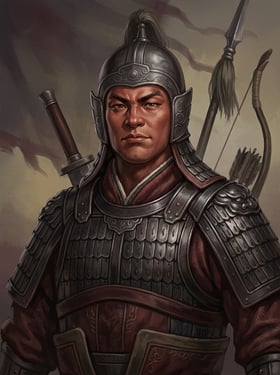
Historical Record
Wei Yan, styled Wenchang, was a man of Yiyang. He followed Liu Bei into Shu as a member of his personal retinue, repeatedly achieved military merit, and was appointed General of the Standard Gate. After Liu Bei proclaimed himself King of Hanzhong and moved his seat of government to Chengdu, a senior commander was needed to garrison Hanzhong. Everyone assumed Zhang Fei would be the choice, and Zhang Fei himself expected it. Yet Liu Bei, in an exceptional promotion, raised Wei Yan to be Commander of Hanzhong and General Who Pacifies Distant Lands, concurrently Administrator of Hanzhong, a move that astonished the whole army. Liu Bei assembled his officials and asked Wei Yan how he would bear so heavy a charge, and Wei Yan declared boldly: "If Cao Cao comes with the whole realm, I beg to repel him for Your Majesty; if a subordinate general arrives with a host of a hundred thousand, I beg to devour them for Your Majesty." Liu Bei greatly praised this, and the assembly too was won over by his bold words.
After Liu Bei proclaimed himself Emperor, Wei Yan was promoted to General Who Guards the North. In the first year of Jianxing he was enfeoffed as Marquis of Duting. In the fifth year of Jianxing, when Zhuge Liang garrisoned Hanzhong, Wei Yan was appointed Commander of the Vanguard, Chancellor's Marshal, and Inspector of Liang Province. In the eighth year of Jianxing, Wei Yan was ordered to lead troops west into the Qiang lands, where he fought the Wei General of the Rear Fei Yao and the Inspector of Yong Province Guo Huai at Yangxi, and routed Guo Huai and the others. He was thereby promoted to Front Army Counselor and Grand General Who Conquers the West, granted the staff of authority, and advanced in enfeoffment to Marquis of Nanzheng.
Each time Wei Yan campaigned with Zhuge Liang, he wished to lead ten thousand crack troops and part ways with Zhuge Liang, reuniting at Tong Pass in imitation of Han Xin's precedent. But Zhuge Liang never agreed to his plan, considering it too reckless. Wei Yan therefore often complained that Zhuge Liang was timid and lamented that his own talents could not be fully employed. He was proud and overbearing by nature, exceedingly valiant, and good at caring for his troops, so that the men of the time all gave way before him by a measure. The Chancellor's Senior Clerk Yang Yi, however, would not defer to Wei Yan, and the two thus harbored deep grudges, as incompatible as fire and water.
In the twelfth year of Jianxing, Zhuge Liang again sent out troops on a Northern Expedition, with Wei Yan as vanguard. As Zhuge Liang lay gravely ill, he secretly arranged the dispositions for withdrawing the army, ordering Wei Yan to cover the rear with Jiang Wei second, and specifying that if Wei Yan would not obey orders, the army should withdraw of itself. After Zhuge Liang died, Yang Yi kept the death secret and sent Fei Yi to probe Wei Yan's intentions. On learning that the Chancellor had passed, Wei Yan held that "though the Chancellor is gone, I am still here," that the great affairs of the realm should not be abandoned for one man's death, and declared he was unwilling to be commanded by Yang Yi and to cover the rear. He discussed plans for withdrawal with Fei Yi, having Fei Yi write out and sign a notice to the generals. Fei Yi feigned agreement but seized the chance to ride off. Wei Yan bitterly regretted it, but it was too late. Wei Yan sent men to scout the movements of Yang Yi and the others, and found them withdrawing according to Zhuge Liang's established plan. Wei Yan flew into a rage and, not waiting for Yang Yi to act, led his troops straight south, burning the gallery roads along the way. Wei Yan and Yang Yi each submitted memorials accusing the other of treason, and within a single day their urgent dispatches arrived together. The Latter Ruler Liu Shan asked the Palace Attendant Dong Yun and the Resident Senior Clerk Jiang Wan, and both believed Yang Yi and doubted Wei Yan. Yang Yi and his men cut through the mountains and opened roads, marching day and night close behind Wei Yan. Wei Yan reached Nangukou first and sent troops to block Yang Yi. Yang Yi ordered He Ping to resist Wei Yan in the van. He Ping rebuked Wei Yan, saying: "The Chancellor's body is not yet cold—how dare you act thus!" Wei Yan's troops, knowing that the fault lay with Wei Yan, were unwilling to serve him, and the army at once scattered. Wei Yan could only flee with his sons and a few men toward Hanzhong. Yang Yi sent Ma Dai to pursue and cut down Wei Yan, presenting his head to Yang Yi. Yang Yi trampled on Wei Yan's head and cursed, "Base slave, can you still do evil now!" He thereupon exterminated Wei Yan's three branches of kin.
In the Novel
In Romance of the Three Kingdoms, Wei Yan's image is given greater dramatic color and a fatalistic, tragic ending. He first appears when Liu Bei attacks Xiangyang: Wei Yan cut down the gate guards, opened the city gate, and loudly called for Liu Bei to enter the city, only to be stopped by Wen Ping. In the end, Wei Yan fought Wen Ping beneath the walls of Xiangyang, lost all his troops, and fled to Changsha to join Han Xuan.
Wei Yan's time at Changsha is the groundwork for the "bones of rebellion" theory. Dissatisfied with Han Xuan's cruelty, he seized the chance during Guan Yu's attack on Changsha to cut down Han Xuan, rescue Huang Zhong, and surrender Changsha to Guan Yu. Yet when Guan Yu brought Wei Yan to see Liu Bei and Kongming, Kongming ordered the executioners to drag Wei Yan out and behead him. When Liu Bei did not understand, Kongming explained: "I observe that Wei Yan has bones of rebellion at the back of his head; he will surely rebel in time, so I would cut him down first to cut off the root of disaster." Liu Bei, mindful of Wei Yan's merit, asked Kongming to spare him. Kongming then pointed at Wei Yan and warned him to serve his lord with full loyalty and harbor no treacherous heart, or else his head would surely be taken. This episode has no basis in the histories; it is the novel's invention to shape Zhuge Liang's "miraculous foresight" and Wei Yan's image of "bones of rebellion."
After the Battle of Red Cliffs, Zhou Yu schemed to seize Jing Province but was seen through by Zhuge Liang. When Zhou Yu pursued Liu Bei, he encountered three ambushing forces under Guan Yu, Huang Zhong, and Wei Yan, was badly defeated, and in his fury his arrow wound burst open. Thereafter Wei Yan followed Liu Bei into Shu; in the attack on Luocheng he divided forces with Huang Zhong to raid the camp and captured Leng Bao alive. In the attack on Mianzhu, Wei Yan once asked to fight Ma Chao, but Kongming declined. After Liu Bei proclaimed himself King of Hanzhong, Wei Yan was enfeoffed as Administrator of Hanzhong, in accord with the historical record of General Who Pacifies Distant Lands and Commander of Hanzhong.
During Zhuge Liang's Southern Campaign against Meng Huo, Wei Yan served as a senior commander alongside Zhao Yun, with overall command of the troops. He achieved merit many times in the southern campaign, such as capturing E Huan alive and taking Meng Huo alive at Mount Jindai. In the final stage of the Seven Captures of Meng Huo, Kongming cleverly used Wei Yan, having him lose fifteen engagements in a row and abandon seven camp stockades to lure Meng Huo into the Coiled Serpent Valley, finally capturing Meng Huo alive once more.
In the novel, Wei Yan's stratagem of the Ziwu Valley is again raised: he offered Zhuge Liang a plan, asking to lead five thousand crack troops through the Ziwu Valley to take Chang'an directly, but Zhuge Liang held the plan too perilous and would not adopt it. This differs from the historical record—"each time Wei Yan campaigned with Liang, he wished to request ten thousand troops to take a separate road and reunite with Liang at Tong Pass, after the precedent of Han Xin; Liang restrained him and would not permit it"—the novel making the location specifically the Ziwu Valley and adding the description of Xiahou Mao as "weak and witless," in order to highlight Wei Yan's daring and Zhuge Liang's caution.
After Zhuge Liang died of illness at the Wuzhang Plains, the conflict between Yang Yi and Wei Yan is further intensified in the novel. Yang Yi falsely conveyed Zhuge Liang's dying order, having Wei Yan cover the rear. Wei Yan refused and instead led his troops north, wishing to supplant Yang Yi. Yang Yi sent Ma Dai in pursuit and, following the plan Zhuge Liang had bequeathed before his death, lured Wei Yan into crying out "Who dares kill me?" whereupon Ma Dai cut him down from behind. The novel's depiction of Wei Yan's death further emphasizes Zhuge Liang's foresight of Wei Yan's "bones of rebellion" and his wisdom in controlling the situation even after death.
Key Relationships
* Liu Bei (serves): Wei Yan followed Liu Bei as a member of his personal retinue, repeatedly achieving merit and winning Liu Bei's deep trust and heavy reliance. Overruling all objections, Liu Bei promoted Wei Yan to garrison Hanzhong and greatly praised his bold words.
* Zhuge Liang (advises_in): Wei Yan was an important general in Zhuge Liang's Northern Expeditions, repeatedly campaigning with him. He once offered Zhuge Liang the "Ziwu Valley stratagem" (novel-only), wishing to split off troops to raid Chang'an, but Zhuge Liang rejected it as "not a wholly safe plan". In the histories, Wei Yan also proposed reuniting with Zhuge Liang at Tong Pass by taking a separate road, but it went unadopted. Zhuge Liang acknowledged Wei Yan's military talent but held a cautious view on strategy. In the novel, Zhuge Liang even foretold that Wei Yan had "bones of rebellion at the back of his head" and was always wary of him.
* Yang Yi (enemy_of): The conflict between Wei Yan and Yang Yi was the key factor leading to Wei Yan's tragic end. The histories record the two as "contending for power and disharmonious, taking up arms against each other, with Wei Yan defeated and fleeing", their relationship "like fire and water". In the novel, Yang Yi used Zhuge Liang's bequeathed plan to lure and kill Wei Yan, and trampled on his corpse.
* Guo Huai (fights_in): The histories record that in the eighth year of Jianxing, Wei Yan routed the Wei Inspector of Yong Province Guo Huai at Yangxi, an important victory in Wei Yan's military career.
* Huang Zhong (comrade): In the novel, Wei Yan and Huang Zhong met beneath the walls of Changsha; Wei Yan cut down Han Xuan, rescued Huang Zhong, and together they went over to Liu Bei. The two also fought side by side in the entry into Shu and the Hanzhong Campaign.
* Ma Dai (killer): The histories record that Yang Yi sent Ma Dai to pursue and cut down Wei Yan. In the novel, Ma Dai, following Zhuge Liang's bequeathed plan, cut Wei Yan down from behind when he cried out "Who dares kill me?"
Iconic Scenes
* Garrisoning Hanzhong, bold declarations: After Liu Bei proclaimed himself King of Hanzhong, he overruled all objections and promoted Wei Yan to Administrator of Hanzhong. Before the assembled officials Wei Yan made his bold pledge: "If Cao Cao comes with the whole realm, I beg to repel him for Your Majesty; if a subordinate general arrives with a host of a hundred thousand, I beg to devour them for Your Majesty." This astonished all present and established his important place in the Shu Han military system.
* Routing Guo Huai at Yangxi: In the eighth year of Jianxing, Wei Yan led troops west into the Qiang lands and routed the Wei Inspector of Yong Province Guo Huai at Yangxi. This battle displayed Wei Yan's outstanding military talent and exceptional valor and won him the honors of Front Army Counselor and Grand General Who Conquers the West.
* The Ziwu Valley stratagem (novel-only): During Zhuge Liang's Northern Expeditions, Wei Yan repeatedly proposed the "Ziwu Valley stratagem" of splitting off troops to raid Chang'an. He held that Xiahou Mao was "weak and witless," and that he could lead five thousand crack troops to reach Chang'an directly within ten days, reunite with Zhuge Liang's main army, and pacify Guanzhong at a stroke. Zhuge Liang, however, considered the plan too risky and would not adopt it. This episode greatly highlights Wei Yan's daring and his keen judgment of opportunity in the novel, while also laying the groundwork for his strategic disagreement with Zhuge Liang.
* Bones of rebellion, Zhuge Liang's prophecy (novel-only): In the novel, after Wei Yan went over to Liu Bei, Zhuge Liang perceived that he had "bones of rebellion at the back of his head," foretold that he would surely rebel one day, and wished to behead him, relenting only after Liu Bei's plea. Though Zhuge Liang spared his life, he left a warning that he would take his head in the future. This scene is the beginning of Wei Yan's tragic fate in the novel and reinforces Zhuge Liang's miraculous foresight.
* The Southern Campaign against Meng Huo, ingenious captures (novel-only): During Zhuge Liang's Southern Campaign against Meng Huo, Wei Yan repeatedly achieved merit as vanguard. Most brilliant was at the Coiled Serpent Valley, where Wei Yan, following Zhuge Liang's stratagem, lost fifteen engagements in a row and abandoned seven camp stockades, successfully luring Meng Huo into the ambush and finally taking him alive. This series of battles displayed Wei Yan's executive ability and valor in a complex battlefield environment.
* Defeated at Nangukou, cut down in pursuit by Ma Dai: After Zhuge Liang died, the conflict between Wei Yan and Yang Yi erupted in full. Unwilling to submit to Yang Yi's command, Wei Yan led his troops south and burned the gallery roads. Yang Yi sent He Ping to resist Wei Yan in the van, and Wei Yan's troops, knowing he was in the wrong, scattered. In the end Wei Yan was cut down in flight by Ma Dai, his head presented to Yang Yi, who trampled on his corpse. This was the end of Wei Yan's life and a tragic manifestation of the intensifying internal conflicts within Shu Han.
Portrait file
Character profile
- Appearance
- Eight chi tall, with a face like a dark date.
- Character
- Wei Yan was good at caring for his soldiers and fierce beyond compare, yet haughty by nature and often harboring resentment, proud of his valor and arrogant in vying for merit. Bold and possessed of an unbridled spirit, he was forever set on winning swift victories by surprise assault.
- Manner of speech
- To Kongming's face he sneered that his 'orders were not clear,' and he arrogantly brought up the old proposal of the Ziwu Valley. On the battlefield he shouted his challenge, 'Sima Yi, do not flee!', and boasted, 'Never mind calling out three times—even three thousand shouts, what difficulty would there be in that?'
- Life
- Wei Yan entered Shu with the Former Lord as a subordinate commander, achieved repeated military merits, and was promoted to General of the Standard Gate. He was singled out by Liu Bei to serve as Commander garrisoning Hanzhong, later advanced to General Who Guards the North, and further promoted to Front Army Adviser and Grand General Who Campaigns in the West, granted the staff of authority and enfeoffed as Marquis of Nanzheng. After Zhuge Liang died, he fell out with Yang Yi and was in the end pursued and beheaded by Ma Dai, with his three kindred branches exterminated.
- Weapons
- Wei Yan brandished a blade and spurred his horse, using bow and arrow and a great saber, and once wielded a long spear.
- Anecdotes
- He once dreamed of horns growing on his head, which Zhao Zhi deceitfully called the sign of a qilin, though in truth it was an ill omen. At his end he called out three times, 'Who dares kill me?', and was straightway beheaded; Sun Quan appraised him as 'full of valor but crooked of heart.'
Relationships
41 relationships
Lord & vassal3
Friends2
Enemies13
Other19
Quotes
38 recorded lines · 3 featured
「夏侯楙乃膏粱子弟,懦弱無謀。延願得精兵五千,取路出褒中,循秦嶺以東,當子午谷而投北,不過十日,可到長安。夏侯楙若聞某驟至,必然棄城望邸閣橫門而走。某卻從東方而來,丞相可大驅士馬,自斜谷而進:如此行之,則咸陽以西,一舉可定也。」
The daring Ziwu Valley stratagem displays Wei Yan's military boldness; though never carried out, it became a controversy for the ages.
「誰敢殺我?」
His arrogant words before death throw his tragic end into relief and became a classic allusion.
「若曹操舉天下而來,請爲大王拒之;偏將十萬之眾至,請爲大王吞之。」
Recorded in the official histories, upon first meeting Liu Bei he displayed his ambition, establishing his image of valor and self-confidence.
Chapters37 回 ▸
- 史ch.32ch.33ch.35ch.40ch.43ch.44
- 演ch.41ch.53ch.55ch.56ch.60ch.61ch.62ch.63ch.64ch.65ch.70ch.72ch.73ch.81ch.85ch.86ch.87ch.88ch.89ch.90ch.92ch.93ch.94ch.95ch.97ch.98ch.100ch.102ch.103ch.104ch.105
Relationship timeline36 条 ▸
史 ch.33
史 ch.40
- Guo Huai§49
fights_in
建兴八年延西入羌中,与魏后将军费瑶、雍州刺史郭淮战于阳谿,延大破之
- Yang Yi§50
rival_of
唯杨仪不假借延,延以为至忿,有如水火
- Zhuge Liang§50
advises_in
每随亮出辄欲请兵万人异道会潼关如韩信故事,亮制不许;延常谓亮为怯
- Yang Yi§51
enemy_of
亮卒后延、仪各相表叛逆;延据南谷口逆击仪,仪遣马岱追斩之
演 ch.41
演 ch.53
- Huang Zhong§11
friend_of
揮刀救起黄忠,呼「黃漢升乃長沙之保障」,引百姓共殛韓玄
- Han Xuan§12
enemy_of
袒臂一呼引数百人,殺上城頭一刀砍韓玄為兩段
- Liu Bei§12
serves
提韩玄首引百姓出城投降雲长
演 ch.55
- Liu Bei§21
serves
右翼伏兵殺出,與黃忠合擊吳軍
演 ch.60
- Liu Bei§30
commands_in
为后军入川
演 ch.61
commands_in
受庞统之命登堂舞剑伺机杀刘璋
演 ch.62
- Huang Zhong§29
friend_of
战后顿首谢救命之恩
演 ch.63
- Leng Bao§2
enemy_of
交马不数合活捉冷苞
演 ch.70
serves
奉命押酒赴军前;并为左右翼接应;瓦口火车截路一计共谋
演 ch.72
- Cao Cao§21
enemy_of
魏延一箭射中曹操人中折门牙两个
演 ch.73
- Cao Cao§1
fights_in
射伤曹操,迫其急班师
演 ch.86
- Meng Huo§2
fights_in
用疑兵计杀退南蛮孟获攻四郡之兵
演 ch.87
- Meng Huo§20
fights_in
山谷设伏,五百步军生擒孟获
演 ch.89
commands_in
受密计先入伏,于大林擒孟获
- Meng Huo§5
fights_in
引数百军于大林内擒孟获,绳缚以献
演 ch.90
- Zhuge Liang§13
commands_in
受计连输十五阵、弃七寨,诱兀突骨入盘蛇谷
演 ch.92
rival_of
献计被孔明笑驳,怏怏不悦
演 ch.94
- Cao Zun§7
enemy_of
交锋不三合,一刀斩曹遵于马下
演 ch.95
- Zhang He§8
fights_in
直取张郃,复夺街亭
演 ch.98
- Wang Shuang§10
enemy_of
受密计设伏,亲刀斩王双于陈仓道口
演 ch.100
rival_of
哂笑丞相"号令不明",引子午谷旧议自负;孔明料其反相而暂留用
演 ch.103
演 ch.104
演 ch.105
Inner monologues · AI-generated3 段 ▸
- I am Wei Yan, courtesy name Wenchang, from Yiyang. I remember following the late lord into Shu, where I repeatedly disti
- After the Chancellor died, the army suddenly found itself without support on the banks of the Wei River. I, Wei Yan, had
- I recall that in those days, when Jing and Xiang were still in turmoil, I was no more than a soldier. What I hoped for w
Life events28 ▸
- 0209-01-01 · ChangshaGuan Yu Fights Huang Zhong and Takes Changsha· Instigator
- 0209-01-01 · LiulangpuLiu Bei's Escape from Wu· Witness
- 0209-01-01 · ChangshaWei Yan Kills Han Xuan and Surrenders· Instigator
- 0210-01-01 · JianglingZhou Yu's Stratagem of Borrowed Road to Destroy Guo· Warrior
- 0212-01-01 · Jiameng PassLiu Bei's Takeover of Yi Province· Warrior
- 0212-01-01 · FuchengMeeting at Fucheng· Warrior
- 0212-01-01 · Fushui PassExecution of Yang Gao at Fushuiguan· Warrior
- 0213-01-01 · Yi ProvinceLiu Bei's Takeover of Yi Province· Warrior
- 0214-01-01 · Valley of the Fallen PhoenixBattle of Luofengpo· Warrior
- 0214-01-01 · Valley of the Fallen PhoenixDeath of Pang Tong at Luofengpo· Warrior
- 0214-01-01 · LuochengZhang Ren Captured at Golden Goose Bridge· Warrior
- 0219-01-01 · MianyangLiu Bei's Elevation to King of Hanzhong· Witness
- 0219-01-01 · HanzhongHanzhong Campaign· Warrior
- 0219-01-01 · NanzhengWei Yan Appointed Administrator of Hanzhong· Commander
- 0223-01-01 · ChengduZhuge Liang Repels the Five Armies· Commander
- 0225-01-01 · NanzhongZhuge Liang's Southern Campaign· Warrior
- 0228-01-01 · JixianTianshui Revolts· Warrior
- 0228-01-01 · ChencangZhuge Liang's Second Northern Expedition· Warrior
- 0228-01-01 · ChencangBattle for Chencang· Warrior
- 0231-01-01 · Mumen RoadZhang He Shot Dead at Mumendao· Warrior
- 0231-01-01 · Mount QiZhuge Liang's Fourth Northern Expedition· Warrior
- 0231-01-01 · Mount QiZhuge Liang's Fifth Northern Expedition· Warrior
- 0234-01-01 · Shangfang ValleyFire Attack at Shangfang Valley· Warrior
- 0234-01-01 · Wuzhang PlainsBattle of Wuzhang Plains· Warrior
- 0234-01-01 · Mount QiZhuge Liang's Six Expeditions to Mount Qi· Warrior
- 0234-01-01 · Mount QiZhuge Liang's Northern Expeditions· Warrior
- 0234-01-01 · NanzhengRebellion of Wei Yan· Commander
- 0234-01-01 · NanzhengDeath of Wei Yan· Killed in action