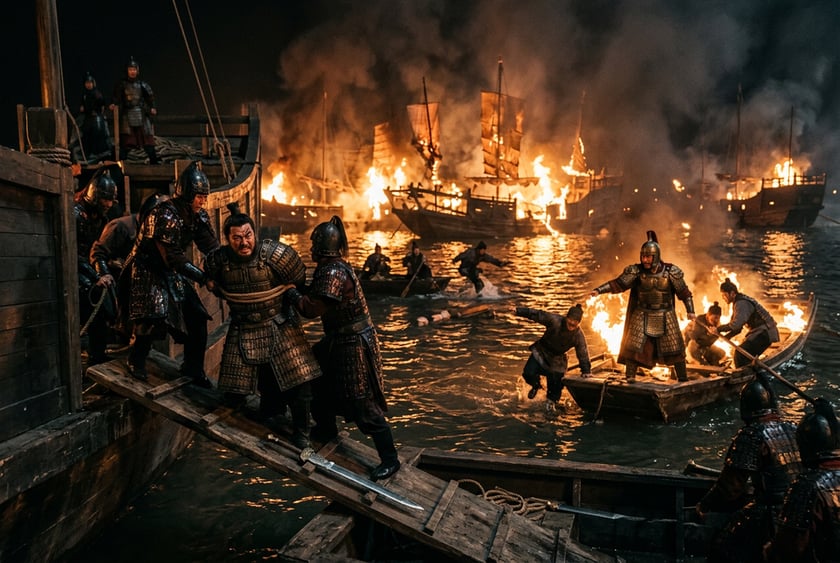
Strategic Background
The standoff at the Wuzhang Plains was the final act of Zhuge Liang's Northern Expeditions. Having learned from the setbacks of earlier campaigns caused by supply lines and terrain, Shu Han this time chose to come out of the Qinling Mountains by way of the Xie Valley and take up position on the Wuzhang Plains at Wugong, pressing the front to the southern bank of the Wei River and closing in on the heartland of Guanzhong [c:16104]. Zhuge Liang knew well the fundamental difficulty of hauling grain over the Shu roads, so he abandoned the idea of a quick battle and divided his forces to farm the land along the Wei's banks, intercropping with the local inhabitants, seeking to establish a forward base capable of garrisoning troops for the long term [c:16104]. Strategically, this was an attempt to trade "long-term encampment" for opportunity: so long as he could take root in Guanzhong, the Wei army's advantage of terrain would be gradually offset. At the same time, Zhuge Liang sent envoys to contact Eastern Wu, hoping Sun Quan would attack Wei simultaneously to form a pincer from east and west; unfortunately the Wu army was repulsed in the direction of Hefei and returned empty-handed, and Shu Han lost its only strategic coordination [c:16116].
Dispositions of the Two Sides
The core of Sima Yi's disposition was "not to fight." Emperor Ming of Wei had long since set the policy of holding fast behind fortifications and waiting at ease for the exhausted enemy, judging that once the Shu army's grain ran out it would withdraw of its own accord without a battle [c:16099]. Guo Huai's judgment was especially crucial: he foresaw that Zhuge Liang would surely contest Beiyuan north of the Wei to cut off the Long road, and advocated occupying it first; having adopted this, Sima Yi indeed frustrated the Shu army's bid for Beiyuan [c:16102]. On the Shu side, Zhuge Liang stabilized his position by relying on the farm colonies, with generals such as Jiang Wei attending the central army and Wei Yan bearing the heavy charge of vanguard and rearguard. It is worth noting that the Wei camp was not monolithic—its generals' urge to fight ran strong, and Sima Yi had to submit a memorial "requesting battle," whereupon the Emperor sent Xin Pi bearing the staff of authority to suppress them; this performance was in essence borrowing the imperial command to quell his own restless generals [c:16101].
Key Decision Point
The deciding move of the whole standoff lay not in battlefield slaughter but in "who would lose composure first." Zhuge Liang challenged repeatedly, even provoking Sima Yi with a gift of women's headdresses, yet none of it could shake Sima Yi's patience [c:16099]. Jiang Wei once worried that Xin Pi's bearing the staff meant the Wei army would never come out, but Zhuge Liang saw straight through it: Sima Yi had no intention of fighting in the first place, and the so-called request for battle was merely a posture put on for his subordinates [c:16104]. This judgment was precise, yet it also highlighted the Shu army's predicament—the opponent had committed to the formula of "stalling," and no matter how many ingenious schemes the Shu army devised, it could find no opening for a decisive battle. The most fatal variable arose in Zhuge Liang himself: his long habit of attending to everything personally—"reviewing in person every punishment of twenty strokes or more"—together with the pressure of grain transport and the anxiety of finding no chance to fight, burned him out over the hundred-odd days of confrontation [c:16101]. The commander's health became the true valve that broke this Northern Expedition.
Outcome and Resonance
That eighth month, Zhuge Liang died of illness in camp, at the age of fifty-four [c:16104]. The Shu army kept his death secret and withdrew slowly in good order; when Sima Yi heard and gave chase, Jiang Wei frightened him off by reversing the banners and sounding the drums in a feigned counterattack, giving rise to the folk saying "A dead Zhuge routs a living Zhongda," to which Sima Yi mocked himself, "I can reckon the living but not the dead" [c:16104]. The withdrawal did not end peacefully: Wei Yan, the General Who Conquers the West, and Yang Yi, Chief Clerk to the Chancellor, had long nursed mutual grievances, and broke utterly over the order of the retreat, each submitting memorials accusing the other of treason; in the end Wei Yan was defeated, pursued and beheaded by Ma Dai, and his three clans exterminated [c:16105]. This internal strife exposed the fragility of Shu Han's power transition after Zhuge Liang's death; fortunately Wang Ping, Jiang Wan, Fei Yi, and others steadied the situation—with Wu Yi commanding Hanzhong and Jiang Wan taking overall charge of state affairs—and the regime did not collapse [c:16103]. Over a longer span, the Wuzhang Plains was both the end point for Zhuge Liang and the starting point for the establishment of Sima Yi's prestige.
Counterfactual Speculation
Had Zhuge Liang not died of illness in this campaign, could Shu Han have broken the deadlock? The answer is likely still not optimistic. Sima Yi's fortification strategy had Emperor Ming of Wei's full backing, and Wei held the upper hand in national strength, grain stores, and terrain; even with farm colonies, the Shu army could hardly sustain an expeditionary force in Guanzhong for the long term [c:16099]. Once Eastern Wu's coordination failed, Shu Han's structural disadvantage of a single-line offensive was beyond remedy [c:16116]. The more realistic projection is that even had Zhuge Liang lived several more years, the best result would have been to consolidate the farm colonies south of the Wei and continue the war of attrition, not to take Chang'an. What truly changed history was rather the Wei Yan–Yang Yi strife touched off by his early death—it laid bare ahead of time Shu Han's latent danger of "the policy dying with the man," and made it all the harder for Jiang Wei, taking up the Northern Expeditions later, to muster anything like Zhuge Liang's overarching authority.