Background
In the spring of the sixth year of Jianxing (228), Zhuge Liang launched the first northern expedition, dividing forces to take the three commanderies of Longright, while Wei Emperor Ming personally went to Changan to supervise the war. The campaign's jugular was Jieting — the supply and retreat route through which the Han army, having crossed the Qinling Mountains, could reach the Guanzhong basin. In selecting a commander to hold it, Zhuge Liang bypassed the veteran generals Wei Yan and Wu Yi and gave the extraordinary appointment to his staff officer Ma Su, requiring him to sign a military oath. This choice was already well outside the norms of standard military assignment: the northern expedition was an all-in gamble on Shuhan's national strength and talent pool, and entrusting the strategic chokepoint to a staff officer who had never led independently reflected both Zhuge Liang's preference for Ma Su's strategic acumen and exposed the thinness of Shuhan's pool of frontline commanders. Once Jieting was lost, every advance the Shu forces had made in Longright instantly lost its strategic anchor, and they were compelled to withdraw entirely back to Hanzhong; the reason Zhanmasu became a "political event" rather than a simple application of military law was precisely that it had to account for this national-level failure.
Key Figures
Ma Su is the center of the event. He came from the Ma clan of Jingxiang, was on intimate terms with Zhuge Liang, served long as a military staff officer, had in the southern campaign proposed the strategy of "conquest of hearts is paramount," and was the most prized young strategist in Zhuge Liang's staff. Jiang Wan at this time was still serving as a staff officer, but subsequently rose successively to Chief Clerk of the Prime Minister's Headquarters and Grand Commander — he was the second-generation core statesman of Shuhan: his rush from Chengdu to the command gate to plead for Ma Su's life was born partly of personal friendship, but more broadly represented the rear civil-official group's anxiety over the scarcity of talent. Wang Ping, as the deputy commander who during the Battle of Jieting held his own formation in its fortified position near the water and ultimately withdrew with his forces intact, stands in sharp contrast to Ma Su; after the battle he was promoted to staff officer, placed in command of five units and concurrently in charge of camp affairs — he was the greatest beneficiary of this act of military discipline. Liu Chan, though not at the front lines, was the final issuer of the disciplinary order; Zhuge Liang first petitioned to demote himself to General of the Right, then memorialized the throne for Ma Su's execution — the entire process drew the boundaries between ruler and minister with meticulous care on paper.
Core Issue
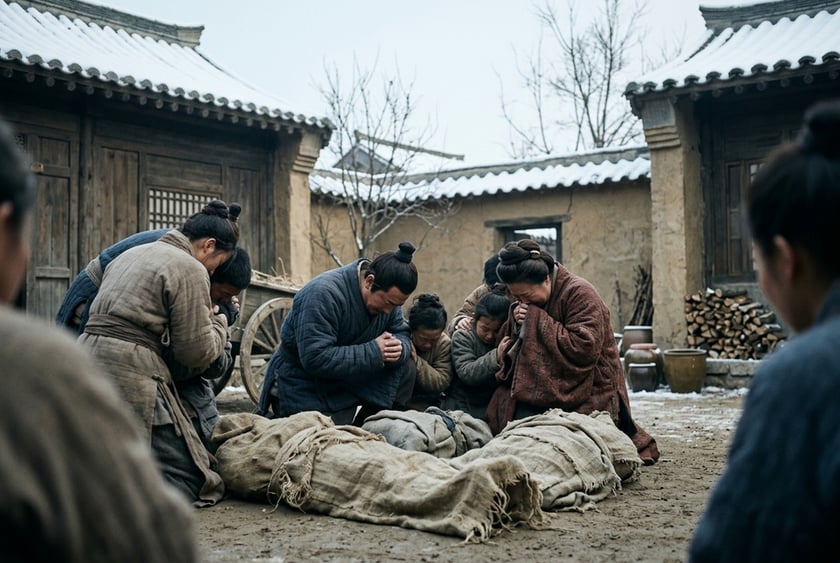
The issue has three layers. The outermost is military law: the question Zhuge Liang had to answer was — could an expeditionary army supported by professional military administrators, after its commanding general had been openly disobeyed in a way that produced a national-level failure, still maintain the possibility of continuing the northern expeditions? Kong Ming's response to Jiang Wan drew upon Sun Wu's precedent of establishing clear law, declaring that "when the four directions are in conflict and armies have only just begun to clash" the law absolutely cannot be abandoned. The middle layer is the responsibility for personnel selection: after weeping and executing Ma Su, Zhuge Liang wept and openly confessed that he had failed to heed Liu Bei's parting words at Baidicheng — this was a political ceremony in which the Prime Minister publicly assumed responsibility before the late emperor and before the state for his error in judging men. The innermost layer is the question of direction: could the northern expedition still continue? Zhuge Liang, through severe punishment to establish authority, self-demotion by three ranks to make amends to all under heaven, and immediate military reorganization, defined the defeat at Jieting as "an isolated failure at the execution level" rather than "an error of strategic direction," thereby preserving the political authorization for the subsequent five expeditions to Qishan.
Political Consequences
First, Shuhan established a far more rigid military discipline tradition than in Liu Bei's time: in the subsequent campaigns of Jiang Wei, Shu forces were still able to maintain formation even in defeat — a lineage continuous with the military discipline overhaul after Jieting. Second, Jiang Wan, having failed in his plea, entered Zhuge Liang's field of vision, and was thereafter designated as Kong Ming's chosen successor, reflecting Zhuge Liang's preference for civil officials who "dare to remonstrate yet know limits." Third, the internal power structure of the Jingxiang faction was reshaped: the Ma clan's standing at court dropped sharply, while the group represented by Wang Ping — "Yi Zhou locals and surrendered generals" — rose accordingly, a key shift in the late Shuhan political map. Fourth, on the external-image front, Zhuge Liang's simultaneous move of "self-demotion plus executing a general" answered the Wei side's propaganda offensive regarding the failed northern expedition, leaving Shuhan with the image of an opponent that "enforces orders with strict law" even at the enemy court.
Counterfactual Analysis
Had Zhuge Liang not executed Ma Su but merely demoted him, the most direct cost would have been rendering the military oath system a dead letter: any later general assigned an independent task could cite this precedent in self-defense, and the command chain of Shuhan's northern expeditions would rapidly have lost rigidity. Had Jiang Wan's plea simultaneously been accepted and Ma Su retained as a staff officer, subsequent military and political personnel affairs might have festered repeatedly around "the Ma Su case" — the political posture in which Zhuge Liang in the novel openly declared "I deeply regret my own lack of discernment" could not have unfolded, and the entire legitimacy of the northern expedition enterprise would have been weakened accordingly. Another counterfactual is Zhuge Liang having used Wei Yan or Wu Yi at Jieting from the outset: according to the novel's account, Jieting might not have been lost, and the Shu forces might have held Longright in prolonged stalemate against Wei forces, but this runs contrary to Zhuge Liang's consistent style of "valuing seniority, being cautious with veteran generals" in managing his army, and would have altered Shuhan's internal power balance — a fork in the road history did not take.