Historical Record
Hua Tuo, styled Yuanhua, was a native of Qiao county in the Pei state, also known as Fu. In his early years he traveled to Xu Province for study and was versed in several classics. He was recommended as Filial and Incorrupt by Chen Gui, the Chancellor of Pei, and summoned by the Grand Commandant Huang Wan, but he declined both posts. Hua Tuo was skilled in the arts of nurturing life, and people of his time believed that, though nearly a hundred years old, his appearance remained youthful. He was especially expert in medicines: when treating illnesses, he compounded no more than a few ingredients, gauging the dosage by experience; once boiled, the medicine was ready to take, and he would explain in detail the cautions to observe, after which the patient would often recover at once. If moxibustion was needed, he took only one or two acupoints, no more than seven or eight cones each, and the symptoms would vanish. If needling was needed, he likewise took only one or two points, telling the patient on inserting the needle where the sensation would reach; when the patient said it had arrived, he at once withdrew the needle, and the affliction would ease.
Hua Tuo's medical skill was superb. For ailments of internal accumulation that needle and medicine could not reach, he would first have the patient drink mafeisan (an anesthetic powder), so that the patient lost consciousness as if drunk to death, and then perform abdominal surgery. If the lesion was in the intestines, he would sever the intestine, wash it, then suture the abdomen and apply ointment. In four or five days the patient would recover, feeling no pain, and within a month would be completely well.
He once diagnosed the wife of the Chancellor of Ganling, finding that she was six months pregnant with abdominal pain and unrest, the pulse showing that the fetus had died. By feeling with his hand he judged the fetus's position and prescribed medicine to expel the dead fetus. For the county clerk Yin Shi, who suffered restlessness of the limbs, dry mouth, and difficult urination, Hua Tuo predicted that if he ate hot food and did not sweat, he would surely die within three days, and accurately foretold that before his death he would weep and expire. He also treated the headache and fever of the prefectural clerks Er Xun and Li Yan; though their symptoms were the same, Hua Tuo, judging by the difference in their constitutions, used purging for one and sweating for the other, and the next day both recovered.
Hua Tuo's diagnostic powers were also astonishing. He once foretold that Yan Xin of Yandu had an acute illness and urged him not to drink much wine; on his way home Yan Xin grew dizzy and fell from his carriage, dying that very night. After the Inspector of Posts Dun Zixian had recovered from an illness, Hua Tuo took his pulse and warned him not to exert himself or have intercourse, lest he die and protrude his tongue several inches; Dun Zixian did not heed the warning, and three days later died just as Hua Tuo had said. The army clerk Xu Yi, whose liver had been mistakenly needled and who thereupon developed a cough, was told by Hua Tuo that his appetite would decline daily and he would be beyond saving in five days—which likewise came to pass.
Hua Tuo was not only superb in medicine but keen in observation. He once met on the road a patient whose throat was blocked so that he could not swallow food; hearing his groans, Hua Tuo told him to drink the garlic paste and vinegar sold by a roadside cake-seller. The patient did so, vomited up a snake, and recovered. He treated Chen Deng, Grand Administrator of Guangling, for chest oppression, a flushed face, and inability to eat, diagnosing worms in the stomach; after drinking a decoction Chen Deng vomited several sheng of living worms and recovered. Hua Tuo foretold that the illness would recur in three years and that without a good physician it could not be cured; sure enough, three years later Chen Deng fell ill again and died.
Cao Cao heard of his fame and summoned Hua Tuo to his residence, where he constantly attended at his side. Cao Cao suffered from "head wind"; whenever it struck, his mind grew confused and his eyes dizzy, but when Hua Tuo needled the Geshu acupoint, it was cured at his hand. The wife of General Li, having lost a fetus in pregnancy that had not been expelled, was diagnosed by Hua Tuo, who correctly judged that a dead fetus remained in her belly; with decoction and needling he caused it to be expelled.
Yet, though Hua Tuo's skill was lofty, he often regretted taking medicine as his profession. When Cao Cao fell gravely ill, he had Hua Tuo treat him exclusively. Hua Tuo held that Cao Cao's illness was hard to cure at the root and could only be relieved over a long course of treatment. Longing for his home, Hua Tuo asked for leave on the pretext that his wife was ill, and repeatedly delayed his return. Cao Cao wrote again and again to urge him, and ordered the commanderies and counties to send him back. Relying on his talent and disdainful of others, Hua Tuo still refused to set out. Cao Cao flew into a rage and sent men to investigate: if his wife were truly ill, he was to be granted forty hu of small beans and an extension of his leave; if he were feigning illness, he was to be arrested and sent to the prison at Xu. Hua Tuo was arrested and imprisoned. Xun Yu once pleaded for him, holding that his medical skill was superb and bore upon human lives and that he should be pardoned. But Cao Cao said: "Need we fear that the world lacks such rats?" and had Hua Tuo tortured to death. Before his death Hua Tuo handed a scroll of medical writings to a jailer, saying "This can save lives," but the jailer, fearing the law, dared not accept it, and Hua Tuo burned it. After Hua Tuo's death Cao Cao's head wind still went uncured, and he sighed: "Hua Tuo could have cured my illness; he only wished to use it to make himself important. Had I not killed him, he would not have rooted out my malady." Later, when his beloved son Cao Chong fell gravely ill and died, Cao Cao was filled with remorse, lamenting: "I regret killing Hua Tuo, for it caused my son to die in vain."
Hua Tuo's disciples Wu Pu of Guangling and Fan A of Pengcheng both learned medicine from him. Wu Pu, following Hua Tuo's teaching, cured many people. Hua Tuo once taught Wu Pu: "The human body needs labor, but it must not be overworked. Movement makes the grain-essence dissolve, the blood and vessels flow freely, so that illness cannot arise—just as a door-hinge does not rot. The immortals of old likewise sought longevity through the art of guiding the breath (daoyin): stretching the neck like a bear, looking back like an owl, pulling and stretching the waist and body, moving the joints. I have a guiding exercise called the 'Five Animal Frolics,' comprising the movements of the tiger, deer, bear, ape, and bird; it too can dispel illness and strengthen the body and benefit the hands and feet. When the body is unwell, perform one set of the Five Animal Frolics; after sweating, apply powder, and the body will feel light and the belly will desire food." Wu Pu practiced accordingly, lived past ninety with keen ears and eyes and sound teeth. Fan A excelled at acupuncture; he could break the taboo, held by physicians, against deep needling between the back and the chest and abdomen, needling the back one or two cun and the chest and abdomen five or six cun, and the illnesses all healed. Fan A once sought from Hua Tuo a formula to take for prolonging life, and Hua Tuo imparted to him the recipe for the "lacquer-leaf and bluish-sticky powder"; taking it according to the formula, Fan A lived to over a hundred years.
In the Novel
In Romance of the Three Kingdoms, Hua Tuo's image is further mythologized, his medical art rendered yet more miraculous and brought into contact with many important historical figures.
His first appearance comes after Sun Ce is wounded by an assassin. Wounded by an arrow, Sun Ce urgently sought Hua Tuo for treatment. Hua Tuo had treated Zhou Tai's arrow wound, healing him in just one month with medicine. However, when Sun Ce himself was wounded, Hua Tuo had already gone to the Central Plains, and only his disciple was in the Wu region. After diagnosis, the disciple pointed out that the arrow's poison had entered the bone and that Sun Ce needed a hundred days of quiet rest, and that if rage agitated him the wound would be hard to treat. This differs from the historical account, in which Sun Ce died when his wound flared up and Hua Tuo could not treat him in time; in the novel, through Hua Tuo's absence and the disciple's diagnosis, his irreplaceable skill is conveyed from the side.
Hua Tuo's most famous deed is the scraping of the bone to cure the poison for Guan Yu. While attacking Fancheng, Guan Yu was struck in the right arm by a poisoned arrow, the poison having entered the bone. Hearing that Guan Yu had been struck by a poisoned arrow, Hua Tuo came specially from Jiangdong to treat him. After diagnosis he pointed out that the arrow's poison had reached the bone and that if not treated early the arm would be ruined. Guan Yu boldly declared that he did not fear pain, and Hua Tuo proposed setting up a post in a quiet place, threading the arm through it, covering the head, then cutting open the flesh with a sharp knife, scraping the poison from the bone, applying medicine and suturing. Guan Yu laughed that it was so easy as to need no post or ring; he simply held a banquet and drank, playing weiqi with Ma Liang, and amid laughter and talk let Hua Tuo scrape the bone. As Hua Tuo scraped the bone with his knife, the bone already showed a bluish color, and the sound of the scraping rasped audibly; bystanders all covered their faces and paled, while Guan Yu, his color unchanged, drank wine and played his game. When Hua Tuo had scraped away all the poison, applied medicine, and sutured, Guan Yu rose with a great laugh and praised Hua Tuo as a divine physician. Hua Tuo too marveled that in all his life of practice he had never seen so divinely brave a man. This episode greatly heightens Guan Yu's heroic spirit and further accentuates the marvel of Hua Tuo's skill, though there is no record in the histories of Hua Tuo scraping the bone for Guan Yu.
After curing Guan Yu, Hua Tuo was offered a hundred taels of gold in thanks, but he firmly declined, saying that he had come specially to treat him out of admiration for his lofty righteousness and sought no reward. This shapes the image of Hua Tuo as a man of noble integrity and benevolent physician's heart.
Hua Tuo's tragic end is also depicted in detail in the novel. When Cao Cao's head wind flared up, he summoned Hua Tuo to treat him. After diagnosis, Hua Tuo proposed that Cao Cao drink mafei decoction and then have his skull split open with a sharp axe to remove the "wind-phlegm" and so root out the malady. On hearing this, Cao Cao flew into a rage, holding that Hua Tuo meant to seize the chance to kill him, no different from Ji Ping, and had him imprisoned and tortured. Jia Xu once remonstrated, saying that Hua Tuo was a fine physician rarely seen in the world and should not be cast aside. But Cao Cao would not listen, and in the end had Hua Tuo tortured to death. In prison Hua Tuo passed the Qingnang Book (Blue-Bag medical text) to the jailer Wu Yayu, hoping he would carry on the art of medicine. However, Wu Yayu's wife held that learning medicine would only end in prison and disaster, and burned the Qingnang Book, leaving only a tattered page or two, so that Hua Tuo's peerless medical art could not be fully transmitted to the world. The novel's depiction of Hua Tuo's death not only highlights Cao Cao's cruelty and suspicion but also adds a layer of mystery and regret to Hua Tuo's medical art.
Key Relationships
* Cao Cao (serves, victim of misjudgment): The histories record that Cao Cao suffered from head wind, that Hua Tuo constantly attended him and needled the Geshu acupoint to cure it at his hand; yet, because Hua Tuo longed for home and feigned that his wife was ill, and would not come despite repeated summons, Cao Cao in the end flew into a rage, had him arrested and imprisoned, and tortured him to death. In the novel, Hua Tuo proposed opening Cao Cao's skull to treat the head wind, and Cao Cao, suspecting that he was in league with Guan Yu to harm him, had him imprisoned and killed. Cao Cao later regretted killing Hua Tuo, especially after his beloved son Cao Chong died of illness.
* Zhou Tai (witnesses): In the novel, Hua Tuo once treated Zhou Tai, a senior general under Sun Ce, for an arrow wound, healing him in a month, to Sun Ce's great delight. There is no such record in the histories.
* Sun Ce (mentor_of): In the novel, after Sun Ce was wounded he sent men to seek out Hua Tuo for treatment, but Hua Tuo had already gone to the Central Plains and could not save him. In the histories, Sun Ce died when his wound flared up, and Hua Tuo could not treat him in time.
* Guan Yu (friend_of): In the novel, Hua Tuo scraped the bone to cure the poison for Guan Yu; Guan Yu deeply admired his skill and character, and Hua Tuo likewise marveled at Guan Yu's heroic spirit. There is no such record in the histories (unique to the novel).
* Wu Pu and Fan A (disciples): The histories record that Wu Pu and Fan A were Hua Tuo's disciples, who respectively learned the art of guiding the breath and the art of acupuncture, carried on his medicine and life-nurturing way, and both attained longevity.
* Xun Yu (intercessor): The histories record that Xun Yu once pleaded for Hua Tuo, holding that his skill was superb and bore upon human lives and that he should be pardoned, but Cao Cao would not listen.
* Wu Yayu (inheritor of medical knowledge): In the novel, Hua Tuo in prison passed the Qingnang Book to the jailer Wu Yayu, but because Wu Yayu's wife burned the book it could not be fully transmitted (unique to the novel).
Signature Scenes
* Abdominal surgery with mafeisan: Hua Tuo was expert in surgery; for ailments of internal accumulation he would first have the patient drink mafeisan to lose consciousness, then perform abdominal surgery, excising the lesion, washing the intestines, and suturing the abdomen, so that the patient recovered in four or five days. This is the signature embodiment of his superb, age-defying medical skill.
* Treating Chen Deng's worm illness: Chen Deng, Grand Administrator of Guangling, suffered chest oppression, a flushed face, and inability to eat; Hua Tuo diagnosed worms in the stomach, and after a decoction Chen Deng vomited several sheng of living worms and recovered. Hua Tuo also foretold that the illness would recur in three years, which proved accurate. This shows Hua Tuo's precise diagnosis and powers of prognosis.
* Needling Cao Cao's head wind: Cao Cao suffered from head wind; whenever it struck, his mind grew confused and his eyes dizzy, but when Hua Tuo needled the Geshu acupoint it was cured at his hand. This embodies Hua Tuo's distinctive treatment of stubborn ailments and its immediate effect.
* Scraping the bone to cure the poison: In the novel, Guan Yu was struck in the right arm by a poisoned arrow, the poison reaching the bone. Amid Guan Yu's laughter and game of weiqi, Hua Tuo scraped the bone to remove the poison, applied medicine and sutured, and Guan Yu's arm at once recovered as before. This scene greatly shapes both Guan Yu's heroic image and Hua Tuo's image as a divine physician (unique to the novel).
* Imparting the Five Animal Frolics: Hua Tuo taught his disciple Wu Pu the "Five Animal Frolics" guiding exercise, which, by imitating the movements of the tiger, deer, bear, ape, and bird, sought to dispel illness, strengthen the body, and prolong life. This reflects Hua Tuo's emphasis on the way of nurturing life and his innovation in traditional medicine.
* The burning of the Qingnang Book: In the novel, Hua Tuo in prison passed the Qingnang Book, the learning of his whole life, to the jailer Wu Yayu, only for it to be burned by Wu Yayu's wife, leaving but a tattered page or two, so that his peerless medical art could not be fully transmitted. This tragic ending is both a portrait of Hua Tuo's personal fate and a source of endless regret and imagination for later ages (unique to the novel).
Portrait file
Character profile
- Appearance
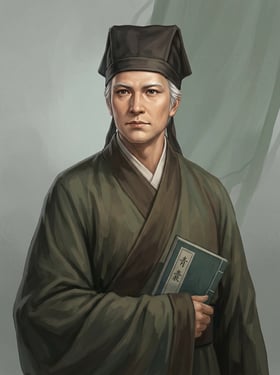
- Hua Tuo had a youthful face and crane-white hair, with an air of one who had risen above the world; he commonly wore a square headscarf and broad robes, a green satchel slung over his arm.
- Character
- He presumed upon his skill and slighted his superiors, and regretted having taken up medicine as his calling, yet he was high-minded and would not accept heavy rewards; humbly, he praised Lord Guan as "truly a heavenly god." Hua Tuo's medical art was marvelous, and when scraping the bone to cure the poison for Lord Guan, his expression did not change.
- Manner of speech
- Hua Tuo's manner of speech was concise and precise; he often diagnosed by the pulse, and pronounced his diagnoses tersely.
- Life
- Hua Tuo was a native of Qiao County in Pei State, styled Yuanhua. He once traveled to study in the region of Xu, and was versed in several classics. He was recommended as filial and incorrupt and summoned by the Grand Commandant, but declined both. Later he was summoned by Cao Cao to serve as an attending physician, and in the end, because he presumed upon his skill and shirked his duties, he was seized, imprisoned, and tortured to death.
- Anecdotes
- Hua Tuo was the founder of the Five Animal Frolics, and his medical cases number several dozen, including inducing a patient to vomit up a snake with garlic-and-leek juice, cutting a yellow sparrow from between the brows with a knife, and treating a toe with acupuncture. He once cured Zhou Tai of Eastern Wu, and passed on his art through the Book of the Green Satchel to a Wu jailer.
Relationships
12 relationships
Lord & vassal1
Friends3
Enemies1
Teacher & student3
Other3
Quotes
37 recorded lines · 3 featured
「大王頭腦疼痛,因患風而起。病根在腦袋中,風涎不能出。枉服湯藥,不可治療。某有一法:先飲麻肺湯,然後用利斧砍開腦袋,取出風涎,方可除根。」
This line displays Hua Tuo's superb medical skill and his willingness to challenge taboos, also foreshadowing his clash with Cao Cao.
「我今將死,恨有《青囊書》,未傳於世。感公厚意,無可為報;我修一書,公可遣人送與我家,取《青囊書》來贈公,以繼吾術。」
The 'Book of the Blue Bag' is a symbol of Hua Tuo's medical art; this line reflects the importance he placed on passing down medicine.
「人體欲得勞動,但不當使極爾。動搖則谷氣得消,血脈流通,病不得生,譬猶戶樞不朽是也。是以古之仙者為導引之事,熊頸鴟顧,引輓腰體,動諸關節,以求難老。吾有一術,名五禽之戲,一曰虎,二曰鹿,三曰熊,四曰猿,五曰鳥,亦以除疾,並利蹄足,以當導引。體中不快,起作一禽之戲,沾濡汗出,因上著粉,身體輕便,腹中欲食。」
This line expounds the health-preserving philosophy of the 'Five Animal Frolics,' Hua Tuo's major contribution to the study of health cultivation in traditional Chinese medicine.
Chapters5 回 ▸
- 史ch.29
- 演ch.15ch.29ch.75ch.78
Relationship timeline8 条 ▸
Inner monologues · AI-generated3 段 ▸
- My surname was Hua, my given name Tuo, and my courtesy name Yuanhua. Now the prison gates are shut tight and the lamplig
- I am Hua Tuo, courtesy name Yuanhua. In my practice, I have seen illnesses of varying severity, each calling for appropr
- My name is Fu, and my courtesy name is Yuanhua. I am from Qiao in Pei Commandery. People sometimes call me “Tuo”; names
Life events4 ▸
- 0208-01-01 · BozhouHua Tuo Teaches the Five-Animal Frolics· Instigator
- 0208-01-01 · XuchangCao Cao Has Hua Tuo Executed· Victim
- 0220-01-01 · XuchangThe Death of Hua Tuo· Victim
- 0220-01-01 · YeCao Cao Dies and Emperor Wen of Wei Ascends the Throne