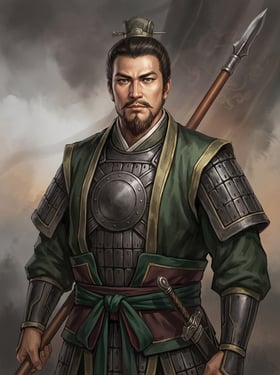
Historical Record
Zhang He, courtesy name Junyi, was a native of Mo in Hejian. At the end of the Han he answered the call to campaign against the Yellow Turbans and became a Major of the Army, later coming under Han Fu. When Han Fu was defeated, Zhang He led his troops over to Yuan Shao. Yuan Shao made Zhang He a Colonel and had him resist Gongsun Zan; after Gongsun Zan was broken, Zhang He, for his merit, was promoted to General of the Household of Ningguo c:1826.
During the Battle of Guandu, Yuan Shao sent Chunyu Qiong and others to oversee the transport of grain stationed at Wuchao, and Cao Cao personally led crack troops to attack it swiftly. Zhang He advised Yuan Shao: "Lord Cao's troops are elite; if they go, they will surely break Qiong and the others. Once Qiong and the others are broken, then, General, your cause is lost—you should hasten to lead troops to relieve them." Guo Tu, however, dissented, advising instead an attack on Cao Cao's main camp. Yuan Shao did not adopt Zhang He's plan, sending only light cavalry to relieve Qiong while using heavy forces to attack Cao Cao's camp, which they failed to take. Cao Cao indeed greatly defeated Chunyu Qiong and the others, and Yuan Shao's army collapsed c:1826. At this critical juncture, Zhang He and Gao Lan led their host over in surrender to Cao Cao c:1825.
Cao Cao was greatly pleased to gain Zhang He, comparing him to Weizi leaving Yin and Han Xin going over to Han, and appointed him Assistant General and enfeoffed him Marquis of Duting c:1828. Thereafter Zhang He repeatedly won merit: he followed Cao Cao in attacking Ye, defeated Yuan Tan at Bohai, and besieged and greatly defeated Yongnu. In the campaign against Liucheng, Zhang He and Zhang Liao were both at the army's spearhead, and for his merit he was promoted to General Who Pacifies the Di. He also separately campaigned against Donglai and chastised Guan Cheng, and joined Zhang Liao in campaigning against Chen Lan, Mei Cheng, and others, defeating them all. At the Battle of Weinan, Zhang He followed Cao Cao in greatly defeating Ma Chao and Han Sui, besieged Anding, and induced the surrender of Yang Qiu c:1828.
When Cao Cao campaigned against Zhang Lu, Zhang He first oversaw the various armies in chastising the Di king Dou Mao of Xinghe, then oversaw five thousand foot soldiers to open the road for Cao Cao. After Zhang Lu surrendered, Zhang He, with Xiahou Yuan and others, stayed to garrison Hanzhong and resist Liu Bei. Zhang He once separately oversaw the various armies, induced the surrender of the two commanderies of Badong and Baxi, and moved their people to Hanzhong. He then advanced to Dangqu, where he was resisted by Liu Bei's general Zhang Fei, and led his troops back to Nanzheng, being appointed General Who Routs Bandits c:1828.
When Liu Bei garrisoned Yangping, Zhang He garrisoned Guangshi. Liu Bei once, with more than ten thousand elite troops divided into ten units, made a night raid on Zhang He; Zhang He led his personal troops in fierce battle, and Liu Bei could not overcome him. After Xiahou Yuan fell in battle, the whole army lost color, and Xiahou Yuan's Major Guo Huai raised Zhang He as commander of the army. Zhang He came forth, marshaled the troops and steadied the ranks, and all the generals received his direction, so that the men's hearts were settled. When Cao Cao heard of it, he sent an envoy granting Zhang He the Staff of Authority, and himself came to Hanzhong; Liu Bei held to the high mountains and dared not give battle, so Cao Cao thereupon led the armies out of Hanzhong, and Zhang He returned to garrison Chencang c:1828.
After Cao Pi, Emperor Wen of Wei, ascended the kingly position, he made Zhang He General of the Left and advanced his rank to Marquis of Duxiang; after Cao Pi took the throne, he was further enfeoffed Marquis of Mo. Zhang He once joined Cao Zhen in campaigning against the Lushui Hu of Anding and the Eastern Qiang, and joined Xiahou Shang in attacking Jiangling, separately overseeing the various armies in crossing the river and taking the fortified camps on the islets c:1838. After Cao Rui, Emperor Ming, took the throne, Zhang He garrisoned in the south at Jing Province, and with Lord Sima (Sima Yi) attacked Sun Quan's separate general Liu A and others, pursuing them to Qikou and greatly defeating them c:1838.
When Zhuge Liang came out at Mount Qi, Zhang He was advanced in rank to Specially Advanced and sent to oversee the various armies in resisting Zhuge Liang's general Ma Su at Jieting. Ma Su relied on the cover of the southern mountain instead of holding the city below; Zhang He cut off his water supply and greatly defeated him. The three commanderies of Nan'an, Tianshui, and Anding, which had rebelled because of Zhuge Liang, were all broken and pacified by Zhang He. Cao Rui issued an edict commending Zhang He's merit, increasing his fief by a thousand households for a total of four thousand three hundred households with what he had before c:1838.
When Lord Sima trained a naval force at Jing Province, intending to campaign against Wu, an edict had Zhang He oversee the armies of Guanzhong to go and receive his direction. On reaching Jing Province, it happened that the winter waters were shallow and the great ships could not move, so they returned to garrison Fangcheng. When Zhuge Liang came out again and urgently attacked Chencang, Cao Rui summoned Zhang He to the capital by relay horse, held a banquet to see him off, and sent thirty thousand soldiers of the southern and northern armies, along with the Military Guards and Tiger Guards, to escort Zhang He. Zhang He reckoned that Zhuge Liang's army, far from base and without grain, could not attack for long, and said Zhuge Liang must already have withdrawn. Indeed it was so: when Zhang He pressed on day and night to Nanzheng, Zhuge Liang had already pulled back his troops c:1838.
When Zhuge Liang again came out at Mount Qi, Zhang He oversaw the generals westward to Lüeyang; Zhuge Liang fell back to hold Mount Qi, and Zhang He pursued to Mumen, where he gave battle to Zhuge Liang's army and was struck in the right knee by a flying arrow and died c:1840. His posthumous title was Marquis Zhuang. His son Zhang Xiong inherited his rank. For his meritorious campaigns over the years, Emperor Ming divided his households and enfeoffed his four sons as marquises, granting his youngest son the rank of Marquis Within the Passes c:1840.
In the Novel
In Romance of the Three Kingdoms, Zhang He's image is further literary-ized on the basis of the historical record, especially in his surrender to Cao Cao and his clashes with the Shu Han generals, where much dramatic color is added.
At the Battle of Guandu, Zhang He, as a great general under Yuan Shao, sallied forth together with Gao Lan, and once fought in single combat with generals such as Zhang Liao, Xu Chu, and Gao Lan, so that Cao Cao, watching, secretly marveled c:1842. After Wuchao was raided, Guo Tu advised Yuan Shao to attack Cao Cao's main camp, while Zhang He strongly urged relieving Wuchao, holding that "Cao Cao is full of stratagems; on going out he will surely make inner preparations to guard against the unexpected. Now if we attack Cao's camp and fail to take it, and Qiong and the others are captured, we will all be made prisoners" c:10683. Yuan Shao did not heed Zhang He's words but adopted Guo Tu's plan instead, sending Zhang He and Gao Lan to attack Cao's camp and Jiang Qi to relieve Wuchao. As a result Jiang Qi's troops were defeated and Wuchao fell. To cover his own fault, Guo Tu falsely accused Zhang He and Gao Lan of being "surely glad in their hearts to see the lord's army defeated," and said the two "have long had the intent to surrender to Cao, and on being sent to attack the camp deliberately would not exert themselves, so that troops were lost" c:5395. Yuan Shao flew into a rage and intended to kill the two. When Gao Lan heard of it, he drew his sword and cut down the messenger, and urged Zhang He to surrender to Cao Cao together. Zhang He likewise had this intent, so the two led their own troops over in surrender to Cao Cao c:5395. Cao Cao welcomed the surrender of the two, calling it "like Weizi leaving Yin and Han Xin going over to Han," and enfeoffed Zhang He as Assistant General and Marquis of Duting c:5396. This differs from the historical record, in which Zhang He surrendered because Chunyu Qiong was broken; the novel adds the details of Guo Tu's slander and the voluntary surrender of Zhang He and Gao Lan, making the characters more vivid.
At the Battle of Changban, when Zhao Yun rescued Adou amid the chaotic host, Zhang He once fought more than ten bouts with Zhao Yun, and Zhao Yun, unwilling to be drawn into a prolonged fight, broke through and got away c:1843. Before the Battle of Red Cliffs, when Cao Cao appointed officers in the central tent of his naval forces, Zhang He was appointed the red banner of the front army c:5398.
His clashes with Zhang Fei are also much depicted in the novel. During the contest for Hanzhong, Zhang He once boasted to Cao Hong: "Everyone fears Zhang Fei, but I regard him as a mere child! On this expedition I will surely capture him!" c:5400 In the end, at the Battle of Dangqu, Zhang He fell for Zhang Fei's stratagem, lost troops and generals, lost all three camps, and retreated in disarray to hold Wakou Pass c:10693. Cao Hong wished to behead Zhang He but was dissuaded by Guo Huai c:1847. Zhang He then fought the veteran generals Huang Zhong and Yan Yan at Jiameng Pass, suffering repeated reverses, and was even made to capture Xiahou Shang alive by Huang Zhong (novel only; unrecorded in history) c:10704.
During Zhuge Liang's Northern Expeditions, Sima Yi was recalled by Emperor Ming of Wei and recommended Zhang He as vanguard. Sima Yi analyzed for Zhang He the characteristics of Zhuge Liang's use of troops and pointed out that Jieting was the throat of Hanzhong, intending to cut off his grain route. Zhang He bowed in admiration, saying, "The Commander's calculations are divine!" c:1849 In the end, Zhang He, pursuing the Shu army at Mumen Road, fell into an ambush and died, essentially in agreement with the historical record c:1840.
Key Relationships
* Cao Cao (defected_to): After the Battle of Guandu, because Yuan Shao did not accept his advice and Guo Tu slandered and framed him, Zhang He led his troops over in surrender to Cao Cao. Cao Cao esteemed him greatly, calling him "like Weizi leaving Yin and Han Xin going over to Han," entrusted him with heavy responsibility, and Zhang He rendered illustrious merit for Cao Wei c:5396.
* Cao Wei (fights_in): Zhang He was an important general of the Cao Wei regime, taking part in a series of major military actions including Cao Cao's unification of the north, the contest with Liu Bei for Hanzhong, and Cao Wei's resistance to Zhuge Liang's Northern Expeditions. Loyal and devoted, he repeatedly rendered extraordinary merit, and was an important military pillar of Cao Wei in its later period c:1828.
* Zhuge Liang (fights_in): During Zhuge Liang's Northern Expeditions, Zhang He clashed many times with the Shu Han army. Especially at the Battle of Jieting, Zhang He greatly defeated Ma Su, causing Zhuge Liang's first Northern Expedition to return without success, displaying his outstanding military talent c:1838. In the end, it was while pursuing Zhuge Liang that Zhang He fell into an ambush and died c:1840.
* Yuan Shao's Faction (serves): In his early years Zhang He served Yuan Shao, rendering merit in campaigning against Gongsun Zan for him. But at the Battle of Guandu, because Yuan Shao would not heed his good counsel and the internal strategist Guo Tu slandered him, he finally chose to leave Yuan Shao and go over to Cao Cao c:1826.
* Zhang Fei (fights_in): During the contest for Hanzhong, Zhang He clashed with Zhang Fei several times. In the novel, Zhang He once made light of Zhang Fei and was defeated by an ambush Zhang Fei set at the Battle of Dangqu, losing troops and generals c:5400 c:10693. In history, Zhang He was resisted by Zhang Fei at Dangqu and led his troops back to Nanzheng c:1828.
* Xiahou Yuan (colleague): Zhang He garrisoned Hanzhong together with Xiahou Yuan, jointly resisting Liu Bei. After Xiahou Yuan fell in battle, Zhang He was raised by Guo Huai as commander of the army and steadied the men's hearts c:1828.
* Sima Yi (commander): In the later period of Zhuge Liang's Northern Expeditions, Zhang He came under Sima Yi's command and served as vanguard. Sima Yi greatly relied on Zhang He's military talent and once analyzed for him Zhuge Liang's strategy in using troops c:1849.
Iconic Scenes
* Surrender at Guandu: At the Battle of Guandu, Yuan Shao would not heed Zhang He's advice to relieve Wuchao and instead believed Guo Tu's slander, leaving Zhang He and Gao Lan facing the prospect of being charged with crimes. In the end, Zhang He and Gao Lan led their troops over in surrender to Cao Cao, and Cao Cao, greatly pleased, called them "like Weizi leaving Yin and Han Xin going over to Han" c:5396. This event marks the turning point of Zhang He's military career and laid an important foundation for Cao Cao's eventual defeat of Yuan Shao.
* Greatly defeating Ma Su at Jieting: During Zhuge Liang's first Northern Expedition, Ma Su was sent to hold Jieting. Zhang He was ordered to go and engage him; he saw through Ma Su's error of encamping on the mountain, cut off his water supply, and finally greatly defeated him, causing Zhuge Liang's Northern Expedition to fail and the three commanderies to be pacified again c:1838. This battle fully displayed Zhang He's military talent for "judging the situation of battle and the lie of the land."
* Reverse at Dangqu (novel only): During the contest for Hanzhong, Zhang He made light of Zhang Fei, boasting "I regard him as a mere child!" c:5400 As a result, at the Battle of Dangqu, Zhang He fell for the empty-camp stratagem Zhang Fei set, suffered heavy losses, lost all three camps, and fled in disarray. Though fictional, this episode vividly depicts how Zhang He, facing an opponent both wise and brave, could at times suffer reverses through underestimating the enemy c:10693.
* Ambush at Mumen Road: During Zhuge Liang's fourth Northern Expedition, Zhang He was ordered to pursue the withdrawing Shu army. At Mumen Road, Zhang He fell into an ambush set by Zhuge Liang and was struck in the right knee by a volley of arrows and died c:1840. This end was both the fate of a veteran of the battlefield and a side-light setting off Zhuge Liang's resourcefulness. Sima Yi had once dissuaded Zhang He from the pursuit, but Zhang He would not listen, finally leading to his death (recorded in the Weilüe, not the official history) c:1840.
* Steadying the army's morale after Xiahou Yuan's death: At the Battle of Hanzhong, Xiahou Yuan fell in battle and the whole Cao Wei host was shaken with dread. Xiahou Yuan's Major Guo Huai decided on the instant to raise Zhang He as commander of the army. Zhang He came forth to marshal the troops and steady the ranks, and all the generals received his direction, swiftly settling the men's hearts and averting a greater rout c:1828. This reflects Zhang He's prestige in the army and his composed leadership in the face of crisis.
Portrait file
Character profile
- Character
- Zhang He understood the shifts of circumstance, was skilled at arranging camps and formations, and could reckon the momentum of battle and the lay of the terrain; though a military man, he loved and delighted in Confucian scholars, and judged the enemy with clear discernment. Brave and ready to fight, fierce and unbending, he could weigh the times and turn to a worthier lord. Yet at times he also showed impatience, combativeness, and obstinacy—even a hot temper and a self-regard for his own loyalty and duty.
- Manner of speech
- Zhang He spoke in decisive terms, often opening his arguments with judgments such as 'my lord's troops are elite,' 'Lord Cao's camp is secure,' or 'a renowned general of the state,' and frequently using the word 'surely' in his reckonings. In the Romance he at times raged and hurled insults, volunteering for battle with 'I willingly accept the penalty of military law,' and at other times was cautious and steady, urging a firm defense.
- Life
- Zhang He was a native of Mo in Hejian. At the end of the Han he enlisted to fight the Yellow Turbans, then joined Yuan Shao; at the Battle of Guandu, fearing Guo Tu's slanders, he surrendered to Cao Cao. He campaigned under Cao Cao for many years, repeatedly winning merit, and rose to General of Chariots and Cavalry Who Campaigns in the West, enfeoffed as Marquis of Mo. In the end, during Zhuge Liang's northern campaigns, he died struck by a hidden crossbow bolt on the Mumen Road.
- Weapons
- The weapon Zhang He used was the spear.
- Anecdotes
- Chen Shou appraised Zhang He as 'renowned for his skillful adaptability.' At the Battle of Guandu he led his men to surrender to Cao along with Gao Lan, and afterward became a famed general of Cao Wei, holding offices such as General of the Left and General of the Right.
Relationships
53 relationships
Family1
Lord & vassal4
Friends4
Enemies18
Teacher & student1
Other21
Quotes
38 recorded lines · 3 featured
「人皆怕張飛,吾視之如小兒耳!此去必擒之!」
This line displays Zhang He's arrogance and self-confidence, a classic portrayal of his character.
「今將軍當於何處進兵?」
Before the Battle of Jieting, this question by Zhang He accentuates his military insight, a key foreshadowing for the battle.
「比臣未到,亮已走矣;屈指計亮糧不至十日。」
Recorded in the official histories, this line precisely predicts Zhuge Liang's withdrawal once his provisions ran out, reflecting his strategic vision.
Chapters31 回 ▸
- 史ch.1ch.2ch.3ch.6ch.17ch.26ch.32ch.33ch.35ch.36ch.39ch.43ch.56
- 演ch.30ch.31ch.41ch.42ch.48ch.56ch.58ch.67ch.69ch.70ch.71ch.94ch.95ch.96ch.97ch.98ch.99ch.101
Relationship timeline32 条 ▸
史 ch.1
- Cao Cao§51
defected_to
与高览闻琼破来降
史 ch.3
fights_in
右将军张郃击亮于街亭,大破之
史 ch.17
- Gongsun Zan§21
enemy_of
为袁绍校尉拒之;瓒破功多迁宁国中郎将
- Yuan Shao§21
rival_of
官渡劝绍急救乌巢;为郭图所谮,惧而归太祖
- Yuan Tan§22
enemy_of
从击于渤海
- Tadun§22
enemy_of
从讨柳城与张辽俱为军锋
- Chen Lan§22
enemy_of
与张辽讨陈兰、梅成等
- Ma Chao§22
enemy_of
渭南破之;又破马超
- Han Sui§22
enemy_of
渭南破之
- Yang Qiu§22
enemy_of
围安定降之
- Liang Xing§22
enemy_of
与夏侯渊讨鄜城贼梁兴
- Zhang Lu§22
enemy_of
太祖征张鲁,郃先督诸军讨兴和氐王窦茂
- Zhang Fei§22
enemy_of
进军宕渠,为飞所拒,引还南郑
- Liu Bei§22
enemy_of
屯广石;备以精卒万余十部夜急攻郃,郃率亲兵搏战,备不能克
- Zhuge Liang§23
enemy_of
拒亮将马谡于街亭;自亮"皆惮之";陈仓料"亮已走";亮复出督西至略阳;木门追之中飞矢右膝
- Ma Su§23
enemy_of
拒之于街亭;绝其汲道击大破之
- Zhang Xiong§25
parent_of
子;嗣
史 ch.35
- Ma Su§17
fights_in
大破马谡军于街亭
演 ch.30
fights_in
阵前对战四五十合,不分胜负
- Guo Tu§32
betrayed_by
谗害张郃以避救乌巢失策之罪
演 ch.41
- Zhao Yun§43
enemy_of
截路战十余合追逐,见红光大惊而退
演 ch.58
- Ma Chao§15
fights_in
出迎,斗二十合败走
演 ch.67
- Yang Ang§6
fights_in
阵中交手,斩杀杨昂
演 ch.70
演 ch.71
advises_in
张郃屡谏夏侯渊勿出战,渊不从致死
演 ch.95
- Sima Yi§2
serves
拜伏称"都督神算也",受计而行
fights_in
当住王平来路,战数十余合
演 ch.97
- Cao Zhen§19
serves
受曹真调度分道把守
演 ch.99
- Sima Yi§2
commands_in
为司马懿先锋;后又自请追蜀兵立军令状
enemy_of
战场对敌;张郃指孔明而骂"山野村夫"
演 ch.101
- Zhuge Liang§21
dies_in
追击蜀军中伏,死于木门道
Inner monologues · AI-generated3 段 ▸
- I am Zhang He, courtesy name Junyi. I was ordered to lead the generals west toward Lueyang. When I heard that Zhuge Lian
- When the fire broke out at Wuchao, Yuan Shao’s army was already wavering. I had long known that Cao Cao’s troops were hi
- I am Zhang He, courtesy name Junyi, a native of Hejian. The realm was already in turmoil when I was young, and fighting
Life events19 ▸
- 0200-01-01 · XuchangBattle of Guandu· Warrior
- 0201-01-01 · CangtingBattle of Cangting· Warrior
- 0201-01-01 · RangshanBattle of Rangshan· Warrior
- 0210-01-01 · Mount TianzhuBattle of Tianzhushan· Warrior
- 0210-01-01 · YeBronze Bird Terrace Inauguration Ceremony· Warrior
- 0214-01-01 · FuhanXiahou Yuan's Campaign Against Baohan· Warrior
- 0215-01-01 · LangzhongBattle of Baxi· Commander
- 0215-01-01 · HanzhongCao Cao's Campaign Against Hanzhong· Warrior
- 0215-01-01 · Yangping PassBattle of Yangping Pass· Warrior
- 0219-01-01 · Mount DingjunBattle of Mount Dingjun· Warrior
- 0219-01-01 · HanzhongHanzhong Campaign· Warrior
- 0219-01-01 · Han RiverBattle of Han River· Warrior
- 0228-01-01 · Mount QiFirst Northern Expedition· Warrior
- 0228-01-01 · JietingBattle of Jieting· Commander
- 0228-01-01 · ChencangSiege of Chencang· Warrior
- 0231-01-01 · Mumen RoadBattle of Mumendao· Killed in action
- 0231-01-01 · Mumen RoadZhang He Shot Dead at Mumendao· Killed in action
- 0231-01-01 · Mount QiZhuge Liang's Fourth Northern Expedition· Killed in action
- 0234-01-01 · Mount QiZhuge Liang's Northern Expeditions· Commander