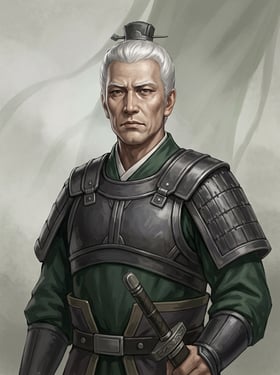
Historical Record
Yu Jin, styled Wenze, was a man of Juping in Mount Tai. During the Yellow Turban rebellion, he followed Bao Xin. When Cao Cao took charge of Yanzhou, Yu Jin and his troops submitted together and he was appointed a dubo, subordinate to the general Wang Lang. Wang Lang esteemed his ability and recommended that Yu Jin was fit to be a general-in-chief. Cao Cao summoned Yu Jin, appointed him major of the army, and sent him to lead troops against Guangwei in Xu Province; after taking it, he was appointed colonel of breaking enemy lines. He once followed Cao Cao in campaigning against Lü Bu at Puyang, and on his own broke two of Lü Bu's camps south of the city, and also defeated Gao Ya at Xuchang. In the campaigns to attack Shouzhang, Dingtao, and Lihu, and to besiege Zhang Chao at Yongqiu, Yu Jin took part and won victory in all. When following Cao Cao against the Yellow Turban Army's Liu Pi, Huang Shao, and others, Huang Shao and the rest made a night raid on Cao Cao's camp; Yu Jin led his troops to break the enemy, slew Huang Shao and the others, and took in their surrendered followers, for which he was promoted to colonel for suppressing rebels. While besieging Qiao Rui at Ku, Yu Jin slew Qiao Rui and three other generals. When the army reached Wancheng, Zhang Xiu surrendered and then rebelled; Cao Cao was defeated and his army scattered. At the critical moment, Yu Jin alone led several hundred men, fighting as he withdrew, his ranks in good order; though there were casualties, no one deserted. When the enemy pursuit slackened, Yu Jin reordered his ranks, beat the drums, and returned. On the way back to Cao Cao's camp, he met more than ten wounded soldiers fleeing naked, and learned they had been plundered by the Qing Province troops. Yu Jin was furious, holding that the Qing Province troops, who likewise belonged to Lord Cao, had committed plunder, and so he chastised them. The Qing Province troops appealed to Cao Cao on their own behalf. When Yu Jin arrived, he first set up camp and fortifications and did not at once go to see Cao Cao. Someone urged him to go and explain himself to Cao Cao quickly, but Yu Jin said: "The enemy is at our rear and may pursue at any moment; if we do not first prepare, how shall we meet them? Besides, the lord is enlightened — what use are slanderous accusations?" Only after the camp was settled did he go in to see Cao Cao and recount the matter in detail. Cao Cao was greatly pleased, praising Yu Jin for keeping strict discipline amid danger, holding his fortifications firm, and possessing an unshakable integrity that even famous generals of old could not surpass. Cao Cao therefore recorded Yu Jin's accumulated merits and enfeoffed him as Marquis of Yishou Precinct. After this, Yu Jin again followed the army to attack Zhang Xiu at Rang, captured Lü Bu at Xiapi, and together with Shi Huan and Cao Ren attacked Sui Gu at Shequan and slew him c:70.
When Cao Cao first campaigned against Yuan Shao, Yuan Shao's forces were strong, and Yu Jin volunteered to serve as the vanguard. Cao Cao admired his valor and dispatched two thousand foot soldiers, ordering Yu Jin to lead them and hold Yanjin against Yuan Shao, while Cao Cao led his army back to Guandu. When Liu Bei rebelled in Xu Province, Cao Cao campaigned east. Yuan Shao attacked Yu Jin, but Yu Jin held firm and would not retreat, and Yuan Shao could not take the position. Yu Jin then, together with Yue Jin and others, led five thousand foot and horse to break Yuan Shao's separate camps, advancing from southwest of Yanjin along the river to the two counties of Ji and Huojia, burning more than thirty gathering points, beheading and capturing several thousand, and taking the surrender of more than twenty of Yuan Shao's generals such as He Mao and Wang Mo. Cao Cao further sent Yu Jin alone to garrison Yuanwu, where he broke Yuan Shao's separate camp at Dushijin. For this Yu Jin was promoted to assistant general, and afterward returned with the army to Guandu. Cao Cao and Yuan Shao faced each other in linked camps, raising earthen hills opposite one another. Arrows from Yuan Shao's army flew into the camp, killing and wounding many of Cao Cao's soldiers, and morale wavered. Yu Jin oversaw and defended the earthen hills, fighting vigorously, and morale rose all the higher. After Yuan Shao was defeated, Yu Jin was promoted to deputy general. After Jizhou was pacified, Chang Xi rebelled again, and Cao Cao sent Yu Jin to campaign against him. Yu Jin fiercely attacked Chang Xi; Chang Xi, who was an old friend of Yu Jin, then surrendered to him. The generals all held that since Chang Xi had surrendered, he should be sent to Cao Cao, but Yu Jin said: "Do you not know the lord's standing order? Those who surrender after being besieged are not pardoned. To uphold the law and carry out orders is the duty of one who serves his lord. Though Chang Xi is an old friend, can I fail in my duty?" He personally bade Chang Xi farewell and, weeping, put him to death. At the time Cao Cao's army was at Chunyu, and on hearing of it he sighed: "That Chang Xi surrendered not to me but went to Yu Jin — is this not fate!" He therefore esteemed Yu Jin all the more. After the East Sea region was pacified, Yu Jin was appointed Tiger-Might General. Later, Yu Jin and Zang Ba and others attacked Mei Cheng, while Zhang Liao, Zhang He, and others campaigned against Chen Lan. When Yu Jin arrived, Mei Cheng surrendered with more than three thousand men. After surrendering, Mei Cheng rebelled again, and his followers went over to Chen Lan. While Zhang Liao and the rest were locked in stalemate with Chen Lan, their provisions ran short; Yu Jin continuously sent grain and fodder, and so Zhang Liao was able to slay Chen Lan. For this Yu Jin's fief was increased by two hundred households, totaling one thousand two hundred households. At that time Yu Jin, along with Zhang Liao, Yue Jin, Zhang He, and Xu Huang, were equally renowned generals; in every campaign Cao Cao made, they took turns serving as vanguard, and as rearguard on the return; Yu Jin governed his troops strictly and never kept spoils for himself, so his rewards were especially generous. Yet because he governed his army by the law, he did not greatly win the hearts of the soldiers. Cao Cao was once displeased with Zhu Ling and wished to seize his camp. Because Yu Jin's prestige was so high, Cao Cao sent Yu Jin with several dozen riders, bearing a written order, straight into Zhu Ling's camp to take command; Zhu Ling and his followers dared not resist. Cao Cao then appointed Zhu Ling as a commander under Yu Jin, and all were awed by this, showing his power to overawe. Yu Jin was afterward promoted to General of the Left, given the staff and axe of authority, with a fief of five hundred households set apart, and one of his sons enfeoffed as a marquis c:75.
In the twenty-fourth year of Jian'an (219), Cao Cao was at Chang'an and sent Cao Ren to campaign against Guan Yu at Fancheng, and also sent Yu Jin to assist Cao Ren. In autumn there was heavy rain for days on end; the Han River surged, the level ground stood several zhang deep in water, and Yu Jin's seven armies were all submerged. Yu Jin and the generals climbed to high ground to escape the flood, and Guan Yu came in great ships to attack Yu Jin and the rest. Yu Jin thereupon surrendered; only Pang De died unyielding. On hearing of it, Cao Cao lamented long, saying: "I have known Yu Jin for thirty years — who would have thought that, facing danger and hardship, he would prove inferior to Pang De!" Later Sun Quan captured Guan Yu and took Yu Jin's followers captive, and Yu Jin was thus detained in Wu. After Cao Pi ascended the throne, Sun Quan declared himself a vassal and sent Yu Jin back to Wei. When Cao Pi received Yu Jin, his hair and beard had turned all white and his appearance was haggard, and he wept and bowed his head to the ground. Cao Pi consoled him with the precedents of Xun Linfu and Meng Mingshi, and appointed him General Who Pacifies the Distant. Cao Pi wished to send Yu Jin as envoy to Wu, and first had him go to Ye to pay respects at Gaoling. Cao Pi had paintings made in the tomb chamber depicting Guan Yu victorious, Pang De furious and unyielding, and Yu Jin surrendering. When Yu Jin saw the paintings, he was overcome with shame and resentment, and so fell ill and died. His son Yu Gui inherited his title, enfeoffed as Marquis of Yishou Precinct. Yu Jin was given the posthumous title Marquis Li c:4491.
In the Novel
In the Romance of the Three Kingdoms, Yu Jin appears early; on his first appearance he is depicted as a general skilled with bow and horse and outstanding in martial arts, and Cao Cao therefore appointed him major of the army staff c:4492. In his early years he campaigned with Cao Cao, and in a clash with Liu Bei he fought several bouts with Zhang Fei before retreating c:6972. When Cao Cao attacked Lü Bu, Yu Jin proposed a night raid on Lü Bu's camp and went out to battle with the army c:6973.
The novel's depiction of Yu Jin's character emphasizes his strict governance of troops and acting according to the law, but at times also portrays him as lacking in humanity. For example, when the Qing Province troops plundered the people, Yu Jin led his troops to suppress and slay them and pacified the villagers, which accords with the historical record of his chastising the Qing Province troops c:4494. When Zhang Xiu pursued Cao Cao, Yu Jin first set up camp and then went to see Cao Cao, and repelled Zhang Xiu; the novel describes this in detail, highlighting his composure in danger and his regard for the larger situation c:6974.
The novel also adds episodes around the time of the Battle of Red Cliffs. He and Mao Jie were appointed by Cao Cao as commanders of the naval forces, replacing the executed Cai Mao and Zhang Yun c:4499. Kongming once prophesied that in the hands of Mao Jie and Yu Jin, Cao Cao's naval forces would lose their lives c:4500, foreshadowing the later defeat at Chibi. At the Battle of Bowang Slope, Yu Jin and Li Dian once warned Xiahou Dun against underestimating the enemy, sensing the danger of a fire attack, but Xiahou Dun would not heed them, and Cao's army was ultimately routed c:6976, c:6978. These episodes have no clear basis in the histories and are literary inventions of the novel to enrich the characters and plot.
Yu Jin's performance at the Battle of Fancheng is another important part of the novel's portrayal. He was appointed by Cao Cao as General Who Campaigns South and went with Pang De to relieve Fancheng c:82. In the novel, Pang De prepared a coffin before setting out, vowing to fight Guan Yu to the death, while Yu Jin appeared relatively cautious and once urged Pang De not to underestimate the enemy c:6981. After Pang De shot Guan Yu, Yu Jin, out of jealousy of Pang De's merit, deliberately sounded the gong to recall the troops, preventing Pang De from slaying Guan Yu c:83. This episode is not recorded in the histories and is the novel's invention to highlight the clash of characters and dramatic effect. In the end, after the flooding of the seven armies, Yu Jin surrendered to Guan Yu, while Pang De would rather die than yield c:6985, c:6986.
The novel also gives artistic treatment to Yu Jin's end. After Cao Pi ascended the throne, he had Yu Jin go to Gaoling to pay respects to Cao Cao, and had the tomb chamber painted with scenes of Guan Yu flooding the seven armies, Pang De unyielding, and Yu Jin surrendering, so as to shame Yu Jin. When Yu Jin saw the paintings, he was overcome with shame and resentment and fell ill and died c:4503. Although this episode is broadly the same as the historical fact, the novel, through detailed description, portrays Yu Jin's inner struggle and humiliation more profoundly.
Key Relationships
* Cao Wei (serves): Yu Jin served Cao Cao and his son Cao Pi all his life and was an important general of the Cao Wei group. He submitted to Cao Cao early on, campaigned north and south with him, repeatedly won merit, was deeply esteemed by Cao Cao, and rose to General of the Left with the staff and axe of authority c:75.
* Zhang Xiu (enemy_of): Yu Jin once followed Cao Cao against Zhang Xiu, and when Cao Cao's army was scattered after Zhang Xiu's rebellion, he alone led his troops in an orderly retreat and repelled Zhang Xiu's pursuit, displaying his outstanding military talent c:70, c:6974.
* Lü Bu (enemy_of): Yu Jin once followed Cao Cao against Lü Bu and on his own broke Lü Bu's camps, contributing to Cao Cao's defeat of Lü Bu c:70, c:6973 (unique to the novel).
* Guan Yu (enemy_of/captive_of): At the Battle of Fancheng, Yu Jin was ordered to relieve Cao Ren, but met with the flooding of the seven armies and finally surrendered to Guan Yu, becoming his captive c:4491.
* Pang De (colleague/rival): At the Battle of Fancheng, Yu Jin and Pang De set out together. In history, Pang De would rather die than yield, while Yu Jin chose to surrender c:4491. The novel adds the episode of Yu Jin's jealousy of Pang De's merit and sounding the gong to recall the troops, highlighting the conflict and rivalry between them c:83.
* Mei Cheng (enemy_of): Yu Jin and Zang Ba and others attacked Mei Cheng; Mei Cheng surrendered for a time and then rebelled, and was finally defeated c:75.
* Qing Province troops (conflict_with): Yu Jin once chastised the Qing Province troops for plundering the people, reflecting his strict governance of troops and upholding of the law c:70, c:4494.
* Zhu Ling (subordinate): Cao Cao once sent Yu Jin to take command of Zhu Ling's troops and appointed Zhu Ling a commander under Yu Jin, showing Yu Jin's prestige in the army and Cao Cao's trust in him c:75.
* Cai Mao, Zhang Yun (colleague/replaced_by): In the novel, Yu Jin and Mao Jie were appointed commanders of the naval forces, replacing Cai Mao and Zhang Yun, whom Cao Cao had executed c:4499 (unique to the novel).
Signature Scenes
* The disaster at the Yu River, ordering the troops amid chaos: When Zhang Xiu rebelled and Cao Cao's army was routed, Yu Jin alone led several hundred men, fighting as he withdrew, his ranks in good order, and finally returned safely. Cao Cao therefore praised him as one who "amid chaos could keep order, suppress the violent and hold his fortifications firm, with an unshakable integrity," and enfeoffed him as Marquis of Yishou Precinct c:70. This event fully displays Yu Jin's outstanding military command and his composure in danger.
* Slaying Chang Xi, upholding the law and carrying out orders: Chang Xi surrendered to Yu Jin, but Yu Jin, holding to Cao Cao's order that "those who surrender after being besieged are not pardoned," disregarded their old friendship and, weeping, put him to death. On hearing of it, Cao Cao sighed, "Is this not fate!" and esteemed Yu Jin all the more c:75. This scene highlights Yu Jin's strict adherence to the law and devotion to duty, but also earned him Pei Songzhi's criticism of a "fondness for killing."
* Seizing Zhu Ling's camp, overawing by his prestige: When Cao Cao wished to seize Zhu Ling's camp, he sent Yu Jin bearing a written order, and neither Zhu Ling nor his followers dared resist; in the end Zhu Ling was appointed a commander under Yu Jin. This event displays Yu Jin's prestige in the army and Cao Cao's absolute trust in him c:75.
* The flooding of the seven armies, surrendering to Guan Yu: At the Battle of Fancheng, the seven armies under Yu Jin met with the surging Han River and were submerged. Facing a hopeless situation, Yu Jin chose to surrender to Guan Yu, while Pang De would rather die than yield c:4491. This scene was the turning point of Yu Jin's life and led to Cao Cao's lament, "I have known Yu Jin for thirty years — who would have thought that, facing danger and hardship, he would prove inferior to Pang De!" c:4491.
* Seeing the paintings in the tomb chamber, dying of shame and resentment: After Cao Pi ascended the throne, he had the tomb chamber at Gaoling painted with scenes of Guan Yu victorious, Pang De unyielding, and Yu Jin surrendering, so as to shame Yu Jin. When Yu Jin saw the paintings, he was overcome with shame and resentment and fell ill and died c:4491, c:4503 (the novel embellishes the details). This ending profoundly reveals the tragic fate of Yu Jin's last years and became the signature endpoint of his image.
* Warning of the fire attack at Bowang Slope: In the novel, Yu Jin and Li Dian once warned Xiahou Dun, pointing out that the southern road was narrow, with mountains and rivers pressing close and dense thickets of trees, so there was danger of a fire attack; but Xiahou Dun would not heed them, and Cao's army was finally routed c:6976, c:6978 (unique to the novel). This scene displays Yu Jin's strategic vision as a general, though it could not avert Cao's army's defeat.
* Sounding the gong to stop Pang De: In the novel, when Pang De shot Guan Yu in their battle and wished to press the pursuit, he was stopped by Yu Jin sounding the gong to recall the troops. The novel explains this as Yu Jin's jealousy of Pang De's merit and his fear that Pang De would achieve a great deed c:83 (unique to the novel). This episode deepens Yu Jin's relatively negative image in the novel and highlights the weakness in his nature.
Portrait file
Character profile
- Character
- He governed his troops with strict order and never took captured goods for himself, ruling his subordinates by the law—though for this he did not much win the soldiers' hearts. Loyal and righteous, he did not spare even old associates: he once beheaded Chang Xi. In the Romance he is given a character of jealousy toward the worthy and able, entrenching himself behind the King of Wei's cautionary edict.
- Manner of speech
- He settled matters by invoking 'the Excellency's standing orders' and 'observing the law and carrying out commands, the duty of serving one's superior,' often overriding debate with rhetorical rebuttal.
- Life
- Yu Jin was a man of Juping in Mount Tai. During the Yellow Turban Rebellion he attached himself to Bao Xin, and later went over to Cao Cao, repeatedly achieving distinction in battle and rising to General of the Left with the authority of the tally and axe. In the twenty-fourth year of Jian'an he aided Cao Ren in campaigning against Guan Yu at Fancheng; when the Han River overflowed and the seven armies were all engulfed, he surrendered to Guan Yu. Afterward he was sent back by Sun Quan, and upon seeing a mural painting he fell ill from shame and indignation and died.
- Anecdotes
- Chen Shou appraised him as 'the most renowned for firmness and gravity, yet unable to see it through to the end.' In the Romance he was one of the vanguard commanders in the campaign against Xu Province, and later, at the Battle of Fancheng, he sounded the gongs to recall his troops, and was brought before Lord Guan to prostrate himself and beg for mercy.
Relationships
25 relationships
Quotes
18 recorded lines · 3 featured
「今賊在後,追至無時,不先爲備,何以待敵?且公聰明,譖訴何緣!」
These words embody Yu Jin's composure in the face of peril and his regard for the greater good, an important expression of his character.
「諸君不知公常令乎!圍而後降者不赦。夫奉法行令,事上之節也。豨雖舊友,禁可失節乎!」
This line displays Yu Jin's strict adherence to military discipline and refusal to bend to personal favor, representative of his image of "rigorous in law and order."
「緊行無好步,當緩圖之。」
These words reflect Yu Jin's prudence and seasoned maturity in military judgment, embodying his steady manner of action.
Chapters23 回 ▸
- 史ch.17ch.18ch.32ch.36ch.57
- 演ch.10ch.11ch.14ch.16ch.17ch.22ch.26ch.39ch.41ch.45ch.46ch.48ch.58ch.59ch.73ch.74ch.75ch.79
Relationship timeline14 条 ▸
Inner monologues · AI-generated3 段 ▸
- I am Yu Jin, courtesy name Wenze. In the twenty-fourth year of Jian’an, by the command of the Grand Ancestor, I went to
- I am Yu Jin, courtesy name Wenze. Looking back on my life, I see not only the advances and retreats of war, but also mom
- I am Yu Jin, courtesy name Wenze, from Juping in Taishan. As the Yellow Turbans rose everywhere, unrest spread through t
Life events11 ▸
- 0189-01-01 · ChenliuCao Cao Raises an Army· Warrior
- 0192-01-01 · Qing ProvinceCao Cao Defeats the Qingzhou Yellow Turbans· Warrior
- 0193-01-01 · Xu ProvinceCao Cao's Campaign Against Xu Province· Warrior
- 0199-01-01 · ShouchunCao Cao's Campaign Against Yuan Shu· Warrior
- 0201-01-01 · CangtingBattle of Cangting· Warrior
- 0203-01-01 · DonghaiYu Jin Executes Chang Xi· Commander
- 0210-01-01 · Mount TianzhuBattle of Tianzhushan· Warrior
- 0219-01-01 · FanchengGuan Yu's Northern Campaign· Killed in action
- 0219-01-01 · FanchengExecution of Pang De· Witness
- 0219-01-01 · FanchengFlooding of the Seven Armies· Commander
- 0221-01-01 · YeYu Jin Surrenders to Guan Yu· Victim