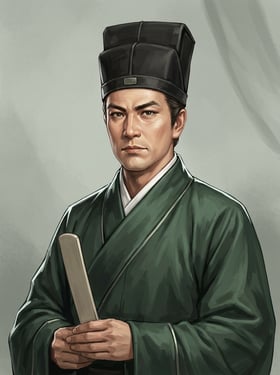
Historical Record
Hua Xin, courtesy name Ziyu, was a native of Gaotang in Pingyuan. In his youth he was already renowned for his lofty and pure conduct. He studied together with Bing Yuan and Guan Ning of Beihai; the three were close friends, and the men of the time called them "one dragon," with Hua Xin as the dragon's head. Pei Songzhi, however, held this characterization to be somewhat biased, considering that Guan Ning's lofty, transcendent virtue ought not to occupy the dragon's tail. Hua Xin was meticulous and prudent in his dealings, even-handed in discussing matters, and never slandered others. A fellow commander, Tao Qiuhong, considered his own perception superior to Hua Xin's; but in the affair of Wang Fen's plot to depose Emperor Ling, Hua Xin dissuaded Tao Qiuhong from taking part, predicting that Wang Fen would surely fail. When events turned out as he had said, Tao Qiuhong was convinced by Hua Xin.
Recommended as Filial and Incorrupt, Hua Xin was appointed a Gentleman of the Interior, but later left office on account of illness. After Emperor Ling's death, when He Jin held the regency, he summoned Hua Xin to be a Gentleman of the Imperial Secretariat. When Dong Zhuo moved the Son of Heaven to Chang'an, Hua Xin requested to be sent out as Prefect of Xiagui, but was unable to take up the post because of illness. He traveled from Lantian to Nanyang, where Yuan Shu detained him at Rang. Hua Xin once urged Yuan Shu to campaign against Dong Zhuo, but Yuan Shu would not adopt his advice. When Hua Xin then wished to depart, it happened that the Grand Tutor Ma Midi was pacifying the region east of the passes and recruited Hua Xin as an aide. Going east to Xu Province, he received an imperial edict appointing him Administrator of Yuzhang. In Yuzhang his governance was quiet and undisturbing, and he won the deep affection of officials and people.
When Sun Ce took Jiangdong, Hua Xin, foreseeing that Sun Ce was skilled in arms, welcomed him "in plain headcloth," and Sun Ce treated him with the courtesy due an honored guest. After Sun Ce's death, Cao Cao, at Guandu, memorialized the Son of Heaven to summon Hua Xin. Sun Quan at first did not wish to send him, but Hua Xin persuaded Sun Quan, pointing out that keeping him would bring no benefit, and that it was better to let him serve Sun Quan's interests at Cao Cao's side. Sun Quan, greatly pleased to hear this, then sent Hua Xin north. Before his departure, his guests presented gifts of several hundred pieces of gold; Hua Xin accepted them all but quietly marked each. At parting, he gathered all the gifts together and declared to the guests that, traveling far alone in a single carriage, "to carry a jade is to invite blame," and asked that the guests take back their gifts. All admired his virtue.
After reaching Cao Cao, Hua Xin was first appointed a Counsellor and took part in the military affairs of the Minister of Works; later he entered as Master of the Imperial Secretariat, was transferred to Palace Attendant, and succeeded Xun Yu as Prefect of the Imperial Secretariat. When Cao Cao campaigned against Sun Quan, he memorialized to make Hua Xin Army Adviser. After the founding of the state of Wei, Hua Xin served as Grandee Secretary. When Emperor Wen took the rank of king, he appointed Hua Xin Chancellor and enfeoffed him as Marquis of Anle District. After Emperor Wen ascended the throne, he transferred him to Minister over the Masses. Hua Xin had always been poor; most of the salary he received he used to relieve relatives and old friends, and his household held no surplus wealth. Emperor Wen once bestowed on the nobles the bondservants confiscated from condemned families, but Hua Xin alone married his off. Emperor Wen sighed at this and issued an edict specially bestowing imperial robes and having clothing made for Hua Xin's household, praising him as "an elder statesman of the realm."
In the fourth year of Huangchu, Emperor Wen issued an edict for the nobles to recommend men of singular conduct, and Hua Xin recommended Guan Ning. After Emperor Ming ascended the throne, Hua Xin was advanced to Marquis of Boping, his fief increased by five hundred households to a total of one thousand three hundred, and he was transferred to Grand Commandant. He once pleaded illness to retire, wishing to yield his place to Guan Ning, but Emperor Ming would not permit it. During the Taihe era, Hua Xin submitted a memorial remonstrating against Emperor Ming's campaign against Shu, pointing out that transporting grain a thousand li and penetrating deep across difficult terrain was no advantage in warfare, and that the levies had already affected agriculture and sericulture; he advised that the sovereign should first attend to the way of good governance and treat military campaigns as a secondary matter. Emperor Ming adopted his words and in the end issued an edict for Cao Zhen to withdraw his army.
In the Novel
In Romance of the Three Kingdoms, Hua Xin's portrayal is given a stronger cast of political opportunism and fawning on the powerful, diverging from the pure and lofty virtue of the histories. He first appears in the novel when Sun Quan wishes to send an envoy to Xu, and Gu Yong recommends Hua Xin, calling him a man Cao Cao admired. Receiving the commission, Hua Xin went to Ye Commandery to meet Cao Cao. Cao Cao adopted Cheng Yu's plan, granting offices to Zhou Yu and Cheng Pu, and appointed Hua Xin Chief of the Court of Judicial Review, keeping him at Xu in an important post. This differs in order from the histories, in which Hua Xin, after being summoned by Cao Cao, first held posts such as Counsellor and Master of the Imperial Secretariat, and only later rose to high offices such as Grandee Secretary and Chancellor.
The most controversial element of the novel's portrayal of Hua Xin is his conduct in the affair of Cao Cao's deposing of Empress Fu. Hua Xin led troops into the palace and personally hunted out Empress Fu, even "with his own hands seizing the empress by her hair-knot and dragging her out", harshly upbraiding her and ordering her to "go and plead with the Duke of Wei yourself." This episode greatly debases Hua Xin's refined image from the histories, depicting him as a cold and ruthless political henchman. The novel also uses this affair to recall the allusion of Hua Xin and Guan Ning "dividing the mat and sitting apart," implying that Hua Xin's character had degenerated through coveting wealth and rank, forming a sharp contrast with Guan Ning's loftiness and purity. Yet the historical account of the "dividing the mat" episode does not clearly attribute it to money or office, but emphasizes rather the difference in the two men's aspirations.
In the process of Cao Pi supplanting the Han and founding Wei, Hua Xin acted as an active mover. He advised Cao Pi that, if Cao Zhi were not removed early, he would surely become a future menace, and proposed testing him with his talent—if he could not compose a poem, he should be put to death. At the abdication ceremony, Hua Xin charged forward, joining Wang Lang and others in forcing Emperor Xian of Han to abdicate. He even "laid his hand on his sword, pointed at the emperor, and said in a stern voice: 'To set up one emperor and depose another is the constant way of antiquity!'", and advised Cao Pi to settle the Han's Liu family at Shanyang, forbidding them to come to court—further highlighting his loyalty to Cao Wei and his ruthlessness toward the Han house. Such episodes are not described in such detail or with such drama in the histories; they are largely the novel's artistic elaboration to establish the legitimacy of the Cao Wei regime and the tragic decline of the Han house.
Key Relationships
* Cao Wei: Hua Xin served the Cao Wei regime throughout his life; summoned in Cao Cao's time, he held a succession of important posts down to the reigns of Cao Pi and Cao Rui, rising to Grand Commandant and Chancellor. He was an important strategist and senior official in the founding and consolidation of Cao Wei.
* Guan Ning: Hua Xin and Guan Ning were fellow students and close friends, together called "one dragon." In the histories Hua Xin recommended Guan Ning to Emperor Wen as a man of singular conduct, and after Emperor Ming's accession even pleaded illness to retire, wishing to yield his place to Guan Ning—showing his esteem for Guan Ning's virtue. In the novel, however, the emphasis is on the allusion of the two "dividing the mat and sitting apart," implying that Hua Xin, coveting wealth and rank, parted ways with Guan Ning as men of different paths. (novel only).
* Bing Yuan: Hua Xin, together with Bing Yuan and Guan Ning, was called "one dragon," and the three were close friends. The histories record that Pei Songzhi held Bing Yuan's virtue to be no less than Hua Xin's.
* Bao Xun: Hua Xin, together with Zhong Yao, Chen Qun, and other nobles, submitted a memorial pleading for Bao Xun, but it was not granted by Cao Pi, and Bao Xun was in the end put to death.
* Sun Quan: While Hua Xin was Administrator of Yuzhang, Sun Quan wished to keep him, but Hua Xin persuaded Sun Quan to release him by appeal to the greater good, bringing about his return north to Cao Wei.
* Cao Pi: Hua Xin was an important mover in Cao Pi's supplanting of the Han and founding of Wei, playing a key role at the abdication ceremony.
* Sima Yi: In Cao Rui's time, Hua Xin, together with Wang Lang, memorialized suspecting that Sima Yi harbored rebellious intent, and advised dismissing him from his military command and sending him back to his fields. (novel only).
Iconic Scenes
* Dissuading Tao Qiuhong from joining Wang Fen's plot to depose Emperor Ling: With his wisdom and foresight, Hua Xin dissuaded Tao Qiuhong from taking part in Wang Fen's plot to depose and set up emperors, foreseeing that it would surely fail, and thus saving Tao Qiuhong from disaster, displaying his meticulous and prudent character.
* Returning north alone, scattering all the gifted gold: When Hua Xin left Sun Quan to return north to Cao Cao, he accepted in full the several hundred pieces of gold his guests presented and marked them, yet at parting returned them all, declaring that "to carry a jade is to invite blame." This act made all admire his conduct, reflecting his integrity and purity.
* Recommending Guan Ning, pleading illness to yield his place: In the fourth year of Huangchu, Hua Xin recommended Guan Ning as a man of singular conduct, and after Emperor Ming's accession even pleaded illness to retire, wishing to yield the office of Grand Commandant to Guan Ning. This reflected not only Hua Xin's recognition of Guan Ning's virtue but also his indifference to fame and gain.
* Remonstrating against Cao Rui's campaign against Shu: During the Taihe era, Hua Xin submitted a memorial remonstrating against Emperor Ming Cao Rui's campaign against Shu, pointing out that it exhausted the people and squandered wealth for no commensurate gain, and stressing that the people should be the foundation, governance first and campaigns after. This act displayed Hua Xin's deep foresight as chancellor and his sense of responsibility for the state.
* Hunting out Empress Fu: In Romance of the Three Kingdoms, Hua Xin personally led armed soldiers to hunt out Empress Fu, even "with his own hands seizing the empress by her hair-knot and dragging her out," and harshly upbraiding her. This scene greatly shaped his cold and ruthless image, becoming a major blemish on him in the novel. (novel only).
* Forcing Emperor Xian of Han to abdicate: At the abdication ceremony of Cao Pi's supplanting of the Han and founding of Wei, Hua Xin, together with Wang Lang and others, actively forced Emperor Xian of Han to abdicate, even "laying his hand on his sword, pointing at the emperor, and speaking in a stern voice." This scene is the concentrated expression of Hua Xin's political opportunism and fawning on the powerful in the novel. (novel only).
Portrait file
Character profile
- Character
- Hua Xin was frugal and sparing, meticulous and careful, and was praised by Chen Qun as "penetrating yet not overbearing, pure yet not aloof." But in the Romance he fawns upon Wei, drafting edicts to coerce Emperor Xian, sinister and calculating, single-mindedly bent on eliminating threats; he even personally seized Empress Fu by the hair and dragged her out, gripping his sword and pointing at the emperor, speaking in a harsh voice.
- Manner of speech
- When urging the abdication, Hua Xin cited the affairs of Yu Shun and Tang Yao to gloss over the usurpation, and intimidated the sovereign with the peril of turmoil on all sides and the calamity of regicide.
- Life
- Hua Xin, a native of Gaotang in Pingyuan, styled Ziyu, was ranked together with Bing Yuan and Guan Ning as "the One Dragon," Xin being the dragon's head. He once served as Administrator of Yuzhang, governing with pure tranquillity, and was later recruited by Cao Cao, holding in turn the offices of Master of Writing, Master of Writing-in-Chief, and Grandee Secretary. After the founding of the state of Wei, he rose to Chancellor, Minister over the Masses, and Grand Commandant, and under Emperor Ming was advanced to Marquis of Boping. He died in the fifth year of Taihe, with the posthumous title Marquis Jing.
- Anecdotes
- Hua Xin was a senior minister of Cao Wei who once bore the imperial credentials to confer upon Cao Pi the seals of the Chancellor and the seal and sash of the King of Wei, and was the first to advocate the abdication, coercing Emperor Xian. He also invoked Cao Cao's words about Sima Yi's "hawk's gaze and wolf's glance," memorializing for Sima Yi's swift execution, and later memorializing to strip him of military power and send him back to the fields.
Relationships
19 relationships
Family1
Lord & vassal1
Friends8
Enemies3
Other5
Quotes
30 recorded lines · 3 featured
「天下之人,皆知陛下無人君之福,以致四方大亂!若非魏王在朝,弒陛下者,何止一人?陛下尚不知恩報德,直欲令天下人共伐陛下耶?」
These words fully expose Hua Xin's shameless demeanor as he pressed Emperor Xian of Han into the Abdication of Emperor Xian of Han, emblematic of his character.
「立一帝,廢一帝,古之常道!今上仁慈,不忍加害,封汝為山陽公。今日便行,非宜召不許入朝!」
This line shows Hua Xin's hardline attitude toward Emperor Xian of Han, an epitome of his political stance and personality.
「司馬懿上表乞守雍、涼,正為此也。先時太祖武皇帝嘗謂臣曰:『司馬懿鷹視狼顧,不可付以兵權;久必為國家大禍。』今日反情已萌,可速誅之。」
These words reveal Cao Cao's wariness of Sima Yi, and also reflect Hua Xin's political foresight.
Chapters17 回 ▸
- 史ch.2ch.3ch.11ch.12ch.13ch.16ch.38ch.57
- 演ch.56ch.66ch.69ch.78ch.79ch.80ch.91ch.94ch.99
Relationship timeline15 条 ▸
史 ch.11
- Guan Ning§59
advises_in
黄初四年司徒华歆荐寧;明帝即位,华歆遜位让寧
史 ch.12
- Bao Xun§66
witnesses
表请鲍勋罪
史 ch.13
史 ch.57
- Luo Tong§42
kin_of
骆统母改适华歆为小妻,统时八岁与亲客归会稽
演 ch.66
演 ch.78
- Cao Cao§4
advises_in
荐华佗诊曹操头风
演 ch.79
- Cao Zhi§9
rival_of
进谗"子建非池中物若不早除必为后患",献以才试之之计
演 ch.80
rival_of
入殿奏请禅位;扯龙袍变色而言;按剑指帝厉声宣旨封山阳公
演 ch.99
- Cao Rui§30
advises_in
上疏谏止伐蜀
Inner monologues · AI-generated3 段 ▸
- By this late stage of my life, my body is frail with illness, and each day feels borrowed. I often reflect that, though
- I am Hua Xin, courtesy name Ziyu. At this moment, serving among the court officials, I see that this is no simple matter
- My name is Hua Xin, and my courtesy name is Ziyu. Whenever I think of my early years, events in my native Pingyuan seem
Life events8 ▸
- 0200-01-01 · YuzhangHua Xin Leaves Wu and Enters Xu (Capital)· Instigator
- 0214-01-01 · XuchangDeath of Empress Fu· Warrior
- 0214-01-01 · XuchangDeposition and Execution of Empress Fu· Warrior
- 0220-01-01 · YeThe Quatrain of Seven Steps· Advisor
- 0220-01-01 · XuchangThe Death of Hua Tuo· Witness
- 0220-01-01 · XuchangCao Pi Supplants the Han· Advisor
- 0220-01-01 · XuchangCao Pi Usurps the Han Throne and Proclaims Himself Emperor· Advisor
- 0220-01-01 · Abdication PlatformAbdication of Emperor Xian of Han· Instigator