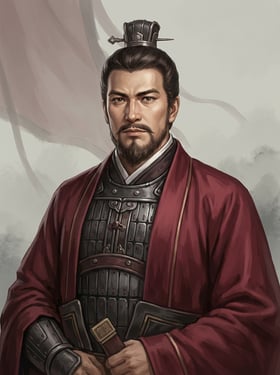
Historical Record
Cao Zhen, styled Zidan, was a clan-nephew of Cao Cao. His father, Cao Shao, was killed by the provincial and commandery authorities when he was recruiting followers during the time Cao Cao raised an army. Pitying Cao Zhen for losing his father at a young age, Cao Cao took him in and raised him together with his own sons, even having him share quarters with the future Emperor Wen of Wei, Cao Pi. Once, while hunting, Cao Zhen was pursued by a tiger; he turned and shot it dead with a single arrow. Cao Cao praised his courage and put him in command of the elite Tiger and Leopard Cavalry. c:2329
Cao Zhen distinguished himself repeatedly in his military career. He campaigned against and pacified the bandits of Lingqiu, for which he was enfeoffed as Marquis of Lingshou Village. In battle against Liu Bei's subordinate commanders, serving as Lieutenant General, he defeated the enemy at Xiabian and was afterward appointed General of the Central Firmness. After Xiahou Yuan fell at Yangping, Cao Cao was deeply troubled and appointed Cao Zhen as Protector of the Army for the Shu Campaign, directing Xu Huang and others to defeat Liu Bei's subordinate Gao Xiang at Yangping. After Cao Cao personally arrived at Hanzhong, he withdrew the various armies and sent Cao Zhen to Wudu to receive Cao Hong and others, jointly garrisoning at Chencang. c:2329
After Cao Pi became King of Wei, he appointed Cao Zhen General Who Guards the West, granting him the staff of authority to oversee the military affairs of Yong and Liang Provinces, and promoted him to Marquis of Dongxiang for his merit. When Zhang Jin and others rebelled in Jiuquan, Cao Zhen dispatched Fei Yao to crush them and behead the rebels. In the third year of Huangchu, Cao Zhen returned to the capital and was appointed Grand General of the Upper Army, overseeing all military affairs within and without, and granted the staff and axe of authority. He campaigned against Sun Quan together with Xiahou Shang and others, defeating the Wu army at the Niuzhu garrison. He was then transferred to Grand General of the Central Army, with the additional title of Palace Attendant. c:2329
When Emperor Wen Cao Pi fell gravely ill, Cao Zhen, together with Chen Qun, Sima Yi, and others, received the testamentary edict to assist the heir Cao Rui. c:5621 After Emperor Ming Cao Rui ascended the throne, Cao Zhen was promoted to Marquis of Shaoling and advanced to Grand General. When Zhuge Liang besieged Mount Qi, the three commanderies of Nan'an, Tianshui, and Anding responded to the Shu army. Emperor Ming of Wei sent Cao Zhen to oversee the various armies stationed at Mei County and dispatched Zhang He to defeat Zhuge Liang's commander Ma Su. Yang Tiao and others of Anding Commandery held the officials and people hostage and occupied Yuezhi City; Cao Zhen advanced and besieged the city, and Yang Tiao finally bound himself and surrendered, so the three commanderies were pacified. c:2330
Cao Zhen predicted that after Zhuge Liang was checked at Mount Qi, his next campaign would have to pass through Chencang, so he dispatched Hao Zhao and Wang Sheng to guard Chencang and build up its walls. In the spring of the following year, Zhuge Liang did indeed besiege Chencang, but because the Wei army was prepared in advance, he was unable to take it. Cao Zhen's fief was increased accordingly, totaling two thousand nine hundred households in all. In the fourth year of Taihe, Cao Zhen came to court at Luoyang and was promoted to Grand Marshal, granted the honors of ascending the hall with sword and shoes and of not hastening when entering court. He advised Emperor Ming that since Shu Han had repeatedly invaded the borders, they should seize the opportunity to attack it by advancing along several routes at once, which could win a great victory. Emperor Ming adopted his plan, and in the eighth month Cao Zhen set out from Chang'an, entering Shu from the south via the Ziwu Road. However, because of more than thirty days of continuous heavy rain, the plank roads were severed, and Emperor Ming issued an edict ordering Cao Zhen to bring the army back. c:2330
In his early years, Cao Zhen had served Cao Cao alongside his kinsman Cao Zun and his fellow townsman Zhu Zan. After Cao Zun and Zhu Zan died young, Cao Zhen took pity on them and requested that part of his own fief be divided among the sons of Cao Zun and Zhu Zan. Emperor Ming issued an edict praising Cao Zhen for having the benevolence of Shuxiang in caring for orphans and the steadfastness of Yan Pingzhong in keeping old commitments, and granted his request, bestowing on the sons of Cao Zun and Zhu Zan the rank of Marquis Within the Passes with one hundred households each. Whenever Cao Zhen went on campaign, he shared hardship and ease with his officers and men; when the army's rewards were insufficient, he often took out his own family wealth to distribute among the soldiers, so the troops were all willing to serve him. When Cao Zhen fell gravely ill and returned to Luoyang, Emperor Ming personally went to his residence to visit him. After Cao Zhen died, he was given the posthumous title of Marquis Yuan. His son Cao Shuang inherited his rank. Recalling Cao Zhen's achievements, Emperor Ming issued an edict posthumously enfeoffing all five of Cao Zhen's sons—Cao Xi, Cao Xun, Cao Ze, Cao Yan, and Cao Ai—as full marquises. c:5622
In the Novel
In Romance of the Three Kingdoms, Cao Zhen, as an important general of Cao Wei, is to some degree given a literary characterization that diverges from historical fact. He first appears in Chapter 84, when after the Battle of Xiaoting Cao Pi, wishing to take advantage of Eastern Wu's depleted forces, ordered Cao Zhen to lead an army out of Nan Commandery, joining with Cao Ren and Cao Xiu in a three-pronged army to launch a surprise attack on Eastern Wu. c:5625 This differs from the historical record in which Cao Zhen was mainly responsible for the western front during Cao Pi's reign; in the novel he takes part in the military action against Wu.
Before Cao Pi's death, Cao Zhen, together with Chen Qun, Sima Yi, and Cao Xiu, received the testamentary edict to assist the young ruler Cao Rui. On his deathbed, Cao Pi pointed to Cao Rui and said to them: "This child is young; you three may assist him well, and do not fail my heart." c:5626 This basically agrees with the historical record, but the novel also includes Cao Xiu among the regents entrusted with the orphaned heir.
In the novel, Cao Zhen clashed with Zhuge Liang many times, but was often at a disadvantage. During Zhuge Liang's Northern Expeditions, Cao Zhen was appointed Grand Commander, leading two hundred thousand troops to resist Shu Han. He campaigned together with Wang Lang, Guo Huai, and others. c:5627 In one engagement against Zhuge Liang, Cao Zhen tried to set an ambush, but Zhuge Liang saw through it, and his camp was raided by the Shu army instead, suffering heavy losses. The novel even portrays Sima Yi's doubts about Cao Zhen's military ability, and an episode in which Cao Zhen fell ill from shame and anger. c:12074 This contrasts with the historical image of Cao Zhen as a renowned Cao Wei general who repeatedly distinguished himself; to highlight Zhuge Liang's cunning, the novel to some extent diminishes Cao Zhen's military ability.
The novel also records that before the campaign against Shu, Cao Zhen consulted with Sima Yi, and because of continuous gloomy rain the army's morale had scattered, so they finally decided to withdraw. c:12094 In another plan to attack Shu, Cao Zhen submitted a memorial to the Wei ruler Cao Rui, requesting to lead a great army into Hanzhong together with Sima Yi to clear out the forces of Shu Han. c:2334 However, in the novel, Cao Zhen repeatedly lost in his battles of wits with Zhuge Liang and finally, due to grave illness, handed over military command to Sima Yi. c:2333 This differs from the historical record in which Cao Zhen returned to Luoyang due to illness and later died of it; the novel links his death to Zhuge Liang's schemes, making it more dramatic.
Key Relationships
* Cao Wei (serves): Cao Zhen served Cao Wei with utter loyalty throughout his life, following from the time of Cao Cao all the way through the reign of Cao Rui, always a pillar minister of Cao Wei. He took part in many important battles and held key posts such as Grand General and Grand Marshal. c:5621
* Zhuge Liang (opposes): In both history and the novel, Cao Zhen clashed with Zhuge Liang many times. The historical record states he oversaw the region west of the passes and repelled Zhuge Liang's Northern Expeditions. c:2327 The novel depicts their many battles of wits at Mount Qi, Chencang, and elsewhere, though in the novel Cao Zhen is usually at a disadvantage. c:5627
* Cao Cao (kinsman and patron): As Cao Cao's clan-nephew, Cao Zhen was taken in and raised by Cao Cao from childhood and grew up alongside Cao Pi. Cao Cao admired his courage, put him in command of the Tiger and Leopard Cavalry, and gradually entrusted him with important responsibilities. c:2329
* Cao Pi (companion and entrusted regent): Cao Zhen and Cao Pi lived together from childhood and were close. When Cao Pi fell gravely ill, he named Cao Zhen one of the regents to assist the young ruler Cao Rui. c:5626
* Cao Rui (regent and trust): As an entrusted regent, Cao Zhen assisted Cao Rui's accession. Cao Rui trusted him greatly, repeatedly entrusting him with important responsibilities, and even personally visited him when he was gravely ill. c:5622
* Sima Yi (colleague and rival): In history, Cao Zhen and Sima Yi were both important Cao Wei ministers who jointly assisted Cao Rui. In the novel, there is a degree of rivalry between them, especially in military command, where Sima Yi's cunning is often portrayed as superior to Cao Zhen's, and he even takes over Cao Zhen's command when Cao Zhen is gravely ill c:2333 (novel only).
* The officers and men (devotion): The historical record states that whenever Cao Zhen went on campaign, he shared hardship and ease with his officers and men; when the army's rewards were insufficient, he often took out his own family wealth to distribute among them, so the troops were all willing to serve him. c:5622
Signature Scenes
* Shooting the tiger in his youth: When Cao Zhen was young, he was pursued by a tiger while hunting; he turned and shot it with a single arrow, felling it on the spot. Cao Cao marveled at his courage and put him in command of the Tiger and Leopard Cavalry. c:2329 This scene shows Cao Zhen's youthful valor.
* Crushing Zhang Jin's rebellion: While serving as General Who Guards the West, Cao Zhen dispatched Fei Yao to crush the rebellion of Zhang Jin and others in Jiuquan, maintaining stability on the frontier. c:2329
* Predicting and defending Chencang: After Zhuge Liang was checked in his first Northern Expedition, Cao Zhen accurately predicted that his next campaign would have to pass through Chencang, so he sent Hao Zhao and Wang Sheng in advance to build up and hold the city of Chencang, so that Zhuge Liang besieged it for more than twenty days without being able to take it. c:2330 This demonstrates Cao Zhen's outstanding military insight.
* The Shu campaign blocked and the army recalled: Cao Zhen advised Emperor Ming of Wei to attack Shu by several routes and personally led the army south via the Ziwu Road. However, because of continuous heavy rain the plank roads were severed, and he finally received an edict ordering the army back. c:2330
* Dividing his fief to care for orphans: Out of pity for his kinsman Cao Zun and his fellow townsman Zhu Zan, who had died young, Cao Zhen requested that part of his own fief be divided among their sons as a token of relief. Emperor Ming praised his benevolence and justice and granted the request. c:5622 This scene shows the kind and generous side of Cao Zhen.
* Entrusted with the orphaned heir by the Wei ruler: When Emperor Wen Cao Pi fell gravely ill, he named Cao Zhen, together with Chen Qun, Sima Yi, and others, as a regent to assist the young ruler Cao Rui. c:5626 This shows Cao Zhen's important standing in Cao Wei and the trust placed in him.
* Checked at Mount Qi (novel only): In the novel, Cao Zhen clashed with Zhuge Liang many times at Mount Qi, but repeatedly lost due to Zhuge Liang's cunning, even having his schemes seen through and his camp raided. c:12086
* Falling ill from shame (novel only): In the novel, Cao Zhen was repeatedly checked in his battles against Zhuge Liang and finally fell ill from shame and anger, handing over military command to Sima Yi. c:12074
Portrait file
Character profile
- Character
- Cao Zhen shared hardships and comforts alike with his officers and men; when the army's rewards fell short he would often distribute his own family wealth among them, and so won the deep devotion of his soldiers. Steady and discerning, he could see through schemes of estrangement, acting with prudent gravity and relying on careful planning. Yet he once caused his vanguard's defeat by failing to vet the men he used, or, eager to win merit and wipe out disgrace, credulously trusted a feigned surrender, and in the end, grown arrogant, complacent, and contemptuous of the enemy, died of shame and rage.
- Life
- Cao Zhen was a clansman of Cao Cao, taken in and raised by him in his early years, and for his valor appointed a commander of the Tiger and Leopard Cavalry. He held in turn the offices of General Who Guards the West, Grand General of the Upper Army, Grand General of the Central Army, and Grand General, finally rising to Grand Marshal with authority over all military affairs within and without. Cao Zhen took part in many campaigns, including defeating a detached general of Liu Bei, campaigning against Sun Quan, quelling rebellions, and resisting Zhuge Liang's northern expeditions. He received Cao Pi's dying decree to assist in the government and correctly predicted Zhuge Liang's line of march, but during a campaign against Shu was forced by heavy rains to turn back.
- Anecdotes
- At Cao Pi's deathbed Cao Zhen was appointed one of the regent ministers, and later became commander of Wei's western front, with authority over the military affairs west of the passes. He held overall command of the troops of Yong and Liang, and yielded the seal of supreme command to Sima Yi. He was the father of Cao Shuang.
Relationships
25 relationships
Family3
Lord & vassal7
Friends2
Enemies2
Other11
Quotes
26 recorded lines · 3 featured
「不可。文皇帝托孤於臣等數人,是知司馬仲達無異志也。今事未知真假,遽爾加兵,乃逼之反耳。或者蜀、吳奸細行反間之計,使我君臣自亂,彼卻乘虛而擊,未可知也。陛下幸察之。」
These words show Cao Zhen's trust in Sima Yi and his political foresight, averting internal conflict.
「吾家人知我病重,不令我知。似此國家危急,何不拜仲達為都督,以退蜀兵耶?」
Recommending Sima Yi while gravely ill reflects his broad-mindedness in putting the greater cause first and his talent for judging and employing men.
「蜀兵數次侵界,屢犯中原,若不剿除,後必為患。今時值秋涼,人馬安閒,正當征伐。臣願與司馬懿同領大軍,逕入漢中,殄滅奸黨,以清邊境。」
This line shows Cao Zhen's aggressive, proactive military attitude in volunteering for the front, in keeping with his image as a general.
Chapters18 回 ▸
- 史ch.2ch.3ch.9ch.17ch.33ch.35ch.56
- 演ch.84ch.85ch.86ch.91ch.93ch.94ch.95ch.97ch.98ch.99ch.100
Relationship timeline10 条 ▸
史 ch.3
fights_in
大将军曹真都督关右并进兵
史 ch.9
- Cao Cao§46
kin_of
太祖族子;太祖哀其少孤,收养与诸子同
- Cao Rui§47
serves
黄初七年文帝寝疾,受遗诏辅政;明帝即位进封邵陵侯,迁大将军
- Zhuge Liang§48
fights_in
督诸军于郿;料亮后必出陈仓,令郝昭、王生守之,亮果不能克
史 ch.17
- Zhang He§23
friend_of
讨安定卢水胡及东羌;并朝许宫
演 ch.93
- Zhuge Liang§16
enemy_of
与郭淮共议劫蜀寨之策;中孔明反伏大败
演 ch.97
- Jiang Wei§27
betrayed_by
伪上'罪将姜维百拜'书诈降,赚曹真用兵
演 ch.98
- Sima Yi§25
friend_of
病中以总兵将印让司马懿,"如仲达不领此任,中国危矣"
演 ch.99
- Cao Rui§24
serves
上表请伐蜀,被拜大司马征西大都督
演 ch.100
- Sima Yi§2
rival_of
以玉带御马为赌注立约;败后同心报国不再言赌赛
Inner monologues · AI-generated3 段 ▸
- I am Cao Zhen, courtesy name Zidan. I lost my father while still young. Taizu took pity on me and brought me into his ho
- I am Cao Zhen, courtesy name Zidan. Looking back on my life now, what I remember most is not the banners before my tent,
- When I recall my youth, my family was caught up in the upheavals that engulfed the realm. Yet the surviving records say
Life events9 ▸
- 0220-01-01 · YeCao Cao Dies and Emperor Wen of Wei Ascends the Throne· Witness
- 0222-01-01 · JianglingThree-Pronged Campaign against Wu· Commander
- 0222-01-01 · GuanglingCao Pi's Guangling Campaign· Commander
- 0223-01-01 · ChengduFive-Route Invasion of Shu· Commander
- 0228-01-01 · Mount QiKongming Scolds Wang Lang to Death· Commander
- 0228-01-01 · Mount QiFirst Northern Expedition· Commander
- 0228-01-01 · ChencangSiege of Chencang· Commander
- 0230-01-01 · ChencangCao Zhen's Invasion of Shu· Commander
- 0234-01-01 · Mount QiZhuge Liang's Northern Expeditions· Commander