Historical Record
Wang Lang, styled Jingxing, was a native of Donghai Commandery. For his mastery of the classics he was appointed a Gentleman of the Interior, and later served as Chief of Ziqiu. He studied under the Grand Commandant Yang Ci, and when Yang Ci died, Wang Lang resigned his office to observe mourning. He was once recommended as Filial and Incorrupt and summoned by the offices of the Excellencies, but he declined all such calls. The Inspector of Xu Province, Tao Qian, recommended Wang Lang as a Flourishing Talent. At that time Emperor Xian of Han was at Chang'an and troops had risen east of the passes; Wang Lang served as Tao Qian's Attendant Officer, and together with the Assistant Officer Zhao Yu and others urged Tao Qian to render service to the throne. Tao Qian thereupon sent Zhao Yu bearing a memorial to Chang'an; the Son of Heaven commended their intent, appointed Tao Qian General Who Pacifies the East, made Zhao Yu Administrator of Guangling, and Wang Lang Administrator of Kuaiji c:2776.
Wang Lang held office in Kuaiji Commandery for four years, bestowing favor upon the people and winning their hearts. When Sun Ce crossed the Yangtze to seize territory, Wang Lang, believing that as a Han official he ought to defend his city, raised troops to fight Sun Ce, but was defeated. He fled by sea to Dongye, but was later pursued and heavily defeated by Sun Ce, and finally submitted to him. Because Wang Lang was refined and scholarly, Sun Ce, though he reproached him, did him no harm c:2776. Though adrift and destitute, with no provision for the morrow, Wang Lang still gathered and relieved his kin and old friends, sharing what little he had, and his righteous conduct was most notable.
In the third year of Jian'an (198 CE), Cao Cao memorialized to summon Wang Lang, and Sun Ce sent him on his way. Cao Cao asked how Sun Ce had been able to reach his present state, and Wang Lang replied: "Sun Ce's valor is foremost in his age, and he has outstanding talent and great ambition. Zhang Zibu, the hope of the people, faces north and serves as his counselor. Zhou Gongjin, the hero of the Yangtze and Huai region, has bared his arms to be his general. His schemes succeed, and what he plans is no small thing—he will in the end be a great brigand of the realm, no mere petty thief." c:5923 Wang Lang was appointed Counselor Remonstrant and took part in the military affairs of the Minister of Works. When the state of Wei was first established, he served as Libationer of the Army concurrently as Administrator of Wei Commandery, and was later promoted to Privy Treasurer, Chamberlain for Ceremonials, and Chamberlain for Law Enforcement. In trying cases Wang Lang strove for leniency, treating doubtful crimes lightly, and together with Zhong Yao—who was perceptive and exacting in applying the law—he was renowned for his handling of cases c:5923.
After Emperor Wen, Cao Pi, ascended the throne of king, Wang Lang was promoted to Grandee Secretary and enfeoffed as Marquis of Anling Precinct. He once submitted a memorial urging Emperor Wen to nurture the people and reduce punishments, pointing out that "since the rising of arms more than thirty years have passed, the realm within the four seas has been overturned, and the myriad states are exhausted and stricken," and stressing the importance of being cautious with law and prisons c:5925. After Emperor Wen took the imperial throne, Wang Lang was transferred to Minister of Works and advanced in enfeoffment to Marquis of Leping District c:12713. He once held a different view from Zhong Yao on the matter of reviving corporal punishment, holding that "Zhong Yao wishes to lighten and reduce the statutes on capital punishment so as to increase the number of cases of amputation; this is to raise a fallen man up into a standing one, to transform a corpse back into a living person," and proposing instead to substitute "the reduced-death penalties of head-shaving and amputation" or "doubling the years of penal labor." In the end Emperor Wen adopted his suggestion, and the revival of corporal punishment was suspended c:12710.
During the Huangchu era, Sun Quan once sent envoys to declare himself a vassal, while at war with Liu Bei. The court deliberated whether it ought to raise an army and join with Wu to take Shu. Wang Lang argued: "The army of the Son of Heaven is weightier than Mount Hua or Mount Dai; it ought truly to sit and let its heavenly majesty shine, unmoving as a mountain." He held that before Sun Quan's army had moved it was not fitting to campaign first, and that with the rains then at their height it was no time to march and mobilize the host. Emperor Wen adopted his strategy c:2780.
After Emperor Ming, Cao Rui, took the throne, Wang Lang was advanced in enfeoffment to Marquis of Lanling, with an increase of five hundred households, making a thousand two hundred in all with the former. He once went to Ye to inspect the tomb of Empress Wenzhao, and seeing that some among the people were in want while at that time palaces were being built, Wang Lang submitted a memorial urging Cao Rui to make diligent farming his task and the practice of military preparedness his concern, rather than great construction works c:5926. He also submitted a memorial on the scarcity of imperial sons, urging Cao Rui to broaden his heirs c:2781. Wang Lang authored commentaries on the *Changes*, the *Spring and Autumn Annals*, the *Classic of Filial Piety*, and the *Rites of Zhou*, as well as *Memorials, Discourses, and Records*, all of which were handed down to the age. In the second year of Taihe (228 CE), Wang Lang died, with the posthumous title Marquis Cheng. His son Wang Su succeeded to his title. Wang Lang was a man of high talent and broad refinement, of strict and high-spirited temperament, abundant in dignified bearing, respectful and frugal, who would not accept the ceremonial gifts of marriage from maternal and paternal cousins. He often mocked the worldly fondness for the name of generosity without any care for the poor and humble, and so put relieving urgent need first in his use of wealth c:2781.
In the Novel
In *Romance of the Three Kingdoms*, Wang Lang's image differs somewhat from the historical record, especially in his clashes with Sun Ce and Zhuge Liang, where the literary coloring is more pronounced.
In the novel, Wang Lang appears as Administrator of Kuaiji and wishes to lead troops to rescue Yan Baihu. The commandery clerk Yu Fan urged him against this, arguing that Sun Ce was an army of benevolence and righteousness while Yan Baihu's host was cruel and violent, and that he ought to seize Yan Baihu and present him to Sun Ce. Wang Lang angrily rebuked Yu Fan and joined forces with Yan Baihu, confronting Sun Ce on the plain of Shanyin. Sun Ce demanded to know why Wang Lang aided a brigand, and Wang Lang cursed Sun Ce for his insatiable greed in forcibly annexing his territory, declaring that he meant to avenge the Yan clan c:2785. In the ensuing battle, Wang Lang fell into Sun Ce's stratagem; his subordinate general Zhou Xin was stabbed to death by Sun Ce, Yan Baihu fled in defeat, and Wang Lang too in the end could not stem Sun Ce's onslaught c:12701.
During the establishment of the Cao Wei regime, Wang Lang, as a civil official, joined Zhong Yao, Wang Can, Chen Lin, and others in presenting poems and verses to Cao Cao, extolling his merit and virtue and hinting that he ought to accept the Mandate of Heaven. Cao Cao expressed modesty at this, though his words also let slip pride in his own achievements c:5927. After Cao Pi ascended the throne of king, Wang Lang was enfeoffed as Grandee Secretary c:5928, and was later promoted to Minister of Works c:5929. At the ceremony of Cao Pi's acceptance of the abdication and assumption of the imperial title, Wang Lang, together with Hua Xin and others, strongly urged Emperor Xian of Han to abdicate; Wang Lang went so far as to say outright: "The House of Han has passed down for more than four hundred years and reached Your Majesty, but its destined span is exhausted. You ought to withdraw early and not hesitate; delay will breed change." c:2786
After Cao Rui took the throne, Wang Lang was enfeoffed as Minister over the Masses c:5930. When Zhuge Liang launched his Northern Expeditions, Wang Lang went on campaign as Military Advisor under the Grand Commander Cao Zhen. At the Battle of Mount Qi, Wang Lang, confident in his eloquence, sought to turn back Zhuge Liang with a single speech. He set forth to Zhuge Liang that the Mandate of Heaven belonged to Cao Wei, urging him to "lay down his weapons and shed his armor, and come to surrender with proper ceremony, and he would not lose the rank of a marquis" c:2787. However, Zhuge Liang refuted Wang Lang with a stirring and impassioned speech, bitterly denouncing him for abetting tyranny, and in the end Wang Lang was cursed by Zhuge Liang until he fell from his horse and died c:2787. This episode is found nowhere in the histories and is a fiction created by the novel to portray Zhuge Liang's resourcefulness and eloquence.
Key Relationships
* Yang Ci (Student of): Wang Lang studied under the Grand Commandant Yang Ci, and when Yang Ci died, Wang Lang resigned his office to observe mourning, showing his respect for his teacher c:2776.
* Tao Qian (Serves): Wang Lang served as Attendant Officer under Tao Qian and urged Tao Qian to render service to the throne; he was later recommended by Tao Qian as Administrator of Kuaiji c:2776.
* Cao Wei (Serves): Wang Lang was summoned in Cao Cao's time and afterward held important posts in the Cao Wei regime, including Counselor Remonstrant, Grandee Secretary, Minister of Works, and Minister over the Masses, and was an important civil official of Cao Wei c:5923, c:5928, c:5929, c:5930.
* Sun Ce (Adversary/Captor): Wang Lang once fought Sun Ce and, after his defeat, submitted to him; because of his refinement Sun Ce did him no harm c:2776.
* Zhong Yao (Colleague): Wang Lang and Zhong Yao each had their own emphasis in trying cases, but both were renowned for it. On the matter of reviving corporal punishment the two held differing views, and Wang Lang's proposal was in the end adopted c:5923, c:12710.
* Zhuge Liang (Adversary): In *Romance of the Three Kingdoms*, Wang Lang had a famous debate with Zhuge Liang at the Battle of Mount Qi, and in the end was cursed to death by Zhuge Liang (novel only) c:2787.
* Cao Zhen (Colleague): In *Romance of the Three Kingdoms*, Wang Lang once went on the Northern Expedition as Military Advisor under the Grand Commander Cao Zhen (novel only) c:5931.
Iconic Scenes
* Bestowing favor on the people as Administrator of Kuaiji: Wang Lang held office in Kuaiji Commandery for four years, with "kindness and love among the people," and once abolished the sacrifices to the First Emperor of Qin, holding that a ruler without virtue ought not to receive sacrifice c:2776.
* Urging Tao Qian to render service to the throne: Wang Lang, together with Zhao Yu and others, urged Tao Qian to honor the royal command and send an envoy to Chang'an, leading to Tao Qian's appointment as General Who Pacifies the East c:2776.
* Fighting Sun Ce and submitting: Wang Lang once led troops to fight Sun Ce; though defeated, because of his refinement he was not harmed, showing his loyalty as a Han official and Sun Ce's magnanimity c:2776.
* The dispute over reviving corporal punishment: In the Cao Wei period, Wang Lang debated with Zhong Yao over the revival of corporal punishment, and in the end his advocacy of leniency was adopted, reflecting his principle of striving for leniency in trying cases c:12710.
* Urging Cao Pi to reduce punishments and nurture the people: Wang Lang submitted a memorial to Emperor Wen, stressing caution with law and prisons and proposing a series of measures to nurture the people and reduce punishments, showing his concern for the people's livelihood and the lasting stability of the state c:5925.
* Urging Cao Rui to frugality in building palaces: In Emperor Ming's reign, Wang Lang, addressing Cao Rui's great construction works, submitted a memorial urging him to make diligent farming and the practice of military preparedness his task rather than the building of palaces, reflecting his respectful and frugal character c:5926.
* The verbal duel with Zhuge Liang: In *Romance of the Three Kingdoms*, Wang Lang engaged in a famous battle of words with Zhuge Liang at the Battle of Mount Qi, and was in the end cursed to death by Zhuge Liang, becoming a classic episode of the novel (novel only) c:2787.
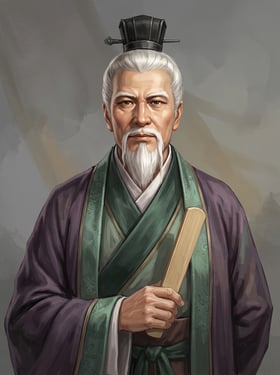
Portrait file
Character profile
- Appearance
- Wang Lang was then seventy-six years old, a white-bearded elder seated at the center.
- Character
- In judging cases Wang Lang aimed at leniency, deciding doubtful crimes toward the lighter penalty; strict yet magnanimous, respectful and frugal, he accepted no betrothal gifts from relatives by marriage. Practiced in argument and careful in speech, he was nonetheless self-assured and fond of speaking of Heaven's mandate.
- Manner of speech
- Wang Lang was skilled at citing ancient maxims, such as 'those who follow Heaven flourish, those who defy it perish,' and expounded the might of 'Great Wei with its million armored men and thousand able generals.' He once argued from 'where there is rise there must be fall, where there is flourishing there must be decline' to urge the ruler to yield in good time.
- Life
- Wang Lang, styled Jingxing, was a native of Donghai commandery. He studied under the Grand Commandant Yang Ci and, for his mastery of the classics, was appointed Gentleman of the Interior. He served as Administrator of Kuaiji, then submitted to Cao Wei, holding in succession the offices of Grand Master of Remonstrance, Privy Treasurer, Chief of Ceremonial, and Chief Judge. When Emperor Wen took the rank of king he became Grandee Secretary, later rising to Minister of Works, and after Emperor Ming's accession was transferred to Minister over the Masses; he died in the second year of Taihe with the posthumous title Cheng (the Accomplished Marquis).
- Anecdotes
- Wang Lang was originally named 'Yan' and later changed it to 'Lang.' He had an old friendship with Xu Jing, and even when he reached the rank of a high ministerial officer in the early years of Cao Wei he still sent letters recalling their bond. He once urged Tao Qian to present a memorial to Chang'an, and also wrote to Sun Ce to discuss the rites for Liu Yao after his death.
Relationships
18 relationships
Family1
Lord & vassal2
Friends7
Enemies5
Teacher & student1
Other1
Quotes
19 recorded lines · 3 featured
「天數有變,神器更易,而歸有德之人,此自然之理也。曩自桓、靈以來,黃巾倡亂,天下爭橫。降至初平、建安之歲,董卓造逆,傕、汜繼虐;袁術僭號於壽春,袁紹稱雄於鄴上;劉表占據荊州,呂布虎吞徐郡:盜賊蜂起,奸雄鷹揚,社稷有累卵之危,生靈有倒懸之急。我太祖武皇帝,掃清六合,席捲八荒;萬姓傾心,四方仰德:非以權勢取之,實天命所歸也。世祖文帝,神聖文武,以膺大統,應天合人,法堯禪舜,處中國以治萬邦,豈非天心人意乎?今公蘊大才,報大器,欲自比於管樂,何乃強欲逆天理,背人情而行事耶?豈不聞古人云:『順天者昌,逆天者亡。』今我大魏帶甲百萬,良將千員。諒腐草之螢光,怎及天心之皓月?公可倒戈卸甲,以禮來降,不失封侯之位。國安民樂,豈不美哉!」
This impassioned oration is Wang Lang's best-known image in the Romance of the Three Kingdoms, establishing the literary allusion of his being 'scolded to death.'
「自古以來,有興必有廢,有盛必有衰。豈有不亡之國、不敗之家乎?漢室相傳四百餘年,延至陛下,氣數已盡,宜早退避,不可遲疑;遲則生變矣。」
These words articulate the decline of the House of Han and the inevitability of Cao Wei supplanting it, reflecting Wang Lang's political stance as a senior minister of Cao Wei.
「來日可嚴整隊伍,大展旌旗。老夫自出,只用一席話,管教諸葛亮拱手而降,蜀兵不戰自退。」
This line displays Wang Lang's conceited and enemy-underestimating character, setting the stage for his later verbal duel with Zhuge Liang.
Chapters15 回 ▸
- 史ch.2ch.3ch.13ch.17ch.27ch.38ch.49ch.52ch.57
- 演ch.15ch.56ch.79ch.80ch.91ch.93
Relationship timeline12 条 ▸
史 ch.13
史 ch.17
- Yu Jin§15
mentor_of
异之;荐才任大将军
史 ch.27
- Wang Ji§32
friend_of
司徒王朗辟王基,王凌不遣
史 ch.49
- Sun Ce§9
friend_of
致书孙策,劝其善遇刘繇家属、收骨育孤
演 ch.15
- Yan Baihu§36
friend_of
引兵会合白虎共陈兵山阴
演 ch.80
rival_of
助华歆劝帝早避退位
演 ch.93
- Zhuge Liang§11
enemy_of
阵前以"天命所归"劝降,被孔明斥为"諂諛之臣"
Inner monologues · AI-generated3 段 ▸
- I am Wang Lang, courtesy name Jingxing. In my youth, I devoted myself to the study of the classics, and in Wei I rose to
- Having come this far, I have often felt that more than my own fortunes are at stake. In earlier years, when summoned to
- I am Wang Lang, courtesy name Jingxing, from Donghai Commandery. I recall that when I was young, my mastery of the class
Life events8 ▸
- 0196-01-01 · ShaoxingWang Lang's Failed Resistance Against Sun Ce· Commander
- 0197-01-01 · KuaijiSun Jing's Stratagem to Attack Kuaiji· Commander
- 0199-01-01 · Qu'eSun Ce's Conquest of Jiangdong· Victim
- 0210-01-01 · YeBronze Bird Terrace Inauguration Ceremony· Witness
- 0220-01-01 · XuchangCao Pi Supplants the Han· Advisor
- 0220-01-01 · XuchangCao Pi Usurps the Han Throne and Proclaims Himself Emperor· Advisor
- 0228-01-01 · Mount QiKongming Scolds Wang Lang to Death· Killed in action
- 0228-01-01 · Mount QiFirst Northern Expedition· Killed in action