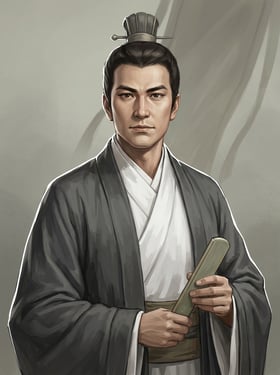
Historical Record
Mao Jie, styled Xiaoxian, was a man of Pingqiu in Chenliu. In his youth he served as a clerk in the county, known for his integrity and fairness. When the realm fell into chaos, Mao Jie intended to take refuge in Jing Province, but on hearing that Liu Biao governed poorly, he turned instead to Luyang. When Cao Cao occupied Yanzhou, he recruited Mao Jie as Attendant Officer of the Headquarters c:5808.
Mao Jie counseled Cao Cao, pointing out that at the time the realm was disintegrating, the ruler of the state was a wandering fugitive, the common people were without occupation, and amid famine and flight, the state had no lasting reserves and the people no settled will, so the situation could not endure. He held that, although Yuan Shao and Liu Biao had numerous and strong officials and people, they both lacked far-reaching plans and had failed to establish a firm foundation. Mao Jie stressed that in using troops one must hold to righteousness to prevail, while to secure one's position one needs material resources. He therefore advised Cao Cao to receive the Son of Heaven and command the unsubmissive in his name, while at the same time tending farming and storing up military provisions; in this way the enterprise of a hegemon-king could be achieved. Cao Cao deeply approved of Mao Jie's advice and adopted his strategy, subsequently appointing Mao Jie as Merit Officer of the Headquarters c:5808.
During the time Cao Cao served as Minister of Works and Chancellor, Mao Jie held the post of Eastern Bureau Aide, and together with Cui Yan was in charge of selecting talent. Those officials he recommended were all upright men, and even those of great renown but flawed conduct in the end could not gain appointment. Mao Jie disciplined himself with frugality and held others to the same standard, so that the scholars of the realm all strove to be incorruptible. Even favored noble ministers did not dare to exceed the rules in their carriages, horses, and dress. Cao Cao sighed over this: "To employ men in this way, so that the people of the realm govern themselves—what is left for me to do!" c:2614 When Cao Pi was established as General of the Five Officials, he personally called on Mao Jie to commend a close associate to him. Mao Jie replied: "That this old subject can hold to his office is already a stroke of fortune in escaping disaster; now the man you speak of does not accord with the order of promotion, and therefore I dare not obey the command." c:2614
After Cao Cao's great army returned to Ye, there was discussion of merging the offices. Because of Mao Jie's reputation for integrity, no one at the time dared lightly to offend him, and all wished to abolish the Eastern Bureau. So they jointly memorialized: "Under the old system the Western Bureau ranks above and the Eastern Bureau below; it is fitting to abolish the Eastern Bureau." Cao Cao understood their intent well, and issued an order: "The sun rises in the east, the moon is fullest in the east, and when ordinary people speak of directions they always name the east first—why abolish the Eastern Bureau?" In the end the Western Bureau was abolished c:2614.
After Cao Cao pacified Liucheng, he distributed the captured goods among his officials, deliberately bestowing on Mao Jie a plain screen and a plain armrest, and saying: "You have the air of the ancients, so I bestow on you the things of the ancients." Mao Jie, though holding high office, often wore cloth garments and ate coarse fare; he raised his orphaned nephews with great devotion, used all the rewards he received to relieve poor kinsmen, and kept not the slightest surplus wealth at home. He was later promoted to Right Army Counselor. At the founding of the state of Wei, Mao Jie served as Vice Director of the Imperial Secretariat and once again took charge of selecting talent. Refined, upright, and incorruptible, scrupulous in office, he selected men of integrity and substance, rejected the false and showy, promoted the modest in conduct, and suppressed those who formed cliques for private gain. Those officials whose governance produced no distinction but whose private wealth was abundant were all dismissed and barred, long kept from selection. The customs of the realm changed for this reason, and scholars all spurred themselves to incorruptibility. There were even senior officials who, returning to their hometowns, had dirty faces and ragged clothes and often rode plain firewood carts; military officials entering the headquarters wore only their court robes and went on foot. People likened themselves to "the cleanliness of a pot of plain food," and household after household imitated the "conduct of washing one's cap-strings"; the noble had no vice of greed, the poor and humble cut off corrupt seeking, officials were incorrupt above and customs changed below, and the people praise him to this day c:12497.
When the position of crown prince was not yet settled, the Marquis of Linzi, Cao Zhi, was much favored. Mao Jie secretly admonished Cao Cao: "Of late Yuan Shao, by failing to distinguish the legitimate from the secondary, brought about the ruin of his clan and the destruction of his state. The deposing and establishing of a crown prince is a great affair of state, and ought not to be lightly noised abroad." Later, when the assembled ministers gathered, Mao Jie rose to change his clothes, and Cao Cao pointed at him and said to all: "This is what the ancients called the upright officer of the state, my own Zhou Chang." c:12497
However, Mao Jie was finally imprisoned for words that offended Cao Cao. He once submitted a memorial in his own defense, citing the fates of such men as Xiao Sheng, Jia Yi, Bai Qi, Chao Cuo, and Wu Yuan, pointing out that he might be harmed through envy or slander. He stated that he had served as an official from youth, exhausting his loyalty in his duties, but that human nature is greedy for profit, the law forbids in matters of profit, and power can harm men. He held that "green flies swarm forth, slandering the subject," and that those slandering him were no others. He asked that Cao Cao, like Xuanzi judging fairly the dispute of Wang Shu and Chen Sheng, clearly discern right from wrong. He even declared that if he were indeed at fault, then even if put to punishment he would gladly accept it c:12498.
In the Novel
In Romance of the Three Kingdoms, Mao Jie's entry differs slightly from historical fact: he was not directly recruited by Cao Cao as Attendant Officer, but entered Cao Cao's headquarters through several layers of recommendation c:5809. In Chapter 10, as Cao Cao gathered worthies and recruited scholars, Xun Yu recommended Cheng Yu to Cao Cao, Cheng Yu recommended Guo Jia, and Guo Jia recommended Liu Ye. Liu Ye further recommended Man Chong and Lu Qian, and finally Man Chong and Lu Qian together recommended Mao Jie, a man of Pingqiu in Chenliu, whereupon Cao Cao engaged him as an Attendant Officer c:5809. This differs from the historical record of Mao Jie being directly recruited by Cao Cao; through layers of recommendation the novel highlights Cao Cao's thirst for talent and indirectly elevates Mao Jie's repute.
In the novel, Mao Jie's changes of office also intersect with historical fact. In Chapter 14, after Cao Cao styled himself Grand General and Marquis of Wuping, Mao Jie and Ren Jun were together appointed Agriculture Commandants, in charge of urging on the collection of money and grain c:5810. In Chapter 39, when Cao Cao abolished the Three Excellencies and concurrently held the office of Chancellor, Mao Jie was appointed Eastern Bureau Aide, ranked alongside Cui Yan, while Sima Yi served as Literary Aide c:5811. This accords with the historical record of Mao Jie serving as Eastern Bureau Aide and taking charge of selection together with Cui Yan, but the novel places Sima Yi in the same period, adding interaction among the figures.
Mao Jie in the novel also displays a certain military insight. In Chapter 24, while Cao Cao was on the march, a fierce wind broke the staff banner, and Mao Jie and Xun Yu, without prior consultation, both judged that Liu Bei would surely come that night to raid the camp c:2616. This shows Mao Jie's acuity in military judgment; though there is no such specific record in historical fact, it accords with his characterization as "refined, clear, and fair."
On the eve of the Battle of Red Cliffs, Mao Jie's status as commander of the naval forces is given prominent mention in the novel. After Cao Cao mistakenly executed Cai Mao and Zhang Yun, in order to steady the morale of his troops, he appointed Mao Jie and Yu Jin as commanders of the naval forces to replace Cai and Zhang c:5812. When Lu Su visited Zhuge Liang, Zhuge Liang at a glance saw through Zhou Yu's "stratagem of sowing discord" and predicted: "I hear that Cao Cao has replaced them with Mao Jie and Yu Jin as commanders of the naval forces; in the hands of these two, the lives of the naval forces will be thrown away one way or another." c:5813 Although this is Zhuge Liang's prediction, it also reflects from the side Mao Jie's important position in Cao Cao's naval forces. In Chapter 48, Mao Jie and Yu Jin together reported to Cao Cao that the ships large and small had been linked and made ready, the banners and weapons of war complete, and asked the Chancellor to direct the advance c:5814. These episodes have no clear basis in historical fact and are literary creations by the novel to enrich the detail and character interactions of the Battle of Red Cliffs.
Key Relationships
* Cao Cao (advises_in): Mao Jie was an important strategist and official of Cao Cao. He put to Cao Cao the hegemon-king strategy of "receiving the Son of Heaven to command the unsubmissive, tending farming, and storing military provisions" c:5808, and long took charge of selecting upright men, deeply respected and trusted by Cao Cao, who praised him as "the upright officer of the state, my own Zhou Chang" c:12497. In the novel, Mao Jie also repeatedly counseled Cao Cao or reported on military matters c:2616.
* Cui Yan (friend_of): In historical fact, Mao Jie and Cui Yan once together served as Eastern Bureau Aides, jointly in charge of selecting talent, all those they recommended being upright men c:2614. The two were like-minded colleagues in the Cao Wei regime.
* Cao Wei (serves): Mao Jie devoted his life to serving the Cao Wei regime, following Cao Cao from the early days of his enterprise, holding in succession the posts of Attendant Officer, Merit Officer of the Headquarters, Eastern Bureau Aide, Right Army Counselor, and Vice Director of the Imperial Secretariat, an important founder and administrator of the Cao Wei regime c:5808, c:12497.
* Cao Pi (enemy_of): In historical fact, when Cao Pi was General of the Five Officials, he personally asked Mao Jie to secure an office for a close associate, but was refused by Mao Jie on the grounds that it did not accord with the rules c:2614. This shows Mao Jie's incorruptible uprightness, but may also have offended Cao Pi, foreshadowing his later misfortunes. Mao Jie was finally imprisoned for words that offended Cao Cao, and this may also have involved the influence of Cao Pi's faction; though the histories do not say that Cao Pi was directly involved, Mao Jie's closeness to Cao Zhi (admonishing Cao Cao not to imitate Yuan Shao's deposing and establishing) may have aggravated his conflict with Cao Pi c:12497.
* Xun Yu (recommendation): In the novel, Mao Jie entered Cao Cao's headquarters only through the several layers of recommendation by Xun Yu, Cheng Yu, Guo Jia, Liu Ye, Man Chong, and Lu Qian c:5809 (Novel only).
* Yu Jin (colleague): In the novel, Mao Jie and Yu Jin were together appointed commanders of the naval forces, jointly in charge of Cao Cao's naval affairs c:5812 (Novel only).
Signature Scenes
* Offering Cao Cao the Strategy to Found His Enterprise: When Mao Jie first joined Cao Cao, he put forward the strategic policy of "receiving the Son of Heaven to command the unsubmissive, tending farming, and storing military provisions," pointing the way for Cao Cao to lay the foundation of hegemony, deeply praised and adopted by Cao Cao c:5808. This was the beginning of Mao Jie's political career and a manifestation of his wisdom.
* Selecting the Upright, Bringing Incorruptibility to the Realm: Mao Jie and Cui Yan together took charge of selecting talent, holding to the principle of "promoting the upright and substantial, rejecting the showy and false, advancing the modest in conduct, and suppressing those who form cliques," so that the atmosphere of Cao Wei officialdom was renewed and the scholars of the realm all spurred themselves to incorruptibility. Cao Cao sighed over this: "To employ men in this way, so that the people of the realm govern themselves—what is left for me to do!" c:12497 This scene fully displays Mao Jie's character as "refined, clear, and fair, scrupulous, frugal, and exemplary."
* Refusing Cao Pi's Request: When Cao Pi was General of the Five Officials, he personally asked Mao Jie to secure an office for a close associate. Unafraid of power, Mao Jie refused on the grounds that "the man you speak of does not accord with the order of promotion, and therefore I dare not obey the command" c:2614. This embodies his adherence to fairness, selflessness, and refusal of favoritism.
* Admonishing on the Position of Crown Prince: When Cao Cao hesitated over the choice of crown prince, Mao Jie secretly admonished him, taking Yuan Shao's failure to distinguish the legitimate from the secondary as a warning, and urging Cao Cao to treat the great matter of deposing and establishing with caution c:12497. This act displays Mao Jie's far-reaching consideration for the state and his responsibility as "the upright officer of the state."
* Serving as Commander of the Naval Forces Before Red Cliffs: In Romance of the Three Kingdoms, after Cao Cao mistakenly executed Cai Mao and Zhang Yun, he appointed Mao Jie and Yu Jin as commanders of the naval forces, jointly in charge of naval affairs c:5812. Though this episode is fiction of the novel, placing Mao Jie at the critical moment of the great battle of Red Cliffs highlights his importance in Cao Cao's camp (Novel only).
* Warning of a Camp Raid by the Fierce Wind: In Romance of the Three Kingdoms, when a fierce wind broke the staff banner during Cao Cao's march, Mao Jie and Xun Yu simultaneously judged that Liu Bei would raid the camp c:2616. This scene displays Mao Jie's keen military insight (Novel only).
* Self-Defense in Prison: In his later years, Mao Jie was imprisoned for words that offended Cao Cao; he submitted a memorial in his own defense, citing the fates of the ancients and asking Cao Cao to discern right from wrong clearly c:12498. This scene displays Mao Jie's integrity and eloquence undimmed even in adversity.
Portrait file
Character profile
- Character
- Mao Jie was refined, upright, and impartial, pure and frugal, leading by his own restraint. In charge of appointments, he promoted the honest and substantial, rejected the flashy and false, and curbed factional cliques. Firm and unbending, keeping few partisans, he held office in the time of Cao Wei and esteemed men of pure and plain conduct.
- Manner of speech
- Mao Jie's manner of speech was concise and pointed; he was adept at citing ancient precedents and remonstrating with blunt candor.
- Life
- Mao Jie was a man of Pingqiu in Chenliu. In his youth he served as a county clerk, known for his integrity and fairness. He originally meant to flee the turmoil to Jing Province, but upon hearing that Liu Biao's governance was unclear, he went instead to Luyang. Cao Cao recruited him as an Attendant Officer of the Bureau of Merit; he advised "revere the Son of Heaven to command the unsubmissive," and together with Cui Yan took charge of appointments, recommending only pure and upright men. When the state of Wei was first established, he served as Vice Director of the Masters of Writing, again managing appointments. After Cui Yan's death, Mao Jie was falsely accused over his words, imprisoned, and dismissed, and finally died at home.
- Anecdotes
- Mao Jie was Cao Cao's Attendant Officer of the Bureau of Merit, Eastern Section clerk, and Vice Director of the Masters of Writing, and strongly advocated "revere the Son of Heaven to command the unsubmissive." He once served alongside Ren Jun as Agricultural Commandant of the Household, pressing the collection of money and grain, and is also mentioned as one of Cao Cao's strategists, joining Xun Yu in reading the omens for a night raid on the enemy camp. In the Romance, he was appointed Commander of the Navy and took part in rescuing Wen Ping amid the fire-filled forest.
Relationships
10 relationships
Quotes
7 recorded lines · 3 featured
今天下分崩,國主遷移,生民废業,饥馑流亡,公家無經歲之儲,百姓無安固之志,難以持久。今袁紹、劉表,雖士民眾强,皆無經遠之虑,未有树基建本者也。夫兵義者勝,守位以財,宜奉天子以令不臣,脩耕植,畜軍资,如此則霸王之業可成也。
This remark laid the strategic foundation for Cao Cao's policy of 'holding the Son of Heaven to command the lords,' with far-reaching influence.
近者袁紹以嫡庶不分,覆宗灭國。废立大事,非所宜聞。
Citing Yuan Shao as an example, Mao Jie warns Cao Cao of the gravity of establishing an heir, reflecting his political foresight.
臣聞萧生缢死,困於石顯;贾子放外,谗在绛、灌;白起賜劍於杜郵;晁错致誅於東市;伍员绝命於吴都:斯數子者,或妒其前,或害其后。……乞蒙宣子之辨,而求王叔之對。若臣以曲聞,即刑之日,方之安驷之赠;賜劍之來,比之重赏之惠。谨以狀對。
This memorial is fierce in its wording, displaying Mao Jie's upright, incorruptible character and his willingness to remonstrate frankly.
Chapters10 回 ▸
- 史ch.12ch.22ch.23
- 演ch.10ch.14ch.24ch.39ch.45ch.46ch.48
Relationship timeline3 条 ▸
Inner monologues · AI-generated3 段 ▸
- I am Mao Jie, courtesy name Xiaoxian. Though I held a high position, all I upheld was integrity, frugality, and fairness
- I am Mao Jie, courtesy name Xiaoxian. Looking back on what I upheld throughout my life, it was no more than to fulfill m
- I am Mao Jie, courtesy name Xiaoxian, from Pingqiu County in Chenliu. In my youth, I served as a county clerk. I sought
Life events3 ▸
- 0192-01-01 · JuanchengMao Jie Advocates the Strategy of Serving the Emperor· Advisor
- 0196-01-01 · XuchangCao Cao Receives and Serves the Emperor· Advisor
- 0208-01-01 · XuchangCao Cao Abolishes the Three Excellencies and Appoints Himself Chancellor· Advisor