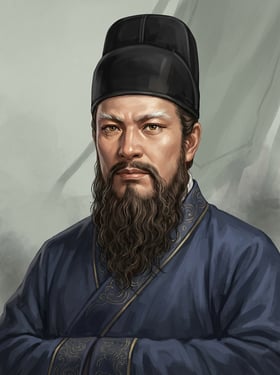
Historical Record
Cui Yan, styled Jigui, was a native of Dongwucheng in Qinghe. He was famed in his time for his lofty character and outstanding powers of discernment. Yuan Shao once conscripted Cui Yan as commandant of cavalry. During Yuan Shao's rule, Cui Yan repeatedly offered remonstrance. When the soldiers ran rampant, digging up tombs and mounds, Cui Yan admonished Yuan Shao that he ought to "cover the bones and bury the corpses, to show grieving compassion and pursue the benevolence of King Wen" c:5224. When Yuan Shao mustered troops at Liyang and wished to attack Xu, Cui Yan again remonstrated, saying, "The Son of Heaven is at Xu, and the hopes of the people aid the compliant; it is better to guard the borders and attend to one's duties, so as to bring peace to the realm"—but Yuan Shao would not listen, and was finally defeated at Guandu c:5224. After Yuan Shao died, his two sons vied for power, and both wished to obtain Cui Yan; Cui Yan firmly declined on the pretext of illness, and was therefore convicted and imprisoned, escaping only through the efforts of Yin Kui and Chen Lin c:5224.
After Cao Cao smashed the Yuan clan, he appointed Cui Yan as aide-de-camp attendant-clerk of Jizhou. Cao Cao once expressed satisfaction that the household registers of Jizhou amounted to as many as three hundred thousand, but Cui Yan bluntly said: "Now the realm is rent asunder and the Nine Provinces split apart; the two Yuan brothers have personally taken up arms against each other, and the common people of Jizhou lie with their bones exposed in the wilds. I have not heard that the royal army's benevolent reputation led the way, inquiring after the customs and rescuing the people from their misery; instead, the reckoning of soldiers and arms is given first priority—is this what the gentlemen and ladies of this humble province hope for from your enlightened lordship?" Hearing this, Cao Cao changed countenance and apologized to him, and all the guests present were dismayed c:5225. When Cao Cao campaigned against Bing Province, Cui Yan was left behind to assist Cao Pi. Cao Pi repeatedly went out hunting, and Cui Yan wrote letters to admonish him c:1521.
When Cao Cao was chancellor, Cui Yan was appointed to the staff of the Eastern and Western Bureaus and recruiting officer. Cao Cao once praised Cui Yan as having "the manner of Bo Yi and the uprightness of Shi Yu—the greedy admire his name and become pure, the brave esteem his fame and grow resolute; such a man can lead the age" c:1522. After the state of Wei was established, Cui Yan was appointed master of writing. At that time Cao Cao was hesitant on the question of establishing an heir and secretly sought the opinions of his ministers. Cui Yan, however, openly declared: "I have heard that by the principle of the Spring and Autumn, one establishes the eldest son as heir; moreover the General of the Five Officials is benevolent, filial, intelligent, and bright, and ought to inherit the orthodox succession. I, Yan, will defend this to the death"—firmly supporting the eldest son, Cao Pi c:1522. Cui Yan's niece's husband was Cao Zhi, yet he was still able to uphold a public-minded fairness, and Cao Cao therefore marveled at his "impartiality and integrity" and promoted him to commandant c:1522.
Cui Yan was tall of stature, with clear brows and eyes and a beard four feet long, extremely awe-inspiring; the court officials all revered him, and even Cao Cao stood in awe of him c:10249. Pure, loyal, lofty, and bright, of refined learning and far-reaching insight, upholding rectitude and the direct way, stern in his bearing at court, in the early founding of Wei he was in charge of the selection of talent, and over the course of more than ten years he promoted many civil and military talents c:10249. He once recommended Yang Xun, who later composed a memorial for the King of Wei, Cao Cao, extolling his merits and virtues. Cui Yan took the draft of the memorial from Yang Xun to read, and wrote a letter saying: "Having read the memorial—the affair is fine indeed! Times, oh times! There will surely come a time of change." His original intent was to satirize those critics who delight in censuring others without seeking out reason and principle. However, someone denounced this letter of Cui Yan's as disdaining the age and harboring grievance and slander; Cao Cao flew into a rage, holding that "merely begot a daughter" and "there will surely come a time of change" implied insolence, and so punished Cui Yan with penal servitude c:10249. Though Cui Yan had been sentenced, guests still filled his gate, and he stared at them with his curling beard, as if in anger. Cao Cao therefore ordered Cui Yan to die c:10249.
Cui Yan was on good terms with Sima Lang, and once appraised Sima Yi, saying: "Your younger brother is wise, discerning, clear, and trustworthy, firm in decision and outstandingly upright—surely beyond what you can match." c:1523 He also once predicted of his cousin Cui Lin, "This is what is called a great vessel that matures late; in the end he will surely go far," and later Cui Lin indeed rose to the highest offices. He also had much praise for Sun Li and Lu Yu of Zhuo Commandery, holding that they were all talents fit for high office c:1523. Cui Yan's discernment and earnest sense of duty are evident from this. He raised the orphans of his friends Gongsun Yu and Song Jie, his kindness to them as if to his own children c:1523.
In the Novel
In the Romance of the Three Kingdoms, Cui Yan's image basically accords with the historical facts, but with some dramatized episodes and dialogue added to highlight his loyal and upright character. He first appears after Cao Cao captured Jizhou. After Xu Chu was rebuked by Cao Cao for killing Xu You, Cao Cao began to seek out the worthies of Jizhou far and wide. The people of Jizhou recommended to Cao Cao the commandant of cavalry Cui Yan, saying that he "had several times offered counsel to Yuan Shao, but Yuan Shao did not follow it, and so he pleaded illness and stayed at home" c:5226.
Cao Cao summoned Cui Yan as aide-de-camp attendant-clerk of the province, and expressed satisfaction that the household registers of Jizhou amounted to as many as three hundred thousand. Cui Yan then bluntly pointed out: "Now the realm is rent asunder and the Nine Provinces split apart; the two Yuan brothers contend with each other, and the people of Jizhou lie with their bones exposed in the wilds. The chancellor does not urgently inquire after the customs and rescue the people from their misery, but first reckons up the household registers—is this what the gentlemen and ladies of this province hope for from your enlightened lordship?" c:5227 This dialogue basically accords with the historical record, but the novel, through a more direct mode of dialogue, intensifies Cui Yan's blunt and forthright image.
After Cao Cao abolished the offices of the Three Excellencies and held the post of chancellor himself, Cui Yan was appointed to the staff of the Western Bureau, assisting Cao Cao together with Mao Jie (staff of the Eastern Bureau) and Sima Yi (literary staff) c:5228. This accords with the historical record that Cui Yan once served on the staff of the Eastern and Western Bureaus, but the specific time of appointment and the combination of colleagues have been adjusted in the novel.
Cui Yan's end in the novel is also more tragic. When the civil and military officials discussed honoring Cao Cao as King of Wei, the master of writing Cui Yan "argued forcefully that it must not be done" c:1528. Someone at odds with Cui Yan reported to Cao Cao his words: "The time! The time! There will surely come a change! Let things take their own course!" Cao Cao flew into a rage and had Cui Yan arrested and imprisoned. In prison, Cui Yan, "with tiger's eyes and curling whiskers, only cursed Cao Cao loudly as a sovereign-deceiving traitor." In the end, Cao Cao ordered Cui Yan beaten to death in prison c:1528. In the historical sources, this is the episode in which Cui Yan was punished with penal servitude for "harboring inward slander," and was later granted death—or took his own life—because his "curling whiskers and direct stare seemed inwardly discontented" c:10249. The novel attributes Cui Yan's death directly to his opposition to Cao Cao's becoming king and his face-to-face reviling, making his image still more tragic and loyally heroic, and more emotionally compelling in literary terms.
Key Relationships
* Yuan Shao's Faction: Cui Yan once served under Yuan Shao as commandant of cavalry and repeatedly offered remonstrance to Yuan Shao, but Yuan Shao mostly would not heed it c:5224. After Yuan Shao died, his two sons vied for Cui Yan, and Cui Yan firmly declined on the pretext of illness, and was therefore convicted and imprisoned c:5224.
* Cao Wei: After Cao Cao captured Jizhou, Cui Yan was recruited as aide-de-camp attendant-clerk, later serving on the staff of the Eastern and Western Bureaus and as recruiting officer; after the state of Wei was established, he served as master of writing and commandant c:5225, c:1522. With his impartial and upright character, he played an important role in the Cao Wei regime.
* Cao Pi: Cui Yan once assisted Cao Pi, and when Cao Cao hesitated over establishing an heir, he strongly advocated establishing Cao Pi as heir apparent c:1521, c:1522.
* Bing Yuan: Cui Yan once recommended Bing Yuan as a recruiting officer, praising him as one who "holds to virtue pure and excellent, his aims and conduct loyal and upright; his calm is enough to reform customs, his firmness enough to accomplish affairs—what is called dragon's pinion and phoenix's wing, a precious treasure of the state" c:1520.
* Sima Lang and Sima Yi: Cui Yan was on good terms with Sima Lang, and highly appraised Sima Yi as "wise, discerning, clear, and trustworthy, firm in decision and outstandingly upright—surely beyond what you can match" c:1523.
* Cui Lin, Sun Li, Lu Yu: Cui Yan showed appreciative recognition to his cousin Cui Lin as well as to Sun Li and Lu Yu, predicting that they would each be a "great vessel that matures late" or a "talent fit for high office," and later they all rose to the highest posts c:1523.
* Gongsun Yu, Song Jie: Cui Yan raised their orphans, his kindness as if to his own children, embodying his earnest sense of duty c:1523.
* Yang Xun: Cui Yan once recommended Yang Xun, and later, because Yang Xun composed a memorial for Cao Cao, Cui Yan's appraisal of his words was misunderstood, ultimately leading to his conviction c:10249.
Iconic Scenes
* Remonstrating with Yuan Shao to no avail: When Yuan Shao mustered troops at Liyang, Cui Yan remonstrated, saying, "The Son of Heaven is at Xu, and the hopes of the people aid the compliant; it is better to guard the borders and attend to one's duties, so as to bring peace to the realm"—but Yuan Shao would not listen, and was finally defeated at Guandu c:5224.
* The debate over the household registers of Jizhou: After Cao Cao took Jizhou and was pleased that the household registers amounted to as many as three hundred thousand, Cui Yan bluntly said that Cao Cao had not first inquired after the customs and rescued the people from their misery, but instead first reckoned up the household registers, which was not what the gentlemen and ladies of Jizhou hoped for c:5225, c:5227. Hearing this, Cao Cao changed countenance and apologized, and the guests were all dismayed; this act manifested Cui Yan's purity, rectitude, and daring.
* Strongly advocating Cao Pi as heir: When Cao Cao hesitated over establishing an heir, Cui Yan, disregarding the fact that Cao Zhi was his niece's husband, openly submitted a memorial strongly advocating "establishing the eldest son," supporting Cao Pi as heir apparent, and saying, "I, Yan, will defend this to the death" c:1522. Cao Cao valued his impartiality and sighed with feeling.
* Convicted for his words: Cui Yan's appraisal of Yang Xun's memorial—"Having read the memorial—the affair is fine indeed! Times, oh times! There will surely come a time of change"—was misconstrued as "disdaining the age and harboring grievance and slander"; Cao Cao flew into a rage and punished him with penal servitude, finally granting him death c:10249.
* Reviling Cao Cao in prison (novel only): In the Romance of the Three Kingdoms, because Cui Yan opposed Cao Cao's becoming King of Wei, he was arrested and imprisoned. In prison, "with tiger's eyes and curling whiskers, he only cursed Cao Cao loudly as a sovereign-deceiving traitor," and was finally ordered by Cao Cao to be beaten to death c:1528. This scene greatly intensifies Cui Yan's image as loyal, heroic, and unyielding.
Portrait file
Character profile
- Appearance
- His voice and bearing were resonant and free, his brows and eyes clear and open, his beard four chi long—of great dignity and gravity. He had tiger-like eyes and a curling beard.
- Character
- Fair-minded and honest, of pure loyalty and high integrity, of refined and far-seeing discernment, and stern of countenance at court; sound in judgment and steadfast in righteousness. He remonstrated frankly, was firm and unbending by nature, and loyal at heart to the Han sovereign.
- Manner of speech
- Grave and direct in remonstrance, he often cited the classics (the Analects, the Spring and Autumn Annals, the Book of Songs, the Book of Documents), and his words and manner never yielded. His sharp reproaches ran in long sentences, including the discourse on "the Nine Provinces torn asunder."
- Life
- A native of Dongwucheng in Qinghe. In his youth he was plain and reticent and fond of swordplay; at twenty-three he first read the Analects and the Han Odes, and at twenty-nine he studied under Zheng Xuan. He traveled through Qing, Xu, Yan, and Yu. Yuan Shao recruited him as Commandant of Cavalry, and after Cao Cao defeated the Yuan clan he recruited him as Attendant Officer and Aide-de-camp; he then successively held the posts of Officer of the Eastern and Western Bureaus, Master of Writing, and Commandant of the Capital. Because his recommendation of Yang Xun drew slander, he was punished and made a convict laborer, and in the end the Grand Progenitor bestowed death upon him.
- Anecdotes
- A renowned gentleman of Jizhou, a subordinate of Cao Cao, Officer of the Eastern Bureau, Master of Writing, and Commandant of the Capital. He recommended the Summoned Officer Bing Yuan and the Court Gentleman for Consultation Zhang Fan as "dragon's plumes and phoenix's wings, precious treasures of the state." He recommended Lu Yu as Registrar of Jizhou, who came to office in Emperor Wu's time, a man esteemed for his purity and simplicity.
Relationships
16 relationships
Quotes
11 recorded lines · 3 featured
今天下分崩,九州幅裂,二袁兄弟親尋干戈,冀方蒸庶暴骨原野。未聞王師仁聲先路,存問風俗,救其塗炭,而校計甲兵,唯此爲先,斯豈鄙州士女所望於明公哉!
These words embody Cui Yan's character of forthright, fearless remonstrance and also reflect the social reality of the wars of the time.
蓋聞春秋之義,立子以長,加五官將仁孝聰明,宜承正統。琰以死守之。
These words embody Cui Yan's insistence on the Confucian principle of establishing an heir, exerting an important influence on the succession of the Cao Wei regime.
此所謂大器晚成者也,終必遠至。
These words became a widely circulated idiom, describing how those of great talent achieve success and renown later in life.
Chapters7 回 ▸
- 史ch.11ch.12ch.22ch.24
- 演ch.33ch.39ch.68
Relationship timeline9 条 ▸
Inner monologues · AI-generated3 段 ▸
- I am Cui Yan, styled Jigui. When I reflect on how I conducted myself throughout my life, I did no more than uphold integ
- I recall what I heard and saw in my youth. As the age grew increasingly turbulent, ritual and righteousness were not thi
- After Taizu defeated the Yuan family and took up the post of governor of Jizhou, he recruited me to serve as an assistan
Life events5 ▸
- 0208-01-01 · XuchangCao Cao Abolishes the Three Excellencies and Appoints Himself Chancellor· Advisor
- 0213-01-01 · YeCui Yan Publicly Endorses Cao Pi as Heir· Instigator
- 0216-01-01 · YeDeath of Cui Yan· Victim
- 0216-01-01 · YeThe Cui Yan Affair· Victim
- 0216-01-01 · YeCao Cao Created King of Wei· Victim