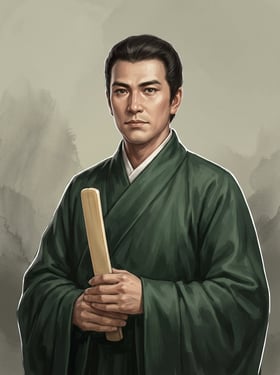
Historical Record
Chen Qun, courtesy name Changwen, was a native of Xu Chang in Yingchuan. His grandfather Chen Shi, his father Chen Ji, and his uncle Chen Chen all enjoyed great renown, and were known to the age as the "Three Lords". In his childhood Chen Qun was regarded by his grandfather Chen Shi as the one who would bring prosperity to the family. He was on good terms with Kong Rong of Lu; Kong Rong even paid Chen Qun's father Chen Ji the ceremony of obeisance, and by this Chen Qun became renowned. When Liu Bei governed Yu Province, he recruited Chen Qun as Aide-de-camp. After Tao Qian died and Xu Province welcomed Liu Bei, Chen Qun dissuaded Liu Bei from advancing east, pointing out that Yuan Shu was still strong, and that if Lü Bu seized the opening, Liu Bei would accomplish nothing. Liu Bei did not heed his words, and indeed, while at war with Yuan Shu, he was attacked and lost Xiapi to Lü Bu, deeply regretting that he had not adopted Chen Qun's advice.
Cao Cao recruited Chen Qun as an aide of the Western Bureau under the Minister of Works. Chen Qun once returned Cao Cao's order unimplemented, holding that Wang Mo of Le'an and Zhou Kui of Xiapi were of corrupt character and would in the end ruin matters, but Cao Cao did not heed him. Later Mo and Kui were indeed executed for villainy, and Cao Cao apologized to Chen Qun for it. Chen Qun also recommended Chen Jiao of Guangling and Dai Qian of Danyang; Cao Cao adopted both, and the two later became famous ministers, so the age praised Chen Qun's discernment of men.
After the founding of the state of Wei, Chen Qun was promoted to Palace Aide to the Censor-in-Chief, and later transferred to Palace Attendant, concurrently serving as aide of the Eastern and Western Bureaus to the Chancellor. He held himself with fairness and impartiality at court, neither leaning to one side nor lending himself to improper ends, and deeply won the esteem of Emperor Wen, Cao Pi, who treated him with the courtesy of a friend. After Cao Pi took the title of King, he enfeoffed Chen Qun as Marquis of the Changwu Precinct, later promoting him to Master of Writing; the Nine-Rank System was instituted, and it was Chen Qun who proposed this law. After Cao Pi proclaimed himself emperor, Chen Qun was successively promoted to Vice Director of the Masters of Writing, Palace Attendant, and Director of the Masters of Writing, and advanced in rank to Marquis of Yingxiang. During the Huangchu era, when Emperor Wen wished to confer posthumous honors on the parents of the Empress Dowager, Chen Qun memorialized against it, holding that "there is no system of apportioning land and conferring rank upon a woman"; Emperor Wen adopted his counsel and had the edict stored in the archives as a permanent precedent for later generations.
After Emperor Ming, Cao Rui, ascended, Chen Qun was advanced in rank to Marquis of Yingyin, with an increase of five hundred households to his fief, and, together with Cao Xiu, Cao Zhen, and Sima Yi, was permitted to establish his own office. Soon he was promoted to Minister of Works while still overseeing the affairs of the Masters of Writing. During the Taihe era, when Cao Zhen wished to invade Shu by several routes, entering through the Xie Valley, Chen Qun dissuaded him on the grounds of the difficulty of transporting provisions and the hazards of the terrain that made advance and retreat alike difficult, and Emperor Ming adopted his counsel. When Cao Zhen further wished to invade Shu by the Ziwu Road, Chen Qun again set forth its disadvantages and proposed a plan for military expenditure, which Emperor Ming passed down to Cao Zhen. Later, when the rains lasted for days, Chen Qun advised recalling Cao Zhen, and Emperor Ming followed this.
Chen Qun was broad-minded and unboastful, never speaking of the faults of the sovereign. In Taizu's (Cao Cao's) time, when Liu Yi was to be executed because his younger brother had taken part in Wei Feng's conspiracy, Chen Qun pleaded for him, and Taizu pardoned Liu Yi. Liu Yi was deeply grateful for Chen Qun's kindness, but Chen Qun said: "To deliberate on punishment is for the state, not for private ends; moreover it was the intent of the enlightened sovereign—what part have I in it?" During his tenure he repeatedly submitted secret memorials, but each time he destroyed the drafts, so that neither his contemporaries nor his sons and juniors knew of his remonstrances. Only during the Zhengshi era, when an edict was issued to compile the memorials of the assembled ministers, did the courtiers come to see Chen Qun's remonstrances, and all sighed in admiration. In the fourth year of Qinglong, Chen Qun died and was given the posthumous title Marquis Jing. His son Chen Tai inherited his rank. Emperor Ming, recalling Chen Qun's merit and virtue, divided his fief of households and enfeoffed one of his sons as a full marquis.
In the Novel
In Romance of the Three Kingdoms, Chen Qun's image overlaps with history but is shaped more as a loyal minister who devised strategies for Cao Wei and assisted its young sovereign. He first appears in Chapter 58, advising Cao Cao to take advantage of the time when Liu Bei wished to take the Western Riverlands by sending troops to attack the Jiangnan region, forcing Sun Quan to seek help from Liu Bei, thereby pacifying Jiangdong and Jing Province and ultimately scheming for the Western Riverlands. Cao Cao greatly praised this plan, holding that "Changwen's words accord exactly with my own intent". This episode has no clear record in the histories and is a literary creation of the novel.
In the course of Cao Cao becoming King and Cao Pi supplanting the Han, Chen Qun repeatedly played important roles. In Chapter 78, when Sun Quan submitted and pledged allegiance to Cao Cao, Chen Qun, together with the Palace Attendants and others, memorialized urging Cao Cao to "respond to Heaven and accord with men, and promptly assume the great position", pressing Cao Cao to proclaim himself emperor. Although Cao Cao outwardly declined, he in fact harbored this intent. In Chapter 80, on Cao Pi supplanting the Han, when Emperor Xian of Han trembled in fear, Jia Xu advised him to issue an edict at once to settle the public mind; Emperor Xian then ordered Chen Qun to draft the edict of abdication, and Hua Xin bore the edict and seal to present them to Cao Pi. These episodes all highlight Chen Qun's active role in the founding and consolidation of the Cao Wei regime, especially in urging the accession and drafting the documents of abdication, further strengthening his image as a core strategist of Cao Wei.
In the scene of Cao Pi entrusting his orphan heir at his death, Chen Qun, together with Cao Zhen and Sima Yi, was summoned into the bedchamber to receive Cao Pi's dying edict and assist the young Cao Rui. This arrangement differs slightly from the historical record, in which Cao Pi entrusted his heir to Cao Zhen, Chen Qun, Cao Xiu, and Sima Yi; the novel omits Cao Xiu and places Sima Yi in a more prominent position. After Cao Pi died, Chen Qun was made Minister of Works and, together with Cao Zhen, Sima Yi, and others, installed Cao Rui as emperor.
In Chapter 106, when Sima Yi besieged Shangyong, Chen Qun (mistakenly written as "Sima Chen Qun" in the novel, but in fact Chen Qun) asked Sima Yi the meaning of his not attacking the city while letting the enemy gather firewood and graze. Sima Yi explained the principles of the art of war, and Chen Qun, having heard him, "bowed in admiration". Although this passage contains the mistaken name, it still displays Chen Qun's image as a strategist and his recognition of Sima Yi's military talent.
Key Relationships
* Cao Wei (serves): Chen Qun was loyal to the Cao Wei regime throughout his life. From Cao Cao's time he held important posts, and through the reigns of Cao Pi and Cao Rui ranked among the Three Excellencies—a key figure in the founding and consolidation of Cao Wei.
* Bao Xun (mentor_of): In the fourth year of Huangchu, the Director of the Masters of Writing Chen Qun, together with the Vice Director Sima Yi, recommended Bao Xun as Inspector of the Palace, and because of this all the officials held him in awe and none failed to be solemn before him. Bao Xun was later executed for offending Emperor Wen by remonstrating frankly; Chen Qun, together with the Grand Commandant Zhong Yao, the Minister over the Masses Hua Xin, and others, pleaded for him, but to no avail.
* Guo Jia (rival_of): Chen Qun once criticized Guo Jia for not regulating his conduct, repeatedly recounting Guo Jia's faults at court; yet Cao Cao, far from distancing himself from Guo Jia because of this, esteemed him all the more, while also admiring Chen Qun for upholding what was right.
* Chen Shi (kin_of): Chen Qun's grandfather Chen Shi was a famous upright official of the late Eastern Han and a man of lofty virtue and prestige; in childhood Chen Qun was held in high hopes by his grandfather Chen Shi, who believed he would surely bring prosperity to the family.
* Cao Cao (lord): Chen Qun served under Cao Cao in his early years; his advice was at times adopted by Cao Cao, and his frank speech also earned Cao Cao's esteem. In the novel, Chen Qun further offered strategies to Cao Cao to help him pacify the realm.
* Cao Pi (lord): Chen Qun deeply won Cao Pi's esteem; while Cao Pi was in the Eastern Palace he treated him with the courtesy of a friend. After Cao Pi became King and then emperor, Chen Qun was repeatedly promoted and received the dying edict to assist the young sovereign.
* Cao Rui (lord): As one of the ministers entrusted with the orphan heir, Chen Qun assisted Cao Rui's accession and continued to hold important posts such as Minister of Works.
* Sima Yi (colleague): Chen Qun and Sima Yi were both senior ministers of Cao Wei and together received Cao Pi's dying edict to assist the young sovereign. In the novel, Chen Qun once consulted Sima Yi on the art of war and bowed in admiration of his military talent (Novel only).
* Zhuge Liang (indirect contact): Chen Qun once exchanged letters with Zhuge Liang, asking after news of Liu Ba, calling him "Liu Junzichu" and expressing his esteem.
Iconic Scenes
* Dissuading Liu Bei from advancing east: When Liu Bei governed Yu Province, Chen Qun dissuaded him from advancing east into Xu Province, predicting that Lü Bu would seize the opening. Liu Bei did not heed him, and indeed lost Xiapi to Lü Bu, deeply regretting that he had not taken Chen Qun's advice. This episode displays Chen Qun's foresight.
* Instituting the Nine-Rank System: Chen Qun took charge of instituting the Nine-Rank System under the Cao Wei regime; this system had a profound influence on the selection of officials in later ages and is one of the most important contributions of his political career.
* Remonstrating against Emperor Wen's posthumous honors for the Empress Dowager's parents: When Emperor Wen Cao Pi wished to confer posthumous honors on the Empress Dowager's parents, Chen Qun remonstrated on the grounds that "there is no system of apportioning land and conferring rank upon a woman"; Emperor Wen adopted his counsel and had the edict made a permanent precedent. This act reflects Chen Qun's principle of upholding ritual law and not bending to private favor.
* Dissuading Cao Zhen from invading Shu: Faced with Cao Zhen's repeated plans to invade Shu, Chen Qun repeatedly dissuaded him on grounds such as the transport of provisions and the hazards of the terrain hindering advance, ultimately prompting Emperor Ming to adopt his counsel and recall Cao Zhen. This shows Chen Qun's prudence and foresight in military strategy.
* Cao Pi entrusting his orphan heir: When Cao Pi was gravely ill, he summoned Chen Qun together with Cao Zhen, Sima Yi, and other senior ministers to receive his dying edict and assist the heir Cao Rui. This scene highlights Chen Qun's core position in the Cao Wei regime and Cao Pi's trust in him.
* Advising Cao Cao to attack Jiangnan: In Romance of the Three Kingdoms, Chen Qun advised Cao Cao to take advantage of the time when Liu Bei schemed for the Western Riverlands by attacking Jiangnan, in order to pacify the realm. This plan greatly pleased Cao Cao and displayed Chen Qun's strategic talent (Novel only).
* Drafting the edict of abdication: In Romance of the Three Kingdoms, when Emperor Xian of Han was forced to abdicate to Cao Pi, he designated Chen Qun to draft the edict of abdication; this episode emphasizes Chen Qun's key role in the process of Cao Wei supplanting the Han (Novel only).
Portrait file
Character profile
- Character
- He held firmly to principle and reputation, was broadly learned yet never boastful, and did not speak of his sovereign's faults.
- Manner of speech
- He drew on the classics and precedents, and submitted memorials that admonished tactfully and to the point.
- Life
- Chen Qun was a man of Xuchang in Yingchuan; his grandfather was Chen Shi and his father Chen Ji. When Liu Bei governed Yu Province he appointed him Aide-de-camp; later Cao Cao recruited him as an assistant in the Western Bureau of the Excellency of Works, and he held many offices thereafter. He devised the Nine-Rank System, and under Emperor Wen of Wei, Cao Pi, he served as Prefect of the Masters of Writing and Marquis of Yingxiang, and, together with Sima Yi and others, received the testamentary charge to assist the government.
- Anecdotes
- He several times reproached Guo Jia at court for his lack of self-discipline in conduct. He was a ministerial pillar of Cao Wei and the originator of the Nine-Rank System.
Relationships
15 relationships
Family2
Lord & vassal2
Friends4
Enemies1
Teacher & student1
Other5
Quotes
7 recorded lines · 3 featured
「今劉備、孫權結為脣齒,若劉備欲取西川,丞相可命上將提兵,會合淝之眾,逕取江南,則孫權必求救於劉備。備意在西川,必無心救權;權無救則力乏兵衰,江東之地,必為丞相所得。若得江東,則荊州一鼓可平也。荊州既平,然後徐圖西川,天下定矣。」
This stratagem demonstrates Chen Qun's outstanding strategic vision, with a profound influence on the tripartite balance of the Three Kingdoms.
「漢室久已衰微,殿下功德巍巍,生靈仰望。今孫權稱臣歸命,此天人之應,異氣齊聲。殿下宜應天順人,早正大位。」
This remark is Chen Qun's key argument urging Cao Cao to claim the imperial throne, reflecting his political stance.
「陛下以聖德應運受命,創業革制,當永爲後式。案典籍之文,無婦人分土命爵之制。在禮典,婦因夫爵。秦違古法,漢氏因之,非先王之令典也。」
This remark reflects Chen Qun's commitment to ritual and legal institutions, which shaped the statutes and systems of Cao Wei.
Chapters12 回 ▸
- 史ch.2ch.3ch.5ch.12ch.14ch.22ch.38
- 演ch.58ch.78ch.80ch.91ch.106
Relationship timeline12 条 ▸
Inner monologues · AI-generated3 段 ▸
- I am Chen Qun, courtesy name Changwen. Whenever I reflect on the duties I have held throughout my life, I dare not judge
- I am Chen Qun, courtesy name Changwen, born in Xu Chang, Yingchuan. My grandfather Chen Shi, my father Chen Ji, and my u
- I recall that in the middle of Huangchu, Emperor Wen wished to posthumously ennoble the parents of the Empress Dowager.
Life events7 ▸
- 0219-01-01 · YeCase of Wei Feng's Conspiracy· Advisor
- 0220-01-01 · LuoyangNine-Rank System· Instigator
- 0220-01-01 · XuchangCao Pi Supplants the Han· Advisor
- 0220-01-01 · LuoyangDeath of Cao Cao· Witness
- 0220-01-01 · YeCao Cao Dies and Emperor Wen of Wei Ascends the Throne· Advisor
- 0230-01-01 · ChencangCao Zhen's Invasion of Shu· Advisor
- 0237-01-01 · LuoyangEmperor Ming of Wei's Lavish Palace Construction· Advisor