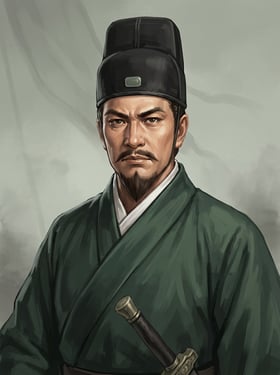
Historical Record
Sun Li, styled Deda, was a man of Rongcheng in Zhuo Commandery. After Cao Cao pacified You Province, he summoned Sun Li to serve as Military Planning Aide to the Minister of Works. In the early chaos of the realm, Sun Li had become separated from his mother. Ma Tai, of the same commandery, helped him find her, and Sun Li gave Ma Tai all the wealth in his household to show his gratitude. Later, when Ma Tai committed a crime punishable by death, Sun Li privately guided him to break out of prison and turn himself in. After surrendering, Ma Tai said: "I have no principle that would let me flee," and went straight to call on Wen Hui, the Registrar for Investigating Treachery. Wen Hui commended his conduct and reported the matter in full to Cao Cao, and in the end both Ma Tai and Sun Li had their sentences reduced by one degree.
Thereafter Sun Li was appointed Assistant to the Administrator of Hejian Commandery, and gradually rose to Commandant of Xingyang. Several hundred bandits in the Lushan region had seized strongholds and were harming the people; so Sun Li was transferred to be Chancellor of Lu. On taking office, he drew on his own salary, mobilized officials and commoners, offered rewards to recruit brave men, accepted those who came to surrender, and sent the surrendered as inside agents, soon pacifying the bandits and restoring order to the area. He successively served as Grand Administrator of Shanyang, Pingyuan, Pingchang, and Langya. When the Grand Marshal Cao Xiu campaigned against Eastern Wu and fought the Wu army at Jiashi, Sun Li had remonstrated that Cao Xiu should not advance deep, but Cao Xiu did not heed him and was ultimately defeated. Sun Li was later transferred to be Grand Administrator of Yangping, and entered the court to serve as Master of Writing.
When Emperor Ming of Wei was hunting on Mount Dashi, a tiger suddenly charged the imperial carriage. Sun Li at once cast aside his whip, dismounted, and made ready to draw his sword to slay the tiger; the emperor decreed that he remount. On his deathbed, the emperor appointed Cao Shuang as Grand General, holding that he needed worthy assistance, and so Sun Li received the dying edict at the emperor's bedside and was appointed Chief Clerk to the Grand General, with the added title of Cavalier Attendant-in-Ordinary. Sun Li was upright and unbending, and Cao Shuang did not like him, so he sent him out as Inspector of Yangzhou, with the added title of General Who Quells the Waves and the rank of Marquis Within the Passes. The Eastern Wu general Quan Cong led an army of tens of thousands to invade; at the time most of the Yangzhou soldiers were on leave and few remained in camp. Sun Li personally led the guards to resist, fighting the Wu army fiercely at Shaobei from morning until dusk, with more than half his officers and men dead or wounded. Sun Li charged into the fray amid the bare blades, his warhorse taking several wounds, holding the war-drum and giving no thought to himself, and in the end repelled the enemy. The court decreed condolences and rewards, granting him seven hundred bolts of silk. Sun Li held a sacrificial mourning for the fallen officers and men, his grief welling from the heart, and distributed all the silk to the families of the fallen, taking not a single bolt for himself.
Sun Li was later summoned to court as Privy Treasurer, then went out as Inspector of Jing Province, and afterward was transferred to be Governor of Jizhou. The Grand Tutor Sima Yi once said to Sun Li: "For eight years now the two commanderies of Qinghe and Pingyuan have disputed their boundary, and two inspectors have passed through without resolving it; the states of Yu and Rui awaited King Wen of Zhou before they were reconciled. You should mark out the boundary clearly." Sun Li replied: "The plaintiff relies on an old grave-site as evidence, and the one judging the suit takes the word of the elders; but the elders cannot be subjected to punishment, and old grave-sites are sometimes moved to higher ground, or moved to escape enemies. By what is now heard, even Gao Yao would find it hard to judge. If one wishes the dispute thoroughly resolved, it should be settled according to the map from when the Exalted Founder first enfeoffed Pingyuan. Why trace back ancient affairs and multiply the litigation? In the past King Cheng jested with Shu Yu using a paulownia leaf, and the Duke of Zhou thereupon enfeoffed him. Now the map is stored in the celestial treasury and can be decided right from one's seat—why wait until I take up the province?" Sima Yi said: "Just so. A separate map should be issued." After taking office, Sun Li judged from the map that the boundary should belong to Pingyuan. However, Cao Shuang heeded Qinghe Commandery's claim and decreed: "The map cannot be used; differing opinions should be consulted." Sun Li submitted a memorial saying: "Guan Zhong, as a hegemon's assistant, though small in capacity, was yet able to take the Pian fief from the Bo clan, so that he bore no resentment to the end of his life. I have received the heavy charge of a regional governor and, holding the sage court's clear map, verified the boundary on the ground—the boundary truly runs along the Wangweng River; yet Shu Commandery takes the Madan Marquis as proof and falsely claims the Mingdu River as the boundary. With their false litigation they have confused the court. I have heard that many mouths melt metal, that a floating stone may sink wood, that three men make a tiger, and that a loving mother will throw down her shuttle. The two commanderies have disputed their boundary for eight years, and the reason it can be resolved in a single day is that there are explanatory maps and pictures to consult and verify. But Shu Commandery will not accept the edict—this shows me to be weak and incapable and unfit for the task. With what face could I idly hold my post and draw its salary?" He then girded his belt and put on his shoes, mounted his carriage, and waited to be dismissed. When Cao Shuang saw Sun Li's memorial, he was furious, impeached Sun Li for harboring resentment, and sentenced him to five years' imprisonment. Sun Li stayed at home for a year, and as many people pleaded on his behalf, he was appointed Colonel of the City Gates.
At the time the Xiongnu king Liu Jing had a powerful following, and the Xianbei repeatedly invaded the frontier, so Sun Li was appointed Inspector of Bingzhou, with the added titles General Who Inspires Valor, holder of the tally, and Protector and General of the Household over the Xiongnu. When he went to take leave of the Grand Tutor Sima Yi, his face wore an angry look yet he said not a word. Sima Yi said: "Do you think Bingzhou too small? Or do you resent the loss when the boundary was divided? Now that we are about to part for distant places, why are you not pleased?" Sun Li said: "How can Your Excellency speak such perverse words! Though I am without virtue, would I take office and past affairs to heart? I had thought Your Excellency would follow in the steps of Yi Yin and Lü Shang, uphold the house of Wei, repay above the late emperor's charge to guard his orphan, and establish below merit for ten thousand generations. Now the altars of state are in peril, the realm is in turmoil—this is why I am not pleased." And with that his tears flowed freely. Sima Yi said: "Stop a while, and bear what cannot be borne." After Cao Shuang was executed, Sun Li entered the court as Colonel-Director of Retainers; he had governed seven commanderies and five provinces in all, and in each enjoyed authority. He was later transferred to be Minister of Works and enfeoffed as Marquis of Dali Pavilion, with a fief of one hundred households. Sun Li and Lu Yu were of the same commandery and the same era, but the two were not on good terms. Though each had his strengths and weaknesses as a man, they were roughly equal in repute and standing. In the second year of Jiaping, Sun Li died and was given the posthumous title of Marquis Jing. His son Sun Yuan inherited the rank.
In the Novel
In Romance of the Three Kingdoms, Sun Li's image centers mainly on his military talent and his loyalty to Wei, especially as displayed in his repeated engagements with Shu Han. He first appears when the Wei sovereign Cao Rui dispatched Zhang He together with Sima Yi to campaign against Shu Han, and Sun Li, together with Xin Pi, was ordered to lead fifty thousand troops to assist Cao Zhen.
During Cao Zhen's standoff with Zhuge Liang, Sun Li appears repeatedly as an important adviser and general of Cao Zhen. When Cao Zhen, resentful of Sima Yi seizing his merit, divided his forces and assigned Guo Huai and Sun Li to guard key positions, Sun Li's military standing is evident. At one important military council, facing the possibility that Zhuge Liang lacked provisions, Sun Li offered a plan, proposing to lead troops disguised as a grain convoy to Mount Qi, the carts loaded with dry firewood and thatch and soaked in sulfur and saltpeter, to lure the Shu army to seize the grain, then set fire to the carts and strike from within and without with ambush troops, in hope of a great victory. Cao Zhen greatly praised this plan and ordered Sun Li to carry it out. However, Zhuge Liang saw through the plan, pointing out that what Sun Li transported was not real grain but kindling, and in turn used the plan against him, leaving the Wei army to strike at nothing. This accords with the historical Sun Li's "upright and unbending" character, but the specific episode is a fictional invention of the novel.
After Sima Yi succeeded Cao Zhen in commanding the campaign against Shu, Sun Li and Guo Huai together reported the situation to Sima Yi. Sima Yi sent them by a back road to relieve the two commanderies of Wudu and Yinping and to seize the chance to strike the Shu army's rear. On the way, Guo Huai and Sun Li discussed the relative wits of Sima Yi and Zhuge Liang, and Sun Li held that "Kongming far surpasses Zhongda". However, Zhuge Liang again saw through Sima Yi's stratagem and seized Wudu and Yinping in advance. When Sun Li and Guo Huai learned the cities had already been taken and that the Shu army was still arrayed outside the walls, Sun Li alertly pointed out, "There must be a ruse; better to retreat quickly". Even so, they ultimately ran into Zhuge Liang's ambush and fled in great defeat. In the novel, Sun Li's caution and his recognition of Zhuge Liang's wits highlight his judgment as a general.
In the subsequent Battle of the Wei River, Sun Li and Guo Huai again advised Sima Yi, pointing out that if the Shu army crossed the Wei River and seized Beiyuan, it would cut off the Long Road, with grave consequences. Sima Yi adopted their advice and ordered Guo Huai to take overall command of the Longxi troops and to hold Beiyuan. When Sima Yi pursued Wei Yan and blundered into Shangfang Valley to be assailed by fire, Sun Li and Guo Huai were fighting the Shu army on the floating bridge; in the end Sima Yi and his sons escaped peril with the help of a downpour, joined forces with Sun Li and the others, and repelled the Shu army. The Sun Li of the novel, though repeatedly taking part in important battles, serves more as a general and adviser on the Cao Wei side, his personal achievements and character drawn less prominently and in less detail than in the histories—especially as the novel scarcely mentions his campaigns against Wu or his administrative achievements in governing localities.
Key Relationships
* Ma Tai (friend_of): Sun Li's relationship with Ma Tai is a notable episode of his early years. Ma Tai once helped Sun Li recover his lost mother, and Sun Li gave all his family wealth in return. Later, when Ma Tai broke the law and faced death, Sun Li contrived to help him surrender himself and pleaded with Wen Hui, so that in the end both had their sentences reduced. This reflects Sun Li's character of valuing loyalty and repaying kindness.
* Cao Wei (serves): Sun Li served the Cao Wei regime all his life, beginning as Military Planning Aide under Cao Cao and passing through the three reigns of Cao Pi, Cao Rui, and Cao Fang to rise to Minister of Works and Marquis of Dali Pavilion. In many posts he displayed outstanding military and administrative talent, an important pillar minister of Cao Wei.
* Cao Xiu (advises_in): Sun Li once served as an aide to the Grand Marshal Cao Xiu in his campaign against Eastern Wu. Before the Battle of Jiashi, Sun Li remonstrated that Cao Xiu should not advance deep, but Cao Xiu did not heed him and was ultimately defeated, showing Sun Li's foresight in military judgment.
* Cao Shuang (advises_in / conflict_with): On Emperor Ming's deathbed, Sun Li was appointed Chief Clerk to the Grand General to assist Cao Shuang. However, Sun Li's "upright and unbending" character clashed with Cao Shuang, who therefore sent him out of the capital. As Governor of Jizhou, Sun Li, insisting on deciding the boundary dispute between Qinghe and Pingyuan according to the map, clashed sharply with Cao Shuang and was impeached and sentenced by him. This highlights Sun Li's upright, fearless character before the powerful.
* Quan Cong (enemy_of): While serving as Inspector of Yangzhou, Sun Li led his guards in a fierce battle at Shaobei against the Eastern Wu general Quan Cong's army of tens of thousands. Against overwhelming odds, Sun Li gave no thought to himself and ultimately repelled Quan Cong's assault, displaying his brave and dauntless military talent.
* Sima Yi (friend_of / advises_in): Sun Li interacted with Sima Yi in both history and the novel. In history, Sima Yi once offered Sun Li advice on the Qinghe-Pingyuan boundary dispute and approved Sun Li's judgment. After Cao Shuang was executed, Sun Li entered the court as Colonel-Director of Retainers and ultimately rose to Minister of Works, not unconnected with Sima Yi's promotion. In the novel, Sun Li repeatedly took part in campaigns against Shu as a subordinate and adviser of Sima Yi, and once discussed with Guo Huai the relative wits of Sima Yi and Zhuge Liang.
* Guo Huai (colleague): In Romance of the Three Kingdoms, Sun Li repeatedly appears alongside Guo Huai as an important general of Cao Wei, jointly taking part in defense and offense against Shu Han. The two often deliberated military strategy together and fought side by side.
* Zhuge Liang (enemy_of) (novel only): In Romance of the Three Kingdoms, Sun Li repeatedly appears as an opponent of Zhuge Liang, taking part in the defense and counterattack against Zhuge Liang's Northern Expeditions. He once offered a plan to lure Zhuge Liang into seizing grain, but it was seen through by Zhuge Liang.
Iconic Scenes
* Repaying Kindness with Wealth and Rescuing a Friend Out of Duty: In his youth, because Ma Tai helped him recover his mother, Sun Li gave all the wealth in his household to Ma Tai. Later, when Ma Tai broke the law, Sun Li privately guided him to surrender himself and pleaded with Wen Hui, so that both had their sentences reduced. This event fully displays Sun Li's character of valuing loyalty and duty and being open-handed with wealth for the public good.
* Pacifying the Bandits of Lushan: As Chancellor of Lu, facing several hundred bandits of Lushan harming the people, Sun Li personally drew on his salary, mobilized officials and commoners, recruited brave men, accepted those who surrendered, and cleverly employed inside agents, swiftly pacifying the bandit disorder and restoring order to the area. This reflects his outstanding administrative ability and military strategy.
* Saving the Emperor on Mount Dashi: When Emperor Ming of Wei was hunting on Mount Dashi and a fierce tiger charged the imperial carriage, Sun Li without hesitation cast aside his whip, dismounted, and made ready to draw his sword to slay the tiger and save the emperor. Although the emperor ordered him to remount, this act fully displayed Sun Li's loyal valor and his composure in the face of danger.
* Resisting Wu at Shaobei: As Inspector of Yangzhou, facing the invasion of the Eastern Wu general Quan Cong's army of tens of thousands, Sun Li, against overwhelming odds, personally led his guards in resistance, fighting fiercely from morning until evening, leading from the front and giving no thought to himself, and ultimately repelled the enemy. After the battle, he gave all the silk the court had rewarded him to the families of the fallen, taking not a single bolt for himself, displaying his lofty virtue and his care for his soldiers.
* The Qinghe-Pingyuan Boundary Case: As Governor of Jizhou, facing the eight-year boundary dispute between the two commanderies of Qinghe and Pingyuan, Sun Li insisted on deciding it according to the old map and did not fear Cao Shuang's pressure, and was therefore impeached and sentenced by Cao Shuang. This event is the concentrated expression of Sun Li's "upright and unbending, firm and rigorous" character—holding to principle even under the oppression of a powerful minister.
* The Fire Attack at Shangfang Valley (novel only): In Romance of the Three Kingdoms, when Sima Yi pursued Wei Yan and blundered into Shangfang Valley to be trapped by Zhuge Liang's fire-attack stratagem, Guo Huai and Sun Li were fighting the Shu army on the floating bridge and could not relieve him in time. Though this scene is not Sun Li's personal high point, as a Wei general he took part in this key battle and in the end fought the Shu army after Sima Yi escaped peril.
* Seeing Through the Grain-Transport Ruse (novel only): In Romance of the Three Kingdoms, Sun Li once offered a plan to disguise a grain transport to lure Zhuge Liang into seizing the grain, intending to counterattack with fire. However, Zhuge Liang saw through the plan and instead exploited the Wei army's emptiness to successfully take Wudu and Yinping. This episode shows Sun Li's attempts at military strategy, but also highlights Zhuge Liang's superior cunning.
Portrait file
Character profile
- Character
- Sun Li was upright and unbending, resolute and severe in judgment, zealous for the public good and free with his wealth. Cui Yan once praised him as a man of ministerial talent.
- Life
- Sun Li, styled Deda, was a native of Rongcheng in Zhuo Commandery. He served as Assistant of Hejian Commandery, Commandant of Xingyang, and Chancellor of Lu, and pacified mountain bandits. Under Emperor Ming he remonstrated to have palace corvee halted; later, over the dispute about the boundary between Pingyuan and Qinghe, he fell out with Cao Shuang and was impeached for 'harboring resentment' and punished. After Cao Shuang was executed, Sun Li entered court as Colonel Director of Retainers and Minister of Works, and was enfeoffed as Marquis of Dali Village. He died in the second year of Jiaping and was given the posthumous name Marquis Jing.
- Anecdotes
- Sun Li was Minister of Works of Wei and was on bad terms with Lu Yu. He was ranked alongside Xu Miao, Han Guan, and Lu Yu, with Xu Miao and Han Guan placed ahead of him.
Relationships
12 relationships
Lord & vassal1
Friends1
Enemies4
Teacher & student1
Other5
Quotes
3 recorded lines · 3 featured
「某去祁山虛妝做運糧兵,車上盡裝乾柴茅草,以硫黃燄硝灌之,卻教人虛報隴西運糧到。若蜀兵無糧,必然來搶。待入其中,放火燒車,外以伏兵應之,可勝矣。」
This stratagem showcases Sun Li's military cunning and is his important appearance in the Romance.
「孔明勝仲達多矣。」
This line directly appraises Zhuge Liang and Sima Yi, reflecting how the people of the time understood strategic wisdom.
「蜀兵既已打破了城池,如何陳兵於外?必有詐也,不如速退。」
This line reflects Sun Li's caution and his insight into the enemy's schemes, embodying his character.
Chapters8 回 ▸
- 史ch.12ch.24
- 演ch.95ch.97ch.98ch.99ch.102ch.103
Relationship timeline11 条 ▸
史 ch.24
- Cao Xiu§39
advises_in
从大司马曹休征吴于夹石,谏不从而败
- Quan Cong§41
enemy_of
芍陂之战御之,自旦及暮,赖力战使全琮退
- Cao Shuang§41
rival_of
礼亮直不挠,爽弗便也,以为扬州刺史;后又因争界事被劾"怨望"
- Sima Yi§42
friend_of
太傅令绳清河平原争界;后又赴并州前涕泣"社稷将危"
- Lu Yu§43
rival_of
同郡时辈,情好不睦
演 ch.95
- Cao Zhen§1
commands_in
奉诏领五万兵助曹真,截箕谷道口
演 ch.97
- Cao Zhen§25
serves
受曹真东西把守
演 ch.98
- Cao Zhen§4
advises_in
心腹人;为曹真献虚装运粮诱蜀之计
演 ch.99
- Sima Yi§2
commands_in
与郭淮同受司马懿命
演 ch.102
- Sima Yi§9
fights_in
与郭淮共领命下寨北原
演 ch.103
- Sima Yi§14
fights_in
与郭淮在浮桥上与蜀兵接战
Inner monologues · AI-generated3 段 ▸
- I am Sun Li, courtesy name Deda. I recall that when I was appointed governor of Jizhou, Grand Tutor Sima Xuanwang questi
- I am Sun Li, courtesy name Deda. Looking back on my life, all I ever upheld was doing my utmost when duty called, never
- My name is Sun Li, courtesy name Deda, and I am from Rongcheng in Zhuo Commandery. At the beginning of the upheaval, my
Life events3 ▸
- 0229-01-01 · WuduZhuge Liang's Third Northern Expedition· Warrior
- 0231-01-01 · Mount QiZhuge Liang's Fourth Northern Expedition· Warrior
- 0249-01-01 · LuoyangCao Shuang's Regency· Witness