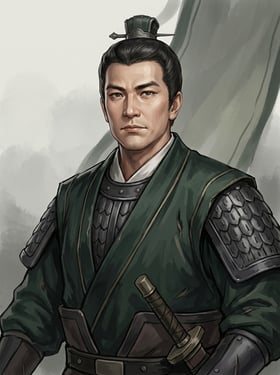
Historical Record
Deng Ai, styled Shizai, was a man of Jiyang in Yiyang. Orphaned and poor in his youth, he moved with his family to Runan after Cao Cao took Jing Province, making his living by farming and herding. At the age of twelve, he went with his mother to Yingchuan, where he read the inscription on the stele of Chen Shi and, inspired by the words "his writing was a model for the age, his conduct a standard for the gentry," took the name Fan and the style Shize, later changing it because it clashed with a kinsman's name. Early on, owing to a stutter, he was not given important employment and once served as a clerk guarding the brushwood of the paddy fields. Yet whenever he saw a high mountain or a great marsh, he would gauge and sketch out where a camp should be placed, displaying extraordinary military talent, though often mocked by his contemporaries c:3815.
Later Deng Ai was recruited as an aide to the Grand Commandant and Prince Xuan of Sima (Sima Yi), and was promoted to Gentleman of the Department of Writing. He put forward a strategy of cutting canals to draw water for irrigation, greatly accumulating military grain, and of opening up water transport—the famous "Treatise on the Ji River." He advised stationing twenty thousand troops north of the Huai and thirty thousand south of the Huai, rotating them for rest, so that there would always be forty thousand men both farming and guarding; he estimated that in six or seven years three thousand myriad hu of military grain could be amassed on the Huai, enough to feed an army of a hundred thousand for five years. Prince Xuan of Sima adopted his advice and put it into practice, and this measure played a key role in securing supplies for Wei's campaigns in the southeast c:6465.
In the first year of the Jiaping era, Deng Ai took up the post of Grand Administrator of Nan'an and, together with the General Who Conquers the West, Guo Huai, resisted the Shu Han general Jiang Wei. After Jiang Wei withdrew, Deng Ai foresaw that he might come again and advised dividing the troops to guard against it. Sure enough, Jiang Wei sent Liao Hua to pin Deng Ai down, intending to make a surprise strike on Tao City. Deng Ai saw through the scheme and led his troops by night to seize Tao City first, so that Jiang Wei could not succeed c:3816. Afterward, as Inspector of Yanzhou, Deng Ai further put forward the proposal that "the Qiang and Hu who dwell mingled with the people should gradually be moved out, so that the settled folk may be openly exalted in the teaching of integrity and shame, and the paths of treachery and crime blocked," which was adopted by Prince Jing of Sima (Sima Shi) c:3817.
After the Duke of Gaogui Township ascended the throne, Deng Ai was enfeoffed as Marquis of Fangcheng Village for his merit. When Guanqiu Jian rose in revolt, Deng Ai beheaded his envoy and advanced by double marches to Lejia City, throwing up a pontoon bridge. Prince Jing of Sima then arrived and crushed Wen Qin's army. Deng Ai pursued Wen Qin to Qiutou, and Wen Qin fled in defeat into Wu c:3818. In the fourth year of the Jingyuan era, Wei launched a great campaign against Shu. Deng Ai put forward the strategy of making a surprise strike on Fucheng by the small road through Yinping, driving straight at the heart of Chengdu. He led his army across more than seven hundred li of uninhabited land, hewing through mountains to open a road and building bridge-galleries, overcoming hardship upon hardship. In the end, he crushed Zhuge Zhan at Mianzhu, killing him and his Master of Writing Zhang Zun and others, and advanced to Luocheng. Liu Shan thereupon sent an envoy to present the seals and cords and surrender c:6466. After Deng Ai entered Chengdu, he pacified the people of Shu and kept his officers and men in check, winning the hearts of the people. Yet he also grew vain over his merit, his speech rather boastful, drawing the derision of the discerning c:14857.
In the Novel
Deng Ai in *Romance of the Three Kingdoms* has his military talent and strategic vision further heightened and intensified, particularly in his repeated clashes with Jiang Wei, where he is often renowned for "divine calculation."
When Guanqiu Jian rose in revolt, Deng Ai was singled out by Sima Shi, who held that he was "resourceful and full of stratagems" and could lead troops to take Lejia City c:6470. In the novel, Wen Yang raided the Wei camp by night, and Sima Shi's eyeball burst from its socket, but Deng Ai arrived in time and fought Wen Yang for fifty bouts without a decision, finally forcing Wen Yang to break out alone on horseback c:14808. This differs from the fact, in which Deng Ai did not directly fight Wen Yang but lured the enemy in deep and crushed Wen Qin's army.
The contest with Jiang Wei is an important chapter for Deng Ai in the novel. In the siege of Didao, Deng Ai joined hands with Chen Tai and, through schemes of ambush and cutting off supplies, forced Jiang Wei to withdraw. Deng Ai had a deep insight into Jiang Wei's tactical style; he once analyzed for Chen Tai the "five reasons why he is sure to come out," including the Shu troops' elite quality, their skill in boat transport, and their feint to the east while striking the west, which made Chen Tai sigh in admiration and call him "one who gauges the enemy like a god" c:3823. Before the Battle of Duangu, Deng Ai further foresaw that Jiang Wei would take Nan'an and accurately laid an ambush at Duangu, crushing Jiang Wei c:3825. The novel also depicts the scene of Deng Ai's son Deng Zhong fighting Jiang Wei, with Deng Ai then appearing and exchanging words with Jiang Wei across the field, highlighting the valor of both father and son c:3826.
In the campaign against Shu, Deng Ai's "stealing across Yinping" is depicted as even more perilous and legendary. He led his army hewing through mountains to open a road and building bridge-galleries, even wrapping himself in felt and rolling down the slope to spur on his soldiers. At Motian Ridge, he discovered a stone tablet left by Zhuge Liang, foretelling: "When the two fires first arise, a man will cross this place. When two gentlemen contend, before long they will die of themselves"—both an affirmation of Deng Ai's achievement and a hint at his future tragic end c:3835. After taking Jiangyou, Deng Ai displayed a decisive and stern side, wishing to behead his subordinate general Tian Xu for proposing to rest, to emphasize that "speed is the essence of war" c:14839. In the novel, Zhuge Zhan set up the ruse of a "wooden carved Kongming" at Mianzhu, which for a time frightened off Deng Ai's subordinate generals Shi Zuan and Deng Zhong, but after Deng Ai saw through it he still fought hard and finally defeated Zhuge Zhan and his son c:14842. These episodes greatly enrich Deng Ai's image, lending him a more legendary cast in the literary work.
Key Relationships
* Jiang Wei (enemy_of): Deng Ai and Jiang Wei were long-standing military adversaries. In fact, Deng Ai clashed with Jiang Wei many times, including at Taoxi and Didao, and successfully resisted Jiang Wei's attacks c:3813. In the novel, the two engage in a direct contest of wit and valor, with Deng Ai often able to see through Jiang Wei's schemes and foresee his moves, as in laying an ambush at Duangu and crushing Jiang Wei c:3825.
* Shu Han (commands_in): Deng Ai finally destroyed Shu Han, making its sovereign Liu Shan surrender c:6466. In the novel, he drove straight at Chengdu by a stratagem of surprise attack, hastening the demise of Shu Han c:3835.
* Sima Shi (commands_in): Sima Shi was Deng Ai's important superior and promoter. In fact, Sima Shi adopted Deng Ai's advice, had him garrison farmland in Huainan, and gave him important employment in resisting Guanqiu Jian's revolt c:3818. In the novel, Sima Shi likewise placed great trust and reliance on Deng Ai's resourcefulness c:6470.
* Sima Yi (mentor_of): Sima Yi was Deng Ai's early discoverer and guide. In fact, Sima Yi recognized Deng Ai's talent, recruited him as an aide, and adopted his "Treatise on the Ji River," which had a far-reaching influence on Wei's military and economic development c:6465.
* Zhuge Zhan (enemy_of): In the conquest of Shu, Deng Ai crushed and killed Zhuge Zhan and his son Zhuge Shang at Mianzhu, the key battle for his taking of Chengdu c:6466. In the novel, Zhuge Zhan is portrayed as a loyal and valiant man who carried on the legacy of his father Zhuge Liang, locked in fierce struggle with Deng Ai c:14842.
* Zhong Hui (rival_of): Deng Ai and Zhong Hui were both chief commanders in the campaign against Shu, but there was clear rivalry and friction between them. In fact, after the conquest of Shu, Deng Ai conferred offices on his own authority, drawing the resentment and framing of Zhong Hui and others c:14859. In the novel, Zhong Hui dismissed Deng Ai's stratagem of surprise attack, regarding him as a "mediocrity," while Deng Ai too harbored grievances against Zhong Hui c:14831.
* Wen Yang (opponent_of): In the novel, Deng Ai once had a fierce clash with Wen Yang outside Lejia City; Wen Yang was extraordinarily valiant, and Deng Ai fought him for several dozen bouts without a decision c:14808 (novel only).
Iconic Scenes
* The Treatise on the Ji River and military farming: Deng Ai put forward to Sima Yi a strategy of cutting canals and farming garrisons to accumulate grain, greatly strengthening Wei's national power and laying the foundation for later military operations. This measure displayed Deng Ai's outstanding strategic vision and economic talent c:6465.
* The Battle of Tao City: Deng Ai saw through Jiang Wei's feint to the east while striking the west, marching by night to seize Tao City first and successfully foiling Jiang Wei's attack, displaying his keen insight and decisive military command c:3816.
* Crushing Wen Qin at Lejia City: In Guanqiu Jian's revolt, Deng Ai advanced by double marches to Lejia and crushed Wen Qin's army, rendering great service in Sima Shi's suppression of the rebellion c:3818. In the novel, he even fought Wen Yang directly, displaying his valor c:14808.
* The surprise march across Yinping: This is the most representative achievement of Deng Ai's military career. He led the Wei army by the small road through Yinping, crossing more than seven hundred li of uninhabited land, hewing through mountains to open a road and overcoming hardship upon hardship, driving straight at the heartland of Shu Han. This bold and successful military operation directly brought about the fall of Shu Han c:6466. In the novel, this process is depicted as even more perilous, even adding the episode of Zhuge Liang's stone tablet prophecy c:3835.
* Crushing Zhuge Zhan at Mianzhu: Deng Ai fought a decisive battle at Mianzhu with the Shu Han General of the Guards Zhuge Zhan, finally crushing the Shu army, killing Zhuge Zhan and his son, and clearing the last obstacle on the road to Chengdu c:6466. In the novel, Zhuge Zhan set up the ruse of a "wooden carved Kongming," adding to the drama of the battle c:14842.
* Receiving the surrender at Chengdu: Liu Shan led the Crown Prince, the various princes, and his ministers in surrendering to Deng Ai, marking the end of the Shu Han regime. After entering the city, Deng Ai pacified the people of Shu, displaying his talent in governance c:3836. Yet his vain and self-satisfied words and deeds were also laid bare at this moment c:14857.
* Zhuge Liang's stone tablet prophecy: In the novel, Deng Ai discovered on the small road through Yinping a stone tablet left by Zhuge Liang, foretelling: "When the two fires first arise, a man will cross this place. When two gentlemen contend, before long they will die of themselves"—both an affirmation of Deng Ai's surprise march and a hint at his conflict with Zhong Hui and his ultimate tragic end c:3835 (novel only).
Portrait file
Character profile
- Character
- Deng Ai was proud and robust, hasty and hot-tempered, and prone to flout convention and propriety, unable to get on smoothly with his colleagues; yet he was deep and resolute and full of stratagems. Though he stammered, he was quick-witted, from boyhood deeply versed in the art of war and skilled at reading terrain, gauging the enemy as if by divine insight, rich in miraculous calculation and strategy, and able to judge the lay of the land.
- Manner of speech
- Because of his stammer Deng Ai would refer to himself as 'Ai, Ai,' and made light of it by saying, 'Phoenix, oh phoenix—it is, after all, but one phoenix.' He analyzed matters point by point, secretly instructing his generals with 'thus and thus'; before the ranks he shouted, 'Jiang Wei, you common fellow, do not pursue my son!', combining probing stratagem with stirring, spirited exhortation.
- Life
- Deng Ai was a native of Jiyang in Yiyang. Orphaned young, on account of his stammer he was made a keeper of the brush and grass over the paddy fields, and rose through the offices of Gentleman of the Masters of Writing and Administrator of Nan'an. From the second year of Zhengyuan he acted as General Who Pacifies the West to resist Jiang Wei; in the first year of Ganlu he crushed Jiang Wei at Shanggui, and in the third year of Jingyuan he defeated Wei at Houhe. In the fourth year of Jingyuan he led his army toward Gansong and Dazhong, and by way of the Yinping road broke through Jiangyou and Mianzhu, receiving the surrender of Liu Shan; after Shu fell he became Grand Commandant. In the first year of Xianxi he was slandered by Zhong Hui, Hu Lie, Shi Zuan, and others, summoned back in a prison cart, and afterward beheaded by Tian Xu west of Mianzhu.
- Weapons
- Deng Ai spurred his horse and leveled his blade.
- Anecdotes
- Deng Ai was the general of foremost merit in resisting Jiang Wei and in the conquest of Shu, and the pivotal figure in the extraordinary feat of destroying Shu. He once fought Wen Yang for fifty bouts without a decision, later arrayed his troops at Xiangling to defeat Jiang Wei, laid an ambush at Duangu to break Jiang Wei, secretly crossed by way of Yinping, took Jiangyou, captured Fucheng, besieged Mianzhu, and received the surrender of Shu at Chengdu.
Relationships
46 relationships
Family2
Lord & vassal11
Friends1
Enemies7
Teacher & student1
Other21
Quotes
53 recorded lines · 3 featured
「今賊摧折,宜遂乘之,從陰平由邪徑經漢德陽亭趣涪,出劍閣西百里,去成都三百餘里,奇兵衝其腹心。劍閣之守必還赴涪,則會方軌而進;劍閣之軍不還,則應涪之兵寡矣。軍誌有之曰:『攻其無備,出其不意。』今掩其空虛,破之必矣。」
This line displays Deng Ai's military brilliance in Deng Ai's Surprise Attack Through Yinping, the crowning moment of his life.
「存亡之分,在此一舉,何不可之有?」
Deng Ai's morale-rousing words before his surprise assault on Chengdu, reflecting his do-or-die resolve.
「銜命征行,奉指授之策,元惡既服;至於承制拜假,以安初附,謂合權宜。今蜀舉眾歸命,地盡南海,東接吳會,宜早鎮定若待國命,往復道途,延引日月。春秋之義,大夫出疆,有可以安社稷,利國家,專之可也。今吳未賓;勢與蜀連,不可拘常以失事機。兵法,進不求名,退不避罪,艾雖無古人之節,終不自嫌以損於國也。」
This line embodies Deng Ai's military autonomy-'a general in the field need not obey every command of his sovereign'-and foreshadows his tragic end.
Chapters19 回 ▸
- 史ch.4ch.22ch.26ch.28ch.33ch.35ch.42ch.44
- 演ch.107ch.110ch.111ch.112ch.113ch.114ch.115ch.116ch.117ch.118ch.119
Relationship timeline27 条 ▸
史 ch.4
- Jiang Wei§39
enemy_of
拒维;上邽大破;侯和破
史 ch.28
史 ch.33
- Zhuge Zhan§43
fights_in
景耀六年冬邓艾破诸葛瞻于绵竹
史 ch.44
- Jiang Wei§27
enemy_of
破姜维于段谷,又破之于沓中、阴平
演 ch.110
- Chen Tai§16
advises_in
奉大将军命来助;献项岭设伏火鼓诱败蜀兵之计
演 ch.111
- Chen Tai§1
friend_of
结为忘年之交;同屯雍凉
rival_of
料蜀必出有五;段谷设伏大破之
parent_of
父子;密授段谷埋伏之计
演 ch.112
- Deng Zhong§22
parent_of
父子;遣长子相助司马望守城
- Sima Wang§22
advises_in
作书相约固守待关中兵;遣子鄧忠相助
- Sima Zhao§22
serves
差人求救
- Jiang Wei§22
enemy_of
阵前呼"姜维匹夫勿赶吾儿";据渭水下寨与维对峙不出
演 ch.113
serves
遣使齎表奏闻;司马昭奏赏邓艾
- Deng Zhong§11
parent_of
父子;受命引兵冲击蜀寨
演 ch.114
rival_of
见蜀兵旗整不敢追,叹姜维深得武侯之法
advises_in
共议蜀君臣不和必有内变
- Jiang Wei§29
fights_in
中王瓘改期之书,引五万精兵至坛山谷中伏遭大败弃甲丢盔
演 ch.117
parent_of
父子;劝父'"小不忍則亂大謀"'容忍钟会;先引五千精兵开路
rival_of
怒钟会自尊大;从子之劝隐忍见会;私下笑钟会以庸才视己
serves
修密书遣使馳报司马昭
演 ch.118
Inner monologues · AI-generated3 段 ▸
- I am Deng Ai, courtesy name Shizai. Ordered to attack Shu, I reached Yinping, where the mountains and rivers were so tre
- In my youth I was poor and low-born, and I spent many years on the frontier. What struck me most was not empty fame in t
- My surname is Deng, my given name Ai, and my courtesy name Shi Zai. I was young and poor, lost my father early, and foll
Life events19 ▸
- 0245-01-01 · ShouchunDeng Ai's Military Farming in Huainan· Instigator
- 0249-01-01 · QushanBattle of Qucheng· Warrior
- 0255-01-01 · LejiaWen Yang Single-handedly Repulses the Wei Army· Warrior
- 0255-01-01 · ShouchunRebellion of Guanqiu Jian and Wen Qin· Commander
- 0255-01-01 · ShouchunRebellion of Guanqiu Jian and Wen Qin· Commander
- 0255-01-01 · LuoyangBattle of Taoxi· Commander
- 0255-01-01 · DidaoBattle of Didao· Advisor
- 0256-01-01 · DuanguBattle of Duangu· Commander
- 0256-01-01 · DuanguDefeat at Duangu· Commander
- 0261-01-01 · Mount QiGreat Defeat of Deng Ai at Tanshan Valley· Commander
- 0262-01-01 · Mount QiJiang Wei's Later Northern Expeditions· Commander
- 0263-01-01 · Mount QiJiang Wei's Northern Expeditions· Commander
- 0263-01-01 · MianzhuBattle of Mianzhu· Commander
- 0263-01-01 · ChengduConquest of Shu by Wei· Commander
- 0263-01-01 · YinpingDeng Ai's Surprise Attack Through Yinping· Commander
- 0263-01-01 · ChengduHuang Hao's Usurpation of Power· Commander
- 0264-01-01 · MianzhuExecution of Deng Ai and His Son· Victim
- 0264-01-01 · ChengduZhong Hui's Rebellion· Victim
- 0264-01-01 · ChengduRebellion of Zhong Hui and Jiang Wei· Victim