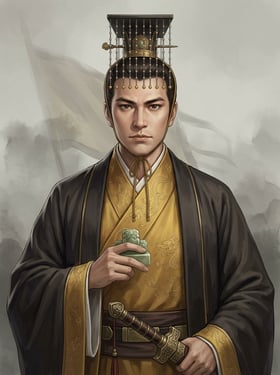
Historical Record
Cao Rui, courtesy name Yuanzhong, was the crown prince of Emperor Wen of Wei, Cao Pi. From childhood he was beloved by Grand Progenitor Cao Cao, often kept at his side. According to the *Book of Wei*, Cao Rui was born with an outstanding bearing, and Cao Cao once said, "Through you I shall have three generations." He was fond of learning and broadly knowledgeable, and especially attentive to law and principle c:2122. In the second year of Huangchu, Cao Rui was enfeoffed as Duke of Qi, and three years later changed to Prince of Pingyuan. However, because his birth mother Lady Zhen had been executed, he was for a time not established as heir. Only in the summer, fifth month, of the seventh year of Huangchu, when Emperor Wen Cao Pi was gravely ill, was Cao Rui formally established as imperial crown prince. On the day dingsi, Cao Rui ascended the imperial throne, granted a general amnesty, and posthumously honored his birth mother Lady Zhen as Empress Wenzhao c:2122.
During his reign, Cao Rui was much concerned with affairs of state. He once discussed with his ministers the question of restoring corporal punishment, but against the backdrop of Wu and Shu not yet being pacified, it was ultimately not implemented c:11223. He also adopted many of his loyal ministers' proposals. For example, the Grand Tutor Hua Xin once submitted a memorial remonstrating with Cao Rui, pointing out that transporting grain a thousand li is no advantage in warfare, that to cross perilous terrain and plunge deep makes it hard to prevail alone, and emphasizing that the people are the foundation of the state, urging him to first attend to the way of governance and treat campaigns as secondary. Cao Rui deeply agreed, and ultimately, because of heavy autumn rains, issued an edict ordering Cao Zhen to withdraw his army c:11225. He also, regarding the matter of Li Yun in the time of Emperor Huan of Han submitting a memorial saying "Emperor [di] means to examine [di]; thus the emperor wishes not to examine," questioned the Palace Attendant Wang Su, exploring whether the cause of his death was justified c:11227.
In military affairs, Cao Rui once dispatched Cao Zhen to campaign against Shu by the Ziwu road and personally went east to Xuchang. When Cao Zhen met with difficulties, he would also heed the remonstrance of Jiang Ji and others c:11230. When Gongsun Yuan of Liaodong rebelled, Cao Rui once asked Jiang Ji whether Sun Quan would send troops to his aid; Jiang Ji analyzed that Sun Quan would not act rashly, and Cao Rui agreed c:11231. Moreover, Cao Rui placed much weight on the selection of talent, issuing an edict to seek out worthy men of ability and intellect, deep in counsel and loyal in spirit, regardless of age, rank, or status c:11250.
In his last years, Cao Rui was gravely ill and once considered making the Prince of Yan, Cao Yu, Grand General to assist in governance, but Cao Yu declined. In the end, he summoned Liu Fang and Sun Zi, adopted their counsel, recalled the Grand Commandant Sima Yi, and appointed Cao Shuang to assist in governance c:2123.
In the Novel
In *Romance of the Three Kingdoms*, Cao Rui's image is given more dramatic coloring. The novel opens by depicting Cao Rui's cleverness, noting that from childhood he was intelligent and deeply beloved by Cao Pi c:11196. However, the novel elaborates in detail on Lady Zhen's death and the process of Cao Rui being established as heir, indicating that Cao Pi, on account of Lady Guo Guifei's slander, granted Lady Zhen death, and Lady Guo Guifei adopted Cao Rui as her son. Because of his mother's death, Cao Rui harbored resentment within, but for the sake of survival he had to serve Empress Guo respectfully. In the novel, during a hunt Cao Pi shot a doe and wished Cao Rui to shoot the fawn, but Cao Rui could not bear to and tearfully pleaded, "Your Majesty has already slain its mother; I cannot bear to slay its child as well." Cao Pi was thereby deeply struck and decided to make him his heir c:11196. This episode is not recorded in the histories; it is the novel's literary invention to highlight Cao Rui's benevolence.
After Cao Rui took the throne, the novel also displays his traits as a young sovereign. When Sima Yi memorialized to request to guard Yong and Liang, the Grand Commandant Hua Xin and the Minister over the Masses Wang Lang both held that Sima Yi harbored rebellious intent and urged Cao Rui to execute him. Cao Rui at one point wished to campaign in person but was dissuaded by Cao Zhen, adopting Cao Zhen's plan to "let Your Majesty proceed to Anyi and observe his movements" c:11197. This differs from history, where Cao Rui trusted Sima Yi. During Zhuge Liang's Northern Expeditions for Shu Han, in the novel Cao Rui appointed Xiahou Mao Grand Commander to meet Zhuge Liang, but Xiahou Mao, being without strategy, was badly defeated c:11198. Afterward, with Cao Zhen repeatedly defeated by the Shu troops, Cao Rui heeded the advice of Zhong Yao, reinstated Sima Yi, and entrusted him with great responsibility c:5548.
In the novel, Cao Rui's trust in and reliance on Sima Yi are also strengthened. When Sima Yi repelled the Shu troops, Cao Rui was greatly pleased and bestowed on him a golden battle-axe with the power to act at his own discretion c:11204. When Eastern Wu's Sun Quan usurped the imperial title and allied with Shu Han, Cao Rui was at first thrown into panic, but under Sima Yi's analysis he concluded that Eastern Wu would not lightly send troops, and so trusted Sima Yi all the more c:11215. The novel also depicts Cao Rui in his later years indulging in building palaces and pursuing the arts of immortality, leading to the neglect of government c:11177. He even granted Empress Mingdao death because she learned of his outing in the garden with Lady Guo, and made Lady Guo empress c:11183. Though these episodes are touched on in the histories, the novel depicts them more minutely and with exaggeration.
In the end, in the novel Cao Rui was gravely ill, and on the advice of Liu Fang and Sun Zi recalled Sima Yi and entrusted his young son Cao Fang to Sima Yi and Cao Shuang. He clasped Sima Yi's hand and, citing Liu Bei's entrustment of his heir to Zhuge Liang as a precedent, charged Sima Yi to assist the young ruler, displaying his deep trust in Sima Yi c:11192.
Key Relationships
* Cao Pi (parent_of): Cao Rui was Cao Pi's crown prince, but because his birth mother Lady Zhen had been executed, his status as heir was for a time unstable. The histories record that only when Cao Pi was gravely ill was he formally established as crown prince c:2122. In the novel, Cao Pi decided to make him heir because of his benevolent act of being unable to bear killing the fawn c:11196.
* Cao Wei (lord_of): Cao Rui was the second emperor of Cao Wei, during whose reign he worked to consolidate the regime and resist external foes. The histories record that he discussed affairs of state such as restoring corporal punishment and military campaigns with his ministers c:11223. In the novel, facing the threats of Shu Han and Eastern Wu, he repeatedly reinstated generals such as Sima Yi c:5548.
* Sima Yi (friend_of): In history, Sima Yi was one of the ministers entrusted with the heir in Cao Rui's last years c:2123. In the novel, Sima Yi was Cao Rui's important military general and strategist, repeatedly reinstated by Cao Rui at critical moments and granted his great trust and authority c:11204.
* Zheng Hun (mentor_of): The histories record that when Cao Rui was young, Cao Pi appointed the Palace Attendant Zheng Cheng (i.e., Zheng Hun) as tutor to the Marquis of Wude, encouraging him to assist Cao Rui with classical learning c:2121. This shows that Zheng Hun played the role of mentor in Cao Rui's upbringing.
* Lady Zhen (parent_of): Cao Rui's birth mother, who was granted death by Cao Pi for some cause. The histories record that after Cao Rui took the throne, he posthumously honored her as Empress Wenzhao c:2122. In the novel, Lady Zhen's tragic end had an important influence on the shaping of Cao Rui's character; even when Cao Rui was gravely ill, the novel depicts the ghost of Empress Mingdao (novel-only) demanding his life, echoing Lady Zhen's death c:2131.
* Empress Guo (parent_of): The histories record that, because Empress Guo had no son, Emperor Wen issued an edict having her raise the emperor; Empress Guo too, having no son of her own, accordingly showed him added affection c:2122. In the novel, Empress Guo is the key figure who brought about Lady Zhen's being granted death; she adopted Cao Rui and, after he took the throne, became empress dowager c:11196.
* Hua Xin (advisor_of): The histories record that Hua Xin once advised Cao Rui to first attend to the way of governance and only later undertake campaigns c:11225. In the novel, Hua Xin also advised Cao Rui to reinstate Sima Yi to repel the Shu troops c:5548.
* Wang Lang (advisor_of): The histories record that Wang Lang once advised Cao Rui on matters such as restoring corporal punishment and the bearing of imperial sons c:11226. In the novel, Wang Lang once advised Cao Rui not to lightly employ Xiahou Mao as a general and recommended employing Cao Zhen c:11198.
* Cao Zhen (friend_of): The histories record that Cao Zhen was ordered to campaign against Shu, and Cao Rui also went east to Xuchang in support c:11225. In the novel, Cao Zhen was entrusted with the heir by Cao Pi, assisted Cao Rui, repeatedly clashed with Zhuge Liang, but was repeatedly defeated c:5547.
* Liu Fang and Sun Zi (advisor_of): The histories record that when Cao Rui was gravely ill, he summoned Liu Fang and Sun Zi and adopted their counsel to recall Sima Yi to assist in governance c:2123. In the novel, Liu Fang and Sun Zi, when Cao Rui was gravely ill, advised him to entrust his heir to Cao Shuang and Sima Yi, and prompted the Prince of Yan, Cao Yu, to return to his fief c:2131.
* Cao Yu (family_of): The histories record that when Cao Rui was gravely ill, he once considered making the Prince of Yan, Cao Yu, Grand General to assist in governance, but Cao Yu declined c:2123. In the novel, Cao Yu was summoned by Cao Rui as Grand General but, on the advice of Liu Fang and Sun Zi, was sent back to his fief c:2131.
* Cao Shuang (friend_of): The histories record that when Cao Rui was gravely ill, on the advice of Liu Fang and Sun Zi, he appointed Cao Shuang to assist in governance c:2123. In the novel, Cao Shuang was enfeoffed by Cao Rui as Grand General, in overall charge of the court, and together with Sima Yi received the entrustment to assist the young ruler c:2131.
* Ma Jun (subordinate_of): In the novel, Cao Rui ordered Ma Jun to dismantle and take the bronze figures atop the Han dynasty's Cypress Beam Terrace in his quest for an art of immortality c:11177 (novel-only).
* Empress Mingdao (family_of): In the novel, Cao Rui's empress, who lost favor because Cao Rui doted on Lady Guo, was ultimately granted death by Cao Rui c:11183 (novel-only).
Iconic Scenes
* Showing Benevolence at the Deer Hunt: In the novel, the young Cao Rui accompanied Cao Pi on a hunt, and after Cao Pi shot the doe, he ordered Cao Rui to shoot the fawn. Cao Rui could not bear to and tearfully pleaded with Cao Pi, who thereby deemed Cao Rui benevolent and decided to make him his heir c:11196 (novel-only). This scene is key to the novel's shaping of Cao Rui's benevolent image.
* Reinstating Sima Yi: In both history and the novel, Cao Rui repeatedly reinstated Sima Yi. Especially during Zhuge Liang's Northern Expeditions, with Cao Zhen repeatedly defeated, Cao Rui heeded Zhong Yao's advice, reinstated Sima Yi, and granted him great power, making him the key figure in resisting Shu Han c:5548.
* Entrusting the Heir to Sima Yi: When Cao Rui was gravely ill, he summoned Sima Yi and entrusted his young son Cao Fang to Sima Yi and Cao Shuang. He clasped Sima Yi's hand and, citing Liu Bei's entrustment of his heir to Zhuge Liang as a precedent, charged Sima Yi to assist the young ruler c:11192. This scene is also recorded in history, but the novel depicts it with greater emotional coloring, emphasizing Cao Rui's trust in and reliance on Sima Yi.
* Building Palaces and Seeking Immortality: In the novel, Cao Rui in his later years indulged in building palaces and pursuing the arts of immortality, even ordering Ma Jun to dismantle and take the bronze figures atop the Han dynasty's Cypress Beam Terrace c:11177 (novel-only). This series of acts led to the neglect of government and reflects the novel's critical shaping of Cao Rui's later image.
* Granting Empress Mingdao Death: In the novel, Cao Rui was enraged that Empress Mingdao had learned of his garden outing with Lady Guo and ultimately granted her death c:11183 (novel-only). This scene displays Cao Rui's cruel and tyrannical side and foreshadows his later death by illness.
* Campaign in Liaodong: Both history and the novel mention that during Cao Rui's reign, Gongsun Yuan of Liaodong rebelled. Cao Rui dispatched Sima Yi to pacify him, and Sima Yi successfully defeated Gongsun Yuan c:5551. This event displays Cao Rui's decisiveness in military decisions and his trust in Sima Yi.
Portrait file
Character profile
- Appearance
- From boyhood he was clever, and skilled in bow and horse.
- Character
- Composed, resolute, and discerning, he acted as his heart inclined; fond of learning and broad in knowledge, he gave particular attention to law and principle. He grieved deeply for his mother's kin, and again and again built shrines and raised observatories for the family of the Zhen clan, his maternal house, conferring rank and title upon them. Benevolent and tender-hearted, moved by compassion, yet as a sovereign he was prone to suspicion, fond of novelty and arrogant ease, drowned in the favor of women, and would not heed remonstrance.
- Manner of speech
- At a loss when confronted with crises, he later repented of having demoted Sima Yi, sighing, 'Your learning and insight surpass even Sun Wu and Wu Qi.' His inquiries were terse, and he conveyed his designs by handwritten edict, deciding matters in short phrases—'What you say accords exactly with my mind'—and he also sighed at an enemy general's ability, 'Lu Xun's use of troops is no less than that of Sun Wu and Wu Qi.'
- Life
- In the fifth month of the first year of Yankang he was enfeoffed as Marquis of Wude; in the third month of the third year of Huangchu he was made Duke of Qi, and afterward established as Prince of Pingyuan. Because his mother had been put to death, he was not set up as heir; only in the summer fifth month of the seventh year of Huangchu, when Emperor Wen fell gravely ill, was he made Crown Prince, and on the dingsi day he ascended the imperial throne. After Emperor Wen died he took the throne, honored Lady Bian as Grand Empress Dowager, and posthumously titled his own mother of the Zhen clan Empress Wenzhao.
- Anecdotes
- He died in the first month of the third year of Jingchu, and having no son, he reared Cao Fang and Cao Xun. In the Jiaping period his adoptive mother Empress Guo died; it was rumored that, harboring a grievance from his childhood, he had forced her to death. He trusted Sima Yi and would not heed the ministers' remonstrance to 'recall Yi'; when mortally ill he grasped Yi's hand and entrusted his young son to him, weeping until his tears soaked his collar.
Relationships
35 relationships
Family12
Lord & vassal4
Friends1
Enemies1
Teacher & student2
Other15
Quotes
82 recorded lines · 3 featured
「昔劉玄德在白帝城病危,以幼子劉禪託孤於諸葛孔明,孔明因此竭盡忠誠,至死方休,偏邦尚然如此,何況大國乎?朕幼子曹芳,年纔八歲,不堪掌理社稷。幸太尉及宗兄元勳舊臣,竭力相輔,無負朕心!」
Cao Rui entrusting his orphaned heir to Sima Yi sowed the seeds for the Sima clan's later domination of power, and is of great historical significance.
「朕建高臺峻閣,欲與神仙往來,以求長生不老之方。」
This line reveals the muddleheaded side of Cao Rui in his later years, indulging in occult arts and pursuing immortality.
「我自召太尉,而曹肇等反使吾止之,幾敗吾事!」
This line embodies Cao Rui's trust in and reliance on Sima Yi, and also hints at Sima Yi's power.
Chapters28 回 ▸
- 史ch.2ch.3ch.5ch.9ch.11ch.13ch.14ch.15ch.16ch.17ch.20ch.24ch.25ch.27ch.35
- 演ch.91ch.92ch.93ch.94ch.95ch.96ch.98ch.99ch.100ch.102ch.103ch.105ch.106
Relationship timeline9 条 ▸
史 ch.14
- Sima Yi§131
friend_of
明帝崩前召司马懿登床受诏
史 ch.16
- Zheng Hun§61
mentor_of
下诏称述,布告天下;迁将作大匠
史 ch.17
史 ch.20
- Cao Lin§116
kin_of
以先帝遗意,爱宠霖异于诸国
演 ch.95
- Zhang He§1
commands_in
命张郃为先锋,与司马懿同征
演 ch.100
- Sima Yi§13
commands_in
闻曹真死,下诏催司马懿出战
演 ch.103
- Lu Xun§4
rival_of
览陆逊表叹"东吴陆逊,真妙算也";监其卒、敕诸将堅守
演 ch.106
- Cao Fang§10
parent_of
养子,以幼子相托司马懿、曹爽;崩
Inner monologues · AI-generated3 段 ▸
- My illness grows ever more grave, and the lamplight flickers. The sounds of the ministers coming and going in the palace
- As I attend court and hear reports, what I fear most is not a beacon fire at one place, but news from several quarters p
- I was born into the imperial house, and from a young age often attended my grandfather, Emperor Wu of Wei, at his side.
Life events13 ▸
- 0228-01-01 · ChencangZhuge Liang's Second Northern Expedition· Witness
- 0229-01-01 · HefeiMan Chong Relocates and Builds the New Hefei City· Commander
- 0230-01-01 · ChencangCao Zhen's Invasion of Shu
- 0234-01-01 · HefeiBattle of Hefei (234)· Commander
- 0234-01-01 · Mount QiZhuge Liang's Northern Expeditions· Witness
- 0237-01-01 · LuoyangEmperor Ming of Wei's Lavish Palace Construction· Instigator
- 0237-01-01 · LuoyangJingchu Calendar Reform· Instigator
- 0237-01-01 · LuoyangControversy over Cao Rui's Palace Construction· Instigator
- 0238-01-01 · XiangpingSima Yi's Liaodong Campaign· Instigator
- 0239-01-01 · LuoyangEmperor Ming of Wei Entrusts the Regency on His Deathbed· Instigator
- 0248-01-01 · LuoyangHimiko Sends Envoys to Wei· Commander
- 0249-01-01 · LuoyangCao Shuang's Regency
- 0254-01-01 · LuoyangGao Rou's Administration of Criminal Law· Witness