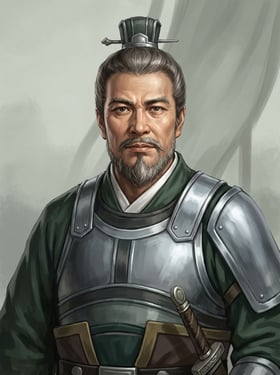
Historical Record
Wang Chang, styled Wenshu, was a native of Jinyang in Taiyuan. In his youth he was already as renowned as Wang Ling of the same commandery; because Wang Ling was older, Wang Chang treated him as an elder brother. When Emperor Wen, Cao Pi, was Crown Prince in the Eastern Palace, Wang Chang served as Literary Attendant to the Crown Prince, and was later promoted to Mid-Household Gentleman. After Emperor Wen took the throne, he was transferred to Cavalier Attendant-in-Ordinary and served as Agriculture Director of Luoyang. During his tenure at Luoyang, he devoted himself to opening up wasteland and exhorting the people to farm, so that the amount of cultivated land in the area increased markedly. Afterward he was promoted to Inspector of Yanzhou.
After Emperor Ming took the throne, Wang Chang was additionally granted the title General Who Spreads Valor and was enfeoffed as a Marquis Within the Passes. While serving in the provinces, Wang Chang kept the court in mind, believing that Cao Wei had inherited the flawed governance of Qin and Han, that its legal system was overly cumbersome, and that without sweeping reform of the state's statutes to emulate the manner of the ancient kings, lasting peace and stability for the state would be hard to achieve. To this end he wrote more than twenty essays of *Discourses on Governance*, whose content broadly followed ancient institutions while combining them with current affairs; he also wrote more than ten essays of *A Book on Warfare*, discussing the use of the unorthodox and the orthodox.
In the fourth year of Qinglong, Emperor Ming of Wei issued an edict seeking men of worth, and the Grand Commandant Sima Xuanwang (Sima Yi) recommended Wang Chang. During the Zhengshi era, Wang Chang was transferred to Xu Province, enfeoffed as Marquis of Wuguan Precinct, and later promoted to General Who Conquers the South, holding the staff of authority and commanding all military affairs of Jing and Yu provinces. He held that the state had standing troops but war had no certain victory, and that terrain had certain natural barriers but defense had no fixed disposition. At the time the army was stationed at Wancheng, more than three hundred li from Xiangyang, the various units were dispersed in their stations, and the boats were moored at Xuanchi, so that in an emergency they could hardly support one another. He therefore submitted a memorial requesting that the seat of administration be moved to Xinye, and that the navy be trained in Jing and Yu provinces, farmland widely opened, and grain and fodder stockpiled.
At the beginning of the Jiaping era, after the Grand Tutor Sima Xuanwang had put Cao Shuang to death, he memorialized the court requesting that the great ministers set forth its gains and losses. Wang Chang put forward five strategies for governing the state: first, to esteem moral conduct and learning and to cut off the trend of ostentatious display, having the sons of the state enter the Imperial Academy to study; second, to implement a system of examinations, using examinations as the standard for measuring talent; third, to let officials serve long in their posts, increasing the rank and emolument of those with achievements; fourth, to economize official salaries and encourage a sense of integrity and shame, not letting officials compete with the people for profit; fifth, to cut off extravagance and waste and esteem frugality, so that dress should follow regulation, high and low should have order, grain and silk should be accumulated, and popular custom should return to simplicity. His proposals were praised in an edict, and he was charged with drafting the matter of examining and assessing the hundred officials. Wang Chang held that although the eras of Tang and Yu had texts on promotion and demotion, the method of examination assessment had not been handed down; and although the office of the Prime Minister under the Zhou had the great reckoning of the conduct of the various officials, together with reward and punishment, it too had no specific system of comparison. From this he concluded that an enlightened ruler is skilled in employing the worthy, broadly grasps the principle of promotion and demotion, and entrusts it to high officials, who manage its main threads, so that the worthy and the foolish can be distinguished.
In the second year of Jiaping, Wang Chang memorialized that Sun Quan had exiled good ministers and that strife between principal and secondary heirs was unceasing, and that this opportunity could be seized to plan against Wu and Shu. He pointed out that between Baidi and Yiling, the regions of Qian, Wu, Zigui, and Fangling all lay north of the Yangtze, that their inhabitants and ethnic peoples bordered on Xincheng Commandery, and that the moment could be seized to take them. He therefore sent the Administrator of Xincheng, Zhou Tai, to attack Wu, Zigui, and Fangling, dispatched the Inspector of Jing Province, Wang Ji, to Yiling, while Wang Chang himself went to Jiangling. They strung bamboo cables across the two banks to set up a floating bridge, and crossed the water to attack the Wu army. The Wu army withdrew to the south bank and cut seven passages to come and counterattack. Wang Chang ordered the massed crossbows to fire all at once, and the Wu general Shi Ji fled by night into Jiangling city. The Wei army pursued and beheaded several hundred. To lure the Wu army onto level ground for a decisive battle, Wang Chang first sent five divisions to feign retreat along the main road, making the Wu army think there was an opening to exploit, and paraded the captured armor, horses, and heads around the city to provoke the Wu army, while at the same time setting an ambush. Shi Ji indeed gave chase, joined battle with the Wei army, and was defeated. Shi Ji fled in defeat, and the Wei army beheaded the Wu generals Zhongli Mao and Xu Min, captured armor, heads, banners and drums, treasures and weapons, and then returned in triumph. Wang Ji and Zhou Tai also won merit thereby.
After this campaign, Wang Chang was promoted to Grand General Who Conquers the South, with ceremonial rank equal to the Three Excellencies, and advanced in enfeoffment to Marquis of Jingling. When Guanqiu Jian and Wen Qin rose in revolt, Wang Chang led troops to resist them with merit; his two sons were enfeoffed as a Precinct Marquis and a Marquis Within the Passes, and he himself was promoted to General of Agile Cavalry. When Zhuge Dan rebelled, Wang Chang held Jiashi, pinning down Shi Ji and Quan Xi so that they could not advance eastward. After Zhuge Dan was put to death, an edict praised Wang Chang, saying: "Of old, Sun Bin aided Zhao by driving straight for Daliang. The sudden advance of the western troops was likewise the means of bringing about the momentum of the eastern campaign." He was therefore granted an additional thousand households of fief, making four thousand seven hundred households in all together with the former, and was promoted to Minister of Works, retaining the staff of authority and his command as before. In the fourth year of Ganlu, Wang Chang died, with the posthumous title Marquis Mu.
In educating his sons and nephews, Wang Chang also left behind precious admonitions. He warned his descendants to cherish their persons and keep their conduct whole so as to bring honor to their parents, emphasizing that filial respect, benevolence, and righteousness are the foremost of all conduct. He opposed ostentation and factionalism, holding that these lead to hypocrisy and calamity. He admonished his descendants to know contentment and not to crave wealth, rank, or reputation, and citing the principle that "what comes to fruition quickly perishes quickly, and what is accomplished late comes to a good end," warned them not to be hasty for success. He further emphasized that the noble man does not boast of himself nor pride himself, but can bend and stretch, can yield and can gain. As for praise and blame, he held that one must be prudent, and citing the words of Confucius he taught his descendants not to lightly praise or blame others. He especially esteemed Ma Yuan's admonition that "to hear of another's faults one should be as one who hears the names of one's parents: the ears may hear them, but the mouth must not speak them," and taught his descendants that when slandered by others they should turn to examine themselves; if they had no fault, there was no need to mind, much less to take revenge.
In the Novel
In *Romance of the Three Kingdoms*, Wang Chang's appearances are concentrated mainly in the later part of the novel; his image accords with that of the military commander and statesman recorded in history, but his specific deeds are simplified and condensed. In the novel, Wang Chang is mentioned when, after Sun Quan's death, Sima Shi discussed attacking Wu. Sima Shi held that "the way of Heaven changes once every thirty years," that with Sun Quan newly dead and Sun Liang young and weak, this was an excellent opportunity to attack Wu. He therefore dispatched Wang Chang to lead a hundred thousand troops to attack Nan Commandery, advancing in three columns together with the General Who Conquers the East Hu Zun and the Garrison Commander Who Guards the South Guanqiu Jian, while Sima Zhao served as Grand Commander, overall in charge of the three columns of forces.
Although this episode in the novel accords with the historical record of Wang Chang's participation in the attack on Wu, the specific battle details—such as the clash with Shi Ji and the beheading of Zhongli Mao and Xu Min—are not developed in detail in the novel. The novel depicts him more as a general who follows the dispatch of the Sima clan and participates in large-scale military operations, rather than, as in history, displaying in detail his outstanding talents in military strategy, agricultural colonization, and political counsel. The novel's portrayal of Wang Chang's character is also relatively thin, chiefly reflecting his loyalty and military efficiency as a Cao Wei general, while his deeper character and thought of being "modest and earnest in self-discipline, cautious in instructing his sons and nephews, with his heart set on the court" go unexpressed.
Key Relationships
* Wang Ling (friend_of): In his youth he was as renowned as Wang Ling, and because Wang Ling was older he treated him as an elder brother; the two were on very close terms.
* Cao Wei (serves): Wang Chang served Cao Wei all his life, from Literary Attendant to the Crown Prince and Cavalier Attendant-in-Ordinary up to Minister of Works, contributing much to the stability and development of Cao Wei.
* Sima Yi (friend_of): Sima Yi recommended Wang Chang in the fourth year of Qinglong, and at the beginning of the Jiaping era, after Sima Yi had put Cao Shuang to death, Wang Chang set forth his strategies for governing the state to Sima Yi, showing that a relationship of mutual trust and support existed between the two.
* Shi Ji (fights_in): During the attack on Wu in the second year of Jiaping, Wang Chang clashed repeatedly with the Wu general Shi Ji and successfully defeated him, beheading his subordinate generals.
* Sun Quan (fights_in) (novel only): In *Romance of the Three Kingdoms*, after Sun Quan's death Wang Chang, on Sima Shi's orders, led troops to attack Nan Commandery, intending to take advantage of the youth of Wu's new ruler to attack Wu.
Iconic Scenes
* Agriculture Director of Luoyang, exhorting farming and opening fields: In his post as Agriculture Director of Luoyang, Wang Chang opened up the wasteland and diligently exhorted the people, so that the amount of cultivated land greatly increased, displaying his pragmatic administrative ability and his concern for the people's livelihood.
* Submitting the *Discourses on Governance* and *A Book on Warfare*: While serving in the provinces, Wang Chang kept the court in mind and, addressing the flaws of Cao Wei's legal system, submitted the *Discourses on Governance* and *A Book on Warfare*, reflecting his far-reaching political insight and military talent.
* Moving the seat to Xinye, training the navy and broadening farming: Wang Chang advised the court to move the seat of administration to Xinye, to train the navy and widely open farmland, in order to meet military threats, showing his outstanding strategic vision and ability in military deployment.
* The great victory at Jiangling, repelling Shi Ji: During the attack on Wu in the second year of Jiaping, Wang Chang personally led the main army, used stratagem to defeat the Wu general Shi Ji, beheaded Zhongli Mao and Xu Min, and won the great victory at Jiangling, establishing his standing as a military commander.
* Five strategies of governance, counseling the court: After Sima Yi put Cao Shuang to death, Wang Chang put forward five strategies for governing the state, covering education, the selection of officials, administration, and the economy, displaying his comprehensive political aspiration and profound thinking on the governance of the state.
* Admonishing his sons and nephews, handing down family precepts: Wang Chang composed family precepts, admonishing his descendants to honor filial respect, benevolence, and righteousness, to shun ostentation, and to know contentment and not contend, emphasizing that "what comes to fruition quickly perishes quickly, and what is accomplished late comes to a good end," reflecting his modesty and farsightedness as an elder.
* Vanguard in the attack on Wu (novel only): In *Romance of the Three Kingdoms*, when Sima Shi attacked Wu, Wang Chang was appointed Grand General Who Conquers the South and led a hundred thousand troops to attack Nan Commandery, becoming one of the three columns of the army attacking Wu.
Portrait file
Character profile
- Character
- Wang Chang was humble and practical, striving to better himself and admonishing his sons and younger kinsmen, his heart devoted to the court.
- Manner of speech
- Wang Chang's speech drew heavily on allusion, citing the ancients to illuminate the present, admonishing patiently and by degrees.
- Life
- Wang Chang was a man of Jinyang in Taiyuan. In his early years he was famed alongside Wang Ling and served him as an elder brother. He held such posts as Literary Scholar to the Heir Apparent, Palace Steward, Cavalier Gentleman-in-Attendance, Agricultural Commandant of Luoyang, and Inspector of Yanzhou, and authored the Zhilun (Treatise on Governance) and a Bingshu (Book of War). Later he was promoted to Xu Province and made Marquis of Wuguan Precinct, and served as General Who Conquers the South commanding the military affairs of Jing and Yu Provinces, moving his seat to Xinye. In the second year of Jiaping, Wang Chang heavily defeated the Wu general Shi Ji at Jiangling and was promoted to Grand General Who Conquers the South, granted ceremonial equal to the Three Excellencies, and made Marquis of Jingling; he died in the fourth year of Ganlu, with the posthumous name Marquis Mu.
- Anecdotes
- In Wei, Wang Chang rose to Grand General Who Conquers the South and Minister of Works, and was praised as one of "opening capacity and discerning judgment." He once led troops to attack Wu's Nan Commandery and fought against Zhu Ji.
Relationships
3 relationships
Friends2
Other1
Quotes
4 recorded lines · 3 featured
「如不知足,則失所欲。」
This line reveals the harm of discontent, carrying a universal philosophy of life.
「救寒莫如重裘,止謗莫如自脩。」
With a vivid metaphor, this line expounds the importance of self-cultivation and became widely current.
「其一,欲崇道篤學,抑絕浮華,使國子入太學而脩庠序;其二,欲用考試,考試猶準繩也,未有舍準繩而意正曲直,廢黜陟而空論能否也;其三,欲令居官者乆於其職,有治績則就增位賜爵;其四,欲約官實祿,勵以廉恥,不使與百姓爭利;其五,欲絕侈靡,務崇節儉,令衣服有章,上下有叙,儲糓畜帛,反民於樸。」
This line reflects Wang Chang's profound thinking and far-sighted insight into governing the state.
Chapters2 回 ▸
- 史ch.27
- 演ch.108
Relationship timeline2 条 ▸
Inner monologues · AI-generated1 段 ▸
- When I was young, Wang Ling of the same commandery and I were both well known. He was older than I, so I treated him as
Life events3 ▸
- 0252-01-01 · DongxingdiBattle of Dongxing· Commander
- 0252-01-01 · DongxingBattle of Dongxing· Commander
- 0252-01-01 · JianglingWang Chang's Campaign at Jiangling· Commander