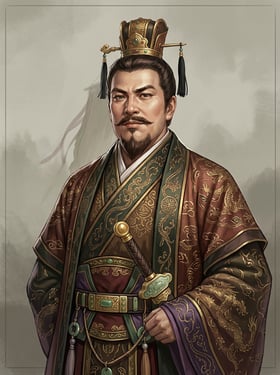
史载(Historical Record)
Cao Shuang, styled Zhaobo, was of imperial clan origin and was known in his youth for being prudent and steady. While Emperor Ming Cao Rui was in the Eastern Palace, he was already on close terms with Cao Shuang. After Cao Rui ascended the throne, Cao Shuang served in succession as Cavalier in Regular Attendance, Colonel of the City Gates, and then with the additional title of Regular Cavalier in Attendance, transferred to General of the Martial Guard, and was greatly favored c:2320. In the first month of the third year of Jingchu (239 CE), Emperor Ming Cao Rui fell gravely ill and summoned Cao Shuang into his bedchamber, appointing him General-in-Chief, granting him the staff of authority and the axe, with command over all military affairs within and without the court and charge of Secretariat affairs; together with the Grand Commandant Sima the Lord (Sima Yi), he received the testamentary edict to assist the young sovereign c:2320.
After Emperor Ming died and Qi-wang Cao Fang ascended the throne, Cao Shuang was given the additional title of Palace Attendant, reassigned as Marquis of Wu'an, with a stipend of twelve thousand households, and granted the honors of wearing sword and shoes into the hall, not hastening when entering court, and being announced without his name being called c:2320. To further consolidate his power, Ding Mi devised a scheme for Cao Shuang, having him petition the emperor to transfer Sima Yi to Grand Tutor—ostensibly to honor his title, but in fact to ensure that when the Secretariat memorialized matters they would first pass through his own hands, so that he could control the weight of court affairs c:2320.
In the second month of the fifth year of Zhengshi (244 CE), Cao Shuang led a great army on a campaign against Shu Han c:5616. However, the Shu Han General Who Guards the North Wang Ping held firm at the encirclement of Mount Xingshi, the General-in-Chief Fei Yi led an army to the rescue, and the Wei army was finally forced to retreat c:5617. In the eighth month of the same year, Cao Shuang withdrew his army and returned c:5616.
In the first month of the tenth year of Zhengshi (249 CE), the Cao Wei emperor Cao Fang went to the Gaoping Tombs to offer sacrifice, and Cao Shuang and his brothers all accompanied the imperial carriage c:2322. Sima Yi seized the moment to muster troops, first occupying the armory, then encamping at the floating bridge over the Luo River. Sima Yi memorialized to impeach Cao Shuang, charging him with betraying the late emperor's testamentary charge, corrupting the institutions of the state, usurping within and monopolizing power without. He pointed out that Cao Shuang had broken up the camps of the imperial guard, taken all the guard troops for himself, installed his confidants in important offices, driven out the old palace guards, and meant to install new men for selfish ends. Sima Yi specially noted that Cao Shuang employed the Yellow Gate attendant Zhang Dang as overseer, who exclusively spied on the emperor, sowed discord between the two palaces, and harmed flesh and blood. Sima Yi held that the realm was in turmoil, men's hearts uneasy, the emperor like a tenant on borrowed seat, and the altars of state imperiled. Citing the affair of Zhao Gao, he stressed that one must act decisively when the time came, and stated that the Empress Dowager had ordered that matters be carried out as memorialized. Sima Yi thereupon ordered the dismissal of the military authority of Cao Shuang, Cao Xi, and Cao Xun, commanding them to return to their residences in their capacity as marquises without lingering. He himself, despite illness, led troops to garrison the floating bridge over the Luo River to guard against the unexpected c:2322. In the end, Cao Shuang and his brothers were dismissed and placed under guard by men Sima Yi dispatched. Sima Yi later appointed Wang Yu to try the case of Cao Shuang c:2324.
演中(In the Novel)
In Romance of the Three Kingdoms, Cao Shuang is cast as a figure who, through favor, became domineering and overbearing and ultimately brought about his own destruction. When Emperor Ming Cao Rui was gravely ill, he was startled in the dead of night, Empress Mingdao demanding his life, which worsened his condition. Cao Rui at first wished to make Yan-wang Cao Yu regent, but the Director of the Palace Secretariat Liu Fang and the Director Sun Zi, who had once received favor from Cao Zhen, strongly recommended Cao Shuang and, on the grounds that "a vassal king may not serve as regent," persuaded Yan-wang Cao Yu to withdraw, so that Cao Shuang was able to become General-in-Chief and take overall charge of court affairs c:5618. This differs from the historical record in which Liu Fang and Sun Zi, for their own protection, persuaded Cao Yu to withdraw and recommended Cao Shuang; the Romance places more stress on Cao Shuang's tie to the line of Cao Zhen.
After Cao Fang ascended the throne, Sima Yi and Cao Shuang jointly served as regents. At first, Cao Shuang was respectful and deferential toward Sima Yi, consulting him before doing anything c:12057. However, incited by retainers such as He Yan, Cao Shuang gradually conceived a desire to monopolize power. He Yan reminded Cao Shuang that Sima Yi had once made Cao Zhen die of frustration, prompting Cao Shuang to take warning c:12057. Cao Shuang then adopted the advice and petitioned the Wei sovereign Cao Fang to grant Sima Yi the title of Grand Tutor, thereby stripping him of his military authority and gathering all military power to himself c:12057.
After monopolizing power, Cao Shuang grew ever more arrogant and unrestrained. He often went out hunting with He Yan, Deng Yang, and others; his brother Cao Xi and the Minister of Agriculture Huan Fan once remonstrated, pointing out that his power was too great and that the brothers should not all go out together lest disorder arise in the city, but Cao Shuang paid no heed, believing that with military power in hand he had nothing to fear c:12060.
To lull Cao Shuang, Sima Yi feigned grave illness, even, when Li Sheng came to inquire after his health, deliberately playing deaf and mute, letting soup and water spill over his lapels, and entrusting Li Sheng with the care of his two sons c:12060. Cao Shuang, believing Li Sheng's report, thought Sima Yi was at death's door and so relaxed his vigilance, overjoyed c:12060.
When Cao Fang went to the Gaoping Tombs to offer sacrifice, Cao Shuang and his brothers and confidants such as He Yan all accompanied the carriage out of the city. The Minister of Agriculture Huan Fan again reined in his horse to remonstrate, pointing out that the lord held overall command of the imperial guard and the brothers should not all go out, lest disorder arise in the city, but Cao Shuang still turned a deaf ear and rebuked Huan Fan for talking too much c:2325. It was precisely this moment that Sima Yi used to launch his coup. After the coup broke out, Huan Fan urged Cao Shuang to take the Son of Heaven to Xu, muster outside troops to attack Sima Yi, and pointed out that with Cao Shuang attending the Son of Heaven and issuing commands to the realm, who would dare not obey c:12063. However, Cao Shuang hesitated, and in the end chose to abandon resistance, believing the persuasions of Xu Yun, Chen Tai, and Yin Damu that Sima Yi merely wished to strip his military authority and had no other intent c:12065. He even, by night, drew his sword and sighed, weeping until daybreak, still unable to make up his mind. Seeing this, Huan Fan wept bitterly and lamented that the son of Cao Zhen was indeed a "pig and calf" c:2326. In the end, Cao Shuang handed his seals of office to Xu Yun and Chen Tai to give to Sima Yi, abandoning resistance. Sima Yi sent men to deliver provisions, making Cao Shuang believe that Sima Yi harbored no intent to harm him, so that he relaxed his vigilance c:12068. These details have no clear record in the histories and are literary inventions by the Romance for the sake of characterization and dramatic conflict.
关键关系
* Cao Wei (serves): As a member of the Cao Wei imperial clan, Cao Shuang was given important posts from the time of Emperor Ming Cao Rui, finally becoming a regent and holding the reins of Cao Wei court affairs c:2320.
* Cao Rui (advises_in): When gravely ill, Cao Rui summoned Cao Shuang into his bedchamber, appointed him General-in-Chief, and had him assist the young sovereign together with Sima Yi, showing his trust in him c:2320.
* Shu Han (fights_in): Cao Shuang once led an army on a campaign against Shu Han, but failed to gain victory and finally withdrew c:5617.
* Cao Zhen (kin_of): Cao Shuang was the son of Cao Zhen; in the Romance, Liu Fang and Sun Zi strongly recommended Cao Shuang on account of Cao Zhen's favor c:5618.
* Sima Yi (rival): Cao Shuang and Sima Yi were both regents entrusted with the heir, but Cao Shuang sought to monopolize power and strip Sima Yi of his military authority, ultimately leading Sima Yi to launch the Incident at the Gaoping Tombs and remove him c:2320, c:2322.
* He Yan, Deng Yang, Li Sheng, Ding Mi, Bi Gui (associates): These figures were Cao Shuang's confidants; in the Romance they were the behind-the-scenes instigators of Cao Shuang's monopoly of power, He Yan in particular having urged Cao Shuang to seize sole authority c:12057.
* Huan Fan (advisor): Huan Fan was Cao Shuang's Minister of Agriculture, who repeatedly remonstrated with Cao Shuang, warning him of the dangers of excessive power and ostentatious conduct, and during the Incident at the Gaoping Tombs strongly urged Cao Shuang to resist, but was not heeded c:12060, c:12063.
标志性场景
* Receiving the regency entrustment: When Emperor Ming Cao Rui was gravely ill, he summoned Cao Shuang into his bedchamber, appointed him General-in-Chief, and had him receive the testamentary edict together with Sima Yi to assist the young sovereign Cao Fang c:2320. This was the starting point of Cao Shuang's political career and the mark of his power reaching its peak.
* Stripping Sima Yi of military authority: On the advice of He Yan and others, Cao Shuang petitioned the emperor to grant Sima Yi the title of Grand Tutor, using this pretext to strip Sima Yi of his military authority and gather all military power to himself, thereby monopolizing court affairs c:12057 (novel only).
* The Incident at the Gaoping Tombs: When Cao Shuang and his brothers accompanied Cao Fang out of the city to offer sacrifice at the Gaoping Tombs, Sima Yi seized the moment to launch his coup, occupying the armory, encamping at the floating bridge over the Luo River, and memorializing to impeach Cao Shuang. This event directly led to Cao Shuang's downfall c:2322.
* Huan Fan weeping "pig and calf": After the coup broke out, Huan Fan strongly urged Cao Shuang to hold the Son of Heaven to command the lords, but Cao Shuang hesitated and in the end chose to abandon resistance, seeking only to be a wealthy private gentleman. Seeing this, Huan Fan wept bitterly and lamented that the son of Cao Zhen was indeed a "pig and calf," foretelling Cao Shuang's tragic end c:2326 (novel only).
* Sima Yi's "feigned illness": To lull Cao Shuang, Sima Yi deliberately feigned illness before Li Sheng, pretending to be deaf, letting soup and water spill over his lapels, and entrusting Li Sheng with the care of his two sons. This scene successfully made Cao Shuang relax his vigilance, creating the conditions for Sima Yi to launch his coup c:12060 (novel only).
Portrait file
Character profile
- Character
- Cao Shuang did not accept Sima Yi's advice and monopolized power; at first he served Sima Yi carefully, but later, misled by He Yan, he seized authority. Domineering, arrogant, and extravagant, he prized rare treasures and filled his household with entertainers; he lightly trusted Li Sheng's report and would not heed the remonstrance of Huan Fan that he and his brother Cao Xi ought not all leave the city together. Irresolute and suspicious, greedy for ease and clinging to life, he in the end sought to live on as a "rich old commoner," unable to accept Cao Jiong's argument for imperial kinsmen as a protective screen for the throne.
- Manner of speech
- His manner of speech was arrogant and curtly dismissive, as in "Who dares to revolt! Speak no more nonsense!" and "The military authority is in my hands—what is there to fear?"
- Life
- Cao Shuang received Emperor Ming's final charge to jointly assist the sovereign with Sima Yi. In the fifth year of Zhengshi he led forces on a campaign against Shu without success. In the first year of Jiaping, during the Incident at the Gaoping Tombs, he was executed by Sima Yi, and his three kindreds were exterminated. He had served as Cavalier Attendant Gentleman, Colonel of the City Gates, Cavalier Regular Attendant, and General of the Martial Guard; when Emperor Ming lay ill, he was appointed Grand General, given the staff of authority, made Commander of All Military Affairs Within and Without, and Overseer of the Masters of Writing. Together with Sima Yi he received the testamentary edict to assist the young sovereign; after the Prince of Qi ascended the throne, he was additionally made Palace Attendant, re-enfeoffed as Marquis of Wu'an, and granted the right to wear sword and shoes in the hall, to enter court without hastening, and to be announced at audience without his name being called. Heeding Ding Mi's scheme, he had the Son of Heaven transfer Sima Yi to Grand Tutor—outwardly honoring him while inwardly stripping his power—and promoted He Yan, Deng Yang, Ding Mi, Bi Gui, and Li Sheng as his trusted confidants.
- Anecdotes
- Cao Shuang was the son of Cao Zhen, the Grand General entrusted with the last charge by Emperor Ming of Wei, who together with Sima Yi received the guardianship of the orphaned heir. His food, carriages, and robes rivaled those of the imperial carriage; his wives and concubines filled his rear halls, and he privately took the late emperor's palace ladies, gathering with He Yan and others in an underground chamber to drink and revel. He was once on bad terms with Sun Li, and once invited Wang Ji to serve as Attendant Officer.
Relationships
36 relationships
Family5
Lord & vassal8
Friends1
Enemies9
Other12
Quotes
13 recorded lines · 3 featured
「兵權在吾手中,何懼之有?」
A textbook display of Cao Shuang's domineering monopoly of power, sowing the seeds of his later destruction.
「我不起兵,請願棄官,但為富家翁足矣!」
Displays Cao Shuang's weakness and wishful thinking during the coup, which ultimately led to his defeat.
「司馬公本無害我之心也!」
Cao Shuang's misjudgment of Sima Yi directly led to his death and the annihilation of his clan.
Chapters15 回 ▸
- 史ch.3ch.4ch.9ch.13ch.14ch.21ch.22ch.24ch.27ch.28ch.33ch.43
- 演ch.106ch.107ch.110
Relationship timeline10 条 ▸
史 ch.3
- Cao Rui§43
advises_in
明帝托孤;与司马懿共辅少子
史 ch.4
- Zhang Dang§20
betrayed_by
付廷尉考实,言爽与谋不轨
史 ch.9
史 ch.22
演 ch.106
- Cao Fang§16
serves
请魏主谒高平陵祭祀先帝,引兄弟御林军护驾出城——为高平陵之变预设场景
演 ch.107
- Sima Yi§10
betrayed_by
自缚纳印绶投降
Inner monologues · AI-generated3 段 ▸
- The oath by the Luo River still rang in my ears, yet the gates of my residence had been locked again. I, Cao Shuang, cou
- I am Cao Shuang, courtesy name Zhaobo. I remember that in my youth, as a member of the imperial clan, I conducted myself
- I remember that when I was young, I often went in and out of the palace and was frequently at Emperor Ming’s side. The p
Life events5 ▸
- 0239-01-01 · LuoyangEmperor Ming of Wei Entrusts the Regency on His Deathbed· Advisor
- 0244-01-01 · Mount XingshiBattle of Xingshi· Commander
- 0244-01-01 · Mount XingshiCao Shuang's Campaign Against Shu via Luogu· Commander
- 0249-01-01 · LuoyangCao Shuang's Regency· Instigator
- 0249-01-01 · LuoyangIncident at the Gaoping Tombs· Victim