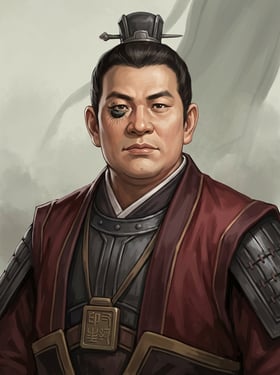
Historical Record
Sima Shi, styled Ziyuan, was the eldest son of Sima Yi, the powerful Cao Wei minister of the Three Kingdoms period. His life is recorded in official histories such as the Records of the Three Kingdoms. In the seventh month of the third year of Jiaping (251 CE), after the death of the Grand Tutor Sima Yi, Sima Shi was appointed General Who Stabilizes the Army and Director of the Masters of Writing, taking hold of Cao Wei's military and political authority. c:4810 In the first month of the following year he was promoted to General-in-Chief. c:4811
In the eleventh month of winter in the fourth year of Jiaping (252 CE), Sima Shi dispatched the General Who Conquers the South Wang Chang, the General Who Conquers the East Hu Zun, the General Who Guards the South Guanqiu Jian, and others to campaign against Eastern Wu; but in the twelfth month the Wu General-in-Chief Zhuge Ke crushed the Wei army at Dongguan, and the Wei forces withdrew in defeat. c:4811 In the face of defeat, Sima Shi showed the bearing to take responsibility, saying: "I did not heed the words of Gongxiu (Zhuge Dan), and so it came to this. This is my fault—what crime have the generals?" He pardoned the generals and only stripped his younger brother Sima Zhao (then Army Supervisor) of his title. This act won the admiration of the people of Wei. c:4811
In the first month of spring in the sixth year of Jiaping (254 CE), the General Who Guards the East Guanqiu Jian and the Inspector of Yangzhou Wen Qin raised troops in revolt in Huainan. Sima Shi personally led a great army to suppress them. c:740 During the campaign he adopted the strategy of the Chamberlain for Ceremonials Fu Gu, reasoning that since the families of the Huainan soldiers were all in the interior, cutting off their route home would surely cause the rebel army to fall apart. c:8586 He also heeded the advice of the Army Supervisor Wang Ji, advancing swiftly to seize Nandun and sever Guanqiu Jian's supply line. c:8587 On the jihai day of the intercalary month, Sima Shi defeated Wen Qin at Lejia, and Wen Qin fled to surrender to Wu. On the jiachen day, the Commandant of Anfeng Ford slew Guanqiu Jian and sent his head to the capital. c:740
After putting down the rebellion of Guanqiu Jian and Wen Qin, Sima Shi fell ill and died at Xu Chang. On the dingsi day of the second month, his younger brother Sima Zhao succeeded to his position as General-in-Chief and Director of the Masters of Writing. c:740 During his tenure, Sima Shi deposed Cao Fang and enthroned Cao Mao, further consolidating the power of the Sima clan.
In the Novel
In Romance of the Three Kingdoms, Sima Shi is drawn more vividly and takes part in many events with no basis in history. He first appears in Chapter 94, when, together with his younger brother Sima Zhao, he comforts their father Sima Yi, who sighs at not being valued by the ruler of Wei. When Sima Yi learns that Meng Da intends to rebel, Sima Shi advises his father to write a memorial in haste to report it to the Son of Heaven; but Sima Yi, judging that waiting for an imperial edict to travel back and forth would take too long, decides to strike first. c:741
In the clashes with Zhuge Liang, Sima Shi several times campaigned alongside his father. In Chapter 102, Zhuge Liang laid a scheme to lure the enemy; Sima Yi saw through it and dispatched Sima Shi and Sima Zhao with troops to relieve the forward camp. c:742 In the same chapter, when Sima Yi wished to lead his two sons personally to raid the Shu camp, Sima Shi remonstrated that his father should not risk himself in person and suggested sending another general first. Sima Yi took his advice and sent Qin Lang to raid the camp; Qin Lang fell into the trap and died. c:8558 In Chapter 103, Sima Shi advised Sima Yi to give battle to Zhuge Liang, but Sima Yi insisted on holding firm and not coming out. c:743 At the battle of Shangfang Valley, Sima Shi expressed his admiration for Sima Yi's stratagem of feinting east to strike west. c:744
After Zhuge Liang's death, Sima Shi and Sima Zhao followed Sima Yi in pursuing the Shu army, only to fall for the empty-fort ruse Zhuge Liang had set after his death—"the dead Zhuge frightened off the living Zhongda." c:745 In the campaign against Gongsun Yuan, Sima Shi and Sima Zhao both followed Sima Yi to war, besieging Gongsun Yuan and his son in Liaodong and finally capturing and killing them. c:746
In the novel, Sima Shi also clashed with Jiang Wei. In Chapter 107, when Jiang Wei attacked Yongzhou, Sima Shi led troops to intercept him but was defeated within three bouts and driven back by the repeating crossbows handed down by the Marquis of Wu. c:747 c:748
After Sima Yi's death, Sima Shi and Sima Zhao monopolized the government. The ruler of Wei, Cao Fang, plotted with Xiahou Xuan, Li Feng, and Zhang Ji to do away with Sima Shi, but Sima Shi saw through it. He had the three cut in two at the waist and their clans exterminated, then deposed Cao Fang and enthroned Cao Mao. c:749 c:8565 c:750 c:752
In suppressing the rebellion of Guanqiu Jian and Wen Qin, the novel adds the episode of Sima Shi going to war while ill with an eye ailment (a tumor). c:754 He adopted the advice of Wang Su and Zhong Hui and personally led the army to put down the revolt. During the campaign his eye ailment worsened, and at night he often saw apparitions of Li Feng, Zhang Ji, and Xiahou Xuan; he finally fell ill and died at Xu Chang, charging Sima Zhao on his deathbed not to lightly trust others and to keep hold of the great power. c:755
Key Relationships
* Cao Wei (serves): Sima Shi was a senior minister of Cao Wei, successively General Who Stabilizes the Army and General-in-Chief, holding military and political power and serving as the actual ruler of late Cao Wei. c:4810
* Cao Fang (enemy_of): Sima Shi deposed Cao Fang from the throne and enthroned Cao Mao, further consolidating the power of the Sima clan. c:752
* Guanqiu Jian (enemy_of): Guanqiu Jian raised troops in revolt; Sima Shi personally led a great army to suppress the rebellion and ultimately slew Guanqiu Jian. c:740
* Sima Yi (kin_of): Sima Shi was the eldest son of Sima Yi, inheriting his father's power as the second-generation holder of the Sima clan's authority. c:4810
* Sima Zhao (kin_of): Sima Shi's younger brother, who succeeded to his position after Sima Shi fell ill and died, continuing to hold the great power of Cao Wei. c:740
* Zhuge Ke (enemy_of): At the battle of Dongguan, Zhuge Ke crushed the Wei army dispatched by Sima Shi. c:4811
* Li Feng, Zhang Ji, Xiahou Xuan (enemy_of): The three plotted to do away with Sima Shi, but he saw through it and put them to death c:749 c:8565 c:750 (novel only).
* Jiang Wei (enemy_of): In the novel, Sima Shi clashed with Jiang Wei but was defeated by him c:747 (novel only).
Iconic Scenes
* Taking responsibility after the defeat at Dongguan: After the Wei army's great defeat at Dongguan, Sima Shi took the blame upon himself, saying "This is my fault—what crime have the generals?" and pardoned the generals, winning the admiration of the people of Wei. c:4811 This displayed his magnanimity and leadership as a commander.
* Suppressing the rebellion of Guanqiu Jian and Wen Qin: Sima Shi personally led a great army to put down the Huainan rebellion, displaying decisive military skill and political acumen. He adopted the advice of Fu Gu and Wang Ji and swiftly dissolved the rebel army. c:740 c:8586 c:8587
* Deposing Cao Fang and enthroning Cao Mao: After seeing through the plot of Cao Fang and others, Sima Shi decisively deposed Cao Fang and enthroned Cao Mao, further consolidating the power of the Sima clan and laying the foundation for the establishment of the Jin dynasty. c:752
* Going to war gravely ill and dying as the eye ailment worsened: In the novel, Sima Shi went to war while ill during the suppression of the Guanqiu Jian and Wen Qin rebellion; as his eye ailment worsened, he often saw apparitions at night of those he had put to death, and finally fell ill and died at Xu Chang, charging Sima Zhao on his deathbed to keep hold of the great power c:754 c:755 (novel only). This episode highlights his tenacity and obsession with power and adds drama to the transfer of authority within the Sima clan.
Portrait file
Character profile
- Appearance
- Sima Shi had a round face and large ears, a square mouth and thick lips, and beneath his left eye grew a black tumor from which sprouted several dozen black hairs. The flesh-tumor on his left eye often ached and itched, and he had recently had it cut off.
- Character
- Gravely ill, he still forced himself to lead troops, his mind and spirit distracted. As Sima Yi's eldest son, he inherited the office of Grand General, monopolized the power of the court, presided over the campaign against Wu, and deposed and enthroned emperors.
- Manner of speech
- Sima Shi remonstrated in a mild and reasoned manner, his words revealing his concern for his father.
- Life
- After Sima Yi died in the third year of Jiaping, Sima Shi became General Who Nurtures the Army with authority over the Masters of Writing, and in the fourth year of Jiaping was promoted to Grand General. In the sixth year of Jiaping he deposed the Prince of Qi, Fang, and enthroned the Duke of Gaogui District, arresting Xiahou Xuan, Li Feng, Zhang Ji, and others and exterminating their three clans. In the second year of Zhengyuan, while campaigning against Guanqiu Jian and Wen Qin, the tumor on his eye burst with blood and he died at Xuchang.
- Anecdotes
- He was Sima Yi's son, who succeeded to control of the government. On his deathbed he handed the seal and sash to Sima Zhao, with the dying words, "Great affairs must on no account be lightly entrusted to another." He was posthumously honored as Prince Jing and Emperor Jing.
Relationships
29 relationships
Quotes
31 recorded lines · 3 featured
「天道三十年一變,豈得常為鼎峙乎?吾欲伐吳。」
This line shows Sima Shi's soaring ambition, foreshadowing the Reunification of the Three Kingdoms under Jin.
「今主上荒淫無道,褻近娼優,聽信讒言,閉塞賢路:其罪甚於漢之昌邑,不能主天下。吾謹按伊尹、霍光之法,別立新君,以保社稷,以安天下,如何?」
This line is Sima Shi's proclamation deposing Cao Fang, reflecting his political dexterity and ambition.
「吾今權重,雖欲卸肩,不可得也。汝繼我為之,大事切不可輕託他人,自取滅族之禍。」
This line is Sima Shi's deathbed charge to Sima Zhao, revealing the transfer of power within the Sima family and its underlying anxieties.
Chapters17 回 ▸
- 史ch.4ch.9ch.13ch.21ch.22ch.27ch.28
- 演ch.94ch.102ch.103ch.104ch.106ch.107ch.108ch.109ch.110ch.119
Relationship timeline16 条 ▸
史 ch.4
- Cao Fang§28
enemy_of
谋废帝,闻于皇太后
- Guanqiu Jian§37
enemy_of
大将军征讨,破钦于乐嘉
演 ch.94
- Sima Yi§14
kin_of
司马懿长子,字子元;通晓兵书
演 ch.102
- Sima Yi§11
kin_of
长子;劝父勿据片纸亲入重地,请别将先去
演 ch.103
演 ch.104
- Sima Yi§29
kin_of
长子,催军追蜀
演 ch.106
- Sima Yi§9
kin_of
长子,与父合围公孙渊
演 ch.107
- Jiang Wei§30
fights_in
阳平关前截维归路,战三合败走
演 ch.108
- Sima Yi§1
kin_of
司马懿长子
演 ch.109
- Sima Zhao§13
sibling_of
兄弟同专制朝权
fights_in
以"张缉之女理当除之"令左右白练绞死于东华门内
- Xiahou Xuan§17
enemy_of
令将三人腰斩于市、灭其三族
- Cao Ju§21
advises_in
拟立彭城王曹据为新君,被太后否决
演 ch.110
Inner monologues · AI-generated3 段 ▸
- I recall that when I was young, my father was living quietly in Wancheng. Wei’s forces were repeatedly routed by Shu’s a
- My eyes pain me more severely by the day. The lamp flickers in the tent, and I know this body cannot hold out much longe
- I hold the office of Grand General, oversee the affairs of the Secretariat, and wield the pivotal authority of the realm
Life events9 ▸
- 0234-01-01 · Shangfang ValleyFire Attack at Shangfang Valley· Warrior
- 0254-01-01 · LuoyangSima Shi Deposes Cao Fang· Instigator
- 0254-01-01 · LuoyangDeposition of Cao Fang· Instigator
- 0254-01-01 · LuoyangConspiracy of Li Feng and Xiahou Xuan· Instigator
- 0255-01-01 · LejiaWen Yang Single-handedly Repulses the Wei Army· Commander
- 0255-01-01 · ShouchunRebellion of Guanqiu Jian and Wen Qin· Commander
- 0255-01-01 · ShouchunRebellion of Guanqiu Jian and Wen Qin· Commander
- 0258-01-01 · ShouchunThree Rebellions in Shouchun· Commander
- 0266-01-01 · LuoyangThe Sima Clan's Seizure of Power· Instigator