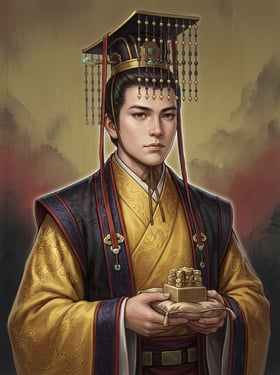
Historical Record
Cao Fang, styled Lanqing, whose origins are not clearly recorded in the histories; only the Spring and Autumn of the Wei Clan mentions that he may have been a son of Cao Kai, Prince of Rencheng. In the third year of Qinglong (235), he was made Prince of Qi by Emperor Ming Cao Rui. In the first month of the third year of Jingchu (239), Cao Rui fell gravely ill and established Cao Fang as Crown Prince; on the same day Cao Fang ascended the imperial throne and granted a general amnesty. After his accession, Cao Fang honored Empress Guo as Empress Dowager, and government was jointly administered by Grand General Cao Shuang and Grand Commandant Sima Yi.
At the start of his reign, Cao Fang issued an edict halting all palace construction works, and freed government slaves over sixty years of age to become commoners. In the second month, envoys from the Western Regions presented fire-washed cloth, and Cao Fang specially ordered Cao Shuang and Sima Yi to examine it together to show the officials. That same year, Sima Yi, for his outstanding achievements—such as capturing Meng Da in the south, breaking the Shu raiders in the west, and destroying Gongsun Yuan in the east—was promoted to Grand Tutor and continued to hold the staff of authority overseeing military affairs. In the third month, Man Chong was appointed Grand Commandant. In the seventh month, Cao Fang began to attend to government in person, hearing the memorials of the high ministers. In the twelfth month, he issued an edict restoring the Xia calendar, making the month of jianyin the first month of the first year of Zhengshi; although this departed from the former emperor's principle of harmonizing the three calendrical systems, it was also a reform of ritual institutions.
In the spring, first month of the fourth year of Zhengshi (243), Cao Fang underwent the capping ceremony and bestowed gifts on the ministers. In summer, fourth month, on the day yimao, he established Lady Zhen as empress and granted a general amnesty. In the seventh month of that same year, he issued an edict to have twenty-one men—Cao Zhen, Cao Xiu, Xiahou Shang, Huan Jie, Chen Qun, Zhong Yao, Zhang He, Xu Huang, Zhang Liao, Yue Jin, Hua Xin, Wang Lang, Cao Hong, Xiahou Yuan, Zhu Ling, Wen Ping, Zang Ba, Li Dian, Pang De, Dian Wei, and others—enshrined in the temple courtyard of the Grand Ancestor.
In the second month of the sixth year of Zhengshi (245), an earthquake occurred in Nan'an Commandery. In the eighth month, on the day dingmao, the Grand Master of Ceremonies Gao Rou was made Minister of Works. In the winter, eleventh month of that year, a collective sacrifice was held at the temple of the Grand Ancestor, and for the first time the aforementioned twenty-one meritorious founding ministers were sacrificed to together. In the twelfth month, an edict declared that the Commentary on the Book of Changes composed by the late Minister Over the Masses Wang Lang could be used for examining scholars.
In the eighth month of the seventh year of Zhengshi (246), Cao Fang issued an edict dismissing the aged or infirm government slaves and restoring them to commoner status, with the commanderies and counties providing them relief. That same year, the Inspector of You Province, Guanqiu Jian, campaigned against Goguryeo and the Yemaek and won victories in both, causing several dozen states such as the Han Naxi to submit.
In the first year of Jiaping (249), the General Who Conquers the West, Guo Huai, for having served more than thirty years in the region west of the passes—campaigning against bandits abroad and pacifying the people and tribes at home, and especially for crushing Liao Hua and capturing Ju An and others—was appointed General of Chariots and Cavalry with ceremonial equal to the Three Excellencies. That same year, the Minister of Works Xu Miao died and was posthumously honored as Marquis Mu.
In the sixth year of Jiaping (254), on the day dingchou, Cao Fang was deposed, and an edict made Cao Mao, the Duke of Gaogui Township and son of Cao Lin, Prince of Donghai, the heir of Emperor Ming. After the Jin received the abdication, Cao Fang was enfeoffed as Duke of Shaoling County; in the tenth year of Taishi (274) he died at the age of forty-three, with the posthumous title of Duke Li.
In the Novel
In Romance of the Three Kingdoms, Cao Fang is portrayed more as a puppet emperor controlled by powerful ministers. He first appears in Chapter 106, set up as emperor jointly by Sima Yi and Cao Shuang. The novel emphasizes that Cao Fang was Cao Rui's adopted son and that his origins were hidden and unknown to anyone—which agrees with the historical record.
After Cao Fang's accession, Cao Shuang was at first respectful and deferential toward Sima Yi, but, heeding the advice of He Yan and others that Sima Yi's great achievements and power might breed future trouble, he advised Cao Fang to promote Sima Yi to Grand Tutor, thereby stripping him of military power and monopolizing authority himself. This differs from the historical fact that Sima Yi was promoted to Grand Tutor for his merit; the novel depicts it as a means by which Cao Shuang weakened Sima Yi's power.
After Sima Yi launched the Incident at the Gaoping Tombs, Cao Fang, accompanied by Cao Shuang, had gone out of the city to make sacrifices to his ancestors. When Sima Yi, in the name of an edict from Empress Dowager Guo, accused the Cao Shuang brothers of monopolizing power and disordering the government, Cao Fang was at a loss and did not know how to decide. He failed to adopt Huan Fan's advice to go to Xu and raise troops to attack Sima Yi, which in the end led to the Cao Shuang brothers being captured and killed.
The novel also depicts Cao Fang's fear of the Sima family. After Sima Yi's death, the brothers Sima Shi and Sima Zhao monopolized court authority, and every time Cao Fang saw Sima Shi enter court, he trembled as though sitting on pins and needles. He once secretly plotted with the Grand Master of Ceremonies Xiahou Xuan, the Director of the Secretariat Li Feng, and the Imperial Household Grandee Zhang Ji (father of Empress Zhang) to try to remove Sima Shi. Cao Fang even bit his finger and wrote a blood edict, handing it to Zhang Ji and instructing them to be careful and not let it leak. However, the plot was finally exposed; Sima Shi saw through their scheme and found the blood edict on Zhang Ji's person. Sima Shi then burst into the inner palace, interrogated Cao Fang, and strangled Empress Zhang to death before his eyes. In the end, Cao Fang was deposed by Sima Shi, who set up Cao Mao as emperor instead, ending his career as a puppet emperor.
Key Relationships
* Cao Wei (lord_of): As the third emperor of Cao Wei, Cao Fang was the supreme ruler of Cao Wei, but during his reign real power gradually slipped away, and he was finally deposed.
* Empress Zhen (spouse_of): The historical record states that Cao Fang established Lady Zhen as empress in the fourth year of Zhengshi (243). In the novel, Empress Zhen is portrayed as a daughter of Zhang Ji, that is, Empress Zhang, and after Cao Fang's plot to remove Sima Shi failed, she was strangled to death by Sima Shi before Cao Fang's eyes (novel only).
* Sima Yi (lord_of): When Cao Fang ascended the throne, Sima Yi administered the government jointly with Cao Shuang. Sima Yi was promoted to Grand Tutor for his merit. In the novel, Sima Yi was Cao Fang's regent minister, but ultimately seized power through the Incident at the Gaoping Tombs, becoming the de facto master of Cao Fang.
* Sima Shi (enemy_of): The historical record states that Sima Shi deposed Cao Fang and set up Cao Mao as emperor instead. In the novel, Sima Shi was Cao Fang's direct enemy; he monopolized the government, leaving Cao Fang as though on pins and needles, and in the end Cao Fang's plot to remove Sima Shi failed, leading to Empress Zhang's death and his own deposition.
* Cao Shuang (lord_of): When Cao Fang ascended the throne, Cao Shuang administered the government jointly with Sima Yi. In the novel, Cao Shuang for a time monopolized power, but in the end lost in the power struggle with Sima Yi and was executed by him, leaving Cao Fang utterly without support.
Signature Scenes
* Accession and regency: Cao Fang was established as Crown Prince when Emperor Ming Cao Rui fell gravely ill, and ascended the imperial throne on the same day. Government was administered jointly by Grand General Cao Shuang and Grand Commandant Sima Yi, marking the prologue to the power struggles of the late Cao Wei.
* The lesson of the fire-washed cloth: At the start of Cao Fang's reign, the Western Regions presented fire-washed cloth, and he ordered Cao Shuang and Sima Yi to examine it together to show the officials. This scene reflects the new ruler's grasp of government and his interest in foreign cultures at the start of his reign.
* Attending to government in person: In the autumn, seventh month of the first year of Zhengshi (240), Cao Fang began to attend to government in person, hearing the memorials of the high ministers, showing that he had tried to grasp real power rather than being reduced entirely to a puppet.
* Freeing the slaves: Cao Fang twice issued edicts freeing government slaves over sixty years of age to become commoners, and dismissing the aged or infirm government slaves, to be relieved by the commanderies and counties. This reflects his benevolent side and his concern for the people's livelihood.,
* The Incident at the Gaoping Tombs: In the novel, Cao Fang went out of the city with Cao Shuang to make sacrifices to his ancestors, and Sima Yi seized the opportunity to launch a coup, accusing Cao Shuang of monopolizing power. Cao Fang appeared weak and powerless in this event, which in the end led to the Cao Shuang brothers being executed and Sima Yi gaining complete control of the government (novel only).
* Plotting to remove Sima Shi: In the novel, out of fear of Sima Shi's monopoly of power, Cao Fang plotted with Xiahou Xuan, Li Feng, and Zhang Ji and wrote a blood edict. This scene shows Cao Fang's struggle to resist the powerful minister, but it ended in failure and led to Empress Zhang's death and his own deposition (novel only).,,
* Being deposed: Cao Fang was finally deposed by Sima Shi, who set up Cao Mao, Duke of Gaogui Township, as emperor instead. This event marked the complete loss of imperial authority by Cao Wei and the acceleration of the Sima family's usurpation.
Portrait file
Character profile
- Character
- As the adopted son and designated heir of Emperor Ming of Wei, Cao Fang took the throne young, and during his reign was placed under the regency and control of powerful ministers such as Cao Shuang, Sima Yi, and Sima Shi. He was once judged by Wang Ling and Linghu Yu unfit for the throne; under coercion from Sima Shi, he secretly plotted to destroy the traitor, but the plot leaked, leading to the empress being strangled and his own deposition.
- Life
- Cao Fang was the adopted son of Emperor Ming of Wei, styled Lanqing. In the third year of Jingchu he was made crown prince and ascended the imperial throne. In the sixth year of Jiaping he was deposed by Sima Shi to be Prince of Qi, and after the Jin received the abdication he was enfeoffed as Duke of Shaoling County. He died in the tenth year of Taishi, with the posthumous title of Duke Li.
- Anecdotes
- During Cao Fang's reign the regent ministers were successively Cao Shuang, Sima Yi, and Sima Shi. He was the heir entrusted on Emperor Ming of Wei's deathbed, and the third emperor of Cao Wei, reigning during the Jiaping era. In his reign he honored Lady Guo as Empress Dowager, and issued edicts commending men such as Guo Huai, Xu Miao, Hu Zhi, and Tian Yu.
Relationships
12 relationships
Quotes
17 recorded lines · 3 featured
「司馬師視朕如小兒,覷百官如草芥,社稷早晚必歸此人矣!」
This line displays Cao Fang's keen insight into, and helplessness before, Sima Shi's monopoly on power.
「朕祖武皇帝誅董承,蓋爲機事不密也。卿等須謹細,勿洩於外。」
Cao Fang warns by invoking Cao Cao's execution of Dong Cheng, reflecting his wariness of the Sima clan.
「太尉體道正直,盡忠三世,南擒孟達,西破蜀虜,東滅公孫淵,功蓋海內。昔周成建保傅之官,近漢顯宗崇寵鄧禹,所以優隆儁乂,必有尊也。其以太尉為太傅,持節統兵都督諸軍事如故。」
This line embodies Cao Fang's reverence for and attempts to win over Sima Yi, foreshadowing the political situation to come.
Chapters7 回 ▸
- 史ch.4ch.26ch.27ch.28
- 演ch.106ch.107ch.109
Relationship timeline4 条 ▸
Inner monologues · AI-generated3 段 ▸
- I once believed that the first duties of an emperor were ritual propriety and care for the people. In the edict of the Y
- Whenever I reflect on the years since I ascended the throne, I see that the realm’s troubles lie not only at the borders
- I was raised in the palace from infancy, but no one knew where I came from—not even the people who served within the pal
Life events4 ▸
- 0239-01-01 · LuoyangEmperor Ming of Wei Entrusts the Regency on His Deathbed· Witness
- 0249-01-01 · LuoyangIncident at the Gaoping Tombs· Witness
- 0254-01-01 · LuoyangSima Shi Deposes Cao Fang· Victim
- 0254-01-01 · LuoyangDeposition of Cao Fang· Victim