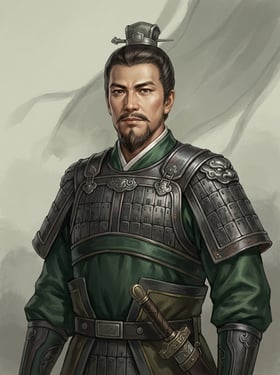
Historical Record
Guo Huai, styled Boji, was a native of Yangqu in Taiyuan. His grandfather Guo Quan once served as Grand Minister of Agriculture, and his father Guo Yun once served as Administrator of Yanmen. During the Jian'an era, Guo Huai was nominated as Filial and Incorrupt and first served as Assistant of Pingyuan. When Cao Pi was General of the Five Offices, he summoned Guo Huai to serve as Bandit-Suppressing Officer of his household, and Guo Huai later transferred to be Aide of the Counsellor for Military Affairs of the Chancellor, accompanying Cao Cao on the campaign against Hanzhong.
After Cao Cao withdrew his army, he left the General Who Conquers the West, Xiahou Yuan, to hold off Liu Bei, with Guo Huai serving as Xiahou Yuan's Marshal. When Xiahou Yuan fought with Liu Bei, Guo Huai was ill and unable to take part in the battle. After Xiahou Yuan was killed in action, the army fell into great disorder; Guo Huai remained calm in the face of crisis, gathered the scattered troops, and recommended the Bandit-Sweeping General Zhang He as commander, thereby steadying the army's morale. The next day, Liu Bei wished to cross the Han River to attack. The other generals all believed they were too few to face the enemy and wished to array themselves along the river. Guo Huai, however, proposed the strategy of "arraying far from the water, drawing the enemy in, and striking after he is half across," successfully making Liu Bei doubt and refrain from crossing, so that in the end he held firm and did not withdraw. When Cao Cao learned of this, he greatly praised Guo Huai's stratagem, granted Zhang He the staff of authority, and continued to have Guo Huai serve as Marshal.
After Cao Pi was proclaimed King, Guo Huai was granted the rank of Marquis Within the Passes and transferred to be Senior Clerk of the Garrison of the West. He also acted as Protector of the Army Who Campaigns Against the Qiang, and together with Zhang He and Yang Qiu suppressed the mountain bandit Zheng Gan and the rebellious Lushui barbarians, bringing peace to the Guanzhong region so that the people could live and work in contentment. In the first year of Huangchu, Guo Huai was ordered to go and offer congratulations on Cao Pi's accession, but was delayed on the way by illness. While the assembled ministers were feasting, Cao Pi sternly demanded the reason for his lateness, and Guo Huai answered with "the Five Emperors first instructed the people with virtue, but when the government of the Xia rulers declined, they began to use punishments," cleverly dispelling the crisis. He greatly won Cao Pi's esteem and was promoted to Inspector of Yong Province and enfeoffed as Marquis of Sheyang Precinct.
During his time as Inspector of Yong Province, Guo Huai put down the rebellion of Bidi, the great chieftain of the Anding Qiang. In dealing with the surrendered Qiang and Hu peoples, he always first sent men to investigate in detail their relatives, men and women, and ages; and upon meeting them, he could relate each one in turn, his inquiries thorough and attentive, so that he won the trust and praise of the Qiang and Hu peoples.
In the second year of Taihe, Zhuge Liang sent troops out to Mount Qi. Guo Huai and Zhang He defeated Ma Su at Jieting and Gao Xiang at Liucheng respectively. He then defeated the famous Qiang chieftain Tangdi of Longxi at Fuhan and was promoted to General Who Establishes Might. In the fifth year, Zhuge Liang sent troops out to Lucheng; at that time grain was scarce in Longyou, and Guo Huai used both authority and kindness to pacify the Qiang and Hu, so that they willingly contributed grain and the levies were settled, securing the supply of military provisions; he was therefore transferred to be General Who Spreads Martial Might. In the second year of Qinglong, Zhuge Liang advanced out of the Xie Valley and farmed military colonies at Lankeng. Guo Huai foresaw that Zhuge Liang would certainly contend for the Northern Plateau, strongly advocated seizing it first, and successfully repelled the assault of the Shu troops.
In the first year of Zhengshi, Jiang Wei advanced out of Longxi; Guo Huai pursued him as far as Qiangzhong, and Jiang Wei withdrew. Guo Huai then pacified more than three thousand households of the Rou Di and relocated them to fill Guanzhong, and was promoted to General of the Left. He also memorialized to settle the surrendered Liang Province Xiutu Hu, Liang Yuanbi and others, at Gaoping in Anding, where he later established the Commandant of Xichuan. He was subsequently appointed General of the Front, while concurrently remaining Inspector of Yong Province as before.
In the first year of Jiaping, Guo Huai was promoted to General Who Conquers the West, with command over military affairs in Yong and Liang Provinces. That same year, together with the Inspector of Yong Province Chen Tai, he subdued the Shu Han Garrison Gate General Ju An and others. In the second year of Jiaping, Emperor Cao Fang of Wei issued an edict commending Guo Huai, declaring that he "saved the day in the face of crisis, his merits recorded in the royal archives. For more than thirty years in the right of the passes, he campaigned against bandits abroad and pacified the people and the barbarians at home," and promoted him to General of Chariots and Cavalry, with Ceremonial Equal to the Three Excellencies, holding the staff of authority and command as before, and advanced his enfeoffment to Marquis of Yangqu. In the second year of Zhengyuan, Guo Huai died and was posthumously honored as Grand General, with the posthumous title Marquis Zhen. His son Guo Tong inherited his position and rose to be Inspector of Jing Province. After Guo Tong's death, his son Guo Zheng inherited the position. During the Xianxi era, Guo Huai was re-enfeoffed as Viscount of Fenyang on account of his merits in the previous reign.
In the Novel
In the *Romance of the Three Kingdoms*, Guo Huai's image is further shaped and reinforced, especially in his many clashes with Shu Han, where he is often noted for his stratagems. He first appears in the Hanzhong Campaign: after Zhang He was defeated in battle with Zhang Fei, Cao Hong wished to behead him, but Guo Huai admonished in time, saying "three armies are easy to obtain, but a single general is hard to find," and advised Cao Hong to grant Zhang He another five thousand troops to take Jiameng Pass and tie down the Shu army, thereby saving Zhang He's life. This displayed Guo Huai's ability to recognize and employ men, and his consideration of the overall situation.
During Zhuge Liang's First Northern Expedition, Cao Rui appointed Cao Zhen as Grand Commander, with Guo Huai as Deputy Commander and Wang Lang as Army Advisor. After Wang Lang was rebuked to death by Zhuge Liang, Guo Huai displayed his military talent, foreseeing that Zhuge Liang would raid the camp by night and proposing a stratagem of splitting the troops to lay an ambush; but in the end, owing to Zhuge Liang's miraculous calculations, it failed, and instead the Wei army trampled itself, suffering heavy losses. Though this engagement was a defeat, it also highlighted Guo Huai's caution and his insight into the enemy's situation.
Guo Huai also once advised Cao Zhen to use the strength of the Western Qiang, promising a marriage alliance so that they would strike the rear of the Shu army, achieving the aim of attacking from both front and rear. However, Zhuge Liang saw through this scheme, withdrew his troops in advance, and laid an ambush that defeated the pursuing Wei army, killing Cao Zun and Zhu Zan. In the Battle of Jieting, Guo Huai consulted with Cao Zhen and split off troops to take Liucheng, successfully capturing that city, but was unable to retake Jieting. After Sima Yi entered the city, Guo Huai expressed that he fell short of his "miraculous calculation".
During Zhuge Liang's Fourth Northern Expedition, Guo Huai and Sima Yi jointly garrisoned Chang'an. Sima Yi ordered Guo Huai and Sun Li to go by a side road to relieve the two commanderies of Wudu and Yinping and to strike the rear of the Shu troops. On the road, Guo Huai discussed Sima Yi and Zhuge Liang with Sun Li, holding that although Kongming had prevailed, this stratagem of Sima Yi's was enough to show his extraordinary wisdom. During Zhuge Liang's Fifth Northern Expedition, Guo Huai again cooperated with Sima Yi, taking charge of patrolling the commanderies of Tianshui to prevent the Shu troops from cutting the wheat. In the battle of the Wei River, Guo Huai was charged with holding the Northern Plateau, digging deep trenches and raising high ramparts, holding his troops in place, and waiting for the Shu army's provisions to run out. He once led troops in pursuit of the Wooden Ox and Flowing Horse that Wang Ping had carried off, but fell into an ambush by Wei Yan and Jiang Wei, and fled in a great defeat.
After Sima Yi launched the Incident at the Gaoping Tombs, Xiahou Ba rebelled. Guo Huai led troops to fight him, and together with Chen Tai defeated Xiahou Ba, causing him to surrender to Shu Han. During Jiang Wei's Northern Expeditions, Guo Huai again displayed his stratagems. When Sima Zhao was trapped at Mount Tielong, Guo Huai adopted Chen Tai's advice, feigned surrender to the Qiang, successfully alienated the Qiang troops, and captured the Qiang king Mi Dang alive, ultimately lifting the siege of Mount Tielong. In the novel, Guo Huai's stratagems and military talent are amply displayed: he was not only a loyal minister of Cao Wei, but also an important arm of the Sima clan.
Key Relationships
* Zhang He (friend_of/colleague): Guo Huai and Zhang He had a close cooperative relationship in both history and the novel. The historical record states that after Xiahou Yuan was killed in action, Guo Huai recommended Zhang He as commander and steadied the army's morale. In the novel, Guo Huai once pleaded for Zhang He, sparing him from Cao Hong's punishment, and many times joined Zhang He in repelling Shu Han's assaults.
* Cao Wei (serves): Guo Huai served Cao Wei loyally all his life, beginning in Cao Cao's time and serving through three sovereigns—Cao Pi, Cao Rui and Cao Fang—rising to General of Chariots and Cavalry, with Ceremonial Equal to the Three Excellencies, and command over military affairs in Yong and Liang Provinces; he was an important pillar of Cao Wei on the western frontier.
* Liu Bei (enemy_of): Guo Huai clashed many times with Liu Bei's army in the Hanzhong Campaign, and once successfully repelled Liu Bei's assault, displaying his military talent.
* Zhuge Liang (enemy_of): Guo Huai was one of the principal generals on the Cao Wei side during Zhuge Liang's Northern Expeditions, and clashed with Zhuge Liang many times—as at the Battle of Jieting, the battle of Lucheng, and the battle of the Xie Valley—obstructing Zhuge Liang's military operations.
* Sima Yi (colleague): In the novel, Guo Huai cooperated with Sima Yi many times, jointly repelling the Northern Expeditions of Zhuge Liang and Jiang Wei, and Guo Huai held Sima Yi's stratagems in considerable esteem.
* Xiahou Ba (enemy_of): In the novel, Xiahou Ba rebelled after the Incident at the Gaoping Tombs, and Guo Huai led troops to fight and defeat him (unique to the novel).
* Jiang Wei (enemy_of): Guo Huai clashed with Jiang Wei many times in both history and the novel, as in pursuing Jiang Wei to Qiangzhong, and at the siege of Mount Tielong, where Guo Huai defeated Jiang Wei and the Qiang troops through stratagem.
Signature Scenes
* Recommending Zhang He as Commander at Hanzhong: After Xiahou Yuan was killed in action and the army's morale wavered, Guo Huai remained calm in the face of crisis, recommended Zhang He as commander to steady morale, and proposed the strategy of "arraying far from the water, drawing the enemy in, and striking after he is half across," successfully repelling Liu Bei's assault. This act displayed Guo Huai's outstanding judgment and leadership, and was a signature event of his early career.
* Wittily Answering Cao Pi's Reproach: When Cao Pi acceded to the throne, Guo Huai was late owing to illness, and Cao Pi sternly reproached him. Guo Huai answered cleverly with "now I have met an age of Tang and Yu, and so I know I shall be spared the execution of Fangfeng," dispelling the crisis and thereby winning Cao Pi's esteem and important employment. This reflects Guo Huai's wit and political wisdom.
* Pacifying the Qiang and Hu: As Inspector of Yong Province, whenever the Qiang and Hu came to surrender, Guo Huai could investigate their circumstances in detail and inquire attentively, winning the people's hearts and bringing peace to the Guanzhong region. This displayed his character of "pacifying the barbarians abroad and securing the people's affairs at home".
* Seeing Through Zhuge Liang's Stratagem at the Battle of Jieting: During Zhuge Liang's Northern Expedition, Guo Huai accurately foresaw that Zhuge Liang would contend for the Northern Plateau, strongly advocated seizing it first, and successfully repelled the assault of the Shu troops. In the novel, he foresaw that Zhuge Liang would raid the camp by night and laid an ambush; though it failed, it also showed his military insight.
* Lifting the Siege of Mount Tielong: In the novel, during Jiang Wei's Northern Expedition, Sima Zhao was trapped at Mount Tielong. Guo Huai adopted Chen Tai's plan, feigned surrender to the Qiang, alienated their relationship with the Shu army, and ultimately captured the Qiang king Mi Dang alive, successfully lifting the siege of Mount Tielong (unique to the novel). This engagement amply displayed Guo Huai's stratagems and adaptability.
Portrait file
Character profile
- Character
- Guo Huai was precise and thorough in his plans, pacifying the barbarians abroad and settling the people's affairs at home. Adaptable and resourceful in strategy, he once foresaw that Kongming would surely take advantage of a mourning to launch a raid, and laid a counter-ambush against him.
- Manner of speech
- Guo Huai was skilled at reading men and circumstances; he once smilingly remarked on "Sima Zhongda's insight," and could declare frankly that "Kongming far surpasses Zhongda."
- Life
- Guo Huai, styled Boji, was a native of Yangqu in Taiyuan. Recommended as a man of filial and incorrupt conduct during the Jian'an era, he served four reigns: Cao Cao, Cao Pi, Cao Rui, and Cao Fang. He garrisoned the region west of the passes for more than thirty years, campaigning against the Qiang and Hu abroad and pacifying the people and non-Han within. In the first year of Jiaping he was promoted to General Who Conquers the West and Commander of Yong and Liang; he died in the second year of Zhengyuan, with the posthumous title Marquis Zhen.
- Anecdotes
- Guo Huai served as Xiahou Yuan's marshal, and after Xiahou Yuan's death he nominated Zhang He to take command of the army. He served as Inspector of Yong Province and Commander of Yong and Liang Provinces. He was at odds with Xiahou Ba, and together with Chen Tai and Deng Ai he resisted Jiang Wei.
Relationships
18 relationships
Quotes
28 recorded lines · 3 featured
「若亮跨渭登原,連兵北山,隔絕隴道,搖盪民、夷,此非國之利也。」
This line shows Guo Huai's precise judgment of Shu Han's strategic intentions, reflecting his military talent.
「此示弱而不足挫敵,非筭也。不如遠水爲陣,引而致之,半濟而後擊,備可破也。」
This stratagem embodies Guo Huai's military wisdom, skilled at luring the enemy in deep and striking after they have committed.
「此城山勢高阜,必然水少,須出城取水;若斷其上流,蜀兵皆渴死矣。」
This stratagem shows Guo Huai's battlefield insight, making skillful use of geographic advantage to defeat the enemy.
Chapters19 回 ▸
- 史ch.17ch.22ch.26ch.33ch.35ch.40
- 演ch.70ch.93ch.94ch.95ch.96ch.97ch.98ch.99ch.101ch.102ch.103ch.107ch.109
Relationship timeline15 条 ▸
史 ch.17
- Zhang He§22
friend_of
渊司马;令众推郃为军主"诸将皆受郃节度"
史 ch.26
演 ch.95
演 ch.97
- Cao Zhen§19
serves
受曹真调度,与张郃分道把守隘口
演 ch.99
- Sima Yi§2
commands_in
受司马懿命袭武都、阴平
演 ch.102
- Sima Yi§9
advises_in
进言据北原以阻陇道,受命总督陇西军马据北原下寨
演 ch.103
- Sima Yi§14
fights_in
与孙礼在浮桥上与蜀兵接战,懿等引兵杀到,蜀兵退去
演 ch.107
- Xiahou Ba§24
fights_in
出马挺枪交战,败走又夹攻败之
演 ch.109
- Mi Dang§11
fights_in
生擒后亲解其缚、好言抚慰,令为前部解铁笼山之围
Inner monologues · AI-generated3 段 ▸
- I am Guo Huai, courtesy name Boji. Looking back on more than thirty years in the lands west of the Pass, what I defended
- I am Guo Huai, courtesy name Boji, from Yangqu in Taiyuan. I recall that in my youth, neither my family’s standing nor m
- In the first year of Huangchu, illness spread along the roads. I was sent to congratulate Emperor Wen on ascending the t
Life events9 ▸
- 0228-01-01 · Mount QiKongming Scolds Wang Lang to Death· Advisor
- 0228-01-01 · Mount QiFirst Northern Expedition· Advisor
- 0229-01-01 · WuduZhuge Liang's Third Northern Expedition· Warrior
- 0231-01-01 · Mount QiZhuge Liang's Fourth Northern Expedition· Warrior
- 0231-01-01 · Mount QiZhuge Liang's Fifth Northern Expedition· Warrior
- 0234-01-01 · Mount QiZhuge Liang's Six Expeditions to Mount Qi· Commander
- 0244-01-01 · Mount XingshiBattle of Xingshi· Commander
- 0249-01-01 · QushanBattle of Qucheng· Commander
- 0255-01-01 · ShouchunRebellion of Guanqiu Jian and Wen Qin· Witness