史载(Historical Record)
Lü Meng, styled Ziming, was a native of Fubei in Runan. In his youth he crossed south following his brother-in-law Deng Dang, who was a subordinate general of Sun Ce and often campaigned against the Shanyue. When Lü Meng was only fifteen or sixteen, he privately followed Deng Dang in attacking bandits; Deng Dang, discovering this, was greatly alarmed, but his shouts could not stop him. Returning home, Deng Dang told Lü Meng's mother, and his mother wished to punish him, but Lü Meng said, "In poverty and low station it is hard to make one's way; if by luck one renders merit, wealth and honor may be hoped for. How can one catch a tiger cub without entering the tiger's den?" His mother, out of love, let the matter drop. At that time an official, slighting Lü Meng for his youth, insulted him with his words, and Lü Meng in his fury drew his blade and killed the official, then fled; he later surrendered himself through the colonel Yuan Xiong, and after Sun Ce summoned and met him, valued him and took him into his retinue.
After Deng Dang died, Zhang Zhao recommended Lü Meng to take over his post, and he was appointed major of a separate detachment. After Sun Quan took charge of affairs, he wished to merge the detachments of generals with few troops and weak commands; Lü Meng secretly bought goods on credit and made crimson uniforms and leg-wrappings for his soldiers. On the day of review, his troops were drawn up in good order and the soldiers were well trained; Sun Quan was greatly pleased and increased his troops. Lü Meng followed the army in campaigning against Danyang, repeatedly rendering merit, and was appointed commandant Who Pacifies the North with command of Guangde as chief. Later, following the campaign against Huang Zu, Lü Meng led the vanguard and with his own hand beheaded Huang Zu's commander Chen Jiu; the officers and soldiers pressed their advantage and stormed the city, and Huang Zu, hearing the news, abandoned the city and fled. Sun Quan praised him: "That the campaign could be won was all because Chen Jiu was first captured." He appointed Lü Meng General of the Household Who Crosses the Wilds and bestowed on him ten million cash.
When Lu Su succeeded Zhou Yu in guarding Lukou, he at first still slighted Lü Meng. Someone advised Lu Su, "General Lü's fame grows by the day; you can no longer regard him with old eyes." Lu Su therefore went to call on Lü Meng. When the wine was flowing, Lü Meng asked Lu Su how he would guard against the latent threat of being a neighbor to Guan Yu, and Lu Su offhandedly answered, "I shall act as the occasion requires." Lü Meng then analyzed five strategies in detail, and Lu Su, hearing them, was greatly impressed; patting Lü Meng on the back he said, "I did not know your talent and stratagems had reached such a level," and he called on Lü Meng's mother and became his friend. Sun Quan once urged Lü Meng and Jiang Qin to study; Lü Meng at first declined on the grounds that military duties were pressing, but Sun Quan, citing himself and Cao Cao as examples, encouraged them to read. From then on Lü Meng began to study, diligent and tireless, his learning so broad that even old scholars could hardly surpass it. After Lu Su succeeded Zhou Yu, whenever he conversed with Lü Meng he often felt himself inferior. Lu Su once patted Lü Meng on the back and said, "I used to think you, dear younger brother, had only military skill, but now your learning is brilliant and broad—you are no longer the Ah Meng of Wu of old." Lü Meng replied, "When a gentleman has parted for three days, one should look upon him anew." And he secretly laid out three strategies for Lu Su.
In the twentieth year of Jian'an, because Liu Bei had already taken Yi Province, Sun Quan sent envoys demanding the return of Jing Province. Liu Bei said, "When I have Liang Province, I will give Jing Province." Sun Quan was greatly enraged and sent Lü Meng to raid and seize the three commanderies of Changsha, Lingling, and Guiyang. Liao Li, styled Gongyuan, was a native of Linyuan in Wuling; when the First Ruler held the post of governor of Jing Province, he summoned Liao Li as an attendant officer, and later promoted him to grand administrator of Changsha. In the twentieth year of Jian'an, when Sun Quan sent Lü Meng to raid the three southern commanderies, Liao Li slipped away and fled, returning to the First Ruler.
After Lu Su died, Lü Meng moved west to garrison Lukou, and Lu Su's force of over ten thousand men all came under Lü Meng's command. Lü Meng was appointed grand administrator of Hanchang, with revenue from Xiajun, Liuyang, Hanchang, and Zhouling. He knew well that Guan Yu was bold and valorous, harbored designs of annexation, and held the upper reaches of the Yangzi, so that his power could hardly last. Lü Meng once secretly laid out his plans to Sun Quan, holding that they should not rely on Guan Yu but should deal with him while he was strong. He also advised Sun Quan to abandon the idea of taking Xu Province, holding it better first to take Guan Yu and hold the whole Yangzi, so as to expand their power.
Lü Meng feigned illness and went to Jianye; Lu Xun came to visit and asked why he had gone so far downriver—was he not afraid Guan Yu would exploit the opening? Lü Meng said that his illness was grave. Lu Xun analyzed that Guan Yu, relying on his boldness and valor, made light of others, and having just rendered great merit, was proud and headstrong, intent only on pressing north and unlikely to guard against Eastern Wu; if he heard that Lü Meng was gravely ill, he would surely grow even more unguarded, and at this moment, striking when least expected, one could capture and control Guan Yu. Lü Meng at first still held that Guan Yu was hard to plot against. When Lü Meng reached the capital, Sun Quan asked who could replace him, and Lü Meng recommended Lu Xun, holding that his thinking was deep and far-reaching and his talent equal to heavy responsibility, and that his fame being slight, he would not be feared by Guan Yu. Sun Quan thereupon summoned Lu Xun, appointed him subordinate general and right commander, to replace Lü Meng in guarding Lukou.
After Lü Meng raided and seized Jing Province, he fell gravely ill. Sun Quan asked him who could replace him, and Lü Meng recommended Zhu Ran. After Lü Meng died, Sun Quan gave Zhu Ran the staff of authority to guard Jiangling.
演中(In the Novel)
In Romance of the Three Kingdoms, Lü Meng's image is artistically elaborated and reinforced on the basis of historical fact. He first appears in Chapter 38, listed among the able generals Sun Quan recruited. Before the Battle of Red Cliffs, Lü Meng, as an Eastern Wu general, was appointed by Zhou Yu, together with Taishi Ci, to the fourth contingent, taking part in the military deployment of advancing by both land and water.
In the campaign to attack Nan Commandery, when Gan Ning was trapped at Yiling and Zhou Yu wished to go to his rescue in person, Lü Meng dissuaded him and offered a plan: to have Ling Tong temporarily fill Zhou Yu's role while he himself served as the vanguard. He even advised Zhou Yu to send troops to fell the trees on the small byway south of Yiling, so as to cut off the Cao army's retreat and thereby obtain warhorses.
Before the Battle of Ruxukou, Lü Meng advised Sun Quan to build a fortified wall at the mouth of the Ruxu River to resist Cao Cao, explaining the necessity of the wall; Sun Quan adopted his advice, praising him: "A man without far thought will surely have near worries. Ziming's vision is most far-reaching".
When Lu Su tried to demand Jing Province from Guan Yu, Lü Meng conferred with Gan Ning and advised Lu Su to set a banquet to entertain Guan Yu: if Guan Yu came with troops, ambushers would fall upon him; if he came without troops, axemen would be set at the banquet to kill him. However, Guan Yu attended the meeting armed with a single blade, and Lu Su dared not act, so Lü Meng's plan failed.
In the attack on Wan, Lü Meng strongly urged a swift assault, holding that "these methods all waste days and months to accomplish, and once the relief army from Hefei arrives, it cannot be plotted. Now our army has just arrived and our morale is sharp; we may exploit this keen spirit and attack with all our might. Advance the troops at dawn tomorrow, and the city should be broken by the hours of wu and wei". At the victory feast, when Ling Tong wished to kill Gan Ning to avenge his father, Lü Meng wielded blade and shield to separate the two, defusing the conflict.
The raid that seized Jing Province is Lü Meng's high point in the Romance. When Sun Quan wished to take Xu Province in the north, Lü Meng advised him first to take Jing Province and hold the whole Yangzi. When Sun Quan learned that there were beacon towers along the river in Jing Province for defense, Lü Meng feigned illness, and Lu Xun saw through his feigned sickness and offered the plan of "crossing the river in white." Lu Xun advised Lü Meng to resign and let himself, of slight fame, take over, and to flatter and praise Guan Yu in humble words to make him proud, so that he would withdraw his troops north, after which they could exploit the opening to seize Jing Province. Lü Meng adopted this plan and recommended Lu Xun to Sun Quan. Sun Quan appointed Lü Meng grand commander, and Lü Meng led thirty thousand elite troops, disguised as merchants, crossed the river in white, and raiding by night, successfully seized Jing Province. He kept strict military discipline: "Whoever wrongly kills a single person or wrongly takes a single thing from the people shall surely be dealt with by military law". He even beheaded a fellow villager for taking a peasant's bamboo hat to cover an official's armor, in order to overawe the whole army. He also used Shi Ren to induce the surrender of Mi Fang, further consolidating his control of Jing Province.
After Guan Yu learned that Jing Province had fallen, Lü Meng told Guan Yu's messenger that the old friendship had been private feeling, while today's matter was carrying out orders, and had the messenger convey to Guan Yu's officers and soldiers that their families were safe, causing the soldiers to lose the will to fight. After Guan Yu fled to Maicheng, Lü Meng offered Sun Quan a plan to set ambushes on the small road north of Maicheng and at Linju, and finally captured Guan Yu.
However, at the victory feast, Lü Meng suddenly hurled down his cup, seized Sun Quan, cursed him in a stern voice, and claimed to be the spirit of Guan Yu, then bled from the seven orifices and died. This episode is not recorded in the histories, and is a fabricated "Guan Yu's spirit manifesting" passage in the Romance to highlight Guan Yu's divine might.
关键关系
* Sun Quan's Faction (serves): Lü Meng was an important general under Sun Quan, deeply esteemed by him. He devised plans for Sun Quan and repeatedly rendered merit, especially in the raid that seized Jing Province, displaying outstanding military talent and strategic vision. Sun Quan once praised him: "Those who grow and improve as they go—such as Lü Meng and Jiang Qin—are simply beyond reach. In wealth, honor, and glory, they can yet bend their pride and love learning, delighting in books and traditions, holding wealth light and esteeming righteousness, their conduct worthy to be a model, both becoming gentlemen of the state—is this not splendid!".
* Liu Bei (fights_in): Lü Meng was in an adversarial relationship with Liu Bei's faction. He took part in the raid that seized the three commanderies of Changsha, Lingling, and Guiyang, contending with Liu Bei for Jing Province. In the end, he schemed to capture and kill Guan Yu, completely seizing Jing Province and dealing a heavy blow to Liu Bei's faction.
* Liao Li (enemy_of): Liao Li had been the grand administrator of Changsha under Liu Bei; when Lü Meng raided the three southern commanderies, Liao Li slipped away and fled, returning to Liu Bei.
* Sun Quan (advises_in): Lü Meng repeatedly offered counsel to Sun Quan, for example advising him to abandon the attack on Xu Province and first take Jing Province, and to build a fortified wall at Ruxukou to resist the enemy (Romance only). Sun Quan followed his advice and praised "Ziming's vision is most far-reaching" (Romance only).
* Lu Su (friend_of): Lü Meng's relationship with Lu Su went from being slighted to being admired. Lu Su at first slighted Lü Meng, but after Lü Meng displayed his outstanding stratagems and learning, Lu Su looked upon him anew and became his friend.
* Lu Xun (advises_in): When gravely ill, Lü Meng recommended Lu Xun to Sun Quan to replace him, holding that Lu Xun's "thinking was deep and far-reaching, his talent equal to heavy responsibility," and that his fame being slight, he would not be feared by Guan Yu. In the Romance, Lu Xun is moreover the one who devised Lü Meng's "crossing the river in white" plan.
* Guan Yu (fights_in): Lü Meng and Guan Yu were sworn foes. Lü Meng knew well the threat Guan Yu posed and finally schemed to raid and seize Jing Province, capturing and killing Guan Yu and accomplishing Eastern Wu's strategic aim. In the Romance, the episode of Guan Yu "possessing" Lü Meng before his death pushes the grievance between the two to its climax (Romance only).
* Gan Ning (friend_of): Lü Meng and Gan Ning were both Eastern Wu generals; after the attack on Wan, Lü Meng defused the conflict between Ling Tong and Gan Ning at the victory feast (Romance only).
标志性场景
* "When a gentleman has parted for three days, one should look upon him anew": At Sun Quan's urging, Lü Meng applied himself to study and his learning greatly increased. When Lu Su saw him again and marveled at his stratagems, Lü Meng uttered the famous line "When a gentleman has parted for three days, one should look upon him anew," displaying his character of eager learning and continual progress.
* Raiding and seizing Jing Province: Lü Meng offered Sun Quan a plan to exploit Guan Yu's northward attack on Fancheng by feigning grave illness and recommending Lu Xun to replace him, then having Lu Xun lull Guan Yu, and finally led his army to "cross the river in white," seizing Jing Province by surprise and capturing and killing Guan Yu, realizing Eastern Wu's strategic aim of holding the whole Yangzi. In the Romance, this process is depicted as more tortuous and dramatic, including details such as Lu Xun's plan, Lü Meng's feigned illness, and his strict military discipline,,.
* Beheading a fellow villager to enforce discipline: In the Romance, after Lü Meng raided and seized Jing Province, in order to enforce strict military discipline he did not shrink from beheading a fellow villager who had taken a peasant's bamboo hat to cover an official's armor, so as to overawe the whole army (Romance only). This episode highlights Lü Meng's strict governance of the army and his refusal to favor private feeling.
* "Guan Yu's spirit manifesting": In the Romance, Lü Meng was suddenly "possessed by Guan Yu" at the victory feast, cursed Sun Quan, and bled from the seven orifices and died (Romance only). This highly legendary scene, though without clear basis in history, greatly enhances Guan Yu's coloring as a tragic hero and adds a sense of fate to Lü Meng's end.
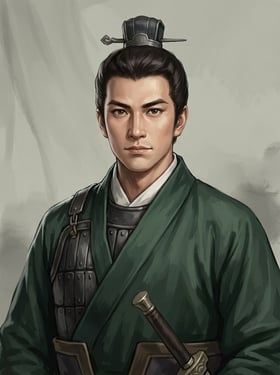
Portrait file
Character profile
- Character
- In his youth Lü Meng was rash and reckless in killing, but later he changed his ways and took to study, possessing the measure of a man of national caliber [c:4]. Full of schemes and deep in cunning, strict and clear in reward and punishment, he once enforced the law and executed a fellow-townsman soldier who had broken the rules in order to keep military discipline [c:5]. Lü Meng's schemes were deep and far-reaching; he employed such stratagems as Lü Meng's River Crossing in White, granting monthly rations of grain, and treating the families of the campaigning soldiers well, so as to unsettle the hearts of the Shu men [c:6].
- Manner of speech
- Lü Meng composed memorials extempore, and in setting forth great matters excelled with strategy [c:40]. He once cited the precedent of Zhou Yu and Cheng Pu holding joint command in his remonstrance [c:39].
- Life
- Lü Meng was a native of Fupi in Runan [c:9]. He was once sent by Sun Quan to seize the three commanderies of Changsha, Lingling, and Guiyang [c:8]. Lü Meng died at the age of forty-two in the inner hall, having risen to the office of Grand Administrator of Nan Commandery [c:9].
- Anecdotes
- Zhao Zi once praised Sun Quan, saying, 'That he raised up Lü Meng from the ranks—this was his discernment' [c:1]. Lü Meng was once ordered to lead three thousand troops to Wulin to support Gan Ning in burning Cao Cao's stockade [c:2]. He once plotted with Lu Xun to attack Guan Yu by surprise, and, claiming illness, returned to Jianye, recommending Lu Xun to Sun Quan to replace himself [c:19].
Relationships
20 relationships
Family1
Lord & vassal1
Friends1
Enemies2
Teacher & student2
Other13
Quotes
36 recorded lines · 3 featured
「雲長倚恃英雄,自料無敵,所慮者惟將軍耳。將軍乘此機會,託疾辭職,以陸口之任讓之他人,使他人卑辭讚美關公,以驕其心,彼必盡撤荊州之兵,以向樊城;若荊州無備,用一旅之師,別出奇計以襲之,則荊州在掌握之中矣。」
This stratagem displays Lü Meng's cunning, the core of his 'River Crossing in White' scheme.
「碧眼小兒!紫髯鼠輩,還識我否?」
Guan Yu's furious rebuke of Lü Meng before his death, highly dramatic and culturally recognizable.
「陸遜意思深長,才堪負重,觀其規慮,終可大任。而未有遠名,非羽所忌,無復是過。若用之,當令外自韜隱,內察形便,然後可克。」
These words reflect Lü Meng's strategic eye for recognizing and employing talent, holding Lu Xun in the highest regard.
Chapters23 回 ▸
- 史ch.32ch.40ch.47ch.51ch.52ch.54ch.55ch.56ch.57ch.58ch.62
- 演ch.38ch.44ch.49ch.51ch.56ch.61ch.66ch.67ch.75ch.76ch.77ch.103
Relationship timeline15 条 ▸
史 ch.32
- Liu Bei§21
fights_in
受孙权遣袭夺长沙、零陵、桂阳三郡
史 ch.40
- Liao Li§29
enemy_of
建安二十年权遣蒙袭南三郡,立脱身走自归先主
史 ch.51
- Sun Quan§15
advises_in
谏权独任己为大督
史 ch.54
史 ch.56
- Zhu Ran§13
mentor_of
病笃时荐然代镇江陵
史 ch.58
- Lu Xun§6
mentor_of
称疾诣建业与逊议关羽;至都对孙权举陆逊代己
演 ch.51
- Zhou Yu§13
advises_in
力主救「江東大將」甘興霸;自請為前驅
演 ch.56
- Zhou Yu§23
commands_in
同上
演 ch.61
- Sun Quan§25
advises_in
进言筑濡须坞拒曹操;权赞子明之見甚遠
演 ch.66
- Lu Su§5
advises_in
段5、7与肃同设伏兵刀斧之计
演 ch.67
- Ling Tong§28
witnesses
持牌刀立其中分隔二人
演 ch.75
- Sun Quan§9
advises_in
自陆口面见进言:乘关公远出袭取荆州;力辩先荆后徐之利
演 ch.76
- Guan Yu§12
enemy_of
善遇荆州征人之家以乱关公军心;本回与关公为敌
Inner monologues · AI-generated3 段 ▸
- After Lu Zijing died, I was ordered to garrison at Lukou, and all the troops under his command were placed under me. Gua
- The wind at Lukou came in from the river. Though I was in the army, my thoughts were not fixed solely on the clash of ar
- I am Lü Meng, courtesy name Ziming. I recall that in my youth, neither my family’s circumstances nor the ways of the wor
Life events16 ▸
- 0208-01-01 · JiangxiaBattle of Jiangxia· Warrior
- 0208-01-01 · JianglingBattle of Jiangling· Advisor
- 0209-01-01 · JianglingBattle of Nanjun· Advisor
- 0209-01-01 · YilingGan Ning Holds Yiling· Advisor
- 0213-01-01 · RuxukouBattle of Ruxukou· Advisor
- 0214-01-01 · WanBattle of Wan· Advisor
- 0215-01-01 · HefeiBattle of Hefei· Warrior
- 0215-01-01 · Xiaoyao FordBattle of Xiaoyao Ford· Warrior
- 0215-01-01 · Jing ProvinceEastern Wu Seizes the Three Commanderies of Jingzhou· Commander
- 0215-01-01 · YiyangSingle Sword Meeting at Yiyang· Warrior
- 0215-01-01 · Xiaoyao FordBattle of Xiaoyao Ford· Warrior
- 0217-01-01 · RuxukouBattle of Ruxu (217)· Warrior
- 0219-01-01 · FanchengGuan Yu's Northern Campaign· Instigator
- 0219-01-01 · JianglingLü Meng Crosses the River in White Robes· Commander
- 0219-01-01 · JianglingLü Meng's River Crossing in White· Instigator
- 0219-01-01 · MaichengRetreat to Mai Castle· Instigator