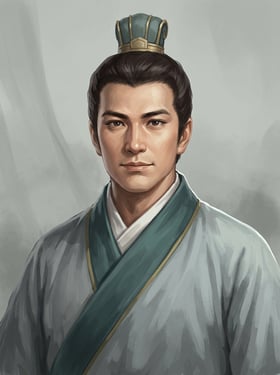
Historical Record
Sun Deng, styled Zigao, was the eldest son of Sun Quan. In the second year of the Wei Huangchu era (221 CE), when Sun Quan was enfeoffed as King of Wu, Sun Deng was appointed General of the Household Gentlemen of the East and enfeoffed as a marquis of ten thousand households, but he declined on grounds of illness. That same year Sun Deng was established as heir apparent. Sun Quan selected tutors for him and recruited worthy men as companions. Zhuge Ke, Zhang Xiu, Gu Tan, Chen Biao, and others were thus chosen for the Eastern Palace, lecturing to him on the Odes and the Documents and accompanying the heir apparent on horseback and archery outings. Sun Quan once wished Sun Deng to study the Han Shu in order to understand recent history; considering that Zhang Zhao had a deep mastery of the classics yet not wishing to overly trouble him, he had Zhang Xiu learn from Zhang Zhao and then pass on what he had learned to Sun Deng c:1368.
Sun Deng treated his subordinates with the courtesy of a commoner, sometimes riding in the same carriage as Zhuge Ke, Zhang Xiu, and Gu Tan, or sharing the same tent. The Grand Tutor Zhang Wen once advised Sun Quan that the post of Palace Cadet was the most intimate and should be filled by men of both talent and virtue, whereupon Chen Biao and others were appointed Palace Cadets. Later, owing to the constraints of cadet etiquette, they were also required to sit in attendance with caps neatly adjusted c:1368. In the first year of the Huanglong era (229 CE), Sun Quan proclaimed himself emperor, and Sun Deng was established as imperial heir apparent. Zhuge Ke was appointed Left Assistant, Zhang Xiu Right Aide, Gu Tan Rectifier of the Right, and Chen Biao Commandant of the Wing Rectification—these four were known as the "Four Friends." In addition, Xie Jing, Fan Shen, Diao Xuan, Yang Dao, and others were all guests of the Eastern Palace, so that for a time the Eastern Palace abounded with talent c:1368.
After Sun Quan moved the capital to Jianye, he summoned the Supreme Grand General Lu Xun to assist Sun Deng in garrisoning Wuchang and to oversee the affairs of the palace offices. When hunting, Sun Deng often chose narrow paths to avoid trampling good fields, and when resting he chose empty ground, unwilling to trouble the people. Once, while riding out, a pellet flew past; his attendants wished to investigate and, finding a man holding a pellet-bow and carrying pellets, concluded he was responsible. The man would not submit, and the attendants wished to flog him, but Sun Deng stopped them, ordered the pellet to be found, and after comparison discovered it was not the man's doing, so he released him. He also once lost a golden horse-basin and traced it to one of his attendants, yet could not bring himself to punish him, merely reproving him before sending him home, and instructing his close associates not to spread the matter c:1373.
Sun Deng's birth mother was of humble status, and Lady Xu had raised him with care from his youth. Later Lady Xu was deposed to Wu out of jealousy, while Lady Bu was most favored. When Lady Bu bestowed gifts, Sun Deng dared not decline, accepting them with a bow and nothing more. But whenever Lady Xu sent clothing, he would invariably bathe before putting it on c:1375. Before his death, Sun Deng submitted an earnest memorial to Sun Quan. He said he was gravely ill, feeling himself feeble and fearing he would not live long. He urged Sun Quan not to grieve over his death but to give priority to the great enterprise of state, to cultivate body and mind and broaden his thinking so as to accomplish a boundless imperial enterprise. He also recommended a host of worthies—Zhuge Ke, Zhang Xiu, Gu Tan, Xie Jing, Fan Shen, Hua Rong, Yang Dao, Diao Xuan, Pei Qin, Jiang Xiu, Yu Fan, and others—holding that they might assist in governance or serve as commanders. He especially emphasized the loyalty and diligence of Lu Xun, as well as the statecraft of Zhuge Jin, Bu Zhi, Zhu Ran, Quan Cong, Zhu Ju, Lü Dai, Wu Can, Kan Ze, Yan Jun, Zhang Cheng, Sun Yi, and others, advising Sun Quan to adopt their counsel, to ease punishments and lighten taxes, to nurture troops and horses, and to comfort the people, so as to pacify the realm within five to ten years. When Sun Quan heard Sun Deng's deathbed memorial, it grieved him beyond measure, and he wept whenever he spoke of it c:1376. Sun Deng died at the age of thirty-three and was given the posthumous title of Prince Xuan c:1376.
In the Novel
In Romance of the Three Kingdoms, Sun Deng's image centers mainly on his status as heir apparent and his relationship with Sun Quan. In Chapter 98, the novel depicts the scene of Sun Quan proclaiming himself emperor. At the urging of his ministers, Sun Quan on the bingyin day of the fourth month in summer of the first year of Huanglong (229 CE) built an altar in the southern suburbs of Wuchang and proclaimed himself emperor, posthumously honoring his father Sun Jian as Emperor Wulie, his mother Lady Wu as Empress Wulie, and his elder brother Sun Ce as Prince Huan of Changsha. At this ceremony Sun Quan formally established his eldest son Sun Deng as imperial heir apparent c:1377.
The novel further relates the advisory team for Sun Deng in the Eastern Palace, appointing Zhuge Jin's eldest son Zhuge Ke as Left Assistant to the heir apparent and Zhang Zhao's second son Zhang Xiu as Right Aide to the heir apparent c:1377. This broadly accords with the historical record of Zhuge Ke, Zhang Xiu, Gu Tan, and Chen Biao as the "Four Friends," but the novel does not detail Sun Deng's daily interactions with these subordinates, such as the historical detail that he "received his subordinates with roughly the courtesy of a commoner" c:1368.
In Chapter 108, the novel mentions Sun Deng's death. The text states plainly that "the lord of Wu, Sun Quan, had earlier had an heir apparent, Sun Deng, born of Lady Xu, who died in Wu in the fourth year of Chiwu" c:1378. This description accords with the historical facts that Sun Deng's birth mother was of humble status, that Lady Xu had nurturing care over him, and his year of death in the fourth year of Chiwu (241 CE) [c:1375, c:1376]. The novel does not detail Sun Deng's deathbed words, nor does it mention specific deeds such as his urging Sun Quan to reduce his fare or to ease punishments and lighten taxes; rather, he is mentioned more as one link in the chain of Sun Quan's heirs, laying the groundwork for the later disputes over the establishment and deposing of heirs such as Sun He and Sun Liang c:1378. On the whole, the novel's portrayal of Sun Deng is relatively cursory, presenting him mainly as a background figure in historical events, with the details of his character and virtue far less full than in the histories.
Key Relationships
* Sun Quan (parent_of): Sun Deng was the eldest son of Sun Quan and was established as imperial heir apparent. Sun Quan placed high hopes in Sun Deng, selecting tutors for him and recruiting worthies to assist him. When Sun Deng submitted his earnest deathbed memorial, Sun Quan was grieved beyond measure upon hearing it c:1376.
* Zhuge Ke (friend_of): Zhuge Ke was one of Sun Deng's "Four Friends," appointed Left Assistant to the heir apparent. In his deathbed words, Sun Deng praised Zhuge Ke as "broad in talent and strategy, fit to assist the age," and recommended him to assist in governance c:1376. The novel likewise mentions Zhuge Ke as Left Assistant to the heir apparent c:1377.
* Zhang Xiu (friend_of): Zhang Xiu was also one of Sun Deng's "Four Friends," appointed Right Aide to the heir apparent. Sun Deng once had Zhang Xiu learn the Han Shu from Zhang Zhao and then pass it on to him. On his deathbed Sun Deng also recommended Zhang Xiu [c:1368, c:1376]. The novel likewise mentions Zhang Xiu as Right Aide to the heir apparent c:1377.
* Gu Tan (friend_of): Gu Tan was one of Sun Deng's "Four Friends," appointed Rectifier of the Right. On his deathbed Sun Deng also recommended Gu Tan [c:1368, c:1376].
* Chen Biao (friend_of): Chen Biao was one of Sun Deng's "Four Friends," appointed Commandant of the Wing Rectification c:1368.
* Lu Xun (mentor_of): After Sun Quan moved the capital to Jianye, he summoned Lu Xun to assist Sun Deng in garrisoning Wuchang and to oversee the affairs of the palace offices. On his deathbed Sun Deng praised Lu Xun as "loyal and diligent in his time, devoting himself to the worries of state" [c:1373, c:1376].
* Lady Xu (foster_mother_of): Sun Deng's birth mother was of humble status, and Lady Xu had raised him with care from his youth. Sun Deng was filial toward Lady Xu, and even after she was deposed, with clothing she bestowed he "would invariably bathe before putting it on" c:1375. The novel likewise mentions Sun Deng as born of Lady Xu (novel only; the historical fact is one of nurturing care) c:1378.
Iconic Scenes
* Declining the Marquisate of Ten Thousand Households and Being Made Heir Apparent: In the second year of Wei Huangchu (221 CE), Sun Deng was appointed General of the Household Gentlemen of the East and enfeoffed as a marquis of ten thousand households, but he declined on grounds of illness. That same year Sun Quan established him as heir apparent, beginning his career as crown prince c:1368. This act displayed Sun Deng's modesty and indifference to vain honors.
* An Eastern Palace Abounding in Talent and the Courtesy of a Commoner: After Sun Deng was made heir apparent, Sun Quan selected tutors for him and recruited worthies as companions, so that talented men such as Zhuge Ke, Zhang Xiu, Gu Tan, and Chen Biao gathered in the Eastern Palace, said to "abound in talent." Sun Deng treated his subordinates with the courtesy of a commoner, sometimes riding in the same carriage as Zhuge Ke, Zhang Xiu, and Gu Tan, or sharing the same tent, reflecting his approachable and unceremonious character c:1368.
* Unwilling to Trouble the People and Sparing the Pellet-Thrower: While garrisoning Wuchang, Sun Deng, when hunting, would keep far from good fields and not trample crops, and when resting would choose empty ground, unwilling to trouble the people. Once, while riding out, a pellet flew past; his attendants wished to punish a suspect, but Sun Deng stopped them and, after ascertaining the truth, released the man. He also once lost a golden horse-basin and traced it to one of his attendants, yet could not bring himself to punish him, merely sending him home and instructing his close associates not to spread the matter c:1373. These deeds reveal Sun Deng's benevolence toward the people and his forgiving treatment of others.
* Filial Piety Toward Lady Xu: Sun Deng's birth mother was of humble status, and Lady Xu had raised him with care from his youth. Later Lady Xu was deposed out of jealousy, while Lady Bu was most favored. When Lady Bu bestowed gifts, Sun Deng dared not decline, but whenever Lady Xu sent clothing, he would invariably bathe before putting it on. This detail reveals Sun Deng's filial piety and gratitude toward his foster mother c:1375.
* Recommending Worthies and Offering Counsel in His Deathbed Memorial: As he lay gravely ill in the fourth year of Chiwu (241 CE), Sun Deng submitted a memorial to Sun Quan, not only consoling his imperial father against grieving over his death but, placing the great enterprise of state foremost, earnestly recommending a host of worthies such as Zhuge Ke, Zhang Xiu, Gu Tan, and Lu Xun, and advising Sun Quan to ease punishments and lighten taxes, to nurture troops and horses, and to comfort the people, so as to pacify the realm c:1376. This deathbed memorial is the concentrated expression of Sun Deng's lifelong virtue and wisdom, displaying his far-reaching political vision and his loyalty to the state.
* Sun Quan Proclaims Himself Emperor and Establishes the Heir Apparent: In Romance of the Three Kingdoms, Sun Deng appears as the figure established as imperial heir apparent after Sun Quan proclaimed himself emperor, an important link in the chain of Sun Quan's heirs c:1377.
Portrait file
Character profile
- Character
- Sun Deng treated his subordinate officials with the courtesy due to commoners, and did not wish to burden or trouble the common people; when he lost a pellet he could not bear to impose punishment, and he served his stepmother as he would his own mother; on his deathbed he submitted a memorial recommending men of talent, and urged his father to relax punishments and lighten taxes.
- Life
- In the second year of Wei's Huangchu era, when Sun Quan was King of Wu, Sun Deng was appointed General of the Household of the East and enfeoffed as a Marquis of Ten Thousand Households, but he pleaded illness and declined; that same year he was established as Crown Prince. In the first year of Huanglong, after Sun Quan proclaimed himself emperor, Sun Deng became Imperial Crown Prince, and four companions were appointed to assist him. After Sun Quan moved the capital to Jianye, he summoned Lu Xun to assist Sun Deng in guarding Wuchang. Sun Deng was Crown Prince for twenty-one years in all, and died in the fourth year of Chiwu, aged only thirty-three.
- Anecdotes
- Sun Deng was Sun Quan's eldest son, established as Crown Prince of the King and later as Imperial Crown Prince, with the posthumous title Prince Xuan. He was companions with Zhuge Ke, Zhang Xiu, Gu Tan, Chen Biao, and others, and was raised by Lady Xu.
Relationships
23 relationships
Family7
Friends6
Teacher & student6
Other3
Quotes
5 recorded lines · 3 featured
「本立而道生,欲立太子,宜先立后。」
These words stress the importance of installing an empress to secure the crown prince's position, reflecting his political foresight.
「慮寢疾不起,此乃命也。方今朔土未一,四海喁喁,天戴陛下,而以下流之念,減損大官殽饌,過於禮制,臣竊憂惶。」
These words express Sun Deng's concern over Sun Quan's frugal way of living, reflecting his attentiveness to the sovereign's conduct.
「臣以無狀,嬰抱篤疾,自省微劣,懼卒隕斃。臣不自惜,念當委離供養,埋胔后土,長不復奉望宮省,朝覲日月,生無益於國,死貽陛下重慼,以此爲哽結耳。臣聞死生有命,長短自天,周晉、顏回有上智之才,而尚夭折,況臣愚陋,年過其壽,生爲國嗣,沒享榮祚,於臣已多,亦何悲恨哉!方今大事未定,逋寇未討,萬國喁喁,係命陛下,危者望安,亂者仰治。願陛下棄忘臣身,割下流之恩,脩黃老之術,篤養神光,加羞珍膳,廣開神明之慮,以定無窮之業,則率土幸賴,臣死無恨也。皇子和仁孝聦哲,德行清茂,宜早建置,以繫民望。諸葛恪才略博達,器任佐時。張休、顧譚、謝景,皆通敏有識斷,入宜委腹心,出可爲爪牙。范慎、華融矯矯壯節,有國士之風。羊衜辯捷,有專對之材。刁玄優弘,志履道真。裴欽博記,翰采足用。蔣脩、虞翻,志節分明。凡此諸臣,或宜廊廟,或任將帥,皆練時事,明習法令,守信固義,有不可奪之志。此皆陛下日月所照,選置臣宮,得與從事,備知情素,敢以陳聞。臣重惟當今方外多虞,師旅未休,當厲六軍,以圖進取。軍以人爲衆,衆以財爲寶,竊聞郡縣頗有荒殘,民物凋弊,姦亂萌生,是以法令繁滋,刑辟重切。臣聞爲政聽民,律令與時推移,誠宜與將相大臣詳擇時宜,博采衆議,寬刑輕賦,均息力役,以順民望。陸遜忠勤於時,出身憂國,謇謇在公,有匪躬之節。諸葛瑾、步隲、朱然、全琮、朱據、呂岱、吾粲、闞澤、嚴畯、張承、孫怡忠於爲國,通達治體。可令陳上便宜,蠲除苛煩,愛養士馬,撫循百姓。五年之外,十年之內,遠者歸復,近者盡力,兵不血刃,而大事可定也。臣聞『鳥之將死其鳴也哀,人之將死其言也善』,故子囊臨終,遺言戒時,君子以爲忠,豈況臣登,其能已乎?願陛下留意聽采,臣雖死之日,猶生之年也。」
This deathbed testament covers statecraft and the recommendation of talent, a concentrated expression of Sun Deng's political thought.
Chapters11 回 ▸
- 史ch.47ch.50ch.52ch.53ch.54ch.59ch.61ch.62ch.64
- 演ch.98ch.108
Relationship timeline9 条 ▸
Inner monologues · AI-generated1 段 ▸
- I am now gravely ill, my breath growing ever weaker. Looking back on my life, what I find hardest to accept is not the h
Life events4 ▸
- 0229-01-01 · WuchangSun Quan Proclaims Himself Emperor and Founds Wu· Witness
- 0229-01-01 · WuchangSun Deng Installed as Crown Prince of Wu· Witness
- 0230-01-01 · JianyeThe Lü Yi Abuse of Power Case· Witness
- 0250-01-01 · JianyeStruggle of the Two Palaces· Witness