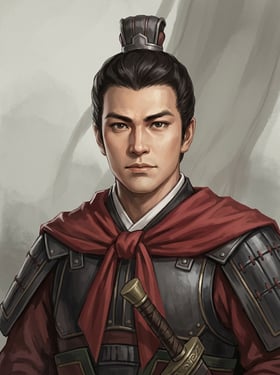
Historical Record
Zhu Huan, styled Xiumu, was a native of Wu County in Wu Commandery. When Sun Quan was still a general, Zhu Huan was already serving in his headquarters, and was later appointed Chief of Yuyao. During his tenure, the locality was struck by an epidemic and grain became scarce and dear. Zhu Huan swiftly organized capable officials, personally visited the sick, and provided medicine and food, winning deep gratitude from the populace. He was thereafter promoted to Colonel Who Sweeps Away Bandits, commanding two thousand troops and tasked with reorganizing the forces of Wu and Kuaiji Commanderies; within a single year he recruited more than ten thousand men.
In Danyang, Poyang, and other places mountain bandits rose in swarms, taking cities and killing the chief officials. Zhu Huan led his generals on campaigns in all directions and put them all down. He was gradually promoted to Auxiliary General, enfeoffed as Marquis of Xincheng Village, and succeeded Zhou Tai as Governor of Ruxu. In the first year of Huangwu (222 CE), the Wei Grand Marshal Cao Ren advanced on Ruxu with tens of thousands of infantry and cavalry. Cao Ren intended to strike at the islet, but spread a deceptive ruse, loudly proclaiming that he would attack Xianxi to the east. Zhu Huan accordingly detached troops to defend Xianxi. Cao Ren's true objective, however, was Ruxu, and his main army had already pressed to within seventy li. Zhu Huan urgently recalled the Xianxi force, but before the reinforcements arrived, Cao Ren's host had come. At the time Zhu Huan's own and detached forces numbered only five thousand, and his generals were all seized with fear. Zhu Huan rallied his officers and men, pointing out that victory or defeat lay with the commander rather than the size of the forces, and analyzed that the enemy had marched a thousand li and were exhausted in men and horses, while his own side held high walls, faced the great river, and had hills at their backs—waiting at ease for the weary foe, the host mastering the guest, a posture of certain victory in every battle. He even boasted that even if Cao Pi himself came, it would be no cause for concern.
Zhu Huan adopted the strategy of lowering his banners and silencing his drums, showing weakness to the enemy to lure Cao Ren into attacking. Cao Ren indeed sent his son Cao Tai to attack the city of Ruxu, and dispatched the general Chang Diao to lead Zhuge Qian, Wang Shuang, and others on oil-boats to raid Zhongzhou (where the wives and families of Zhu Huan's troops were kept). Cao Ren himself led ten thousand men to remain at Tuogao as a rearguard. Zhu Huan directed his forces—some to seize the oil-boats, some to strike at Chang Diao and the others—while he personally resisted Cao Tai, in the end burning the enemy camp and forcing a retreat. In this battle he slew Chang Diao, captured Wang Shuang alive, and killed or drowned more than a thousand. Sun Quan commended Zhu Huan's achievement, enfeoffing him as Marquis of Jiaxing, promoting him to General Who Rouses Valor, and granting him concurrent appointment as Chancellor of Pengcheng.
In the seventh year of Huangwu (228 CE), the Grand Administrator of Poyang, Zhou Fang, feigned surrender to deceive the Wei Grand Marshal Cao Xiu, and Cao Xiu led a hundred thousand infantry and cavalry to Wan to receive him. Lu Xun served as commander-in-chief, while Quan Cong and Zhu Huan served as the left and right supervisors, each leading thirty thousand men to meet Cao Xiu. After Cao Xiu saw through the ruse he wished to withdraw, but, presuming on his numbers, still wished to give battle. Zhu Huan offered a plan, saying: "Cao Xiu was appointed because he is a kinsman, not because he is a wise and valiant famed general. He must lose this battle, and after losing he will surely flee to the two strongholds of Jiashi and Guache. If we block his road with ten thousand troops, we may annihilate his entire army and capture Cao Xiu alive. If this succeeds, we can ride the victory forward, take Shouchun, carve out the Huai frontier, and then plot for Xu and Luo—this is an opportunity in ten thousand generations and must not be lost." However, Sun Quan had already consulted Lu Xun, who deemed it unworkable, and so the plan was not carried out.
In the first year of Huanglong (229 CE), Zhu Huan was appointed General of the Vanguard, made Governor of Qing Province, and granted a staff of authority. In the sixth year of Jiahe (237 CE), the Registrar of Wei's Lujiang, Lü Xi, requested that a large army come to receive him, intending to open the city in response. Zhu Huan and the General of the Guards Quan Cong were ordered to lead troops there. After the plot was leaked, the Wu army was forced to withdraw. During the retreat, beyond the city lay a stream more than thirty zhang wide and eight or nine chi deep. As the various forces crossed, Zhu Huan personally covered the rear. The Grand Administrator of Lujiang, Li Ying, had intended to strike while the Wu army was midway across, but seeing Zhu Huan's staff-canopy at the rear, he dared not attack—proof of his intimidating presence.
At that time Quan Cong was the supervisor, and Sun Quan further ordered the Auxiliary General Hu Zong to convey an imperial decree and take part in military affairs. Zhu Huan was by nature proud and disdained being subordinate to others, so he went to see Quan Cong and asked his intentions, his words fierce as he quarreled with Quan Cong. Quan Cong, wishing to absolve himself, said: "His Majesty himself ordered Hu Zong to be supervisor; Hu Zong believes it should be so." Hearing this, Zhu Huan grew angrier still, and on returning to his camp ordered Hu Zong summoned. When Hu Zong reached the camp gate, Zhu Huan went out to receive him and said to his attendants: "I have let go; you may each disperse." One man came forward and urged Hu Zong to turn back. Not seeing Hu Zong, and knowing it was his attendants' doing, Zhu Huan slew this man. When his aide-de-camp remonstrated, Zhu Huan stabbed the aide as well, then feigned madness from illness and went to Jianye for treatment. Sun Quan, valuing his talent, did not punish him. He let Zhu Huan's son Zhu Yi temporarily command the troops, and sent physicians to care for him. After some months Zhu Huan recovered, and Sun Quan personally went out of the city to see him off, encouraging him: "The enemy still survives, the royal road is not yet unified; I shall settle the realm together with you, and wish to have you command fifty thousand men holding one front to plan for advance—I trust your illness will not recur." Zhu Huan replied: "Heaven has granted Your Majesty sage bearing; you are to reign over the Four Seas. You burden me with weighty charge to eliminate the treacherous rebels, and my illness shall heal of itself." The Record of Wu records that Zhu Huan once toasted Sun Quan and asked to stroke his beard, at which Sun Quan laughed heartily and consented.
In the Novel
In the Romance of the Three Kingdoms, Zhu Huan's image is further developed, emphasizing his youthful capability and outstanding daring. He first appears in Chapter 38, described as one of the talented men of Wu Commandery in Jiangdong—alongside Kan Ze, Yan Jun, and Xue Zong—who came when Sun Quan was broadly gathering worthy men.
The novel gives particular emphasis to Zhu Huan's performance at the Battle of Ruxu. In Chapter 85, Zhu Huan is set as being twenty-seven years of age, extremely daring, deeply loved by Sun Quan, and serving as Governor of Ruxu. When Cao Ren's host attacked, Zhu Huan had misjudged the enemy's movements and shifted his main force to Xianxi, leaving only five thousand troops in the city of Ruxu. Facing the fifty thousand elite troops led by Chang Diao, Zhuge Qian, and Wang Shuang, the whole army wore looks of fear. Zhu Huan, gripping his sword, rallied his officers and men, his words essentially matching the historical record—stressing that "victory or defeat lies with the commander, not the number of troops"—and analyzing the relative positions of the two sides, concluding that "this is a posture of certain victory in every battle. Even if Cao Pi came himself it would scarcely be cause for worry, let alone Cao Ren and the others?"
The novel here adds a display of Zhu Huan's personal martial prowess. He gave the order to lower the banners and silence the drums, showing the enemy an empty city. When Chang Diao approached with his army, Zhu Huan dashed out on horseback with sword leveled, and clashing with Chang Diao for "not three bouts," cut him down from his horse. The Wu troops surged forward to slay, and the Wei troops were utterly defeated, the dead and wounded beyond count. Zhu Huan thus won a great victory and seized a great quantity of weapons. Afterward Cao Ren was defeated by the Wu troops who sallied out from Xianxi and led his army back. After this battle the novel also narrates together such events as Cao Zhen and Xiahou Shang besieging Nan Commandery being routed by the pincer of Lu Xun and Zhuge Jin, and Cao Xiu being defeated by Lü Fan, and through Cao Pi's lips sighs at not heeding the words of Jia Xu and Liu Ye, which led to the defeat of the three armies.
In Chapter 96, Zhu Huan appears again at the Battle of Shiting. Sun Quan gathered his officials to deliberate, and the Grand Administrator of Poyang, Zhou Fang, feigned surrender to deceive Cao Xiu. Lu Xun was appointed Grand General Who Upholds the State and Marshal-in-Chief Who Pacifies the North, commanding the great army, and he recommended Zhu Huan as Left Chief Supervisor and Quan Cong as Right Chief Supervisor. Zhu Huan offered a plan to Lu Xun, advising that when Cao Xiu retreated in defeat, ambushes be set at the strongholds of Jiashi and Guiche to block his road, capture Cao Xiu alive, and then take Shouchun and watch for Xu and Luo. However, Lu Xun held that "this is no good plan; I have my own subtle use," and Zhu Huan therefore "withdrew harboring discontent." The novel does not mention Zhu Huan's conflict with Quan Cong and Hu Zong, nor his "feigned madness" episode; these plots are omitted or downplayed in the novel.
Key Relationships
* Sun Quan: Zhu Huan served in his headquarters from the time Sun Quan was still a general, and was deeply esteemed and trusted by him. Sun Quan not only rewarded his achievements with marquisates and titles, but after Zhu Huan's "feigned madness" valued his talent and did not punish him, personally seeing him off and placing great expectations on him. The novel likewise stresses that Sun Quan "loved him greatly."
* Zhou Tai: Zhu Huan once succeeded Zhou Tai as Governor of Ruxu, showing that he attained a position in military command of equal importance to Zhou Tai.
* Cao Ren: At the Battle of Ruxu, Zhu Huan with five thousand troops crushed Cao Ren's host of tens of thousands, slaying Chang Diao and capturing Wang Shuang alive—a high point of his military career. The novel's depiction of this battle is more vivid, with Zhu Huan personally slaying Chang Diao.
* Lu Xun: At the Battle of Shiting, Zhu Huan served together with Quan Cong as Lu Xun's left and right supervisors. Zhu Huan offered a plan to Lu Xun which was not adopted, attested in both the histories and the novel; the novel especially stresses that Zhu Huan therefore "withdrew harboring discontent."
* Quan Cong: Zhu Huan and Quan Cong served together as left and right supervisors at the Battle of Shiting, but during the withdrawal in the sixth year of Jiahe, Zhu Huan—being proud and disdaining subordination to Quan Cong—quarreled fiercely with him and even vented his anger on Hu Zong, touching off the "feigned madness" episode.
* Hu Zong: Because of his quarrel with Quan Cong, Zhu Huan vented his anger on Hu Zong, which led to a killing, and he finally "feigned madness" to escape punishment.
Signature Scenes
* Relieving epidemic and famine as Chief of Yuyao: When Zhu Huan first took office as Chief of Yuyao, the locality was struck by epidemic and famine. He acted personally, organizing treatment and food supply, displaying his character of loving the people as his own and outstanding administrative ability, and winning deep gratitude from the populace.
* Crushing Cao Ren at the Battle of Ruxu: Facing Cao Ren's host of tens of thousands bearing down on him, Zhu Huan with five thousand troops, by superb military strategy and the ability to inspire morale, successfully lured the enemy deep in and finally crushed Cao Ren, slaying Chang Diao and capturing Wang Shuang alive; this battle established his standing as a famed general. The novel further depicts him as a valiant figure who personally slew a commander.
* Offering an unadopted plan at the Battle of Shiting: Before the Battle of Shiting, Zhu Huan offered the commander Lu Xun a clever plan to block Cao Xiu's retreat, intending to annihilate the enemy and ride the victory to take Shouchun directly. However, this plan was not adopted by Lu Xun, reflecting Zhu Huan's strategic vision and hinting at the possible difference of opinion between him and Lu Xun. The novel explicitly states that Zhu Huan therefore "withdrew harboring discontent."
* Covering the rear and intimidating Li Ying: In the sixth year of Jiahe, as the Wu army withdrew, Zhu Huan personally covered the rear. The Grand Administrator of Lujiang, Li Ying, had intended to seize the chance to pursue, but seeing Zhu Huan's staff-canopy at the rear, dared not attack—proof of Zhu Huan's renown and personal daring.
* "Stroking the tiger's whiskers" and "feigning madness": After Zhu Huan recovered from illness, Sun Quan personally saw him off, and Zhu Huan asked to stroke Sun Quan's beard, at which Sun Quan laughed heartily and consented—a gesture showing the intimate, unguarded relationship between ruler and minister. Yet earlier, because of his conflict with Quan Cong and Hu Zong, Zhu Huan angrily killed his subordinates and "feigned madness" to escape punishment, exposing the fierce, proud side of his character.
Portrait file
Character profile
- Character
- Zhu Huan was fiercely protective of his standing, unwilling to place himself below others; he made light of wealth and prized honor, had a strong memory, and cared for his subordinates. He was extremely bold and resourceful, and Sun Quan was very fond of him. Keenly set on advancing, he chafed when his strategies went unadopted, and would at times fly into a rage out of wounded pride.
- Manner of speech
- In battle Zhu Huan was skilled at rousing the morale of his troops and laying out the calculus of advantage and harm, his speech often employing parallel phrasing and rhetorical questions.
- Life
- Zhu Huan was a man of Wu in Wu Commandery. When Sun Quan was still a general, he served in his headquarters, and later became chief of Yuyao. During a plague he dispatched capable officers to seek out and shelter kinfolk for treatment, winning deep affection from the gentry and common people. He once expanded a force of two thousand men to over ten thousand within a year, and campaigned against the mountain bandits of Danyang and Poyang. He succeeded Zhou Tai as commander of Ruxu, and in the Ruxu campaign of the first year of Huangwu he defeated Cao Ren, burned the enemy's forces, and took Wang Shuang alive, for which he was enfeoffed as Marquis of Jiaxing and promoted to General Who Rouses Martial Might. In the seventh year of Huangwu, together with the three commanders Lu Xun, Quan Cong, and others, he defeated Cao Xiu, who had been lured to Wan by Zhou Fang. In the first year of Huanglong he was appointed General of the Front, concurrently Governor of Qing Province, and granted the Staff of Authority. In the sixth year of Jiahe, he and Quan Cong failed in receiving Lü Xi; he beheaded the assistant-army envoy sent by Hu Zong, and afterward, pleading illness, went to Jianye for treatment. His son Zhu Yi inherited his title.
- Anecdotes
- Zhu Huan was a general of Eastern Wu, only twenty-seven years of age, who garrisoned Ruxu and greatly defeated Cao Ren. He once served as Lu Xun's left wing, and also advanced toward Hefei together with Quan Cong.
Relationships
13 relationships
Quotes
6 recorded lines · 3 featured
「凡兩軍交對,勝負在將,不在眾寡。諸君聞曹仁用兵行師,孰與桓邪?兵法所以稱客倍而主人半者,謂俱在平原。無城池之守,又謂士眾勇怯齊等故耳。今人既非智勇,加其士卒甚怯,又千里步涉,人馬罷困,桓與諸軍。共據高城,南臨大江,北背山陵,以逸待勞,為主制客,此百戰百勝之勢也。雖曹丕自來,尚不足憂,況仁等邪!」
This line displays Zhu Huan's military talent and strategic vision, stressing the importance of the commander.
「休本以親戚見任,非智勇名將也。今戰必敗,敗必定。走當由夾石、掛車,此兩道皆險阨,若以萬兵柴路,則彼眾可盡。而休可生虜,臣請將所部以斷之。若蒙天威,得以休自效,便可乘勝長驅,近取壽春,割有淮面,以規許、洛,此萬世一時,不可失也。」
This line embodies Zhu Huan's precise reading of the battle situation and his bold strategic conception.
「天授陛下聖姿,當君臨四海,猥重任臣,以除奸逆,臣疾當自愈。」
This line displays Zhu Huan's loyalty to Sun Quan and his optimism about his own illness.
Chapters4 回 ▸
- 史ch.56
- 演ch.38ch.85ch.96
Relationship timeline13 条 ▸
史 ch.56
- Sun Quan§39
serves
孙权为将军时给事幕府,除余姚长
- Zhou Tai§39
rival_of
代周泰为濡须督
- Cao Ren§40
fights_in
黄武元年曹仁来攻濡须,桓以五千人偃旗鼓诱致仁;曹仁遣子泰攻濡须城;桓燒营退泰,斩雕生虏王双
- Chang Diao§40
fights_in
桓部斩常雕
- Wang Shuang§40
fights_in
生虏王双送武昌
- Cao Xiu§41
fights_in
黄武七年皖城周鲂诱曹休,桓与全琮为左右督击休;进计断夹石挂车以塞其归路,被陆逊议否
- Lu Xun§41
rival_of
皖城之役权先与陆逊议,逊以为不可故桓计不施行
- Quan Cong§42
rival_of
嘉禾六年与全琮俱以师迎吕习,事露军引还,桓自断后;全琮为督议欲掩袭,桓气高耻见部伍,往见琮校计,怒甚
- Hu Zong§42
enemy_of
权令胡综宣传诏命参与军事;桓恚恨呼综至,欲斫之;综逃,桓斫杀其佐军
- Li Ying§42
rival_of
桓自断后,李膺欲半渡迫击;见桓节盖在后卒不敢出
- Zhu Yi§48
parent_of
父子(朱桓子);以父任除郎,后拜骑都尉代桓领兵
演 ch.85
斩于阵前
- Cao Ren§8
大败
Inner monologues · AI-generated3 段 ▸
- I, Zhu Huan, courtesy name Xiumu, was charged with defending the frontiers of Jiangdong. I have always believed that a g
- I am Zhu Huan, courtesy name Xiumu. Whenever trouble arose in the army, I first asked what would determine victory or de
- I, whose courtesy name was Xiumu, was from Wu County in Wu Commandery. Looking back on my early years, when Sun Quan was
Life events4 ▸
- 0222-01-01 · JianglingThree-Pronged Campaign against Wu· Commander
- 0222-01-01 · RuxuBattle of Ruxu· Commander
- 0228-01-01 · WanDefeat of Cao Xiu at Wan· Warrior
- 0228-01-01 · ShitingBattle of Shiting· Warrior