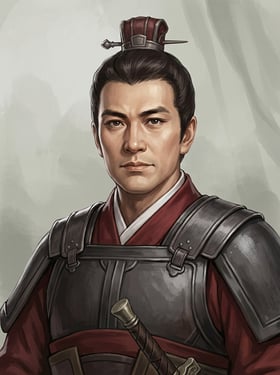
Historical Record
Lu Kang, styled Youjie, was a maternal grandson of Sun Ce, and his father was the famous Wu general Lu Xun. When Lu Xun died, Lu Kang was only twenty; he was appointed Colonel of Establishing Valor, commanding his father's former troops, five thousand men. Sun Quan once questioned Lu Kang about the twenty matters Yang Zhu had charged against Lu Xun, and Lu Kang answered each point by point with clear reasoning, so that Sun Quan gradually let go of his doubts c:4022. In the ninth year of Chiwu, Lu Kang was promoted to Gentleman of the Household Who Establishes Principle, and exchanged garrisons with Zhuge Ke at Chaisang. Before leaving Chaisang, Lu Kang meticulously repaired the city defenses and the buildings and protected the mulberry-and-fruit groves, so that when Zhuge Ke took over, the Chaisang camp was wholly renewed. Zhuge Ke's former garrison, by contrast, was much damaged, leaving him deeply ashamed c:4022.
In the second year of Taiping, when the Wei general Zhuge Dan raised troops at Shouchun and surrendered to Wu, Lu Kang was appointed Commander of Chaisang and went to Shouchun in support, successfully defeating the Wei Garrison Gate General and a General of the Vanguard, and was afterward promoted to General Who Conquers the North c:4022. In the second year of Yong'an, Lu Kang was appointed General Who Guards the Army, Commander of Xiling, with a defensive zone reaching from Guan Yu to Baidi. Three years later he was granted a staff of authority. After Sun Hao took the throne, Lu Kang was further appointed Grand General Who Guards the Army and Governor of Yi Province. In the second year of Jianheng, after the Grand Marshal of the Left Shi Ji died, Lu Kang was appointed to command all military affairs at Xinling, Xiling, Yidao, Lexiang, and Gong'an, with his seat at Lexiang c:4022.
In the first year of Fenghuang, the Commander of Xiling, Bu Chan, held the city in revolt and surrendered to Jin. On hearing of it, Lu Kang at once mustered his army and sent the generals Zuo Yi, Wu Yan, Cai Gong, and others straight to Xiling. He ordered his troops to press on with building a tight encircling wall, running from Chixi to Gushi, hemming in Bu Chan within and guarding against the Jin army without. Although the officers and men were wearied by this, and the generals urged a swift assault on Bu Chan, Lu Kang judged that Xiling was strongly walled and well provisioned, hard to take quickly, and that Jin relief troops would surely arrive; without an outer defense he would be caught between two fronts. He finally took the advice of the Administrator of Yidu, Lei Tan, and made one assault on the city, but it did not succeed, after which he continued to perfect the siege c:4025.
When the Jin General of Chariots and Cavalry Yang Hu advanced his army toward Jiangling, the generals held that Lu Kang should not abandon Jiangling. Lu Kang, however, judged that Jiangling was strongly walled and amply garrisoned and need not be feared. He reckoned that even if Jiangling fell, the Jin army would find it hard to hold and the loss would be slight; but if the Xiling revolt continued, the Yi tribes of the southern mountains would be stirred up, with consequences too dire to contemplate. Therefore he would rather give up Jiangling to keep Xiling c:4025. Lu Kang had ordered the Commander of Jiangling, Zhang Xian, to build a great dam to cut off the Jin army's water transport; later, when Yang Hu gave out that he would break the dam, Lu Kang resolutely ordered Zhang Xian to destroy it himself, so that Yang Hu had to switch from water transport to cart transport, at enormous cost c:4025.
The Jin Inspecting Commander of Badong, Xu Yin, led a naval force to attack Jianping, while the Inspector of Jingzhou, Yang Zhao, arrived at Xiling. Lu Kang deployed Zhang Xian to hold the city fast, Sun Zun to patrol the south bank to guard against Yang Hu, and Liu Lü and Zhu Wan to repel Xu Yin's navy. Lu Kang himself led the three armies and, relying on the encircling wall, opposed Yang Zhao. When Zhu Qiao and Yu Zan deserted to Yang Zhao, Lu Kang foresaw that the enemy would strike at the weak point held by the Yi troops, and that night he shifted his dispositions. The next day Yang Zhao indeed attacked the old Yi-troop position, and Lu Kang seized the chance to counterattack, severely defeating Yang Zhao. With his schemes exhausted, Yang Zhao fled by night; Lu Kang, mindful that Bu Chan might exploit the moment to counterattack, did not pursue with full force, but merely beat the drums in a show of strength, so that Yang Zhao's troops scattered in terror. Lu Kang then stormed the city of Xiling, executed Bu Chan's family and his chief commanders, and pardoned the tens of thousands who surrendered. After the battle, Lu Kang repaired the city defenses and returned east to Lexiang, his bearing modest and yielding as ever, winning the affection of the officers and men c:15163.
In the Novel
In the *Romance of the Three Kingdoms*, Lu Kang is further shaped into a far-sighted and devoted general. In the fifth year of Jingyuan of Wei (the first year of Xianxi), after the fall of Shu Han, the Wu sovereign Sun Xiu adopted the counsel of the Aide to the Secretariat Hua He and appointed Lu Kang Grand General Who Conquers the East and Governor of Jing Province, garrisoning the river mouth to guard against Sima Zhao's invasion of Wu c:6583.
In the novel, Lu Kang's interactions with the Jin general Yang Hu are especially prominent, displaying his modest, unboastful nature. Once, Yang Hu and Lu Kang each went out hunting, and Yang Hu ordered the Jin troops not to cross the border; seeing this, Lu Kang sighed at the strictness of the Jin army's discipline. When Yang Hu returned to camp, he sent back the game that the Wu side had shot and wounded first, and the men of Wu were all pleased. On learning of this, Lu Kang specially sent Yang Hu a measure of wine he had brewed himself, as a return courtesy, explaining: "Since he has shown me kindness, how can I not requite it?" c:4027 This repaying of virtue with virtue, though recorded in the histories as Lu Kang and Yang Hu "cultivating the friendship of Qiao and Zha" c:15163, is vividly displayed in the novel through specific episodes.
On another occasion, when Lu Kang fell ill, Yang Hu sent over a prepared medicine. His generals suspected the medicine might be treacherous, but Lu Kang firmly believed Yang Hu would not poison him, and so took it and recovered. By this he instructed his officers: "He uses virtue alone, I use violence alone; thus he would have me submit without battle. Now we should each guard our own borders, and not seek petty gains." c:15158 This episode, though the histories likewise record Lu Kang taking the medicine Yang Hu sent and Sun Hao questioning it — Lu Kang answering, "Even a single town or village cannot be without men of good faith and righteousness; how much more a great state?" c:15163 — is treated more dramatically in the novel and given a clearer moral didactic meaning.
The novel also portrays Lu Kang's loyal remonstrance to the Wu sovereign Sun Hao. When Sun Hao wished to send troops to attack Xiangyang, Lu Kang submitted a memorial of remonstrance, pointing out that Jin could not be attacked, and urging Sun Hao to cultivate virtue and be sparing with punishments, making internal stability his priority. However, Sun Hao flew into a rage, regarding Lu Kang as colluding with the enemy, and so stripped him of his military authority, demoted him to Major, and ordered Sun Ji to take over his army in his stead c:4028. This episode is not clearly recorded in the histories as Lu Kang being stripped of military authority for this reason; but in the histories Lu Kang once submitted a memorial urging Sun Hao to release Xue Ying c:4026, reflecting his loyal and frank-speaking side. The novel, through the contrast of Sun Hao's folly and Lu Kang's loyal remonstrance, further highlights Lu Kang's uprightness and helplessness.
Key Relationships
* Bu Chan (enemy_of): In the Battle of Xiling, Lu Kang successfully suppressed Bu Chan's revolt and exterminated his family c:15163.
* Eastern Wu (serves): Lu Kang served Eastern Wu loyally all his life, repeatedly turning the tide in key battles and defending the state's frontiers c:4022.
* Lu Xun (parent_of): Lu Kang was the son of Lu Xun, inheriting his father's military talent and loyal character c:4022.
* Sun Ce (kin_of): Lu Kang was a maternal grandson of Sun Ce, related by marriage to the Wu imperial house c:4022.
* Yang Hu (friend/rival): Lu Kang and the Jin general Yang Hu confronted each other on the frontier, yet built a relationship of mutual respect, recorded in history as "cultivating the friendship of Qiao and Zha" c:15163. In the novel, the episodes of exchanging wine and medicine further highlight this relationship of foe and friend c:4027, c:15158.
* Sun Hao (serves/criticizes): As an important general of late Wu, Lu Kang served Sun Hao. But he repeatedly remonstrated with Sun Hao, and was even stripped of his military authority for it (unique to the novel) c:4028.
Iconic Scenes
* Good governance at Chaisang: When exchanging garrisons with Zhuge Ke at Chaisang, Lu Kang repaired the camp anew, leaving it "looking as if new," displaying his meticulous and thorough management c:4022.
* The Battle of Xiling: Lu Kang suppressed Bu Chan's revolt and successfully repelled the Jin relief forces, displaying outstanding military command and strategic vision. He first built an encircling wall to trap the enemy, then cleverly exploited the terrain, and resolutely decided to destroy the water dam, finally severely defeating the Jin army and recovering Xiling c:4025, c:15163.
* Friendship with Yang Hu: Lu Kang and the Jin general Yang Hu were opponents on the battlefield, yet privately respected each other, exchanging wine and medicine, displaying his modest, unboastful, and forthright character. Yang Hu once sent medicine to Lu Kang, who took it without suspicion and used it to instruct his officers: "He uses virtue alone, I use violence alone; thus he would have me submit without battle" c:15158.
* Loyal remonstrance to Sun Hao: Lu Kang once submitted a memorial remonstrating with Sun Hao, pointing out that Jin could not be attacked and urging him to cultivate virtue and be sparing with punishments. Although Sun Hao flew into a rage and stripped him of his military authority (unique to the novel), this reflects Lu Kang's responsibility and foresight as a loyal minister c:4028.
* The virtue of unboastfulness: After his great victory in the Battle of Xiling, Lu Kang returned east to Lexiang, "without a boastful look, modest and yielding as ever," winning the favor of the officers and men c:15163. This detail depicts Lu Kang's humble character.
Portrait file
Character profile
- Character
- Lu Kang was deep and far-seeing in his planning, humble and unassuming, disciplined in conduct and fond of learning, and he cultivated harmony among the frontier generals.
- Manner of speech
- Lu Kang cited the Book of Changes and the Commentaries in his remonstrances; his prose was dignified and grave.
- Life
- Lu Kang was the second son of Lu Xun and a maternal grandson of Sun Ce. He once besieged and captured Bu Chan at Xiling, and he died in the third year of Fenghuang.
- Anecdotes
- Lu Kang was a great general of Sun Wu, holding such posts as General Who Guards the Army, Grand Marshal, and Governor of Jing Province. On his deathbed, Lu Kai recommended him as a worthy minister.
Relationships
11 relationships
Quotes
10 recorded lines · 3 featured
「彼專以德,我專以暴,是彼將不戰而服我也。今宜各保疆界而已,無求細利。」
This line embodies Lu Kang's strategic philosophy of winning men over through virtue, a concentrated expression of his military wisdom.
「江陵城固兵足,無所憂患。假令敵沒江陵,必不能守,所損者小。如使西陵槃結,則南山群夷皆當擾動,則所憂慮,難可而竟也。吾寧棄江陵而赴西陵,況江陵牢固乎?」
This line displays Lu Kang's far-sighted strategic vision—sacrificing the small to preserve the great—reflecting his military talent.
「豈有酖人羊叔子哉?汝眾人勿疑。」
This line conveys Lu Kang's trust and respect for Yang Hu, a classic portrayal of the 'friendship between Yang and Lu.'
Chapters5 回 ▸
- 史ch.48ch.58ch.61
- 演ch.119ch.120
Relationship timeline8 条 ▸
Inner monologues · AI-generated3 段 ▸
- I am Lu Kang of Wu, courtesy name Youjie. Looking back now on the Battle of Xiling, what I remember most is not the arro
- Beneath Xiling, military encampments stretched one after another, day and night. The soldiers were worn out from buildin
- My courtesy name was Youjie, and I was born into the Lu clan. The histories record little of my father and grandfather’s
Life events5 ▸
- 0258-01-01 · ShouchunLu Kang Goes to Shouchun to Aid Zhuge Dan· Commander
- 0272-01-01 · XilingBattle of Xiling· Commander
- 0272-01-01 · XilingLu Kang Defeats Yang Zhao and Recovers Xiling· Commander
- 0278-01-01 · XiangyangYang Hu's Garrison at Xiangyang· Commander
- 0280-01-01 · JianyeSun Hao's Accession and the Decline of Wu· Commander