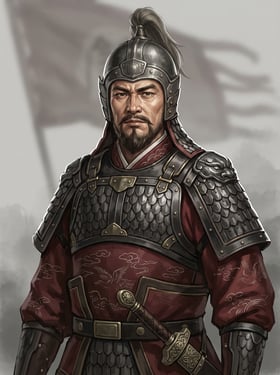
Historical Record
Cao Xiu, courtesy name Wenlie, was a clansman's son of Cao Cao. When the realm fell into chaos, Cao Xiu lost his father while barely more than ten years old; alone, with a single retainer, he attended to the funeral and carried his aged mother across the Yangtze into the land of Wu. Later, because Cao Cao had raised a righteous army, he changed his name, made his way through Jing Province, and finally returned north by back roads to gain an audience with Cao Cao. Upon seeing him, Cao Cao praised him as "the thousand-li colt of my house," and had him lodge with Cao Pi, treating him as a son.
Cao Xiu often accompanied Cao Cao on campaign and once led the Tiger and Leopard Cavalry as palace guards. In the twenty-third year of Jian'an (218 CE), when Liu Bei sent his general Wu Lan to garrison Xiabian, Cao Cao dispatched Cao Hong to campaign against him, appointing Cao Xiu Cavalry Commandant to participate in Cao Hong's military affairs. Cao Cao specifically instructed Cao Hong, "Though you are an army adviser, in truth he is the commander." Cao Hong therefore entrusted Cao Xiu with great responsibility. At that time Liu Bei also sent Zhang Fei to garrison Gushan, intending to cut off the Wei army's rear. While the generals argued back and forth, Cao Xiu held, "If the enemy truly meant to cut the road, he would move in stealth with hidden troops. Now he first makes a show of force—this proves he cannot do it. We should strike Wu Lan before they gather; once Wu Lan is broken, Zhang Fei will withdraw of himself." Cao Hong adopted his counsel, advanced and broke Wu Lan, and Zhang Fei indeed withdrew.
After Cao Cao captured Hanzhong and the armies returned to Chang'an, Cao Xiu was appointed Central Commander of the Army. After Cao Pi ascended the throne of King of Wei, Cao Xiu was appointed General Commander of the Army and, for his cumulative merits, enfeoffed as Marquis of Dongyang Precinct. After Xiahou Dun died, Cao Xiu was appointed General Who Guards the South, granted the staff of authority and command over all military affairs. Cao Pi personally saw him off, stepping down from his carriage to clasp his hand in farewell.
During his tenure, Cao Xiu fought Sun's Wu on several occasions. When Sun Quan once sent a general to garrison Liyang, Cao Xiu broke him upon arriving, then sent troops across the Yangtze and burned the Wu army's encampments of several thousand households at Wuhu. He was later promoted to General Who Conquers the East and made Inspector of Yang Province, advanced to Marquis of Anyang Village. When Cao Pi personally campaigned against Sun Quan, he made Cao Xiu Grand General Who Conquers the East, granted the yellow battle-axe, and put him in command of Zhang Liao and others, together with more than twenty armies of the various provinces and commanderies, defeating Sun Quan's great general Lü Fan and others at Dongpu.
After Emperor Ming, Cao Rui, took the throne, Cao Xiu was advanced to Marquis of Changping. When the Wu general Shen De garrisoned Wan, Cao Xiu broke him and slew Shen De. The Wu generals Han Zong, Zhai Dan, and others also led their followers in surrender to Cao Xiu one after another. Cao Xiu thus had his fief increased by four hundred households, for a total of two thousand five hundred households with the earlier grants, and was promoted to Grand Marshal, still commanding Yang Province as before.
In the second year of Taihe (228 CE), Emperor Ming divided his forces along two routes to campaign against Sun's Wu: Sima Yi advanced down the Han River, while Cao Xiu led the armies toward Xunyang. A Wu general feigned surrender, and Cao Xiu credulously plunged in deep, with the result that the campaign went badly, and he withdrew to encamp at Shiting. At night the army fell into panic, the soldiers scattered, and a great quantity of armor, weapons, and baggage was abandoned. Cao Xiu submitted a memorial confessing his fault; Emperor Ming sent the Commandant of the Encamped Cavalry, Yang Ji, to comfort and reassure him, bestowing lavish rewards. Yet Cao Xiu, from this, suffered an abscess on his back and died, with the posthumous title of Marquis Zhuang.
In the Novel
*Romance of the Three Kingdoms* portrays Cao Xiu in a manner that largely follows the historical record but with literary embellishment that makes his image more vivid. In the novel, Cao Xiu's first appearance displays his youthful martial spirit. When Cao Cao held an archery contest on the drill field, Cao Xiu, as a son of the Cao clan, struck the bullseye with a single arrow, delighting Cao Cao, who called him "the thousand-li colt of my house". Although this episode is not recorded in history, it echoes Cao Cao's appraisal of him as a "thousand-li colt" in the histories and reinforces his image of early success.
In the novel, after Cao Pi ascended the throne, Cao Xiu was appointed Commander-in-Chief of the Imperial Forest Army, responsible for guarding the capital. When Cao Pi was gravely ill and entrusted his heir, Cao Xiu, together with Cao Zhen, Chen Qun, and Sima Yi, received the testamentary edict to assist the young ruler Cao Rui. After Cao Rui took the throne, Cao Xiu was enfeoffed as Grand Marshal and commanded the troops of Yong and Liang, holding an exalted position.
The novel emphasizes Cao Xiu's crushing defeat at the Battle of Shiting. The Wei ruler Cao Rui believed Eastern Wu's Zhou Fang's stratagem of feigned surrender and dispatched Cao Xiu, Jia Kui, and Sima Yi along three routes to campaign against Wu. Cao Xiu credulously trusted Zhou Fang, ignored Jia Kui's remonstrance, and even wished to behead Jia Kui, ultimately falling into Lu Xun's ambush at Shiting. In the novel, Cao Xiu was routed by Lu Xun at Shiting, suffered heavy losses, and was nearly annihilated, escaping only thanks to Jia Kui's rear-guard. This crushing defeat led to Cao Xiu "growing ill from anxiety; upon reaching Luoyang, an abscess erupted on his back and he died", consistent with the histories' record of "an abscess erupting on his back and his death," but the novel attributes it to the shame and resentment of defeat, making it more dramatic.
Key Relationships
* Cao Cao (kin_of): Cao Xiu was a clansman's son of Cao Cao, valued and esteemed by him from childhood, praised as the "thousand-li colt," lodged with Cao Pi, and treated as a son.
* Cao Wei (serves): Cao Xiu served Cao Wei loyally his whole life, beginning his campaigns in Cao Cao's time and serving through the reigns of Cao Pi and Cao Rui, rising to Grand Marshal, an important military general and senior kinsman of Cao Wei.
* Eastern Wu (fights_in): Cao Xiu repeatedly led armies against Eastern Wu, defeating generals such as Wu Lan, Lü Fan, and Shen De, but was routed by Lu Xun at the Battle of Shiting.
* Lu Xun (fights_in): Cao Xiu faced Lu Xun at the Battle of Shiting. Because he credulously trusted Zhou Fang's feigned surrender and plunged deep into enemy territory, he was ultimately routed by Lu Xun's ambush.
* Cao Pi (kin_of): Cao Xiu was close to Cao Pi; Cao Cao had them lodge together, and after Cao Pi took the throne he entrusted Cao Xiu with great responsibility, personally seeing him off before his departure.
* Cao Rui (serves): After Cao Rui took the throne, Cao Xiu was advanced to Grand Marshal and continued to command the military affairs of Yang Province. Cao Rui trusted Cao Xiu deeply, and even after the crushing defeat at Shiting, sent an envoy to comfort and reassure him with lavish rewards.
* Jia Kui (rivals): Before the Battle of Shiting, Jia Kui had remonstrated that Cao Xiu should not credulously trust Zhou Fang, but Cao Xiu ignored him and even wished to behead him. After the defeat, Jia Kui led troops to the rescue, enabling Cao Xiu to escape. The histories record that Cao Xiu and Jia Kui were never on good terms; Emperor Wen had wished to grant Jia Kui the staff of authority, but Cao Xiu held that Jia Kui's harsh nature made him unfit as a commander. In the novel, Cao Xiu was enraged by Jia Kui's remonstrance, believing he "wished to seize my merit," and stripped him of his command, but in the end Jia Kui still saved Cao Xiu.
* Zhou Fang (deceived_by): Zhou Fang was an Eastern Wu general who feigned surrender to Cao Wei at the Battle of Shiting, successfully luring Cao Xiu deep in and causing his crushing defeat (novel-only).
Iconic Scenes
* Cao Cao Praises the "Thousand-li Colt": In his youth, at Cao Cao's archery contest on the drill field, Cao Xiu struck the bullseye with a single arrow, delighting Cao Cao, who praised him as "the thousand-li colt of my house" (novel-only). This scene vividly displays Cao Xiu's youthful martial spirit and Cao Cao's esteem for him.
* Battle of Xiabian: At the Battle of Xiabian, Cao Xiu accurately judged the intentions of Wu Lan and Zhang Fei, advised Cao Hong to strike Wu Lan swiftly, and successfully repelled the enemy, displaying his military talent.
* Cao Pi's Farewell: After Cao Pi took the throne, he appointed Cao Xiu General Who Guards the South, granted the staff of authority and command of military affairs. Cao Pi personally saw him off, stepping down from his carriage to clasp his hand in farewell, showing Cao Xiu's standing among the Cao Wei kinsmen and Cao Pi's trust in him.
* Breaking Lü Fan at Dongpu: When Cao Pi personally campaigned against Sun Quan, Cao Xiu, as Grand General Who Conquers the East and commander of the armies, broke Sun Quan's great general Lü Fan at Dongpu, displaying his ability in warfare against Wu.
* Crushing Defeat at Shiting: In the second year of Taihe (228 CE), Cao Xiu credulously trusted a Wu general's feigned surrender, plunged deep into enemy territory, and was routed by Lu Xun at Shiting, suffering heavy losses. This battle dealt Cao Xiu a tremendous blow, ultimately leading to the abscess on his back and his death. The novel depicts this battle in greater detail, emphasizing Cao Xiu's underestimation of the enemy, his refusal to heed counsel, and Jia Kui's rescue.
* Minister Entrusted with the Heir: When Cao Pi was gravely ill, Cao Xiu, together with Cao Zhen, Chen Qun, and Sima Yi, received the testamentary edict to assist the young ruler Cao Rui, becoming one of Cao Wei's ministers entrusted with the heir.
Portrait file
Character profile
- Character
- Cao Xiu won trust through close kinship, but was impetuous in temperament and prone to suspicion, once doubting that the generals were vying for merit. Eager to win merit because of Zhou Fang's feigned surrender, he would not heed Jia Kui's dissuasion, and in the end brought about the great defeat at Shiting.
- Life
- Cao Xiu was a clansman of Cao Cao. Losing his father early, he took his mother across the river into Wu. After changing his name and returning north, he was esteemed by Cao Cao, who called him a "thousand-li colt," and he lived together with Cao Pi. Cao Xiu often accompanied the army on campaign and once routed Wu Lan; he later rose to Grand Marshal and commanded the military affairs of Yang Province. At the Battle of Shiting, he fell for Zhou Fang's feigned-surrender ploy and was heavily defeated by Lu Xun, and finally died of a carbuncle that erupted on his back.
- Anecdotes
- Cao Xiu was extremely filial toward his mother, and his conduct in receiving and mourning his mother even earned the emperor's courtesy. He was one of the ministers entrusted with the last testament at Cao Pi's deathbed, and an important commander on Cao Wei's eastern front.
Relationships
18 relationships
Quotes
15 recorded lines · 3 featured
「吾不用公言,果遭此敗!」
This line displays Cao Xiu's stubborn self-assurance and his later regret, a classic portrayal of his character.
「原將銳卒虎步江南,因敵取資,事必克捷;若其無臣,不須為念。」
Drawn from the official histories, this line reflects the spirited confidence and military talent of Cao Xiu in his early years.
「吾中賊之計矣!雖然如此亦不足懼。」
This line is Cao Xiu's classic dialogue after falling for a ruse, reflecting his character—proud even in defeat—and is highly recognizable.
Chapters24 回 ▸
- 史ch.2ch.3ch.9ch.14ch.15ch.17ch.18ch.22ch.24ch.28ch.56ch.57ch.58ch.60ch.62
- 演ch.56ch.69ch.71ch.80ch.84ch.85ch.91ch.96ch.97
Relationship timeline5 条 ▸
Inner monologues · AI-generated3 段 ▸
- I am Cao Xiu, courtesy name Wenlie. Looking back on my life today, the most unbearable thing is not the words “defeated
- I, Cao Xiu, courtesy name Wenlie, have today been appointed General Who Conquers the East and charged with commanding th
- I am Cao Xiu, courtesy name Wenlie. The historical records say little about my early years; to recall them, I can only l
Life events6 ▸
- 0210-01-01 · YeBronze Bird Terrace Inauguration Ceremony· Warrior
- 0218-01-01 · XuRebellion of Geng Ji and Wei Huang at Xu· Warrior
- 0222-01-01 · JianglingThree-Pronged Campaign against Wu· Commander
- 0228-01-01 · ShitingZhou Fang's Feigned Surrender to Lure Cao Xiu· Victim
- 0228-01-01 · WanDefeat of Cao Xiu at Wan· Killed in action
- 0228-01-01 · ShitingBattle of Shiting· Commander