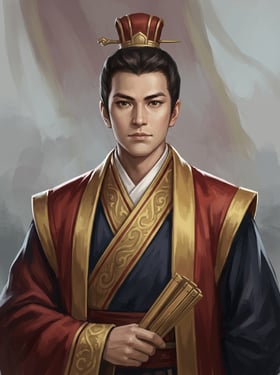
Historical Record
Sun He, styled Zixiao, was the third son of Sun Quan, the Great Emperor of Wu; his mother was Lady Wang. From childhood he was deeply beloved of Sun Quan because his mother was favored, and at the age of fourteen Sun Quan established a palace guard for him and ordered the great Confucian scholar of the day, the Secretariat Director Kan Ze, to teach him the art of letters c:1226. Sun He was naturally clever and tireless in study, and able to treat scholars with humility, and thereby won wide praise. In the fifth year of Chiwu (242), Sun He, at just nineteen, was made Crown Prince. At that time Kan Ze was appointed Grand Tutor of the Crown Prince, Xue Zong as Junior Tutor, and worthy men such as Cai Ying, Zhang Chun, Feng Fu, and Yan Wei often attended at his side, jointly assisting the Crown Prince c:1226.
Sun He achieved not only in learning but also showed surpassing excellence in moral cultivation. The Book of Wu records that he was "from youth precocious and of keen intelligence," and Sun Quan therefore "especially favored him," keeping him often at his side, and the garments and playthings bestowed on him were such as none of the other sons could match. He loved literature, was skilled in riding and archery, received instruction and ranged widely in learning, was of fine discernment and keen intelligence, held his teachers in respect, and cherished worthy men. Whenever the court ministers came to offer congratulations, Sun He would often lower his bearing to treat with them, conversing with them in pleasure. He went deeply into expounding and collating the meanings of the classics, examining right and wrong, and inquired of the court ministers, assessing their conduct and ability so as to learn their merits and shortcomings, forming clear and well-ordered judgments c:1226.
In times of national peril, Sun He also displayed a heart of concern for the state and the people. Once, when Sun Quan secretly moved troops to lie in wait for the Wei general Zhuge Dan, Sun He, well aware of the danger of war, could not bear to see his father exposed in the field, and so was often troubled with grief and anxiety, even refusing to gather and dine with others. He remonstrated repeatedly, urging Sun Quan to act with caution and to seek complete victory, and only after Sun Quan returned to court did he dare to set his mind at ease c:1226.
Sun He was deeply troubled by the declining moral climate, in which scholars indulged in social games and gambling rather than cultivating learning. He held that the scholars of the age should study the arts and learning and practice archery and charioteering so as to meet the affairs of the world, rather than wallow in useless gambling. At one banquet attended by the ministers, he took the occasion to set forth the harms of gambling, holding that it hindered one's enterprise, wasted one's days, and exhausted the spirit and strained the thoughts to no avail. He stressed that a man of resolve should cherish his days and husband his strength, and that a gentleman should aspire to lofty and far-reaching aims and be ashamed of mediocrity and idleness. He pointed out that life is brief and glory does not return; if one could cut off useless desires, follow the way of virtue and righteousness, cast aside non-urgent affairs, and cultivate the foundations of a worthy enterprise, would not his name and conduct be fine? He held that human feeling cannot be without amusement, but that amusement too may be found in feasting, the zither, books, archery, and charioteering—why must it be gambling? He therefore ordered the eight men sitting in attendance each to compose an essay to correct this trend. The Palace Cadet Wei Zhao thereupon wrote the famous Treatise on Gambling c:9726c:1229.
However, Sun He's position as Crown Prince was not without troubles. He was on bad terms with Princess Quan, and at last, through Princess Quan's slander, Sun Quan deposed Sun He from his position as Crown Prince. Sun He thereupon died of grief and resentment c:1230. Later, after Sun He's son Sun Hao ascended the throne, he gave his father Sun He the posthumous title of Emperor Wen c:1224.
In the Novel
In Romance of the Three Kingdoms, Sun He's image is relatively brief, appearing mainly as one link in the affair of Sun Quan's establishing and deposing of his heir. The novel clearly states that Sun Quan first installed Crown Prince Sun Deng, and only after Sun Deng's death installed his second son Sun He as Crown Prince c:1230. This accords with the historical record, which has Sun Deng dying in the fourth year of Chiwu and Sun He being made Crown Prince in the fifth year of Chiwu c:1225c:1226.
The novel stresses the reason for Sun He's deposition, namely that "because He was on bad terms with Princess Quan, he was slandered by the Princess, and Quan deposed him. He died of grief and resentment" c:1230. This episode echoes the historical "Struggle of the Two Palaces," but the novel simplifies it into Princess Quan's slander alone, without delving into the complex political struggle and the contention of the various factions. In actual history, Sun He's deposition involved Sun Quan's vacillation over his heir in his later years, the division of the court ministers, and the fanning of the flames by Princess Quan, Prince Lu Sun Ba, and others—far more than a single slander can sum up.
The novel makes almost no mention of Sun He's character, learning, governance during his time as heir, or his heart of concern for the state and people, forming a sharp contrast with the histories' detailed descriptions of him as one who "loved study and treated scholars with humility," "held his teachers in respect," and "was often troubled with grief and anxiety" c:1226. The novel lays more weight on the tragic end of his deposition as Crown Prince and the political turmoil of Sun Quan's later years that it set off, laying the groundwork for the later appearances of Sun Liang, Sun Xiu, and Sun Hao. Sun He appears in the novel only in Chapters 108 and 120, with but a single line of dialogue (novel only); his existence serves more to drive the plot forward than to shape a three-dimensional character c:1230.
Key Relationships
* Sun Hao (parent_of): Sun He was Sun Hao's father. After Sun Hao ascended the throne, he gave his father Sun He the posthumous title of Emperor Wen c:1224.
* Sun Deng (sibling_of): Sun He was Sun Deng's younger brother. Only after Sun Deng's death was Sun He made Crown Prince c:1225c:1226c:1230.
* Kan Ze (student_of): Sun He was once Kan Ze's student. Sun Quan ordered Kan Ze to teach Sun He the art of letters, and Kan Ze later served as Sun He's Grand Tutor c:1226.
* Xue Zong (student_of): Sun He was once Xue Zong's student. Xue Zong was appointed Junior Tutor after Sun He was made Crown Prince c:1226.
* Cai Ying, Zhang Chun, Feng Fu, Yan Wei (associated_with): These figures were all attendants during Sun He's time as Crown Prince, often at his side c:1226.
* Wei Zhao (associated_with): Wei Zhao was once Sun He's Palace Cadet, and at Sun He's command wrote the Treatise on Gambling to correct the trend of the times c:9726c:1229.
* Princess Quan (adversary_of): Sun He was on bad terms with Princess Quan and was at last slandered and deposed by her (novel only; in actual history an important participant in the "Struggle of the Two Palaces") c:1230.
Iconic Scenes
* Being made Crown Prince and studying under famous scholars: In the fifth year of Chiwu, Sun He, at just nineteen, was made Crown Prince. Sun Quan equipped him with a strong roster of teachers, including the Grand Tutor Kan Ze and the Junior Tutor Xue Zong, as well as attendants such as Cai Ying and Zhang Chun. During this period, Sun He displayed the excellent qualities of loving study, treating scholars with humility, and respecting his teachers, and was praised by the world c:1226.
* Anxious over the war, remonstrating with his father: When Sun Quan secretly moved troops to lie in wait for the Wei general Zhuge Dan, Sun He was deeply anxious, fearing for his father's safety. He remonstrated repeatedly, urging Sun Quan to act with caution and seek complete victory, and only set his mind at ease after Sun Quan returned to court. This embodies his deep concern for the state and his father c:1226.
* Advocating learning and correcting the trend of gambling: Sun He was deeply displeased with the phenomenon of the scholars of the day indulging in gambling and neglecting their studies. At one banquet, he delivered a discourse on the harms of gambling and ordered the eight men sitting in attendance each to compose an essay to correct this trend. The Palace Cadet Wei Zhao thereupon wrote the famous Treatise on Gambling, which became an iconic event of his valuing learning and rectifying the ills of the time c:9726c:1229.
* Being deposed and dying of grief and resentment: Because he was on bad terms with Princess Quan, Sun He was at last, through her slander, deposed by Sun Quan from his position as Crown Prince, and thereby died of grief and resentment. This event marks the tragic end of his political career, and is also an epitome of the political turmoil of Sun Quan's later years c:1230.
* Posthumously honored as Emperor Wen after his death: After Sun He's son Sun Hao ascended the throne, he gave his father Sun He the posthumous title of Emperor Wen. This was not only an affirmation of his status but also a reflection of his son's remembrance and reverence for him c:1224.
Portrait file
Character profile
- Character
- Sun He loved learning and was humble toward men of talent, respected his tutors, disliked gaming, and often grieved with anxious sorrow over his father's military expeditions.
- Life
- In his youth Sun He was favored because his mother, Lady Wang, enjoyed favor. In the fifth year of Chiwu he was made Crown Prince, but later, because of enmity between Lady Wang and the Princess Quan, Lady Wang died of grief, and Sun He gradually lost favor and faced deposition. In the end he was placed under confinement, later moved to Guzhang, and then enfeoffed as Prince of Nanyang and sent to Changsha. After Zhuge Ke was executed, Sun Jun stripped him of his seal and cord and moved him to Xindu, then bestowed death upon him; Sun He and his consort Lady Zhang both took their own lives. After Sun Hao ascended the throne, he was posthumously honored as Emperor Wen.
- Anecdotes
- A son of Sun Quan, once made Crown Prince, he was the natural father of Sun Hao. His wife, Lady Zhang, took her own life to follow him after Sun He's death.
Relationships
18 relationships
Family7
Friends6
Enemies1
Teacher & student3
Other1
Lines
- 史 ch.59 §17
「文武在事,當能幾人,因隙構簿,圖相危害,豈有福哉?」
Chapters10 回 ▸
- 史ch.47ch.48ch.50ch.52ch.58ch.59ch.61ch.65
- 演ch.108ch.120
Relationship timeline7 条 ▸
Inner monologues · AI-generated1 段 ▸
- I am Sun He, courtesy name Zixiao. In my youth, I was favored by my imperial father. At fourteen, he assigned palace gua
Life events5 ▸
- 0242-01-01 · JianyeSun He Designated Crown Prince
- 0245-01-01 · JianyeGu Tan's Memorial on Legitimate and Illegitimate Succession· Victim
- 0250-01-01 · JianyeStruggle of the Two Palaces· Victim
- 0250-01-01 · JianyeDeposition of the Crown Prince and Execution of Prince of Lu Sun Ba· Victim
- 0253-01-01 · XinduSun He Deposed and Forced to Commit Suicide· Victim