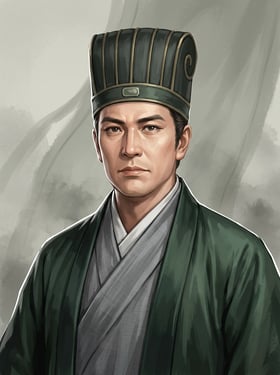
Historical Record
Gu Yong, styled Yuantan, was a native of Wu in Wu Commandery. His great-grandfather Gu Feng once served as Administrator of Yingchuan. In his youth Gu Yong studied the zither and calligraphy under Cai Yong, who greatly admired his talent and even bestowed his own given name upon him, so that Gu Yong shared a name with Cai Yong; his style "Yuantan" also carries the sense of being admired (tan) by Cai Yong c:4198. At the age of capping, Gu Yong was nominated by the province and commandery, and successively served as Prefect of Hefei, Lou County, Qu'e and Shangyu, with outstanding administrative records. When Sun Quan held the post of Administrator of Kuaiji, since he was not always resident in the commandery, he appointed Gu Yong as his Assistant to act in the Administrator's stead. During his tenure, Gu Yong put down bandits and brought peace within the commandery's borders, so that officials and people gave their allegiance. After several years, he was summoned into the court to serve as Marshal of the Left. After Sun Quan was proclaimed King of Wu, Gu Yong successively served as Chief Justice and Master of Ceremonies, and concurrently as Master of Writing, and was enfeoffed as Marquis of Yangsui Precinct c:4198.
In the fourth year of Huangwu, Gu Yong's mother came from the Wu region to the capital. Sun Quan personally went to offer congratulations and paid his respects to her in the courtyard; the lords and high ministers all attended, and the Crown Prince afterward also went to offer congratulations c:6730. Gu Yong did not drink wine and was sparing of words, yet his conduct and bearing were always perfectly apt. Sun Quan once marveled: "When Lord Gu does not speak, his words are sure to hit the mark when he does." During feasts and celebrations, the attendants on either side, because Gu Yong was present, did not dare to be unrestrained, and Sun Quan once said: "With Lord Gu in his seat, one cannot make merry." Such was the awe his dignity inspired c:6730. That same year, Gu Yong transferred to be Grand Master of Ceremonies, was advanced to Marquis of Liling, and succeeded Sun Shao as Chancellor, overseeing the affairs of the Department of State Affairs c:6728. He selected and employed civil and military officers, each able to give full play to his talent, without partiality or bias. Gu Yong often privately visited the people to learn of their hardships and of the gains and losses in government affairs, and secretly reported them to Sun Quan. If his advice was adopted, he attributed the credit to his sovereign; if it was not adopted, he never let it out. Sun Quan therefore held him in great esteem. In the open deliberations of the court, although Gu Yong's words were deferential, the principles he upheld were perfectly fair. Sun Quan once sought opinions on the gains and losses of government; Zhang Zhao held that the laws and ordinances were too cumbersome and the punishments too heavy, and advised some reduction. Sun Quan was silent and made no reply, then turned to ask Gu Yong's view, and Gu Yong answered: "What I have heard is also as Zhang Zhao has set forth." So Sun Quan adopted their advice and resolved to lighten the punishments c:6730.
Later, Lü Yi and Qin Bo served as Palace Writers, charged with collating the documents of the various offices and of the provinces and commanderies. Lü Yi and his fellows used this gradually to wield power and abuse it, creating profits from the liquor monopoly and other controls, exposing offenses and ferreting out treachery, reporting even the most trivial matters, and by means of harsh literalism and slanderous distortion, defaming great ministers and ousting the innocent—so that Gu Yong and others too came under impeachment and censure. Lü Yi's treacherous deeds were in the end exposed, and he was arrested and imprisoned. Gu Yong went to try the case, and Lü Yi met Gu Yong in the status of a prisoner. With a kindly and pleasant manner Gu Yong inquired into his testimony, and on leaving even asked Lü Yi: "Is there perhaps something you wish to say?" Lü Yi kowtowed and said nothing. At the time the Gentleman of the Department of State Affairs Huai Xu reviled Lü Yi to his face, and Gu Yong reproached Huai Xu, saying: "There is proper law for officials; why go to such lengths?" c:6730 Pan Jun had once wished to slay Lü Yi with his own hand at a banquet to rid the state of this scourge, but Lü Yi, hearing of it, pleaded illness and did not attend. Whenever Pan Jun was received in audience by Sun Quan, he never failed to set forth Lü Yi's treachery and danger. Lü Yi therefore gradually lost favor and was in the end executed c:6731.
In the Novel
In the *Romance of the Three Kingdoms*, Gu Yong's image basically accords with the historical record, but his appearances and role are given more dramatic coloring. He first appears in Chapter 29, recommended to Sun Quan by Zhang Hong, who described him as "sparing of words, abstaining from wine, stern and upright"; Sun Quan thereupon appointed him Assistant to act in the Administrator's stead—which accords with the historical record of his early service as Assistant of Kuaiji c:4199. In the novel, Gu Yong often appears together with civil officials such as Zhang Zhao, serving as an important strategist of Sun Quan and taking part in many key decisions.
On the eve of the Battle of Red Cliffs, Gu Yong, together with Zhang Zhao, advised Sun Quan to surrender to Cao Cao, holding that Liu Bei was "adding fuel to fire" and ought not to be relied upon c:4200. When Zhou Yu feigned a wish to surrender to Cao Cao, Gu Yong too, with Zhang Zhao and others, voiced approval—reflecting his stance in the novel as a member of the pro-surrender faction c:6734. However, when Liu Bei took the Western Riverlands, Gu Yong offered Sun Quan a plan, advising him to cut off Liu Bei's route of return and seize the chance to take Jingzhou and Xiangyang, displaying a side of his stratagems c:4202. After Guan Yu "attended the meeting armed with a single blade," Gu Yong further proposed sending a man to Xu to memorialize for Liu Bei to be made Governor of Jing Province, so as to sow discord between Cao and Liu and seize the chance to plot against him; though this plan was adopted, it is unrecorded in history c:4201.
In the novel, after Sun Quan was proclaimed King, Gu Yong once remonstrated that Sun Quan ought not to accept the enfeoffment of the Wei emperor, but should style himself Supreme General and Earl of the Nine Provinces, reflecting his stance of upholding the dignity of Wu c:4203. After the Battle of Xiaoting, when Sun Quan wished to employ Lu Xun as Commander, Gu Yong, together with Zhang Zhao, Bu Zhi and others, questioned whether Lu Xun, being young and of slight repute, might fail to command the generals' respect; but in the end Sun Quan still adopted Kan Ze's advice and gave Lu Xun important employment c:4204. In the first year of Huangwu, Gu Yong, together with Zhang Zhao, memorialized Sun Quan to change the reign title and assisted the Crown Prince in guarding Wuchang c:6735. When Wei mounted a great invasion of Eastern Wu, Gu Yong advised Sun Quan to write to Zhuge Liang, having him send troops out to Hanzhong to divide the Wei force, and to dispatch a great general to garrison Nanxu to ward off the Wei army—again displaying his stratagems c:4205. Before the Battle of Shiting, Gu Yong also recommended Lu Xun as Grand Commander to meet Cao Xiu's assault c:6736.
Key Relationships
* Eastern Wu (serves): Gu Yong served Sun Quan all his life and was an important pillar of the Sun Wu regime. He began assisting Sun Quan from the time Sun Quan first held the post of Administrator of Kuaiji, held many posts, and ultimately rose to Chancellor, deeply trusted and esteemed by Sun Quan c:4198.
* Cai Yong (student_of): Gu Yong studied the zither and calligraphy under Cai Yong, who greatly admired his talent and even bestowed his own given name upon him—showing the deep bond between teacher and student c:4198.
* Gu Ji (parent_of): The historical sources do not directly mention Gu Ji as Gu Yong's son, but Gu Yong had a son, Gu Yu, and his family enjoyed considerable repute in the Wu region.
* Gu Yu (parent_of): Gu Yu was Gu Yong's son; the sources mention that Gu Yong and his son once attended a banquet of Sun Quan's together c:6730.
* Zhang Zhao (colleague): Gu Yong and Zhang Zhao were both eminent ministers of Sun Wu and deliberated affairs together on many occasions, especially in the novel, where the two often appear together as representatives of the pro-surrender or conservative faction c:4200.
* Lü Yi (adversary): Lü Yi had once falsely accused Gu Yong and other great ministers, and Gu Yong, in trying Lü Yi's case, displayed the magnanimous bearing of an elder statesman c:6730.
* Lu Xun (colleague): Gu Yong and Lu Xun were both eminent ministers of Sun Wu; in the novel, Gu Yong once raised objections to Lu Xun's appointment, but in the end also recognized Lu Xun's ability c:4204.
* Zhuge Jin (colleague): In the novel, Zhuge Jin, on Gu Yong's plan, once went to Jing Province to seek a marriage between Sun Quan's heir and Guan Yu's daughter, but was refused by Guan Yu c:15485.
Signature Scenes
* Acting as Administrator of Kuaiji: When Sun Quan was not resident in the commandery, Gu Yong acted in the Administrator of Kuaiji's stead, put down bandits and brought peace within the commandery's borders, displaying his outstanding ability to govern and his political skill c:4198.
* Sun Quan Pays Respects to His Mother: In the fourth year of Huangwu, when Gu Yong's mother came to the capital, Sun Quan personally paid his respects and held a banquet for her, with the lords and high ministers all attending; this was not only a great honor to Gu Yong but also reflected Sun Quan's esteem for filial piety c:6730.
* "When Lord Gu Does Not Speak, His Words Hit the Mark When He Does": Sun Quan's appraisal of Gu Yong precisely captures Gu Yong's character of being sparing of words yet always reasonable when he spoke, and reflects Gu Yong's important standing and influence at court c:6730.
* Trying Lü Yi's Case: In trying Lü Yi, who had framed him, Gu Yong could still keep a kindly and pleasant manner and bear no grudge, displaying the broad-mindedness of an elder statesman and his fair and selfless character. His reproach of Huai Xu for reviling Lü Yi to his face also reflects his rigorous attitude toward upholding the law c:6730.
* Advising Surrender Before the Battle of Red Cliffs: In the novel, Gu Yong, together with Zhang Zhao, advised Sun Quan to surrender to Cao Cao; though it was ultimately not adopted, it reflected his stance at the time as a member of the pro-surrender faction c:4200.
* Offering a Plan to Take Jingzhou and Xiangyang: In the novel, Gu Yong once offered Sun Quan a plan to seize the chance, while Liu Bei was campaigning afar in the Western Riverlands, to cut off his route of return and take Jingzhou and Xiangyang, displaying his keen strategic eye c:4202.
* Remonstrating Against Accepting the Wei Emperor's Enfeoffment: In the novel, when Sun Quan accepted the Wei emperor's enfeoffment, Gu Yong remonstrated that he ought not to accept it, reflecting his stance of upholding Wu's independent standing and dignity c:4203.
* Questioning Lu Xun as Commander: In the novel, after the Battle of Xiaoting, when Sun Quan wished to employ Lu Xun as Commander, Gu Yong, together with Zhang Zhao and others, questioned whether Lu Xun, being young and of slight repute, was suitable—reflecting the court's view of Lu Xun at the time and, from the side, setting off Lu Xun's eventual success c:4204.
Portrait file
Character profile
- Character
- Gu Yong drank no wine, spoke little, was proper in bearing, and stern and upright. He once urged Sun Quan to heed Zhang Zhao's advice to surrender, and also remonstrated that Sun Quan should style himself 'Supreme General and Earl of the Nine Provinces' and ought not to accept enfeoffment from the state of Wei.
- Manner of speech
- Gu Yong did not open his mouth lightly, but every time he spoke he struck to the heart of the matter.
- Life
- When Cai Yong took refuge in the land of Wu, Gu Yong followed him to study the zither and calligraphy, and Cai Yong passed his own name-title on to him. In his youth, upon coming of age, he was recommended by the province and commandery as chief of Hefei, and later transferred to Lou, Qu'e, Shangyu and other places, achieving notable results everywhere. When Sun Quan served as Grand Administrator of Kuaiji, he appointed Gu Yong to act in the administrator's duties. After Sun Quan proclaimed himself King of Wu, Gu Yong rose in successive promotions to Grand Judge and Chamberlain, concurrently Prefect of the Masters of Writing, and was enfeoffed as Marquis of Yangsui Village. In the fourth year of Huangwu he was transferred to Grand Master of Ceremonies, advanced to Marquis of Liling, succeeded Sun Shao as Chancellor, and took charge of the affairs of the Masters of Writing. In the sixth year of Chiwu, Gu Yong died at the age of seventy-six.
- Anecdotes
- At the public court Gu Yong's manner in presenting memorials was compliant in tone, yet the principles he upheld were correct, and so he was respected and trusted. He was once recommended by Zhang Hong, and together with Zhang Hong managed the guest lodge, receiving visitors from all quarters. He served as Chancellor for nineteen years, and after his death was given the posthumous title of Marquis Su.
Relationships
5 relationships
Friends1
Teacher & student1
Other3
Quotes
12 recorded lines · 3 featured
「許都豈無細作在此。若知孫、劉不睦,操必使人勾結劉備。備懼東吳,必投曹操。若此,則江南何日得安?為今之計,莫若使人赴許都,表劉備為荊州牧。曹操知之,則懼而不敢加兵於東南。且使劉備不恨於主公。然後使心腹用反間之計,令曹劉相攻,吾乘隙而圖之,斯為得耳。」
This stratagem shows Gu Yong's deep foresight and his crystal-clear grasp of the relations among the three parties of Sun, Liu, and Cao.
「主公宜自稱上將軍九州伯之位,不當受魏帝封爵。」
This line reflects Gu Yong's political foresight and cautious attitude toward Sun Quan Proclaims Himself Emperor.
「陸遜年幼望輕,恐諸公不服;若不服則生禍亂,必誤大事。」
This line shows Gu Yong's skill in judging and employing men, strongly recommending Lu Xun to avoid internal strife.
Chapters15 回 ▸
- 史ch.47ch.52ch.61
- 演ch.29ch.38ch.43ch.44ch.56ch.61ch.73ch.82ch.83ch.86ch.96ch.98
Relationship timeline8 条 ▸
史 ch.52
- Cai Yong§25
student_of
蔡伯喈从朔方还避怨于吴,雍从学琴书
演 ch.29
- Cai Yong§39
student_of
中郎蔡邕之徒
演 ch.43
- Sun Quan§27
附议降曹
演 ch.56
- Sun Quan§2
advises_in
獻「表薦劉備為荊州牧」之計;薦華歆為使
演 ch.61
- Sun Quan§5
advises_in
进计劉備分兵遠涉山險而去,何不差一軍先截川口斷其歸路
演 ch.82
- Sun Quan§6
advises_in
谏孙权"宜自稱上將軍九州伯之位,不當受魏帝封爵"
演 ch.83
- Lu Xun§24
advises_in
以陆遜年幼望轻为虑
演 ch.86
- Sun Quan§12
advises_in
议修书诸葛孔明出汉中分势,遣大将屯南徐以拒魏
Inner monologues · AI-generated3 段 ▸
- Looking back on my life at this moment, the one thing I can most take pride in may be that I spoke little and never spok
- I often think back to my youth, when I studied music and texts under Cai Bojie. The Master taught me to be focused and c
- I am Gu Yong, courtesy name Yuan Tan. I recall that when I was young, little about me was recorded. I dare not invent an
Life events4 ▸
- 0208-01-01 · ChaisangSun Quan's Decision to Resist Cao Cao· Advisor
- 0208-01-01 · ChaisangZhuge Liang's Mission to Eastern Wu· Witness
- 0230-01-01 · JianyeThe Lü Yi Abuse of Power Case· Victim
- 0250-01-01 · JianyeStruggle of the Two Palaces· Advisor