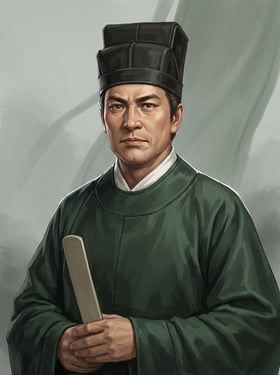
Historical Record
Lu Kai, styled Jingfeng, was a man of Wu County in Wu Commandery and a clansman of the Chancellor Lu Xun c:4010. He displayed his talents early, serving in the early Huangwu era as chief of Yongxing and Zhuji, where his administrative record was distinguished. He was later appointed Commandant of Establishing Valor (Jianwu duwei), leading troops in battle. Though burdened with military duties, Lu Kai never set down his books, being especially fond of the *Taixuan*, on whose meaning he could expound, and his divinations proved correct again and again. During the Chiwu era he was appointed Administrator of Dan'er, and having successfully campaigned against Zhuya, he was promoted for merit to Colonel of Establishing Valor. In the second year of Wufeng, Lu Kai again took the field, campaigning against the mountain bandit Chen Bi of Lingling, taking many heads and captives, and was thereby made Commander of Baqiu, General of the Vanguard, and enfeoffed as Marquis of Duxiang. Thereafter he transferred to be Commander of the Right Division at Wuchang, and once joined the other generals in campaigning at Shouchun c:4010.
After Sun Xiu took the throne, Lu Kai was appointed General Who Conquers the North, with a staff of authority and acting as Governor of Yu Province. After Sun Hao succeeded, Lu Kai's offices rose further: he was transferred to be Grand General Who Guards the West, Commander at Baqiu, Governor of Jing Province, and advanced in enfeoffment to Marquis of Jiaxing c:4010. In the first month of the first year of Baoding, Wu dispatched the Grand Herald Zhang Yan and the Gentleman of the Five Offices Ding Zhong to the state of Jin to offer condolences for Emperor Wen of Jin. After Ding Zhong returned to Wu, he advised Sun Hao that Yiyang could be seized, the north having set up no garrison and defensive equipment. When Sun Hao sought his ministers' opinions on this, Lu Kai overrode the others and remonstrated: "War is to be used only when there is no alternative. Moreover, since the three kingdoms stood in tripod balance, they have invaded one another in turn, never living a year in peace. Now this strong enemy has newly absorbed Ba and Shu, possessing the substance of doubled territory, yet sends an envoy seeking friendship, wishing to rest from military service — this cannot be called seeking our aid. The enemy's strength and position are now waxing, and to seek victory by chancing fortune — I do not see the profit in it." c:15149 Although the General of Chariots and Cavalry Liu Zuan held a contrary view, Sun Hao in the end adopted Lu Kai's counsel and did not carry out the move. In the eighth month of that year, on the discovery of a great cauldron, Sun Hao changed the era name and granted a general amnesty, appointing Lu Kai Chancellor of the Left and the Regular Attendant Wan Yu Chancellor of the Right c:15149.
Lu Kai was upright and bold of speech, and even faced with Sun Hao's cruelty he did not flinch. He once denounced the flattering minister He Ding outright, urging him to reform himself, or else disaster would surely befall him c:15151. When he fell gravely ill in the first year of Jianheng, Sun Hao sent the Director of the Secretariat Dong Chao to inquire after his last words. Lu Kai once more gave his utmost loyalty, declaring that He Ding must not be entrusted with power, and recommending worthies — Yao Xin, Lou Xuan, He Shao, Zhang Ti, Guo Chuo, Xue Ying, Teng Xiu, and his clan-younger-brothers Lu Xi and Lu Kang — hoping Sun Hao would employ them to make the altars of state secure c:4012. Lu Kai at last died at the age of seventy-two. Although Sun Hao harbored resentment at Lu Kai's repeated frank remonstrances, because of his standing as a chief minister and because Lu Kang was then on the frontier, he long restrained himself. Only after Lu Kang died did he banish Lu Kai's household to Jian'an c:4015.
In the Novel
In the *Romance of the Three Kingdoms*, Lu Kai appears chiefly in Chapter 120, his image largely consistent with the loyal remonstrating minister of the historical record c:4020. The novel stresses Sun Hao's cruelty and misrule after taking the throne, and Lu Kai as one of the few ministers daring to remonstrate, anxious for state and people. In the novel, after Sun Hao took the throne, the era was changed to the first year of Yuanxing, then to the first years of Ganlu and of Baoding, and Lu Kai and Wan Yu were made Chancellors of the Left and Right c:4020.
The novel particularly emphasizes that after Sun Hao moved the capital to Wuchang, the people of Yangzhou suffered bitterly from the burden of supplying the river transport, and that Sun Hao's boundless extravagance emptied the treasury. Against this background Lu Kai submitted a remonstrance, whose spirit closely matches that of the historical record, all centering on the faults of Sun Hao's governance and urging him to reform c:4020. Although the novel does not detail Lu Kai's specific conduct in the Yiyang affair, his image as a loyal minister runs throughout. The novel's portrayal of Lu Kai is more that of a clear-eyed man and a resister under Sun Hao's tyranny, using his remonstrances to set off Sun Hao's folly and reinforce his "frank-speaking" character.
It is worth noting that the novel does not mention the details of Lu Kai conspiring with Ding Feng and Ding Gu to depose and replace Sun Hao, which is recorded in the historical sources but not adopted in the novel, perhaps in order to keep Lu Kai's image as a purer loyal minister c:4015.
Key Relationships
* Lu Xun (kin_of): Lu Kai was a clansman of the Chancellor Lu Xun c:4010, a family background that gave him a certain standing and influence in the politics of Wu.
* Eastern Wu (serves): Lu Kai served Eastern Wu all his life, from holding local office in the Huangwu era to ranking as Chancellor of the Left under Sun Hao, always an important official of Wu c:4010.
* Sun Hao (advises_in): Lu Kai was an important remonstrating minister under Sun Hao, repeatedly admonishing him frankly — including opposing the attack on Yiyang, criticizing his failure to follow the late emperor's governance, his employment of flatterers, and his harming of loyal and good men c:15149, c:4017.
* He Ding (enemy_of): Lu Kai once denounced the flatterer He Ding to his face, charging him with subverting the government and foretelling that he would not die well; the two were as fire and water c:15151.
* Ding Zhong (debates_with): After Ding Zhong returned from Jin, he advised Sun Hao to attack Yiyang, while Lu Kai firmly opposed it; the two held opposing views on the matter c:15149.
* Wan Yu (colleague_of): Lu Kai and Wan Yu were Chancellors of the Left and Right together, but Lu Kai took a negative view of Wan Yu's talent and character, regarding him as "a man of petty and common stuff" unfit for high office c:15149, c:4017.
* Wang Fan (defends): Lu Kai once submitted a memorial protesting on behalf of Wang Fan, whom Sun Hao had killed, calling him "a weighty bulwark of the altars of state, the Long Feng of great Wu" c:4017, c:4019.
* Lu Kang (kin_of): Lu Kang was Lu Kai's clan-younger-brother, and on his deathbed Lu Kai recommended Lu Kang as a pillar of the state. Because Sun Hao dreaded Lu Kang's power, he dared not move against Lu Kai's household during Lu Kang's lifetime c:4012, c:4015.
Iconic Scenes
* Remonstrating against the attack on Yiyang: In the first year of Baoding, when Ding Zhong advised Sun Hao to attack Yiyang, Lu Kai overrode the others and, with arguments such as "war is to be used only when there is no alternative" and "I do not see the profit in it," successfully dissuaded Sun Hao from the military action, averting a possibly disadvantageous war c:15149. This reflects his far-sighted political wisdom and his sense of responsibility for the state's safety.
* Denouncing He Ding to his face: Lu Kai, in Sun Hao's very presence, sternly denounced the flatterer He Ding, charging him with "subverting the government" and "befouling the imperial ear," and foretelling that disaster would befall him c:15151. This scene fully displays Lu Kai's upright, unbending character and his fearlessness before the powerful.
* Recommending worthies on his deathbed: As Lu Kai lay gravely ill and dying, Sun Hao sent to inquire after his last words; heedless of his own safety, Lu Kai remonstrated once more, not only pointing out that flatterers like He Ding must not be employed, but also recommending a body of loyal, diligent, and able men — Yao Xin, Lou Xuan, He Shao, Zhang Ti, Guo Chuo, Xue Ying, Teng Xiu, and his clan-younger-brothers Lu Xi and Lu Kang — for the sake of Wu's future c:4012. This reflects his loyalty in giving his all unto death.
* Memorial denouncing Sun Hao's failure to follow the late emperor's governance: Lu Kai once submitted a memorial to Sun Hao enumerating his offenses of "not following the late emperor" — among them not consulting his chief ministers, harming the loyal and good Wang Fan, employing the mediocre Wan Yu, not cherishing the people, drowning himself in wine and women, neglecting affairs of state, boundless extravagance, and intimacy with flatterers c:4017. This memorial, fierce in its language and striking at Sun Hao's fundamental faults, is the concentrated expression of Lu Kai's frank remonstrance.
* Conspiracy to depose and replace (not clearly recorded in the novel): According to the *Wu Lu*, in the twelfth month of the first year of Baoding, Lu Kai conspired with the Grand Marshal Ding Feng and the Imperial Counsellor Ding Gu, wishing to depose and replace Sun Hao when he visited the ancestral temple and to enthrone a son of Sun Xiu. However, because the General of the Left Liu Ping refused to cooperate, and because Lu Kai's son Lu Yi failed to convey his intention successfully, the plan was abandoned c:4015. This event shows the extraordinary measures Lu Kai was prepared to take to save the state in an extreme situation, but this episode was not adopted by the *Romance of the Three Kingdoms*.
Portrait file
Character profile
- Character
- Lu Kai was bold in remonstrance and outspoken, loyal, vigorous, and forthright, his heart set on the public good, his sense of justice showing in his face; his memorials all addressed matters plainly, without embellishment.
- Manner of speech
- Lu Kai remonstrated bluntly and fearlessly, citing the classics for support; he once laid out a direct remonstrance enumerating 'twenty matters in which the late emperor's ways were not followed.'
- Life
- Lu Kai, styled Jingfeng, was a man of Wu in Wu Commandery, a clansman's son of the Chancellor Lu Xun. He served as chief of Yongxing and Zhuji, and was later appointed Commandant Who Establishes Martial Might in command of troops, distinguishing himself in the campaign against Zhuya. When Sun Hao took the throne, he was promoted to Grand General Who Guards the West, area commander of Baqiu concurrently governing as Governor of Jing Province, advanced to Marquis of Jiaxing, and in the first year of Baoding promoted to Chancellor of the Left.
- Anecdotes
- Lu Kai was a senior minister of Sun Wu. He once plotted secretly with the General of the Left Liu Ping, the Grand Marshal Ding Feng, and the Grandee Secretary Ding Gu to depose Hao, but without success. He often bore Hao's repeated defiance of his imperial will, and, with He Ding's slanderous contrivances added, he submitted a memorial grieving over the death of Wang Fan.
Relationships
10 relationships
Quotes
5 recorded lines · 3 featured
「夫兵不得已而用之耳,且三國鼎立已來,更相侵伐,無歲寧居。今彊敵新并巴蜀,有兼土之實,而遣使求親,欲息兵役,不可謂其求援於我。今敵形勢方彊,而欲徼幸求勝,未見其利也。」
This line reflects Lu Kai's clear-eyed grasp of the Three Kingdoms situation, admonishing Sun Hao not to lightly start a war.
"何定不可任用,宣授外任,不宜委以國事。奚熙小吏,建起浦裡田,欲復嚴密故跡,亦不可聽。姚信、樓玄、賀劭、張悌、郭逴、薛瑩、滕脩及族弟喜,抗,或清白忠勤,或姿才卓茂,皆社稷之楨干,國家之良輔。願陛下重留神思,訪以時務,各盡其忠,拾遺萬一。"
This passage portrays Lu Kai as a loyal minister who recommends worthy men and worries for the state and its people.
「常侍王蕃黃中通理,知天知物,處朝忠蹇,斯社稷之重鎮,大吳之龍逢也。昔事景皇,納言左右,景皇欽嘉,歎為異倫。而陛下忿其苦辭,惡其直對,梟之殿堂,屍骸暴棄,邦內傷心,有識悲悼。」
This line directly remonstrates against Sun Hao's killing of the loyal minister Wang Fan, showing Lu Kai's loyalty and courage and his criticism of tyranny.
Chapters4 回 ▸
- 史ch.48ch.61ch.65
- 演ch.120
Relationship timeline11 条 ▸
史 ch.61
- Lu Xun§10
kin_of
丞相逊族子
- Sun Hao§11
advises_in
反复谏皓,二十事不遵先帝;皓常衔其犯颜忤旨
- Dong Chao§23
friend_of
建衡元年疾病,皓遣中书令董朝问所欲言
- Lu Kang§23
kin_of
临终荐抗为良辅;时抗为大将在疆场,皓以此容忍凯
- Lu Yi§24
parent_of
父子
- Ding Feng§25
friend_of
与大司马丁奉、御史大夫丁固谋废皓未果
- Liu Ping§25
rival_of
密语留平欲令执据;平拒而不许誓以不泄
- Wang Fan§29
friend_of
上疏称王蕃为大吴龙逄,伤皓枭其于殿堂
- Wan Yu§29
rival_of
上疏讥其昔从家隶今超步紫闼,瑣才凡庸而陛下荣以尊辅
史 ch.65
- Wang Fan§6
friend_of
丞相上疏痛蕃,誉为大吴龙逄
演 ch.120
- Sun Hao§2
advises_in
上疏切谏奢侈黩武
Inner monologues · AI-generated3 段 ▸
- I, Lu Kai, hold the office of Chancellor and receive the state’s favor and generous emoluments. What concerns me is not
- As my illness has grown severe and my strength wanes by the day, Your Majesty sent the Secretariat Director Dong Chao to
- My name is Lu Kai, my courtesy name Jingfeng, and I am from Wu County in Wu Commandery. I am a kinsman of the Chancellor
Life events4 ▸
- 0265-01-01 · JianyeSun Hao's Purge of Loyal Ministers· Victim
- 0265-01-01 · WuchangSun Hao Moves the Capital to Wuchang· Advisor
- 0266-01-01 · JianyeLu Kai's Plot to Depose Sun Hao· Instigator
- 0280-01-01 · JianyeSun Hao's Accession and the Decline of Wu· Advisor