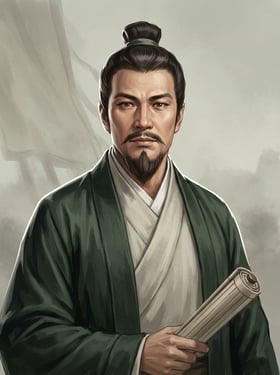
Historical Record
Bu Zhi, courtesy name Zishan, was a native of Huaiyin in Linhuai. When Sun Quan was General Who Conquers the Caitiffs, he once summoned Bu Zhi to be a Registrar, but Bu Zhi declined on grounds of illness. He associated in the Wu region with Zhuge Jin, Yan Jun, and others, and being renowned, was acclaimed one of the outstanding talents of the age c:2587. He was later appointed Chief of Haiyan County, and was once recruited as an Eastern Section Clerk to the General of Chariots and Cavalry. When Sun Quan served as Governor of Xu Province, he again made Bu Zhi an Attendant Clerk of the Bureau of Merit and recommended him as a Cultivated Talent c:2587.
In the fifteenth year of the Jian'an era (210 CE), Bu Zhi became Administrator of Poyang, and in the same year was transferred to Inspector of Jiaozhou and General of the Gentlemen-of-the-Household Who Establishes Martial Might, leading a thousand archer-officers southward. The following year he was additionally appointed Bearer of the Staff of Authority and General of the Gentlemen-of-the-Household Who Campaigns South c:2587. At the time, the Administrator of Cangwu, Wu Ju, who had been appointed by Liu Biao, harbored disloyal intentions, outwardly submissive but secretly nursing thoughts of rebellion. Bu Zhi lured him into a meeting by a policy of conciliation, then beheaded him and displayed his body to all, his prestige greatly shaking the region c:2587. When the Administrator of Jiaozhi, Shi Xie, and his brothers learned of this, they all came over of their own accord, and from then on the southern borderlands began to submit to Eastern Wu. The powerful Yi Province clan of Yong Kai and others killed Zheng Ang, the Administrator appointed by Shu Han, and entered into friendly relations with Shi Xie, requesting to attach themselves to Eastern Wu. Bu Zhi therefore, acting on the emperor's commission, sent envoys to proclaim grace, soothing and winning them over, for which he was additionally appointed General Who Pacifies the Rong and enfeoffed as Marquis of Guangxin c:2587.
After Sun Quan proclaimed himself emperor, Bu Zhi was appointed General of Agile Cavalry and concurrently Governor of Jizhou. In the same year he took command of Xiling, replacing Lu Xun in guarding the frontier. Later, because Jizhou lay within the territory of Shu Han, Bu Zhi was relieved of the governorship c:5797. In the ninth year of the Chiwu era (246 CE), Bu Zhi succeeded Lu Xun as Chancellor; even in this high office, he still instructed his disciples and never let a book leave his hand, dressing in the manner of a scholar. His wives and concubines, however, wore lavish and ornate attire, for which he drew some criticism. Bu Zhi guarded Xiling for twenty years, and the neighboring enemies stood in awe of his prestige and trustworthiness. He was magnanimous by nature and won people's hearts; he did not show his joy or anger in his face, yet within and without all held him in solemn respect c:5798.
In the first month of spring in the seventh year of the Chiwu era (244 CE), Lu Xun was appointed Chancellor. In autumn, Wanling reported the growth of auspicious grain. In the same year, Bu Zhi, Zhu Ran, and others memorialized that those returning from Shu Han all said Shu Han wished to break the alliance and communicate with Cao Wei, building many ships, repairing its city walls, and that Jiang Wan was guarding Hanzhong. They held that when Sima Yi marched south, Shu Han, instead of taking the chance to send out troops in a pincer attack, abandoned Hanzhong and fell back to defend Chengdu, the matter being already plain, and that preparation should be made for it. Sun Quan, however, held it was not so, saying that he had treated Shu Han generously, with hospitality and sworn alliance, and had failed it in nothing—why would Shu Han do such a thing? Moreover, when Sima Yi had earlier entered Shu region, he had withdrawn within ten days; Shu Han was ten thousand li away—how could it know of the urgency and so send out troops? Sun Quan held that for Shu Han to govern its state and build ships and walls was a routine matter, and could not be cause for suspicion. He overruled the dissenting voices and firmly believed Shu Han would not break the alliance c:12482.
In the tenth year of the Chiwu era (247 CE), Bu Zhi died, and his son Bu Xie inherited his position, commanding Bu Zhi's troops with the additional title of General Who Calms the Army. After Bu Xie died, his son Bu Ji inherited the marquisate. Bu Xie's younger brother Bu Chan carried on the line, serving as Commander of Xiling with the additional title of General Who Manifests Valor and the rank of Marquis of Xiting. In the first year of the Fenghuang era (272 CE), Bu Chan was recalled to serve as Commander of the Surrounding Tents. The Bu family had guarded Xiling for generations, and on being summoned this time, Bu Chan felt he had lost his post and feared slander and disaster, and so held the city and surrendered to Jin, sending Bu Ji and his younger brother Bu Xuan to Luoyang as hostages. Jin appointed Bu Chan Commander of all military affairs at Xiling, General of the Guards, with ceremonial rank equal to the Three Excellencies, the additional title of Palace Attendant, the staff of authority, and the office of Governor of Jiaozhou, and enfeoffed him as Duke of Yidu c:2588.
In the Novel
In Romance of the Three Kingdoms, Bu Zhi's image is shown mainly through his identity as a civil official of Eastern Wu and his statements and stances at critical moments. He first appears on the eve of the Battle of Red Cliffs, during Zhuge Liang's Debate with the Scholars of Jiangdong. Bu Zhi questioned whether Zhuge Liang meant to wield a tongue like Su Qin and Zhang Yi to lobby Eastern Wu. Zhuge Liang retorted that Su Qin and Zhang Yi were likewise heroes with schemes to uphold the state, not men who feared the strong and bullied the weak, and mocked Bu Zhi and the others for wishing to surrender out of fear of Cao Cao c:2589. On hearing this, Bu Zhi fell silent, reflecting the predicament of a civil official who, cautious by nature, could not gain the upper hand in debate.
Before the Battle of Red Cliffs, after Lu Su brought Zhuge Liang back from Jiangxia, Zhang Zhao, Gu Yong, Zhang Hong, Bu Zhi, and others once went together to visit Zhou Yu. Zhang Zhao and the rest laid out for Zhou Yu the pros and cons of Cao Cao's overwhelming strength and of persuading Sun Quan to surrender, and pointed out that Lu Su, provoked by Zhuge Liang, was obstinately deluded. Here Bu Zhi sided with Zhang Zhao and the others, inclining toward surrender to Cao Cao c:5799. This differs from the histories, in which Bu Zhi came to prominence only after the Battle of Red Cliffs and was noted chiefly for his military and administrative talents; the novel here casts him as one of the representatives of the pro-surrender faction.
When Guan Yu attacked Fancheng, Bu Zhi offered a plan to Sun Quan. He pointed out that Cao Cao wished to usurp the Han, and the man he feared was Liu Bei; now Cao Cao had sent an envoy ordering Eastern Wu to send troops to attack Shu, which was in truth to shift the disaster onto Wu. Bu Zhi advised Sun Quan to send an envoy to Xu to meet Cao Cao, have Cao Ren attack Jing Province first by the overland route, so that Guan Yu would surely move the troops of Jing Province to relieve Fancheng. At that moment Sun Quan could send a general to seize Jing Province in secret, and the matter could be accomplished at a stroke c:12478. Sun Quan adopted this plan, which ultimately led to Guan Yu's defeat and death and the loss of Jing Province. This stratagem has no clear basis in the histories and was a literary creation by the novel to highlight the cunning of Eastern Wu's strategists.
When Liu Bei, to avenge Guan Yu, mounted a great attack on Wu, Sun Quan, his courage shaken because Mi Fang and Shi Ren had been killed by the Shu army, gathered his civil and military officials to deliberate. Bu Zhi again offered a plan, holding that those the Shu sovereign hated were Lü Meng, Pan Zhang, Ma Zhong, Mi Fang, and Shi Ren, and that now these men were all dead, only Fan Jiang and Zhang Da remaining in Eastern Wu. Bu Zhi advised Sun Quan to seize Fan Jiang and Zhang Da and send them back to Liu Bei together with the head of Zhang Fei, while also returning Jing Province, sending back Lady Sun, presenting a memorial to sue for peace and renew their old amity, and jointly plotting the destruction of Wei—then the Shu troops would withdraw of themselves c:12480. Sun Quan adopted this plan and sent Cheng Bing as envoy, bearing the state letter and Zhang Fei's head, to Xiaoting. This episode too is unique to the novel, meant to display Bu Zhi's strategy and his judgment of the situation in a moment of crisis.
When Lu Xun was appointed Grand Commander to resist Liu Bei, Zhang Zhao, Gu Yong, Bu Zhi, and others questioned the appointment. Bu Zhi held that Lu Xun's talents sufficed only to govern a commandery, and that to entrust him with so heavy a charge was perhaps beyond his abilities c:2590. Kan Ze, however, overruled the others and firmly vouched for Lu Xun, and Sun Quan in the end adopted Kan Ze's advice. This episode highlights Bu Zhi's conservative view, as a traditional civil official, of a young general, contrasting with Kan Ze's foresight.
Key Relationships
* Eastern Wu (serves): Bu Zhi served Sun Quan throughout his life, from Registrar, county Chief, and Administrator, up to Inspector of Jiaozhou and General of Agile Cavalry, finally rising to Chancellor—a vital pillar of the Eastern Wu regime c:5794.
* Wu Ju (enemy_of): While serving as Inspector of Jiaozhou, Bu Zhi beheaded the disloyal Administrator of Cangwu, Wu Ju, pacifying Jiaozhou and extending Eastern Wu's territory c:2587.
* Wei Jing (friend_of): When the Crown Prince Sun Deng wrote to Bu Zhi asking about the worthy talents of Jing Province, Bu Zhi listed eleven men, including Wei Jing, distinguishing their conduct and memorializing to commend and encourage them, showing that Wei Jing was one of the worthy talents Bu Zhi recognized c:5797.
* Shi Xie (friend_of): After Bu Zhi pacified Wu Ju, Shi Xie and his brothers came over one after another to Eastern Wu, and Bu Zhi established friendly relations with Shi Xie, jointly governing the southern borderlands c:2586.
* Zhuge Liang (opponent_of): In Romance of the Three Kingdoms, Bu Zhi once crossed words with Zhuge Liang during the Debate with the Scholars of Jiangdong, questioning Zhuge Liang's intent to lobby Eastern Wu, but was ultimately left speechless by Zhuge Liang's retort c:2589 (unique to the novel).
* Lu Xun (colleague_and_successor_of): Bu Zhi once took command of Xiling in succession to Lu Xun, and later succeeded Lu Xun as Chancellor c:5798. In the novel, Bu Zhi once questioned Lu Xun's military talent, holding that his talents "sufficed only to govern a commandery" c:2590 (unique to the novel).
Signature Scenes
* Beheading Wu Ju and Pacifying Jiaozhou: Bu Zhi lured Wu Ju into a meeting by a policy of conciliation, then beheaded him, his prestige shaking the southern land, so that the Shi Xie brothers came over and he rendered great service in stabilizing and extending Eastern Wu's southern territory c:2587. This event is a concentrated display of Bu Zhi's military and political talent and the most decisive action of his early career.
* Rising to Chancellor and Guarding Xiling: Bu Zhi succeeded Lu Xun as Chancellor in the ninth year of the Chiwu era (246 CE), and guarded Xiling for twenty years, winning the awe of neighboring enemies through his magnanimous nature and strict, disciplined command of the army c:5798. This marks the pinnacle of his official career, his virtue and prestige stabilizing the frontier of Eastern Wu.
* Overruling the Court and Firmly Trusting Shu Han: In the seventh year of the Chiwu era (244 CE), when Bu Zhi and other ministers memorialized their fears that Shu Han might break the alliance and communicate with Cao Wei, Sun Quan overruled the court and firmly believed Shu Han would not betray the alliance c:12482. This scene displays Bu Zhi's concern, as a minister, for the security of the state, and Sun Quan's decisiveness as a sovereign.
* Debating Zhuge Liang: In Romance of the Three Kingdoms, on the eve of the Battle of Red Cliffs, Bu Zhi, as one of the representatives of Eastern Wu's civil officials, crossed words with Zhuge Liang. He questioned Zhuge Liang's intent to emulate Su Qin and Zhang Yi, but was left dumbstruck by Zhuge Liang's argument about "heroes" c:2589 (unique to the novel). Although this scene is a fabrication of the novel, it vividly portrays Bu Zhi's image as a civil official and his performance when facing a formidable opponent.
* Offering the Plan to Take Jing Province: In Romance of the Three Kingdoms, Bu Zhi offered Sun Quan the stratagem of "shifting the disaster onto Wu," advising him to take advantage of Cao Cao's attack on Jing Province to seize Jing Province in secret while Guan Yu moved his troops c:12478 (unique to the novel). This plan ultimately caused Guan Yu to flee to Maicheng in defeat and Jing Province to fall into the hands of Eastern Wu, displaying Bu Zhi's cunning as a strategist in the novel.
* Advising Reconciliation with Liu Bei: In Romance of the Three Kingdoms, when Liu Bei mounted a great campaign against Wu to avenge Guan Yu, Bu Zhi advised Sun Quan to return Fan Jiang, Zhang Da, and the head of Zhang Fei to Liu Bei, and to return Jing Province, in order to seek reconciliation and jointly resist Wei c:12480 (unique to the novel). This strategy reflects Bu Zhi's clear understanding of the situation and his pragmatic attitude in the novel.
Portrait file
Character profile
- Character
- Bu Zhi was magnanimous in temperament and able to win the support of the multitude; joy and anger never showed in his voice or expression, so that all within and without were kept in awe. He was once of equal renown and on friendly terms with Yan Jun, and once joined his name with Zhuge Jin in a memorial.
- Manner of speech
- Even so he went on instructing and nurturing his disciples, never letting a book out of his hand, his dress and dwelling like those of a scholar.
- Life
- Bu Zhi took refuge in Jiangdong during the turmoil of the age. At first he was single and destitute, and together with Wei Jing of Guangling he grew melons to support himself, toiling with his four limbs by day and reciting the classics by night. When Sun Quan was General Who Chastises Bandits, he summoned Bu Zhi as recorder, and later appointed him chief of Haiyan. In the fifteenth year of Jian'an he went out to serve as Grand Administrator of Poyang, and within the year was transferred to Inspector of Jiaozhou. After Sun Quan assumed the honored title, he appointed Bu Zhi General of Agile Cavalry, concurrently Governor of Jizhou, and in the ninth year of Chiwu he succeeded Lu Xun as Chancellor.
- Anecdotes
- Bu Zhi was a great general of the state of Wu, serving as Chancellor, General of Agile Cavalry, concurrently Governor of Jizhou, and area commander of Xiling; for twenty years at Xiling the neighboring enemies respected his prestige and trustworthiness. He once received a letter that Sun Quan had copied out and shown him; the dress of the wives and concubines within his household was extravagant and ornate, and for this he drew a good deal of criticism.
Relationships
7 relationships
Family1
Friends1
Enemies1
Other4
Quotes
6 recorded lines · 3 featured
「曹操久欲篡漢,所懼者劉備也;今遣使來令吳興兵吞蜀,此嫁禍於吳也。」
This line exposes Cao Cao's scheme to kill with a borrowed knife, showing Bu Zhi's deep insight into the situation.
「今曹仁見屯兵於襄陽、樊城,又無長江之險,旱路可取荊州,如何不取,卻令主公動兵?只此便見其心。主公可遣使去許都見操,令曹仁旱路先起兵取荊州,雲長必掣荊州之兵而取樊城。若雲長一動,主公可遣一將,暗取荊州,一舉可得矣。」
This stratagem displays Bu Zhi's military cunning, providing the key idea for Eastern Wu to seize Jing Province.
「蜀主所恨者:乃呂蒙、潘璋、馬忠、糜芳、傅士仁也。今此數人皆亡,獨有范彊、張達二人,現在東吳。何不擒此二人,並張飛首級,遣使送還,交與荊州,送歸夫人,上表求和,再會前情,共圖滅魏,則蜀兵自退矣。」
This line reflects Bu Zhi's precise grasp of Shu Han's psychology, providing a strategy for reconciliation between Wu and Shu.
Chapters9 回 ▸
- 史ch.47ch.49ch.52ch.53ch.60
- 演ch.43ch.44ch.73ch.83
Relationship timeline5 条 ▸
史 ch.49
- Wu Ju§31
enemy_of
至交州斩怀异心之吴巨
史 ch.52
演 ch.43
- Zhuge Liang§12
诘难
演 ch.83
- Lu Xun§24
advises_in
以为陆逊才堪治郡,不宜託以大事
Inner monologues · AI-generated3 段 ▸
- I am Bu Zhi, courtesy name Zishan. Looking back on my life, what occupies my thoughts is not fleeting fame, but how, whi
- In the fifteenth year of Jian’an, Sun Quan appointed me to serve as the Administrator of Poyang. Before a year had passe
- My courtesy name was Zishan. If asked about my early years, these few records before me give no detailed account. I dare
Life events4 ▸
- 0208-01-01 · ChaisangZhuge Liang's Debate with the Scholars of Jiangdong· Advisor
- 0210-01-01 · CangwuBu Zhi Pacifies Jiao Province· Commander
- 0230-01-01 · JianyeThe Lü Yi Abuse of Power Case· Victim
- 0250-01-01 · JianyeStruggle of the Two Palaces· Advisor