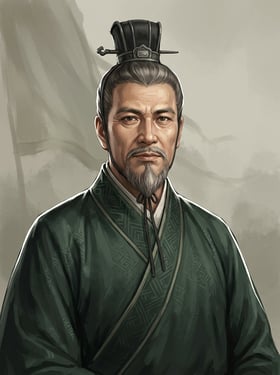
史载(Historical Record)
Lü Dai, styled Dinggong, was a native of Hailing in Guangling. When the realm fell into chaos, he fled the turmoil and crossed south to Jiangdong. After Sun Quan took control of affairs, Lü Dai went to serve in his headquarters and was appointed county aide of Wu County c:847. When Sun Quan personally examined matters concerning the county's granaries and prisoners, Lü Dai distinguished himself in handling legal affairs and interrogating criminals, winning Sun Quan's high regard. He was thus summoned to be a recording clerk, and later sent out as the chief of Yuyao County. While in office at Yuyao, Lü Dai recruited elite troops and gathered over a thousand men.
In the sixteenth year of Jian'an (211), the bandits Lü He and Qin Lang of the five counties of Dongye in Kuaiji Commandery rose in rebellion. Sun Quan appointed Lü Dai as supervising colonel, and together with the general Jiang Qin and others he led troops to put down the revolt. In the end they captured Lü He and Qin Lang and pacified the disorder of the five counties, and for this Lü Dai was made General of the Household Who Manifests Trust c:847.
In the first year of Yankang (220), Lü Dai succeeded Bu Zhi as inspector of Jiaozhou. After taking up his post, the bandit chief Qian Bo of Gaoliang surrendered of his own accord, and Lü Dai, acting on delegated authority, appointed Qian Bo as the western commandant of Gaoliang. Soon after, the Yi tribesmen of Yulin Commandery attacked and besieged the commandery towns, and Lü Dai led troops to crush them. At this time the bandit chief Wang Jin of Guiyang and Zhenyang gathered a force to make trouble on the borders of Nanhai Commandery, and Sun Quan again ordered Lü Dai to go and suppress him. Lü Dai took Wang Jin alive and sent him under escort to the capital, capturing and killing more than ten thousand in all in this campaign. For this Lü Dai was promoted to General Who Pacifies the South, given the staff of authority, and enfeoffed as Marquis of Duxiang c:848.
After Shi Xie died, Sun Quan at first intended to appoint Shi Xie's son Shi Hui as General Who Pacifies the Distant, with command of Jiuzhen as its grand administrator, and to send the colonel Chen Shi to replace Shi Xie. However, Lü Dai submitted a memorial proposing to divide the three southern commanderies of Jiaozhou into a province of Jiaozhou, appointing the general Dai Liang as its inspector, and to divide the four eastern commanderies into a province of Guangzhou, with Lü Dai himself as inspector c:8922. When Dai Liang and Chen Shi went south to take up their posts, Shi Hui refused to obey orders and raised troops to hold the harbor mouth against them. Lü Dai then submitted a memorial requesting to campaign against Shi Hui, and personally led three thousand troops, advancing by sea day and night without rest. Lü Dai knew well that Shi Hui's family had held sway over Jiaozhou for generations, and that if he hesitated, Shi Hui might hold his cities firm and the hundred tribes of the seven commanderies might answer his call, making him hard to deal with thereafter. He acted swiftly, and after passing Hepu he joined forces with Dai Liang. When Shi Hui heard that Lü Dai's troops had arrived, he was greatly alarmed, and led his six brothers out, baring their flesh, to surrender. Lü Dai thereupon had the brothers executed and sent their heads to Wuchang c:49. Shi Hui's officers Gan Li, Huan Zhi and others led officials and people to attack Lü Dai, but Lü Dai fought back fiercely and routed the enemy, and for this he was advanced in fief to Marquis of Panyu. Thereafter Guangzhou was abolished and Jiaozhou restored to its former state. After pacifying Jiaozhou, Lü Dai advanced further to campaign against Jiuzhen Commandery, capturing and killing tens of thousands. He also sent emissaries to spread the imperial influence in the south, so that the kings of the distant lands of Funan, Linyi, Tangming and others all sent envoys to pay tribute. Sun Quan commended his merit and advanced him to General Who Guards the South c:8922.
In the third year of Huanglong (231), the southern region having been pacified, Lü Dai was recalled and stationed his troops at Oukou in Changsha c:850. Before long the Man tribes of Wuling stirred, and Lü Dai joined the Grand Master of Ceremonies Pan Jun in suppressing them. In the third year of Jiahe (234), Sun Quan ordered Lü Dai to take command of Pan Zhang's forces and station them at Lukou, later moving them to Puqi. In the fourth year of Jiahe (235), the Luling bandits Li Huan and Lu He, the Dongye bandit Sui Chun of Kuaiji, and the Nanhai bandit Luo Li and others all rose at the same time. Sun Quan again ordered Lü Dai to supervise the generals Liu Zuan, Tang Zi and others in separate campaigns against them. Sui Chun surrendered at once, and Lü Dai made him a subordinate general and put him in command of his own forces, raising him to the ranks of the generals. Li Huan, Luo Li and the others were executed and their heads sent to the capital c:850.
After Pan Jun died, Lü Dai succeeded him in charge of the documents of Jing Province, and together with Lu Xun he was stationed at Wuchang, continuing to oversee Puqi. Before long Liao Shi rose in rebellion, attacking and besieging the towns, so that the commanderies of Lingling, Cangwu and Yulin were thrown into unrest. Lü Dai volunteered to campaign and set out with all haste day and night. Sun Quan sent an envoy after him to appoint him governor of Jiaozhou, and dispatched Tang Zi and other generals to reinforce him in succession. After a year of campaigning, Lü Dai finally pacified the rebellion, executing Liao Shi and Fei Yang, the grand administrator of Linhe whom Liao Shi had falsely installed, and wiping out his partisans; the commanderies and counties were all pacified, and Lü Dai accordingly returned to Wuchang c:851.
Lü Dai was upright and devoted to public service, abounding in clever stratagems, loyal and martial with principle. He once befriended Xu Yuan of Wu Commandery; Xu Yuan was generous and had ambition and talent, and Lü Dai, knowing he could succeed, gave him a headcloth and sleeve-guards, conversed with him, and afterward recommended and promoted him until he rose to attendant censor. Xu Yuan was loyal and forthright by nature and fond of plain speaking; whenever Lü Dai had a fault, Xu Yuan would remonstrate and discuss it openly. When someone reported this to Lü Dai, Lü Dai sighed and said, "This is precisely why I value Deyuan (Xu Yuan's style name)!" When Xu Yuan died, Lü Dai wept most bitterly, saying, "Deyuan was Lü Dai's beneficial friend. Now that he has died untimely, where shall Lü Dai hereafter hear of his own faults?" People of the time all praised Lü Dai's magnanimity c:8923.
演中(In the Novel)
In Romance of the Three Kingdoms, Lü Dai's image appears mainly in his later years, with only a brief treatment. He is portrayed as one of the senior ministers to whom Sun Quan entrusted his heir on his deathbed c:4885. In the novel, after the heir apparent Sun Deng died in the fourth year of Chiwu (241), Sun Quan made his second son Sun He heir apparent, but Sun He, being at odds with the Princess of Quan, was deposed and died of grief and resentment. Sun Quan then made his third son Sun Liang heir apparent. By this time the veteran ministers Lu Xun, Zhuge Jin and others had all died, and matters great and small fell largely to Zhuge Ke. In autumn, the eighth month of the first year of Taihe (248), strange portents occurred in the land of Wu: great winds, surging tides on river and sea, water eight feet deep on level ground; the pines and cypresses Sun Quan had planted were all uprooted and flew straight to outside the south gate of Jianye, where they fell and stuck into the road upside down. Sun Quan was so startled by this that he fell ill, and his illness grew grave. On his deathbed, Sun Quan summoned the Grand Tutor Zhuge Ke and the Grand Marshal Lü Dai to his bedside to entrust the affairs after his death c:4885. In the novel, Lü Dai together with Zhuge Ke received Sun Quan's dying command, jointly assisting the young ruler Sun Liang—this accords with the historical fact that Lü Dai had already attained the rank of Senior General-in-Chief and Grand Marshal before Sun Quan's death c:4882. However, the novel does not depict in detail Lü Dai's specific activities after Sun Quan's death, nor does it mention his glorious military achievements in pacifying Jiaozhou and campaigning against the tribes; his rich military and political career is greatly simplified in the Romance, where he appears merely as a background figure in Sun Quan's deathbed entrustment.
关键关系
* Sun Quan (serves): Lü Dai was an important general and official under Sun Quan, deeply trusted and esteemed by him, repeatedly charged with heavy responsibilities including putting down rebellions, guarding the frontiers, and handling government affairs [c:847, c:848, c:850]. In the Romance, Lü Dai is moreover one of the senior ministers to whom Sun Quan entrusted his heir on his deathbed c:4885.
* Shi Hui (enemy_of): Shi Hui was Lü Dai's principal adversary in the pacification of Jiaozhou. After Shi Xie died, Shi Hui refused to obey Sun Quan's orders and raised troops to hold out, but was finally captured and executed by Lü Dai's stratagem [c:49, c:8922].
* Jiang Qin (fights_in): Lü Dai early on was ordered together with Jiang Qin to campaign against the bandits Lü He and Qin Lang of the five counties of Dongye in Kuaiji, and successfully put down the rebellion c:847.
* Bu Zhi (also_known_as): Lü Dai succeeded Bu Zhi as inspector of Jiaozhou, continuing to guard the southern frontier c:848.
* Zhuge Ke (colleague): In Sun Quan's later years, Lü Dai and Zhuge Ke were both senior ministers of the court. In the Romance, the two are moreover the regent ministers who jointly received Sun Quan's deathbed entrustment c:4885.
* Xu Yuan (friend): Xu Yuan was a close friend of Lü Dai; Lü Dai, knowing his talent, promoted him to attendant censor. Xu Yuan was loyal and forthright by nature, daring to remonstrate over Lü Dai's faults, which Lü Dai deeply admired, calling him a "beneficial friend" c:8923.
* Pan Jun (colleague): Lü Dai once joined Pan Jun in suppressing the Man tribes of Wuling. After Pan Jun died, Lü Dai succeeded him in charge of the documents of Jing Province [c:850, c:851].
* Tang Zi (colleague): In pacifying the rebellions in Luling, Kuaiji, Nanhai and elsewhere, Lü Dai supervised Tang Zi and other generals in separate campaigns. Later, in pacifying Liao Shi's Rebellion, Tang Zi and the other generals were also ordered to reinforce Lü Dai [c:850, c:851].
标志性场景
* Pacifying Jiaozhou and executing Shi Hui: This is one of the most representative events of Lü Dai's career. After Shi Xie died, his son Shi Hui refused to obey Sun Quan's orders and raised troops to hold out. Lü Dai assessed the situation and decisively led troops by sea day and night, and catching Shi Hui off guard, captured and executed him by stratagem, sending his head to Wuchang. This not only pacified Jiaozhou but also overawed the distant regions, so that Funan, Linyi and other lands sent envoys to pay tribute one after another—fully displaying Lü Dai's military talent and political stratagem [c:49, c:8922].
* Sun Quan's deathbed entrustment (Romance only): In Romance of the Three Kingdoms, as Sun Quan lay gravely ill and dying, he summoned the Grand Tutor Zhuge Ke and the Grand Marshal Lü Dai to his bedside to entrust the affairs after his death, committing the young ruler Sun Liang to the two of them. This scene highlights Lü Dai's standing as a veteran senior minister of Eastern Wu and reflects Sun Quan's trust in him c:4885.
* His noble friendship with Xu Yuan: Lü Dai befriended and promoted the talented Xu Yuan, and even though Xu Yuan often pointed out Lü Dai's faults openly, Lü Dai not only took no offense but praised Xu Yuan as his "beneficial friend," and lamented that after Xu Yuan's death no one could point out his errors again. This scene displays Lü Dai's character of humbly accepting remonstrance and his broad-mindedness c:8923.
* Repeatedly pacifying southern rebellions: Throughout his life Lü Dai was repeatedly ordered to pacify rebellions across the south, including Lü He and Qin Lang of Dongye in Kuaiji, Wang Jin of Guiyang and Zhenyang, the Man tribes of Wuling, as well as Li Huan and Lu He of Luling, Sui Chun of Dongye in Kuaiji, Luo Li of Nanhai, and Liao Shi's Rebellion. These achievements consolidated the southern frontier of Eastern Wu and displayed his outstanding military command and his loyalty to the state [c:847, c:848, c:850, c:851].
* "This is why I value Deyuan": When Lü Dai heard that someone had reported Xu Yuan openly discussing his faults, far from being angry, he sighed and said, "This is precisely why I value Deyuan (Xu Yuan's style name)!" This remark profoundly reflects Lü Dai's character of cherishing the worthy, welcoming remonstrance, and being magnanimous, and became a defining portrait of his personal character c:8923.
Portrait file
Character profile
- Character
- Lü Dai kept himself pure and served the public interest; his plans and strategies were often ingenious, he was loyal and valiant with principle, close to the worthy and welcoming of remonstrance. He once campaigned against the Shanyue together with Wu Can.
- Life
- Lü Dai, styled Dinggong, was a native of Hailing in Guangling.
- Anecdotes
- Lü Dai held such posts as General of the Household Who Manifests Trust, Grand Administrator of Luling, Inspector of Jiaozhou, General Who Pacifies the South, General Who Guards the South, Supreme Grand General, and Grand Marshal, and was enfeoffed as Marquis of Duxiang and Marquis of Panyu. At eighty he was still vigorous and diligent, personally attending to the affairs of the king; he died in the first year of Taiping, aged ninety-six.
Relationships
9 relationships
Quotes
3 recorded lines · 2 featured
今徽雖懷逆計,未虞吾之卒至,若我潛軍輕舉,掩其無備,破之必也。稽留不速,使得生心,嬰城固守,七郡百蠻,雲合響應,雖有智者,誰能圖之?
This line displays Lü Dai's military cunning, stressing the importance of striking first and winning swiftly.
德淵,呂岱之益友,今不幸,岱復於何聞過?
This line embodies Lü Dai's valuing of friendship and his openness to accepting counsel, shaping his loyal and honest image.
Chapters7 回 ▸
- 史ch.47ch.48ch.49ch.53ch.57ch.60
- 演ch.108
Relationship timeline7 条 ▸
Inner monologues · AI-generated3 段 ▸
- I am Lü Dai, and my courtesy name is unknown. Now, looking back over my life, I see that much of what I experienced took
- I am Lü Dai, courtesy name Dinggong, from Hailing in Guangling. Amid the wars at the end of the Han, I left my home and
- My name was Dai; my courtesy name is not recorded here, so I dare not claim one without basis. I recall that in my youth
Life events4 ▸
- 0226-01-01 · LongbianLü Dai's Surprise Attack and Execution of Shi Hui· Commander
- 0226-01-01 · LongbianLü Dai Executes Shi Hui· Commander
- 0231-01-01 · WuxiPan Jun's Campaign Against the Wuxi Tribes· Commander
- 0239-01-01 · LinglingLiao Shi's Rebellion· Commander