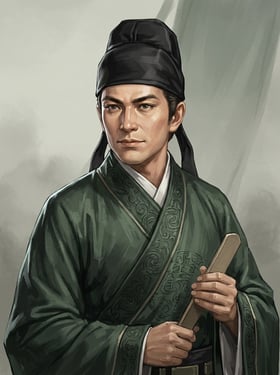
Historical Record
Guo Tu, styled Gongze, was a native of Yingchuan, from the same commandery as Xun Yu, Xin Ping, and others. Amid the turmoil at the end of the Han, he, together with Xun Yu's younger brother Xun Chen and with Xin Ping, went to take service under Yuan Shao, the Governor of Jizhou. c:6511 Yuan Shao gave them all important positions, and Guo Tu thus became a leading adviser within Yuan Shao's group. In the Battle of Guandu, Guo Tu played a key role. When Cao Cao led his army to attack the grain and fodder depot at Wuchao where Yuan Shao's stores were piled, Yuan Shao's general Zhang He advised immediately leading troops to relieve Wuchao, holding that Cao Cao's soldiers were elite and that once Wuchao fell, Yuan Shao's whole position would be lost. Guo Tu, however, took a different view. He held that Zhang He's plan was wrong, and argued that it would be better, while Cao Cao's main force had gone to Wuchao, to concentrate troops to attack Cao Cao's main camp; in that case Cao Cao would be bound to turn back to relieve it, and the siege of Wuchao would lift of itself without needing to be relieved. c:3901 Zhang He opposed this, pointing out that Cao Cao's camp was strong and hard to take, and that if Wuchao were broken by Cao Cao, they would all become captives. Yuan Shao in the end adopted Guo Tu's advice, dispatching only light cavalry to relieve Wuchao while sending his heavy troops to attack Cao Cao's main camp—which they failed to take. Cao Cao did indeed break Wuchao, and Yuan Shao's army was thereby routed. After the battle, Guo Tu, feeling ashamed and wishing to shift the blame, turned to slander Zhang He before Yuan Shao, claiming that Zhang He was pleased at the defeat and had spoken insolently. Zhang He, taking fright at this, in the end surrendered to Cao Cao. c:3901
In the Novel
In Romance of the Three Kingdoms, Guo Tu is shaped into an adviser skilled at framing others and narrow of mind, his words and deeds often forming a sharp contrast with the upright Tian Feng, Ju Shou, and the like. On his first appearance, in Yuan Shao's camp he actively advocated raising troops to campaign against Cao Cao, refuting the cautious counsel of Tian Feng and Ju Shou and arguing that attacking Cao was an action "in a just cause and with right on its side." c:6512 During the standoff between Yuan Shao and Cao Cao, Guo Tu advised many times, not a few of his words being stratagems to sow division. For example, after Guan Yu slew Wen Chou, Guo Tu, together with Shen Pei, slandered before Yuan Shao, claiming that Liu Bei "feigned ignorance," intending to enrage Yuan Shao and make him suspect Liu Bei. c:3902 When Liu Bei was sent by Yuan Shao to win over Liu Pi, Guo Tu again remonstrated with Yuan Shao, holding that Liu Bei would surely not return on this errand, and expressed concern that Jian Yong was going with Liu Bei, arguing that Liu Bei would surely not come back from this journey. c:14955
At the Battle of Guandu, Guo Tu's framing nature once more showed itself fully. When the grain and fodder at Wuchao were attacked, Zhang He advised relieving Wuchao, but Guo Tu strongly advocated "besieging Wei to rescue Zhao," attacking Cao Cao's main camp. His reasoning was that since Cao Cao had gone to seize the grain, his main camp must be empty. c:6514 Yuan Shao believed Guo Tu's advice and dispatched Zhang He and Gao Lan to attack Cao Cao's camp, with the result that they were greatly defeated. To avoid blame, Guo Tu slandered Zhang He and Gao Lan before Yuan Shao, claiming that they "had long harbored intentions of surrendering to Cao, and now, sent to attack the camp, deliberately refused to exert themselves," leading the two in the end to surrender to Cao Cao. c:3903
After Yuan Shao died, Guo Tu continued to play the role of stirring up division in the struggle for power among the Yuan brothers. He, together with Xin Ping, assisted Yuan Tan, forming an opposition to Shen Pei and Feng Ji, who assisted Yuan Shang. c:3905 He once advised Yuan Tan to feign inviting Yuan Shang to drink and then to set an ambush and kill him. c:14968 When Yuan Tan was besieged by Yuan Shang at Pingyuan, Guo Tu again offered the plan of having Yuan Tan surrender to Cao Cao, using Cao Cao's strength to attack Yuan Shang, and then, after Cao Cao had defeated Yuan Shang, scheming for Jizhou. c:14969 He even advised Yuan Tan to bribe Lü Kuang and Lü Xiang as inside agents, and, after Cao Cao broke Yuan Shang, to seize the chance to scheme against Cao Cao. c:14971 In the end, at the Battle of Nanpi, Guo Tu advised Yuan Tan to drive the common people in front and place the army behind, fighting Cao Cao to the death. c:3907 This plan led to countless deaths and injuries among the people, and Yuan Tan too was slain by Cao Hong. Seeing that the situation was lost, Guo Tu fled hastily into the city, only to be shot dead in the moat by Yue Jin. c:3908
Key Relationships
* Yuan Shao's Faction (serves): Guo Tu was a leading adviser in Yuan Shao's camp and deeply trusted by Yuan Shao, who, especially in Romance of the Three Kingdoms, often believed his slanderous words. c:6514
* Zhang He (rival_of): At the Battle of Guandu, Guo Tu and Zhang He differed over military strategy, and in the end Guo Tu framed Zhang He, causing him to surrender to Cao Cao. c:3901
* Yuan Shao (advises_in): Guo Tu offered counsel to Yuan Shao many times—whether the strategy of attacking Cao, the military dispositions at the Battle of Wuchao, or the handling of figures such as Liu Bei and Zhang He—and Yuan Shao adopted his advice. c:6512
* Gao Lan (betrayed_by): Together with Zhang He, Gao Lan too was forced to surrender to Cao Cao because of Guo Tu's framing. c:3903 (novel only)
* Tian Feng, Ju Shou (rival_of): In Romance of the Three Kingdoms, Guo Tu's aggressive advocacy often stands opposed to the cautious counsel of Tian Feng and Ju Shou, throwing into relief his bellicose and short-sighted character. c:6512
* Yuan Tan, Yuan Shang (advises_in): After Yuan Shao died, Guo Tu assisted Yuan Tan and actively took part in the internal strife among the Yuan brothers, scheming on Yuan Tan's behalf, including sowing division between the brothers and borrowing Cao Cao's strength. c:3906
Iconic Scenes
* Framing Zhang He at the Battle of Guandu: At the crucial moment of the Battle of Guandu, Guo Tu and Zhang He differed over the relief of Wuchao. Guo Tu strongly advocated attacking Cao Cao's main camp rather than relieving Wuchao, leading to the great defeat of Yuan Shao's army. After the battle, to shift the blame, he turned to slander Zhang He, claiming that he was "pleased at the defeat and spoke insolently," directly causing Zhang He to surrender to Cao Cao and becoming an important turning point in the collapse of Yuan Shao's group. c:3901
* Advising Yuan Tan in the struggle for power among the Yuan brothers: After Yuan Shao died, Guo Tu assisted Yuan Tan and actively took part in the internal strife of the Yuan brothers. He once advised Yuan Tan to surrender to Cao Cao, using Cao Cao's strength to attack Yuan Shang, and planned, after Cao Cao defeated Yuan Shang, to scheme for Jizhou—displaying his fickle and opportunistic character. c:14969
* Driving the people to attack the city at the Battle of Nanpi: At the Battle of Nanpi, Guo Tu offered Yuan Tan a vicious plan, advising him to "drive all the people in front and follow with the army behind, fighting Cao Cao to the death." c:3907 This caused countless innocent people to lose their lives, and in the end Yuan Tan was defeated and killed, while Guo Tu himself met his death beneath Yue Jin's arrow. c:3908 (novel only) This scene profoundly shapes the image of Guo Tu as sinister, vicious, and unscrupulous.
Portrait file
Character profile
- Character
- Guo Tu was skilled at framing others to escape blame, full of schemes and adept at sowing discord, and made a habit of dark stratagems. He upheld the primacy of the eldest legitimate heir and understood the currents of the times.
- Life
- Guo Tu was a native of Yingchuan. He was once sent by Yuan Shao to Hedong to receive the Son of Heaven, yet later advised Shao not to welcome the emperor. At the Battle of Guandu he, together with Shen Pei, argued for war. In the tenth year of Jian'an, when Cao Cao attacked Nanpi, Guo Tu was beheaded along with Yuan Tan.
- Anecdotes
- Guo Tu was an adviser to Yuan Shao, and later assisted Yuan Tan. He joined Chunyu Qiong and Yan Liang in attacking Baima; at the Battle of Guandu he strongly urged an assault on Cao Cao's camp, and slandered Zhang He so as to drive him to surrender to Cao Cao. He advised Yuan Shao to join with Liu Bei against Cao Cao, and proposed allying with Sun Ce to attack Cao Cao together.
Relationships
7 relationships
Quotes
23 recorded lines · 3 featured
「不可。曹軍劫糧,曹操必然親往;操既自出,寨必虛空,可縱兵先擊曹操之寨;操聞之,必速還。此孫臏『圍魏救趙』之計也。」
Although this stratagem was not adopted, it demonstrates Guo Tu's military cunning.
「二人素有降曹之意,今遣擊寨,故意不肯用力,以致損折士卒。」
These words are ironclad proof that Guo Tu framed Zhang He and Gao Lan, revealing his sinister side.
「今城中糧少,彼軍方銳,勢不相敵。愚意可遣人投降曹操,使操將兵攻冀州,尚必還救。將軍引兵夾擊之,尚可擒矣。若操擊破尚軍,我因而斂其軍實以拒操。操軍遠來,糧食不繼,必自退去;我可以仍據冀州,以圖進取也。」
This stratagem shows Guo Tu's scheming and his read of the situation—vicious, but effective.
Chapters10 回 ▸
- 史ch.10ch.17
- 演ch.22ch.26ch.27ch.28ch.30ch.31ch.32ch.33
Relationship timeline6 条 ▸
Inner monologues · AI-generated3 段 ▸
- After the fires of Guandu had died down, the Yuan brothers turned against each other, and my own path, Guo Tu’s, came to
- I am Guo Tu, courtesy name Gongze. In my youth, Xin Ping, Yuan Chen, and I were all employed by the Yuan clan. At the ti
- I am Guo Tu, courtesy name Gongze, from Jizhou. Even in my youth, I saw that the realm was no longer at peace. Though th
Life events3 ▸
- 0202-01-01 · YeDeath of Yuan Shao and the Succession Struggle among the Yuan Clan· Advisor
- 0205-01-01 · NanpiBattle of Nanpi· Killed in action
- 0207-01-01 · Yi PrefectureCao Cao Defeats the Yuan Clan· Advisor