Eastern Wu · General of the Rear, with Acting Authority of the Imperial Staff, Governor of Xu Province
He Qi
courtesy name 公苗 · –227
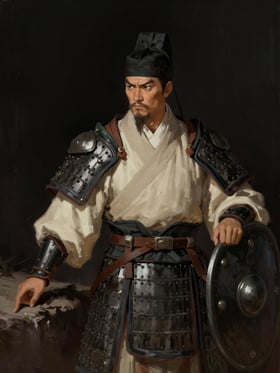
He Qi, courtesy name Gongmiao, was an Eastern Wu general famed for pacifying the Shanyue, developing Xindu, and quelling rebellions.
Life
History 5 vols.
- Eastern Wu· Undated
On the boards
Where this person ranks on each board.
Historical Record
He Qi, courtesy name Gongmiao, was from Shanyin in Kuaiji. In his youth, he served as a commandery clerk and once acted as magistrate of Shan County. When dealing with the county clerk Si Cong, he showed no regard for the power of Si Cong’s prominent clan. After executing Si Cong, he faced an attack on the county seat by more than a thousand members of the clan. He led the clerks and commoners in opening the gates and launching a sortie, defeating them. He later held a succession of local posts and took part in suppressing the forces of Shang Sheng, Zhang Ya, Zhan Qiang, and others. Through his reputation and strategic skill, he gradually secured Kuaiji and the surrounding areas. In the first year of Jian’an, Sun Ce recommended him as a xiaolian. He later put down rebellions by means of proclamations, sowing discord, and advancing troops, revealing a resolute character and an ability to judge situations.
In the eighth year of Jian’an, Jian’an, Hanxing, and Nanping again fell into turmoil. He Qi advanced into Jian’an and established a commandant’s headquarters to coordinate the troops of the counties. Ding Fan, magistrate of Songyang, refused orders to remain at Yuhan. He Qi had him beheaded, and the army was consequently cowed into obedience. He then successively defeated the forces of Hong Ming and others, beheaded six thousand, and captured or won the surrender of their leaders, earning appointment as Colonel Who Pacifies the East. In the tenth year of Jian’an, he campaigned against Shangrao and divided it off to establish Jianping County. That same year, while campaigning against the You bandits, he also fought alongside Jiang Qin.
In the thirteenth year of Jian’an, He Qi campaigned against the Shanyue of Yi and She. The enemy held Linlishan, whose steep terrain made it difficult to attack. He secretly recruited agile troops to climb the mountain at night, then had drums and horns sounded from all sides to give the impression that a large army had reached the summit, throwing the defenders into confusion. Seizing the moment, he broke the forces of Chen Pu and others and beheaded seven thousand. Yi, She, and other areas were subsequently made into Xindu Commandery, with He Qi as its administrator and the seat of government at Shixin. He later suppressed rebellions by Lang Zhi of Yuhang and Peng Cai in eastern Yuzhang, among others, and was promoted for his military achievements.
When Sun Quan campaigned against Hefei, He Qi rescued Xu Sheng, who was wounded and had lost his spear. He later joined Lu Xun in defeating You Tu and pacifying three counties of Danyang, for which he was enfeoffed as Marquis of Shanyin and appointed General Who Pacifies the East. In the early Huangwu era, when Wei forces invaded, He Qi led a detached force to garrison Xinshi. Because he had not yet crossed the river, his troops escaped the storm at Dongkou. He became a force on which the Wu army could rely, and was subsequently transferred to the post of General of the Rear and appointed acting Shepherd of Xu Province. Later, Sun Quan ordered him and Hu Zong to launch a surprise attack on Jin Zong, who had defected to Wei. He Qi and the others caught Jin Zong off guard and took him alive.
In the Novel
The Romance materials provided contain no fictional episodes featuring He Qi, so they do not support a description of his appearances, words, deeds, or literary portrayal in Romance of the Three Kingdoms. The events in this biography are all drawn from the Records of the Three Kingdoms and Pei Songzhi’s annotations.
Key Relationships
He Qi served Eastern Wu. Sun Ce recommended him as a xiaolian, while after He Qi had pacified Lang Zhi, Sun Quan personally saw him off, presented him with a carriage and horses, and encouraged the officers and troops with the words “accumulated conduct and repeated diligence.” These accounts show both his longstanding ties to the Eastern Wu regime and Sun Quan’s regard for his military achievements. In military cooperation, he joined Jiang Qin in campaigning against the You bandits, combined forces with Lu Xun to pacify You Tu, and later carried out a swift surprise attack with Hu Zong to capture Jin Zong. His opponents and the rebels he faced included Si Cong’s clan, Shanyue groups under Hong Ming and others, the commanders of Yi and She, and figures such as You Tu and Jin Zong. The accounts portray He Qi as using both forceful suppression and strategies such as persuasion, ambush, and diversionary tactics.
Signature Scenes
Sortie through the open gates: After Si Cong was executed, more than a thousand members of his clan gathered to attack the county seat. He Qi led the clerks and commoners in opening the gates and striking out, routing the attackers and making his reputation feared among the Shanyue. This episode establishes his image as a decisive official who dared to counterattack local powerholders in the midst of battle.
Night ascent of Linlishan: Chen Pu and other commanders of Yi held a strong position in steep mountain terrain, frustrating a direct assault. He Qi ordered agile troops to slip up the mountain at night, then had drums and horns sounded from all sides so that the defenders would think Wu troops had reached the summit everywhere. Once the enemy ranks were thrown into disarray, the main force climbed up and won the battle. This episode exemplifies his way of reading the terrain, creating a false impression, and seizing the moment.
A detached force spared by the storm at Dongkou: In the early Huangwu era, the fleets at Dongkou were scattered and sunk by a storm. He Qi’s force alone remained intact because it had not yet crossed the river. Other commanders consequently relied on his troops, and Cao Xiu and the others eventually withdrew. The account highlights his role in preserving his forces amid a sudden turn in the battle and becoming a mainstay of the Wu army.
Surprise attack and capture of Jin Zong: After Jin Zong defected from Wu to Wei, he became administrator of Qichun. While the troops had only just been demobilized and it was midsummer, Sun Quan ordered a surprise attack. He Qi led the troops alongside Hu Zong in a swift raid, ultimately capturing Jin Zong alive. The episode shows how effectively he took advantage of the enemy’s lax vigilance.
- Family
- Lord & vassal
- Enemies
- Other

Continue
He Jing
Sibling
Relationship timeline3 entries ▸
History · vol. 60
- Xu Sheng§8
Fights
In the Battle of Hefei, led troops to repel the attack and recovered the spear Xu Sheng had lost
- Lu Xun§9
Fights
Joined Lu Xun in campaigning against and defeating You Tu, beheading several thousand
- Cao Xiu§10
Enemy
At the beginning of Huangwu, resisted Cao Xiu at Xinshi; his detached force alone remained intact, and Xiu and the others feared him and withdrew their troops