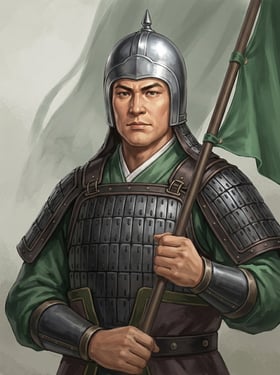
Historical Record
Xu Sheng, styled Wenxiang, was a man of Ju in Langya. Amid the upheaval at the end of the Eastern Han, he sojourned in the Wu region, where he became known for his valor. After Sun Quan took charge of the affairs of Jiangdong, he appointed Xu Sheng as a Separate Commander, allotted him five hundred troops, and ordered him to garrison Chaisang and resist Huang Zu. Huang Zu's son Huang She once led several thousand men to attack Chaisang, while at the time Xu Sheng had fewer than two hundred soldiers under him. Though the forces were vastly unequal, Xu Sheng still stubbornly resisted the enemy and wounded more than a thousand of Huang She's men. He then opened the city and sallied out to battle, routing the enemy and causing Huang She never to dare invade again c:2003.
For his military merit, Sun Quan appointed Xu Sheng as Colonel and Magistrate of Wuhu. He once again sent out troops to campaign against the Nan'a Mountain rebels of Lincheng, and for the merit thus gained was promoted to General of the Household and put in charge of overseeing the inspection of troops c:2003. In his early dealings with Jiang Qin, Xu Sheng once arrested Jiang Qin's garrison clerk over official business and memorialized to request his execution, but Sun Quan, because Jiang Qin was campaigning abroad, did not grant it. This made Xu Sheng for a time fear that Jiang Qin would bear him a grudge. However, when Cao Cao sent troops to Ruxu and Jiang Qin together with Lü Meng jointly commanded the various armies, Jiang Qin, far from taking the chance to retaliate, instead repeatedly praised Xu Sheng's merits. Xu Sheng was therefore won over heart and soul, and commentators of the time praised the matter greatly c:2002.
Later, Xu Sheng was promoted to General Who Establishes Martial Power, enfeoffed as Marquis of a Capital Precinct, concurrently made Administrator of Lujiang, and granted Lincheng County as his fief. When Liu Bei advanced into Xiling, Xu Sheng led troops to take several of Liu Bei's encampments, achieving merit wherever he went. When Cao Xiu sent troops to Dongkou, Xu Sheng together with Lü Fan and Quan Cong crossed the river to meet him in battle. In a battle that met with a great wind, many ships and men were heavily lost; Xu Sheng gathered the remaining troops and confronted Cao Xiu across the river. Cao Xiu once sent troops in boats to attack Xu Sheng, but Xu Sheng, with the few against the many, successfully resisted the enemy's assault, and the two sides then each withdrew their troops. After this, Xu Sheng was promoted to General Who Pacifies the East and enfeoffed as Marquis of Wuhu c:5466.
When Sun Quan declared himself a vassal of Cao Wei and the Wei envoy Xing Zhen came to invest Sun Quan as King of Wu, Sun Quan received Xing Zhen at a capital precinct pavilion. Xing Zhen's manner was arrogant; Zhang Zhao was angered by it, and Xu Sheng was even more filled with righteous indignation. He turned to his colleagues and said: "That we cannot exert ourselves to the utmost for the state, to annex Xu and Luo and swallow up Ba and Shu, but instead make our lord ally with Xing Zhen—is this not a disgrace!" And as he spoke, his tears flowed freely. When Xing Zhen heard of this, he said to his attendants: "When the generals and ministers of Jiangdong are like this, they will not long remain under another's command." c:10972
In the Novel
In Romance of the Three Kingdoms, Xu Sheng's image is further enriched; as a valiant general of Eastern Wu, he took part in many major battles. At his first appearance he is listed among the able generals Sun Quan recruited after broadly gathering worthies, who together with Lü Meng, Lu Xun, Pan Zhang, Ding Feng, and others assisted Sun Quan, making Jiangdong abound in talent c:5467.
After the Battle of Red Cliffs, when Zhou Yu schemed to kill Zhuge Liang, Xu Sheng together with Ding Feng was ordered to pursue him. As Zhuge Liang departed by boat, Xu Sheng called out loudly from the prow trying to detain him, but Zhuge Liang had long foreseen Zhou Yu's intent and had Zhao Yun receive him and leave, so Xu Sheng failed to succeed c:2004. When Zhou Yu wished to take Nan Commandery, Xu Sheng and Ding Feng were appointed deputy generals to Jiang Qin, leading five thousand crack troops to cross the river first c:5468.
After Liu Bei borrowed Jing Province, Zhou Yu set up the "beautiful-woman stratagem," wishing to trap Liu Bei in Eastern Wu. When Liu Bei fled with Lady Sun, Xu Sheng and Ding Feng, on Zhou Yu's orders, set an ambush at the boundary of Chaisang to intercept them. They sternly ordered Liu Bei to dismount and be bound, but Lady Sun came forward to rebuke them and, invoking the name of Sun Quan and the Dowager, overawed Xu Sheng and Ding Feng, so that they dared not block the way and had to let them pass c:10955, c:10956. Then Chen Wu and Pan Zhang arrived and joined Xu Sheng and Ding Feng in pursuit, but were again driven back by Lady Sun's rebuke c:10959.
When Zhou Yu wished to take Jing Province, Xu Sheng and Ding Feng went on campaign as the second echelon, intending to recover Jing Province c:2005. In the attack on Wan, Xu Sheng once proposed raising scaling ladders and building rainbow bridges to assault the city, but Lü Meng held that this method would take too long, and in the end Lü Meng's plan of a swift assault was adopted c:10960. At the Battle of Ruxukou, facing Cao Cao's five great armies, Xu Sheng displayed dauntless courage: he led several hundred fierce warriors in small boats across the river and charged into Li Dian's army, dashing back and forth, valiant beyond compare c:10961.
After Guan Yu carelessly lost Jing Province, Xu Sheng together with Ding Feng, Jiang Qin, Han Dang, Zhou Tai, and other generals besieged Guan Yu, finally driving Guan Yu in defeat to Maicheng c:2006. After Sun Quan declared himself king, when the Wei envoy Xing Zhen came to invest him, Xu Sheng again showed his indignation at the state's disgrace, weeping aloud and holding it a great shame that they had failed to annex Wei and swallow up Shu; this episode accords closely with the historical record c:2007.
In the Battle of Xiaoting, Lu Xun was appointed Grand Commander, and Xu Sheng together with Ding Feng accompanied the army as escorts. At first, the generals were unconvinced by Lu Xun's youth, but Lu Xun gradually won them over by his stratagems. When the Shu general Wu Ban came to challenge and hurl abuse, Xu Sheng and Ding Feng requested to sally out, but Lu Xun saw through the Shu army's lure-the-enemy scheme and successfully used a fire attack to rout the Shu army c:2008, c:2009, c:10965.
When Emperor Wen of Wei, Cao Pi, personally led a great army to campaign against Wu, Xu Sheng volunteered for the task and was appointed General Who Pacifies the East, in overall command of the troops and horses of Jianye and Nanxu. He used the stratagem of binding reeds into figures, setting up false cities stretching for several hundred li along the river, with banners planted thick atop the city towers, creating the illusion of a mighty host of Wu troops, successfully overawing Cao Pi so that he dared not cross the river c:5469, c:2011. During this time, Sun Shao once wished to cross the river to meet the enemy on his own, disobeying orders, and Xu Sheng wished to behead him to enforce military law, but desisted only after Sun Quan interceded c:10967, c:2010.
Key Relationships
* Sun Quan: Xu Sheng was an important general under Sun Quan, loyal and devoted, repeatedly achieving merit and deeply esteemed by Sun Quan. Sun Quan once promoted him for his valor, and when friction arose between him and Jiang Qin over official business, deftly resolved it, displaying his trust in and protection of Xu Sheng c:2003, c:2002.
* Eastern Wu: Xu Sheng was a steadfast defender of the Eastern Wu regime, showing the highest loyalty and sense of responsibility in both resisting foreign foes and upholding the state's dignity. He once wept at the state's disgrace, and also defended Jiangdong with stratagem and valor c:10972, c:2011.
* Jiang Qin: In the early period, Xu Sheng and Jiang Qin had friction over official business, and Xu Sheng even feared Jiang Qin would retaliate. However, Jiang Qin repaid resentment with virtue and instead praised Xu Sheng, so that Xu Sheng was won over heart and soul; this episode became a fine tale in the histories c:2002.
* Lu Xun: In the Battle of Xiaoting, Xu Sheng, as a subordinate of Lu Xun, though at first doubtful of Lu Xun's youth, was finally won over by Lu Xun's stratagems and obeyed his command, together defeating the great army of Shu Han c:2008, c:2009.
* Ding Feng: In the novel, Xu Sheng and Ding Feng often acted together, jointly carrying out tasks such as pursuing Zhuge Liang, intercepting Liu Bei, and taking part in the Battle of Xiaoting; the two were comrades fighting side by side c:2004, c:10955, c:2008.
* Sun Shao: In the novel, Sun Shao is Sun Quan's nephew; he once disobeyed Xu Sheng's orders, wishing to cross the river to meet the enemy on his own, and Xu Sheng wished to behead him to enforce military law, embodying Xu Sheng's character of strict enforcement of the law c:10967, c:2010 (novel-only).
Signature Scenes
* Resisting Huang Zu at Chaisang: Xu Sheng, with fewer than two hundred troops, routed the several thousand men of Huang Zu's son Huang She and made him never dare invade again, displaying his surpassing courage and military talent c:2003.
* Resolving the friction with Jiang Qin: Xu Sheng once offended Jiang Qin over official business, but Jiang Qin repaid resentment with virtue and instead praised Xu Sheng, so that Xu Sheng was won over completely—a fine tale embodying Xu Sheng's uprightness and Jiang Qin's broad-mindedness c:2002.
* Bitterly rebuking the Wei envoy Xing Zhen: When the Wei envoy Xing Zhen arrogantly and rudely invested Sun Quan as King of Wu, Xu Sheng was filled with righteous indignation and wept openly, holding it a disgrace to the state, displaying his strong defense of the state's dignity c:10972, c:2007.
* Charging Li Dian's ranks at Ruxukou: In the Battle of Ruxukou, facing Cao Cao's five great armies, Xu Sheng led several hundred fierce warriors across the river and charged into Li Dian's army, dashing back and forth, valiant and dauntless, striking fear into the enemy c:10961 (novel-only).
* Repelling Cao Pi with false cities: When Cao Pi's great army bore down, Xu Sheng cleverly used the stratagem of binding reeds into figures, setting up false cities stretching for several hundred li along the river, creating the illusion of a mighty host, successfully overawing Cao Pi so that he dared not cross the river, and defending Jiangdong c:2011, c:5469 (novel-only).
* Escorting Lu Xun in the Battle of Xiaoting: As Lu Xun's escort, Xu Sheng took part in the Battle of Xiaoting and obeyed Lu Xun's command, together defeating the great army of Shu Han and witnessing Lu Xun's military talent c:2008, c:2009 (novel-only).
Portrait file
Character profile
- Character
- Xu Sheng was calm and strategic in character, strict and impartial in enforcing the law without yielding to private favor. He once reproached himself for failing to throw himself body and life into his lord's cause of absorbing Wei and swallowing Shu, showing his loyalty and aspiration toward his lord.
- Life
- Xu Sheng once volunteered to command the army in resisting Wei, and would not permit Sun Shao to cross the river to meet the enemy. In the night he set up bundled reeds as figures with green garments and banners, and along several hundred li of the river "raised a chain of fortresses in a single night," startling Cao Pi into retreat. He then routed the Wei troops, won great merit in full, and received abundant rewards.
- Anecdotes
- Xu Sheng once served as Colonel of the Army Protectorate and Prefect of Wuhu of Eastern Wu, rising to General Who Establishes Valor, General Who Pacifies the East, and Marquis of Wuhu. He once joined Ding Feng in pursuing Zhuge Liang, and on Zhou Yu's orders laid an ambush to intercept Liu Bei and rescued the arrow-struck Zhou Yu. He was also a commanding general under Lu Xun, followed Lü Meng in the seizure of Jing Province, and together with Ding Feng encircled Guan Yu.
Relationships
12 relationships
Quotes
20 recorded lines · 3 featured
「食君之祿,忠君之事,何懼哉?」
This line embodies Xu Sheng's loyalty and sense of responsibility as a general, and has circulated widely.
「臣雖不才,願統一軍以當魏兵。若曹丕親渡大江,臣必生擒,以獻殿下;若不渡江,亦殺魏兵大半,令魏兵不敢正視東吳。」
This line displays Xu Sheng's military talent and heroic spirit, one of his finest moments.
「法非臣所立,亦非大王所立,乃國家之典刑也。若以親而免之,何以令眾乎?」
This line stresses the gravity of military discipline, embodying Xu Sheng's adherence to principle.
Chapters14 回 ▸
- 史ch.55
- 演ch.38ch.49ch.51ch.55ch.56ch.67ch.68ch.76ch.82ch.83ch.84ch.86ch.96
Relationship timeline10 条 ▸
Inner monologues · AI-generated3 段 ▸
- The river wind swept past the camp tents. I, Xu Sheng, courtesy name Wenxiang, look back now on my life. What has remain
- I am Xu Sheng, courtesy name Wenxiang. Whenever I think of my early days as a guest in Jiangdong, when I first earned a
- Whenever I think back to my early years, I often recall how, once Jiangdong had first been pacified, scholars and milita
Life events5 ▸
- 0208-01-01 · JianglingBattle of Jiangling· Warrior
- 0217-01-01 · RuxukouBattle of Ruxu (217)· Warrior
- 0221-01-01 · JianyeSun Quan Invested as King of Wu· Witness
- 0222-01-01 · GuanglingCao Pi's Guangling Campaign· Commander
- 0224-01-01 · JianyeXu Sheng Builds Phantom Walls to Repel Cao Pi· Commander