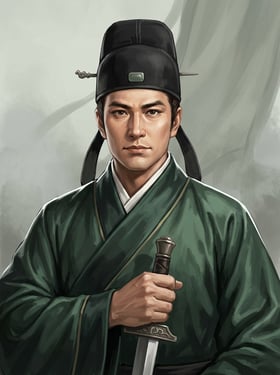
Historical Record
Zhou Fang, courtesy name Ziyu, was a native of Yangxian in Wu Commandery. In his youth he was fond of learning and was once recommended as a Filial and Incorrupt candidate, serving as Chief of Ningguo and later transferring to Huai'an. During his tenure, the great chieftain Peng Shi and others in the Qiantang region gathered followers and turned to banditry, and Zhou Fang was appointed Chancellor of the Marquisate of Qiantang. Within a single month, he had slain Peng Shi and his confederates, and was therefore promoted to Commandant of the Western Division of Danyang. During the Huangwu era, the great chieftain Peng Qi of Poyang rose in revolt and overran the subordinate towns. Sun Quan thereupon appointed Zhou Fang as Grand Administrator of Poyang; he and Hu Zong worked together to attack the rebels, finally capturing Peng Qi alive and sending him to Wuchang, for which Zhou Fang was promoted to Colonel Who Manifests Righteousness.
Thereafter, Zhou Fang was charged with secretly seeking out, among the old clans and notable chieftains of the mountains, those known to the northern enemy, so as to carry out a scheme to lure the Wei Grand Marshal and Governor of Yangzhou, Cao Xiu. Zhou Fang replied that he feared these petty chieftains of the common people were not to be relied upon, and that once the matter leaked out, it would be impossible to draw Cao Xiu in. He requested that a trusted man be sent carrying seven letters to deceive Cao Xiu. These seven letters set out in detail his reasons and plans for "betraying" Eastern Wu, including expressing dissatisfaction with Eastern Wu, longing for Cao Wei, and anxiety over his own situation. He even cut his hair to show his resolve (the histories do not explicitly mention the cutting of hair, but his ruse to lure the enemy included acts of going to great lengths to win the other's trust), and laid out in detail the route of the Wei army's advance and the disposition of Eastern Wu's forces, intending to make Cao Xiu wholly believe him. In the end, Cao Xiu indeed believed Zhou Fang and led a hundred thousand foot and horse, baggage trains filling the roads, straight into the Wan region. Zhou Fang too gathered his forces and, together with Lu Xun, intercepted Cao Xiu, routing Cao Xiu's great army and inflicting tens of thousands of casualties.
In the Novel
In the Romance of the Three Kingdoms, Zhou Fang's appearance is closely tied to his feigned-surrender scheme. In the novel, the Yangzhou Major and Grand Commander Cao Xiu submitted a memorial to Emperor Ming of Wei, Cao Rui, stating that the Eastern Wu Grand Administrator of Poyang, Zhou Fang, wished to surrender his commandery, and secretly presented seven matters, declaring that Eastern Wu could be broken and requesting that troops be dispatched. After Emperor Ming consulted with Sima Yi, Sima Yi judged the plan workable, but the General Who Establishes Might, Jia Kui, raised an objection, holding that Zhou Fang was a man of stratagem and that this was a ruse to lure the enemy. Nonetheless, Emperor Ming still sent Sima Yi together with Jia Kui to assist Cao Xiu, and dispatched three armies to advance.
When Cao Xiu's troops arrived before Wan, Zhou Fang came forth to welcome him. Cao Xiu still harbored doubts about his feigned surrender, and to win Cao Xiu's trust Zhou Fang actually wept aloud and drew his sword to cut his own throat, declaring that his loyalty was as clear as the sun and moon. Cao Xiu hastily stopped him, whereupon Zhou Fang cut his hair with the sword and threw it to the ground to show his heart. Cao Xiu was thereby wholly convinced and held a banquet to entertain him. Jia Kui again advised, pointing out that an oath sworn by cutting one's hair could not be lightly trusted, and warning Cao Xiu not to advance rashly. However, Cao Xiu flew into a rage, believing Jia Kui was obstructing his achievement, and wished to behead him; only after the generals pleaded was he spared death, but Jia Kui's military authority was stripped. When Zhou Fang learned that Jia Kui's command had been stripped, he secretly rejoiced, believing Heaven was aiding his success, and immediately sent a secret report to Lu Xun. Lu Xun thereupon set an ambush at Shiting to await the Wei army. Under Zhou Fang's guidance, Cao Xiu marched his entire army and baggage train to Shiting. The next day, when Cao Xiu discovered that the Wu army was prepared, he realized in alarm that he had fallen for the scheme, and Zhou Fang had already vanished. In the end, Cao Xiu was crushingly defeated by the Wu army at Shiting, suffering heavy losses. The novel's portrayal of Zhou Fang emphasizes his stratagem and daring, using dramatic episodes such as cutting his hair and feigning suicide to strengthen the realism of his feigned surrender and the cleverness of his scheme.
Key Relationships
* Eastern Wu (serves): Zhou Fang was an important general of Eastern Wu, devotedly loyal and of illustrious battle merit. He pacified the rebellions at Qiantang and Poyang, and with his outstanding stratagem successfully lured Cao Xiu, winning Eastern Wu the victory at the Battle of Shiting.
* Cao Xiu (enemy_of): Cao Xiu was the chief target of Zhou Fang's feigned-surrender scheme. Through carefully crafted seven letters and a series of deceptions, Zhou Fang successfully deluded Cao Xiu into wholehearted belief, ultimately leading to Cao Xiu's crushing defeat at Shiting.
* Lu Xun (fights_in): Lu Xun was the collaborator and final executor of Zhou Fang's feigned-surrender scheme. After successfully luring Cao Xiu, Zhou Fang relayed the intelligence to Lu Xun in time, enabling Lu Xun to set an ambush at Shiting and, striking from within and without with Zhou Fang, to rout Cao Xiu.
* Jia Kui (doubter; novel only): In the novel, Jia Kui was the only Wei general to see through Zhou Fang's feigned-surrender scheme. He repeatedly advised Cao Xiu, pointing out the falseness of the hair-cutting oath, but was not heeded and instead had his military authority stripped by Cao Xiu for it.
Signature Scenes
* Pacifying the Poyang rebellion: After being appointed Grand Administrator of Poyang, Zhou Fang worked in concert with Hu Zong to successfully capture the rebel chieftain Peng Qi alive and pacify the rebellion in the Poyang region, displaying his outstanding military talent and administrative ability.
* Luring Cao Xiu with seven letters: To lure in Cao Xiu, Zhou Fang carefully composed seven letters, setting out in detail his reasons and plans for "betraying" Eastern Wu, and sent a trusted man to deliver them to Cao Xiu. These detailed and seemingly heartfelt letters finally dispelled Cao Xiu's doubts and won his wholehearted belief, laying the foundation for the victory at the Battle of Shiting.
* Cutting his hair to win trust (novel only): In the Romance of the Three Kingdoms, to further win Cao Xiu's trust, Zhou Fang went so far as to draw his sword to cut his own throat and to cut off his hair to show his loyalty. This dramatic act completely dispelled Cao Xiu's doubts and made him wholly believe in Zhou Fang's feigned surrender, becoming a signature scene of Zhou Fang's extraordinary stratagem.
* Crushing Cao Xiu at Shiting: After successfully luring in Cao Xiu, Zhou Fang, in coordination with Lu Xun within and without, set an ambush at Shiting and crushed Cao Xiu's hundred-thousand-strong army, inflicting tens of thousands of casualties. This was the most brilliant military achievement of Zhou Fang's life and the finest embodiment of his "richly cunning and full of surprising stratagems" character.
Portrait file
Character profile
- Character
- Zhou Fang was cunning in strategy and full of surprising devices, wielding authority and kindness alike. Skilled in ruses, he dared to stake his own person as part of the performance, once drawing his sword to feign cutting his own throat and shearing off his hair as an oath to win others' trust.
- Manner of speech
- His manner of speech took the form of self-sworn oaths, as in, 'My loyal heart—only Heaven can bear witness to it.'
- Life
- Zhou Fang, styled Ziyu, was a native of Yangxian in Wu Commandery.
- Anecdotes
- He served as Grand Administrator of Shenyang and Grand Administrator of Poyang. In the seventh year of Huangwu, he feigned rebellion to lure the Wei general Cao Xiu, secretly plotting a false surrender; he drew Cao Xiu to Wan, and when the plan succeeded he was enfeoffed as Marquis Within the Passes.
Relationships
2 relationships
Enemies1
Other1
Quotes
11 recorded lines · 3 featured
「吾以忠心待公,公以吾為戲,吾割父母所遺之髮,以表此心。」
This line shows the ruthlessness and resolve of Zhou Fang, who mutilated himself to win Cao Xiu's trust and prove his loyalty.
「曹休若用賈逵之言,則東吳敗矣!今天使我成功也!」
This line is the key to the success of Zhou Fang's feigned-surrender scheme, embodying his surpassing cunning.
魴以千載饒幸,得備州民,遠隔江川,敬恪未顯,瞻望雲景,天實為之。精誠微薄,名位不昭,雖懷焦渴,曷緣見明?狐死首丘,人情戀本,而逼所制,奉覿禮違。每獨矯首西顧,未嘗不寤寐勞歎,展轉反側也。今因隙穴之際,得陳宿昔之志,非神啟之,豈能致此!不勝翹企,萬里托命。謹遣親人董岑、邵南等托叛奉箋。時事變故,列於別紙,惟明公君侯垂日月之光,照遠民之趣,永令歸命者有所戴賴。
This is Zhou Fang's first letter feigning surrender to Cao Xiu, the beginning of his scheme, and it carries important historical significance.
Chapters2 回 ▸
- 史ch.60
- 演ch.96
Relationship timeline2 条 ▸
Inner monologues · AI-generated3 段 ▸
- I, Zhou Fang, styled —. Looking back now on the events at Shiting, what I remember most is not the outcome of the battle
- My courtesy name is Changxu. Now, steeling myself, I take up my brush to set out seven points to Cao Xiu; every word mus
- My courtesy name was Ziyu, and I was from Yangxian in Wu Commandery. As a young man, I loved learning. The words and dee
Life events3 ▸
- 0228-01-01 · ShitingZhou Fang's Feigned Surrender to Lure Cao Xiu· Instigator
- 0228-01-01 · WanDefeat of Cao Xiu at Wan· Instigator
- 0228-01-01 · ShitingBattle of Shiting· Instigator