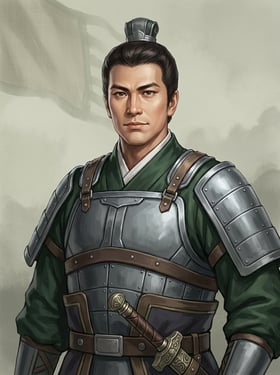
Historical Record
Quan Cong, styled Zihuang, was a native of Qiantang in Wu Commandery. His father Quan Rou had been recommended as Filial and Incorrupt in the time of Emperor Ling of Han, and later, amid the turmoil of Dong Zhuo's Coup, gave up his office and returned home; Sun Ce memorialized to make him Commandant of Danyang, and in Sun Quan's time he served as Chief Clerk and Grand Administrator of Guiyang. Quan Cong showed extraordinary character from an early age. Once Quan Rou ordered Quan Cong to transport several thousand hu of rice to the Wu region for trade, but on arriving Quan Cong distributed all the rice to the gentry then in urgent need and returned with an empty boat. Quan Rou, hearing of this, was furious, but Quan Cong bowed his head and explained: "I considered that what was on the market was not urgent, while the gentry were in the distress of being hung upside down; so I relieved them, and had no time to report first." Hearing this, Quan Rou instead marveled at his conduct. At that time, gentry of the Central Plains fleeing the chaos migrated south, and those who came to depend on Quan Cong numbered several hundred; Quan Cong exhausted his family wealth to relieve them, sharing all he had with them, and so his fame spread far c:60.
Sun Quan appointed Quan Cong Colonel Who Rouses Might, granting him several thousand troops and ordering him to campaign against the Shanyue. Through recruitment, Quan Cong obtained over ten thousand crack troops and garrisoned Niuzhu, gradually rising to General of the Auxiliary. In the first year of Huangwu (222 CE), the Wei state launched a great naval invasion at Dongkou; Sun Quan sent Lü Fan to command the various generals in resisting it. The enemy repeatedly raided with light boats, and Quan Cong constantly wore armor, weapon in hand, ever vigilant. Before long, several thousand of the enemy sallied out from the river, but Quan Cong crushed them and beheaded the enemy general Yin Lu. For this achievement Quan Cong was promoted to General Who Pacifies the South and advanced to Marquis of Qiantang. In the fourth year of Huangwu (225 CE), he received the staff of authority and was concurrently Grand Administrator of Jiujiang. In the seventh year of Huangwu (228 CE), Sun Quan came in person to Wan and ordered Quan Cong, together with the General Who Upholds the State Lu Xun, to defeat Cao Xiu at Shiting c:162.
At this time, the mountain people of the three commanderies of Danyang, Wu, and Kuaiji rose again in revolt and overran the subordinate counties. Sun Quan carved the strategic strongholds of the three commanderies into Dong'an Commandery and appointed Quan Cong its Grand Administrator. After taking up his post, Quan Cong was clear in reward and punishment and took in those who submitted, recruiting over ten thousand men within a few years. Sun Quan recalled Quan Cong to Niuzhu and abolished Dong'an Commandery. In the first year of Huanglong (229 CE), Quan Cong was promoted to General of the Guard, Protector of the Left Army, and Governor of Xu Province, and married a princess c:162. According to the Book of Wu, when Quan Cong first served as a general he was brave and decisive, throwing himself into the fray heedless of his own safety when facing the enemy; but once he became a commander, he cultivated dignity and gravity, and whenever he led troops he often relied on stratagem and did not contend for small gains c:162.
In the second year of Jiahe (233 CE), Quan Cong led fifty thousand foot and horse to campaign against Lu'an, and the people of Lu'an scattered at the news. The generals wished to divide their forces to capture them, but Quan Cong held: "To court fortune by exploiting danger, undertaking what is not wholly secure, is not the great principle of the state. To divide our forces now to seize the people would be half gain and half loss—how could that be called secure? Even if we captured some, it would still not be enough to weaken the enemy or live up to the nation's hopes. And should we meet with mishap, the loss would be no small thing. Rather than incur such guilt, I would bear it on my own person. I dare not court merit and so fail the state." c:7096 In the ninth year of Chiwu (246 CE), Quan Cong was promoted to Grand Marshal of the Right and Army Adviser of the Left c:7097. He was respectful and compliant by nature, good at reading faces and accepting remonstrance, and his words never came into fierce conflict with others. Sun Quan once planned to besiege Zhuya and Yizhou and beforehand asked Quan Cong's opinion. Quan Cong remonstrated: "With the might of the sacred court, where could we turn and not conquer? Yet these distant, alien regions, cut off beyond barriers and seas, with their poisonous climate and water, have been so since ancient times; when troops enter and the people come out, illness is bound to arise and spread by contagion, so that those who go fear they cannot return—and how much can we gain? To squander the troops of the riverbanks in hope of a one-in-ten-thousand profit is something this foolish subject cannot rest easy with." Sun Quan did not heed him, and the result was that eight or nine in ten of the expeditionary soldiers died of illness, and Sun Quan deeply regretted it. Later, when the matter was raised, Quan Cong replied: "At that time, there were ministers who did not remonstrate; I considered them disloyal." c:7097
In the Novel
In Romance of the Three Kingdoms, Quan Cong's image is chiefly that of a military commander, but his characterization and specific deeds are depicted relatively briefly and mostly tied to major battles. He first appears on the eve of the Battle of Shiting between Eastern Wu and Cao Wei. At that time, Zhou Fang's feigned surrender lured Cao Xiu deep into Wu territory, and Sun Quan gathered his ministers to deliberate. Lu Xun was appointed Grand General Who Upholds the State and Grand Marshal Who Pacifies the North, in command of the great army. Lu Xun recommended the General Who Rouses Might Zhu Huan and the General Who Pacifies the South Quan Cong as commanders of the left and right to meet the three-pronged Wei advance. Sun Quan adopted this advice, making Zhu Huan Commander of the Left and Quan Cong Commander of the Right c:4544.
In this battle, Zhu Huan offered Lu Xun a stratagem, advising that when Cao Xiu retreated in defeat, ambushes be laid at the two rugged mountain passes of Jiashi and Guiche, blocking the roads with timber and great stones to capture Cao Xiu. Lu Xun, however, considered this no good plan, saying "I have my own clever use," and did not adopt Zhu Huan's advice, so that Zhu Huan withdrew harboring resentment c:4544. The novel does not describe Quan Cong's specific performance in this battle in detail, mentioning only that he took part as Commander of the Right, which echoes the historical account of Quan Cong joining Lu Xun in defeating Cao Xiu, though the specifics differ.
Quan Cong's other appearance in the novel comes after Zhuge Liang's death. The Latter Lord Liu Shan received a frontier report that Eastern Wu's Quan Cong had garrisoned the border of Baqiu with tens of thousands of troops, his intentions unclear. Liu Shan was alarmed at this, fearing Eastern Wu would take the chance of the Chancellor's recent death to break the alliance and invade. Jiang Wan advised sending Wang Ping and Zhang Ni to garrison Yong'an against the unexpected, and dispatching someone to Eastern Wu to announce the death and probe its true intent. Zong Yu volunteered to go c:4545. Here the novel mentions Quan Cong garrisoning Baqiu with unclear intent, seemingly suggesting that Eastern Wu might have designs amid Shu Han's period of mourning; but the histories contain no clear record of Quan Cong garrisoning Baqiu after Zhuge Liang's death—this is more the novel's literary invention to create tension and introduce Zong Yu's mission.
Key Relationships
* Eastern Wu (serves): Quan Cong served the Eastern Wu polity all his life and was an important general and minister under Sun Quan. He followed Sun Quan from early on, repeatedly winning distinction, rising to Grand Marshal of the Right and Army Adviser of the Left and marrying a princess, becoming one of the core figures of the Eastern Wu polity c:4542.
* Lu Xun (fights_in): In history, Quan Cong joined Lu Xun in defeating Cao Xiu at Shiting c:162. In the novel, Lu Xun is the supreme commander at the Battle of Shiting, while Quan Cong is appointed Commander of the Right and takes part in the battle under Lu Xun c:4544.
* Cao Xiu (enemy_of): As an Eastern Wu general, Quan Cong was in opposition to the Cao Wei general Cao Xiu. The histories record that Quan Cong and Lu Xun routed Cao Xiu at Shiting c:162. The novel likewise describes Quan Cong taking part as an Eastern Wu general in the operation against Cao Xiu c:4544.
* Zhu Huan (co-commander): In the novel, Zhu Huan and Quan Cong were both recommended by Lu Xun as commanders of the left and right, jointly taking part in the Battle of Shiting c:4544 (novel only). In history, Zhu Huan and Quan Cong jointly met the Wei Lujiang Registrar Lü Xi in the sixth year of Jiahe (237 CE), but withdrew because the matter was leaked, during which Zhu Huan and Quan Cong quarreled over a difference of opinion on military affairs c:7094.
* Hu Zong (dispute_with): The histories record that in the military operation against Lü Xi in the sixth year of Jiahe (237 CE), Sun Quan ordered the General of the Auxiliary Hu Zong to take part in the campaign; Quan Cong, having gained nothing from his sortie, wished to divide his forces for a surprise attack, while Hu Zong held a different view. Quan Cong and Hu Zong thus quarreled c:7094 (history only).
Iconic Scenes
* Scattering wealth to relieve the gentry, his fame spreading far: In his youth, on his father's orders, Quan Cong transported rice to the Wu region for trade, but distributed all the rice to gentry in urgent need and returned with an empty boat. Quan Rou, hearing of it, was at first angry and then amazed, and for this act Quan Cong rose to fame among the gentry, with many coming to depend on him c:60. This act displays Quan Cong's character of valuing righteousness over wealth and delighting in charity.
* Defeating Cao Xiu at Shiting: In the seventh year of Huangwu (228 CE), Sun Quan ordered Quan Cong, together with the General Who Upholds the State Lu Xun, to defeat Cao Xiu at Shiting. This battle was an important victory in Eastern Wu's foreign campaigns, in which Quan Cong played a key role c:162. The novel likewise mentions Quan Cong taking part as Commander of the Right, though without elaborating the specifics c:4544.
* Remonstrating against Sun Quan's campaign on Zhuya and Yizhou: In the ninth year of Chiwu (246 CE), Sun Quan wished to campaign against Zhuya and Yizhou; Quan Cong strongly remonstrated, pointing out that a distant expedition to the islands, with unacclimatized water and soil and rampant disease, would likely cause heavy losses among the soldiers and not be worth the cost. Sun Quan did not heed him, and the result was that eight or nine in ten of the expeditionary soldiers died of plague, and Sun Quan deeply regretted it. Afterward Quan Cong frankly said: "At that time, there were ministers who did not remonstrate; I considered them disloyal." c:7097 This displays Quan Cong's foresight and his loyalty and responsibility as a minister.
* Prudent decision at the Battle of Lu'an: In the second year of Jiahe (233 CE), Quan Cong led troops to campaign against Lu'an, and the local people scattered. Faced with the generals' proposal to divide their forces in pursuit, Quan Cong, putting the great principle of the state first, held that dividing forces to seize the people was half gain and half loss and that he should not take unnecessary risks, preferring to bear responsibility himself rather than court merit by chance c:7096. This reflects his steadiness and deliberation as a commander.
* Garrisoning Baqiu (novel only): In Romance of the Three Kingdoms, after Zhuge Liang's death, Eastern Wu's Quan Cong garrisoned the border of Baqiu with tens of thousands of troops, arousing Shu Han's vigilance and concern c:4545. This episode has no clear record in the histories and is the novel's invention to advance the plot.
Portrait file
Character profile
- Character
- Quan Cong was humble in receiving gentlemen, with no trace of arrogance in his manner, deferential and adept at reading a superior's face and accepting admonition. When he first became a general he was exceedingly brave and decisive, but Pang Tong appraised him as "fond of giving and craving renown."
- Life
- Quan Cong, styled Zihuang, was a native of Qiantang in Wu Commandery. In the first year of Huangwu he joined Xu Sheng in pursuing and beheading the Wei general Yin Lu; in the fifth year of Huangwu he suppressed the Shanyue; in the fourth year of Chiwu he fought the decisive battle at Shaobei; and in the sixth year he raided Lu'an without taking it. In the ninth year of Chiwu he was promoted to Grand Marshal of the Right, and died in the tenth year.
- Anecdotes
- Quan Cong was a leading minister of Eastern Wu, holding such offices as Colonel Who Displays Might, Subordinate General, General Who Pacifies the South, General of the Guards, Protector of the Army of the Left, Governor of Xu Province, Grand Marshal of the Right, and Army Adviser of the Left; he also married a princess and was enfeoffed as Marquis of Yanghua Precinct and Marquis of Qiantang. He was of the paternal clan of Empress Quan, and the later husband of Sun Luban.
Relationships
8 relationships
Quotes
5 recorded lines · 2 featured
以聖朝之威,何向而不克?然殊方異域,隔絕障海,水土氣毒,自古有之,兵入民出,必生疾病,轉相污染,往者懼不能反,所獲何可多致?猥虧江岸之兵,以冀萬一之利,愚臣猶所不安。
These words embody Quan Cong's careful deliberation over the state's larger interests, counseling Sun Quan against rashly opening hostilities.
當是時,群臣有不諫者,臣以為不忠。
This line, spoken plainly and without reserve, displays Quan Cong's responsibility and moral backbone as a loyal minister.
Chapters8 回 ▸
- 史ch.24ch.28ch.37ch.47ch.56ch.60
- 演ch.96ch.105
Relationship timeline3 条 ▸
Inner monologues · AI-generated3 段 ▸
- I, Quan Cong, served as a general, though this account does not record my courtesy name. I often reflected that soldiers
- I am Quan Cong, courtesy name Zihuang, from Qiantang. My reputation and achievements are now well established, yet when
- My name is Quan Cong, and my courtesy name is Zihuang. I recall that when I was young, my family still had ample means,
Life events5 ▸
- 0228-01-01 · WanDefeat of Cao Xiu at Wan· Warrior
- 0228-01-01 · ShitingBattle of Shiting· Warrior
- 0230-01-01 · YizhouSun Quan's Expedition to Yizhou· Advisor
- 0241-01-01 · ShaobeiBattle of Quebei· Commander
- 0250-01-01 · JianyeStruggle of the Two Palaces· Instigator