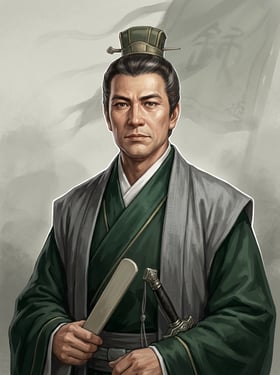
Historical Record
Gaotang Long, styled Shengping, was a native of Pingyang in Mount Tai and a descendant of Gaotang Sheng of Lu. In his youth he was already known as a classical scholar. The Administrator of Mount Tai, Xue Ti, once appointed him as a Surveillance Officer. On one occasion the commandery's military supervisor quarreled with Xue Ti, going so far as to call Xue Ti by his given name and shout at him. Seeing this, Gaotang Long laid his hand on his sword and rebuked the supervisor, citing the stories of Duke Ding of Lu with Confucius, and of Zhao with Qin, to emphasize the principle that a subject must remonstrate frankly and uphold the dignity of his lord. c:4297 The supervisor turned pale at his words, and Xue Ti, too, started up and stopped Gaotang Long. Afterward, Gaotang Long resigned his post and withdrew to live in Jinan.
In the eighteenth year of Jian'an (213), Cao Cao summoned Gaotang Long as an aide on the Chancellor's military council. Thereafter he served as Literary Officer to Cao Hui, Marquis of Licheng. During the mourning for Cao Cao, Cao Hui, far from grieving, went galloping about hunting; Gaotang Long admonished him with ritual propriety, fulfilling his duty of guidance. c:4298 During the Huangchu era, Gaotang Long went out as Chief of Tangyang, and because of his outstanding performance was later selected as Tutor to the Prince of Pingyuan (the future Emperor Ming of Wei, Cao Rui). After Cao Rui ascended the throne, he appointed Gaotang Long as Attendant of the Palace Gentlemen, Erudite, and Commandant of the Imperial Equipages. When the Emperor Ming first came to the great inheritance, a minister proposed holding a banquet, but Gaotang Long cited the precedents of the grief of Tang Yao, Yu Shun, and Gaozong, holding that a banquet should not be set, and the Emperor Ming adopted his advice. c:4298
Gaotang Long was later transferred to be Administrator of Chenliu. He once recommended a man of Du named You Mu, over seventy years old and of lofty virtue, as Aide of the Accounts Section; the Emperor Ming approved and specially granted him the office of Gentleman of the Interior in commendation. Gaotang Long was summoned to be a Cavalier Attendant-in-Ordinary and granted the rank of Marquis Within the Passes. c:4298 His learning was profound, and he was especially versed in astronomy. Together with the Gentleman of the Masters of Writing Yang Wei and the Erudite-in-Waiting of the Grand Historian Luo Lu, he collated and reckoned the calendar and compiled the Taihe Calendar. Although he differed with the Grand Historian in calculating solar eclipses and the dark of the moon, his subtlety was nonetheless known far and near. c:4298
During the Qinglong era (233–237), the Emperor Ming of Wei undertook great construction works, building palaces and transporting a great bell from Chang'an. Gaotang Long submitted a memorial of remonstrance, pointing out the historical lesson of how King Jing of Zhou's casting of large coins and making of a great bell had brought about the decline of Zhou's virtue, and criticizing the Emperor Ming for seeking instruments that ruined the state and for exhausting the people and squandering wealth. c:4299 The Emperor Ming once handed Gaotang Long's memorial to Bian Lan, ordering him to refute it. Gaotang Long then emphasized that rites and music are the foundation of governing the state, pointed out that rise and fall, survival and ruin, are often bound up with whether the institutions of rites and music are observed, and admonished the Emperor Ming to emulate the sage kings in accepting remonstrance, and the loyal minister likewise to exhaust his integrity. c:4299 The Emperor Ming expressed his approval of this.
When the Lingxiao Tower-Gate was first built, magpies nested upon it. The Emperor Ming questioned Gaotang Long, who replied with the lines from the Book of Songs, "The magpie has its nest, the dove dwells in it," warning the Emperor Ming that this was a portent showing Heaven's admonition, that with the palace unfinished there was danger of another surname becoming its master, and urging him to halt the multitude of labors and govern with frugality. c:15630 In the same year, a comet appeared at the constellation Dachen. Gaotang Long again submitted a memorial, emphasizing that in building capitals and palaces a sovereign should give priority to the ancestral temple and the altars of state, not to lavishly adorning his dwelling. He pointed out that the Emperor Ming's great construction works had set the people to lamenting and complaining, and that the warning of the heavenly portent was precisely Heaven's earnest, fatherly instruction to the Emperor Ming, urging him to heed it so as to avoid repeating the downfall of Jie of Xia and Zhou of Shang. c:15631
At that time, military and state affairs were many and the laws severe. Gaotang Long submitted a memorial proposing that rites and music be honored, Confucian scholars esteemed, recluses raised up, the calendar corrected, the color of garments changed, harmony and ease promoted, and frugality and simplicity prized, holding that this was the fundamental way to transform custom and pacify the people in governing the state. c:6789 The Emperor Ming adopted his advice, changing the third month of spring in the fifth year of Qinglong to the fourth month of early summer in the first year of Jingchu, esteeming yellow as the color of garments and using white for sacrificial victims, so as to accord with the rectitude of earth. c:6789 Gaotang Long was later transferred to be Superintendent of the Imperial Household. The Emperor Ming continued to expand the palaces and ornament the towers and pavilions, burdening the people with labor. Liaodong did not pay court, the mourned Empress died, excessive rains fell, and Ji Province suffered floods. Gaotang Long once again submitted a memorial of earnest remonstrance. c:6790
In the Novel
Romance of the Three Kingdoms gives no independent literary portrayal of Gaotang Long; his deeds are not incorporated into the novel's plot. There is therefore no distinctive depiction of Gaotang Long in the novel nor any deviation from the historical biographies.
Key Relationships
* Cao Rui (advises_in): Gaotang Long was an important counselor and remonstrating minister of Emperor Ming of Wei, Cao Rui. He remonstrated with Cao Rui many times, including advising against setting a banquet during the mourning period c:4298, opposing great construction works and the casting of a great bell c:4299, warning of the portent of the magpies nesting on the Lingxiao Tower-Gate c:15630, and pointing out the heavenly warning of the comet at Dachen c:15631. Cao Rui adopted much of Gaotang Long's loyal counsel and praised his remonstrances. c:4299
* Xue Ti (serves): In his early years, Gaotang Long served as Surveillance Officer under Xue Ti, Administrator of Mount Tai. When the commandery's military supervisor was insolent to Xue Ti, Gaotang Long stepped forward, laid his hand on his sword, and rebuked the supervisor, upholding Xue Ti's dignity. c:4297
* Cao Wei (serves): Gaotang Long served the Cao Wei regime all his life—from aide on the Chancellor's military council in Cao Cao's time to Attendant of the Palace Gentlemen, Erudite, Commandant of the Imperial Equipages, Administrator of Chenliu, Cavalier Attendant-in-Ordinary, and Superintendent of the Imperial Household in the time of Emperor Ming of Wei—always loyal in his service. c:4298 c:6790
* Cao Hui (mentor_of): Gaotang Long once served as Literary Officer to Cao Hui, Marquis of Licheng. During the mourning for Cao Cao, when Cao Hui made merry instead of grieving, Gaotang Long admonished him with ritual propriety, fulfilling his duty of guidance. c:4298
Iconic Scenes
* Laying his hand on his sword to save his lord: While serving as Surveillance Officer under Xue Ti, Administrator of Mount Tai, when the commandery's military supervisor was insolent to Xue Ti, Gaotang Long stepped forward, laid his hand on his sword, and rebuked the supervisor, taking the deeds of the ancients as a mirror and upholding Xue Ti's dignity, displaying his loyal, valiant, and upright character. c:4297
* Earnestly remonstrating with the Emperor Ming: When Emperor Ming of Wei, Cao Rui, undertook great construction works and exhausted the people and squandered wealth, Gaotang Long submitted memorials of earnest remonstrance many times. He cited the precedent of King Jing of Zhou's casting of a great bell bringing about the decline of Zhou's virtue, pointing out that the Emperor Ming's conduct was no different from that of a ruler who ruined his state. c:4299 He also took the magpies nesting on the Lingxiao Tower-Gate and the comet at Dachen as portents, warning the Emperor Ming that these were Heaven's admonitions to him, and urging him to halt the multitude of labors and govern with frugality, displaying his bearing as a loyal minister concerned for state and people and bold in frank remonstrance. c:15630 c:15631
* Correcting the calendar and changing the color of garments: Gaotang Long held that transforming custom and making clear the way of moral instruction must begin from the root, and proposed honoring rites and music, correcting the calendar, and changing the color of garments. The Emperor Ming adopted his advice, changing the third month of spring in the fifth year of Qinglong to the fourth month of early summer in the first year of Jingchu, esteeming yellow as the color of garments and using white for sacrificial victims so as to accord with the rectitude of earth, embodying Gaotang Long's contribution to the reform of ritual institutions. c:6789
* Concern even unto death: Although the histories do not directly record the specific words and deeds of Gaotang Long before his death, his repeated earnest remonstrances with the Emperor Ming throughout his life—submitting memorials even amid the Emperor Ming's great construction works and the frequent natural and human calamities, heedless of personal danger—and his spirit of "though my body be ground to dust and my clan destroyed, it would still be a year of life; how should I fear the calamity of offending so as to keep Your Majesty from hearing the most loyal words" c:15630 fully embody his unwavering loyalty unto death and his deep concern for the fate of the state.
Portrait file
Character profile
- Character
- Deep and superior in learning, and expert in astronomy as well; loyal to the utmost and earnest in remonstrance, his aim was to set his sovereign right; he laid hand to sword to save his lord, and even at the point of death still worried for the altars of state.
- Manner of speech
- He cited the classics at length, fond of drawing contrasts between the Three Kings and Five Emperors and the tyrants Jie, Zhou, You, and Li; he repeatedly used the language of calamities and portents as warnings.
- Life
- Gaotang Long, a native of Pingyang in Taishan, styled Shengping, was a descendant of Gaotang Sheng of Lu. He held such posts as Aide for Military Deliberations to the Chancellor, Tutor to the Prince of Pingyuan, Palace Attendant, Erudite, Commandant of the Imperial Son-in-law, Administrator of Chenliu, Cavalier Regular Attendant, and Chamberlain for the Imperial Insignia (guanglu xun); he repeatedly remonstrated against the labor of palace construction, and to his last hour still worried for the altars of state.
- Anecdotes
- A Palace Attendant, Grand Astrologer, and Chamberlain for the Imperial Insignia of Cao Wei, he is one of the subjects of this biography; in discussing the suburban sacrifices he held Wei to be the descendant of Shun.
Relationships
3 relationships
Quotes
8 recorded lines · 3 featured
「昔周景王不儀刑文、武之明德,忽公旦之聖制,旣鑄大錢,又作大鍾,單穆公諫而弗聽,泠州鳩對而弗從,遂迷不反,周德以衰,良史記焉,以爲永鑒。然今之小人,好說秦、漢之奢靡以盪聖心,求取亡國不度之器,勞役費損,以傷德政,非所以興禮樂之和,保神明之休也。」
These words warn the sovereign against imitating the extravagance of Qin and Han, lest he repeat their ruin—carrying a profound lesson from history.
「詩云『惟鵲有巢,惟鳩居之』。今興宮室,起陵霄闕,而鵲巢之,此宮室未成身不得居之象也。天意若曰,宮室未成,將有他姓制御之,斯乃上天之戒也。夫天道無親,惟與善人,不可不深防,不可不深慮。夏、商之季,皆繼體也,不欽承上天之明命,惟讒諂是從,廢德適欲,故其亡也忽焉。太戊、武丁,覩災竦懼,祗承天戒,故其興也勃焉。今若休罷百役,儉以足用,增崇德政,動遵帝則,除普天之所患,興兆民之所利,三王可四,五帝可六,豈惟殷宗轉禍爲福而已哉!臣備腹心,苟可以繁祉聖躬,安存社稷,臣雖灰身破族,猶生之年也。豈憚忤逆之災,而令陛下不聞至言乎?」
Invoking the allusion of 'the magpie's nest taken by the dove,' it warns that Cao Rui's excessive palace-building will invite the calamity of a fallen state; highly recognizable culturally.
「凡帝王徙都立邑,皆先定天地社稷之位,敬恭以奉之。將營宮室,則宗廟爲先,廄庫爲次,居室爲後。今圜丘、方澤、南北郊、明堂、社稷,神位未定,宗廟之制又未如禮,而崇飾居室,士民失業。外人咸云宮人之用,與興戎軍國之費,所盡略齊。民不堪命,皆有怨怒。書曰『天聦明自我民聦明,天明畏自我民明威』,輿人作頌,則嚮以五福,民怒吁嗟,則威以六極,言天之賞罰,隨民言,順民心也。是以臨政務在安民爲先,然後稽古之化,格于上下,自古及今,未嘗不然也。夫采椽卑宮,唐、虞、大禹之所以垂皇風也;玉臺瓊室,夏癸、商辛之所以犯昊天也。今之宮室,實違禮度,乃更建立九龍,華飾過前。天彗章灼,始起於房心,犯帝坐而干紫微,此乃皇天子愛陛下,是以發教戒之象,始卒皆於尊位,殷勤鄭重,欲必覺寤陛下;斯乃慈父懇切之訓,宜崇孝子祗聳之禮,以率先天下,以昭示後昆,不宜有忽,以重天怒。」
It stresses that the people's allegiance determines a nation's rise and fall, and uses celestial omens as a warning, reflecting ancient political wisdom and the notion of resonance between Heaven and humankind.
Chapters3 回 ▸
- 史ch.3ch.23ch.25
Relationship timeline4 条 ▸
Inner monologues · AI-generated3 段 ▸
- I am Gaotang Long, courtesy name Yuansheng. Now that my end is near, I reflect on all I have said in my life: I never da
- I am Gaotang Long. My courtesy name was Yuan (the historical sources I have seen do not record his courtesy name, so I d
- My name is Gaotang Long, my courtesy name is Shengping, and I am from Pingyang in Taishan. I am a descendant of Gaotang
Life events3 ▸
- 0237-01-01 · LuoyangEmperor Ming of Wei's Lavish Palace Construction· Advisor
- 0237-01-01 · LuoyangJingchu Calendar Reform· Advisor
- 0237-01-01 · LuoyangControversy over Cao Rui's Palace Construction· Advisor