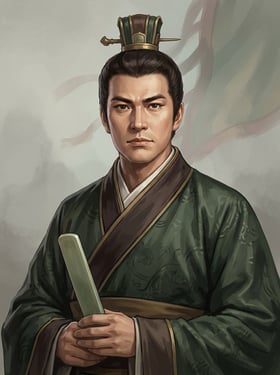
Historical Record
Yang Fu, courtesy name Yishan, was a man of Ji in Tianshui. In his youth he was equally renowned with his fellow-countrymen Yin Feng and Zhao Ang, and once served as an attendant officer of Liang Province. As a provincial attendant officer he was sent on Wei Duan's orders as an envoy to Xu, and was afterward appointed senior clerk of Anding. On his return journey, when the generals of the Guanyou region asked him whether Yuan Shao or Cao Cao was the superior, Yang Fu plainly stated that Yuan Shao was "generous but indecisive, fond of scheming yet lacking resolve," and would never accomplish great things; whereas Cao Cao "had heroic talent and far-reaching strategy, and seized opportunities without hesitation," and was sure to achieve great deeds. Disliking the post of senior clerk, he then resigned. Later, when Wei Duan was summoned to be Grand Coachman and his son Wei Kang succeeded him as inspector, Wei Kang recruited Yang Fu as his aide (biejia). Yang Fu had been nominated as a man of filial piety and integrity, and was summoned to the Chancellor's office, but the provincial government memorialized to keep him as a participant in military affairs.
After Ma Chao's defeat at Weinan, he fled to the various Rong tribes. Cao Cao pursued him to Anding, but because of Su Bo's rebellion in Hejian he prepared to return east. Yang Fu advised Cao Cao, pointing out that Ma Chao "had the valor of Han Xin and Ying Bu and greatly won the hearts of the Qiang and Hu," and that if he were not strictly guarded against, the commanderies of the Long highlands might be lost. Although Cao Cao adopted his words, the urgency of the military situation left the defenses inadequate. Ma Chao indeed led the chieftains of the various Rong to attack the commanderies and counties of the Long highlands, and the counties responded one after another—only Jicheng held firm. Ma Chao, joined by Zhang Lu's general Yang Ang, led more than ten thousand men to besiege Jicheng. Yang Fu led over a thousand gentlemen, officials, and clansmen in fierce battle with Ma Chao for several months. When there was no hope of relief and the inspector and grand administrator wished to surrender, Yang Fu remonstrated with tears, swearing to defend the city to the death. Yet the inspector and grand administrator in the end opened the gates and welcomed the surrender, resulting in the killing of Wei Kang and others.
Yang Fu harbored a resolve to avenge Wei Kang, but lacked the opportunity. On the pretext of mourning his wife, he took leave and went to his cousin Jiang Xu. Yang Fu wept to Jiang Xu and his mother about the disaster at Jicheng, bitterly denouncing Ma Chao for "betraying his father, rebelling against his lord, and cruelly slaughtering the provincial general". Jiang Xu's mother, deeply understanding of righteousness, urged Jiang Xu to follow Yang Fu's plan. Yang Fu then allied with his fellow-countrymen Jiang Xu, Zhao Ang, and Yin Feng, and contacted Liang Kuan of Anding, Zhao Qu, Pang Gong, and others of Nan'an, agreeing to join in punishing Ma Chao. In the ninth month of the seventeenth year of Jian'an, Yang Fu and Jiang Xu raised troops at Lucheng. When Ma Chao heard of it, he sent out troops, while Zhao Qu, Liang Kuan, and the others rescued the imprisoned Yang Yue, closed the gates of Jicheng, and attacked Ma Chao's wife and children. Ma Chao raided Licheng and captured Jiang Xu's mother, who reviled Ma Chao and was in the end killed. Yang Fu fought Ma Chao, suffered five wounds, and seven of his clansmen and brothers died in battle. Ma Chao at last fled south to Zhang Lu.
After Longyou was pacified, Cao Cao, in recognition of his merit in attacking Ma Chao, enfeoffed Yang Fu as a Marquis Within the Passes. Yet Yang Fu declined the rank, holding that he had "rendered no service in warding off calamity while his lord lived, and shown no merit of dying for principle when his lord perished," and so should not receive a stipend. Cao Cao praised his loyalty and righteousness, and had his deeds, together with the noble act of Jiang Xu's mother, recorded in the histories.
When Cao Cao campaigned against Hanzhong, he appointed Yang Fu inspector of Yi Province. He was later transferred to be grand administrator of Jincheng, and before taking up that post was transferred again to be grand administrator of Wudu. As Wudu commandery bordered Shu Han, Yang Fu requested to follow the precedent of Gong Sui and pacify the people. Liu Bei sent Zhang Fei, Ma Chao, and others to attack Xiabian, and the Di chieftain Lei Ding and others of Wudu responded. Cao Hong led troops to resist them, and Ma Chao and the rest withdrew. Cao Hong held a banquet and had female entertainers dance bare-bodied upon drums; Yang Fu rebuked Cao Hong on the spot in a stern voice, saying that "the distinction between men and women is a great principle of the state," and indignantly left his seat. Cao Hong at once removed the female musicians, invited Yang Fu back to his seat, and held him in solemn respect.
When Liu Bei seized Hanzhong and pressed near Xiabian, Cao Cao wished to relocate the people of Wudu. Yang Fu, long esteemed for his authority and trustworthiness, successively moved more than ten thousand households of the Di people to Jingzhao, Fufeng, Tianshui, and other places, and the people all followed him carrying their children on their backs. In governing he grasped the broad principles, and the people lived and worked in peace. Emperor Wen once asked Palace Attendant Liu Ye and others their assessment of Yang Fu, and all said he had the bearing of a high minister of state. After more than ten years in the commandery, Yang Fu was summoned and appointed Colonel of the City Gates. He once frankly remonstrated with Emperor Ming that he should not wear garments contrary to ritual propriety; the emperor was silent and did not answer, but from then on no longer appeared before him in irregular dress.
Yang Fu was later transferred to be Grand Architect (Jiangzuo Dajiang). At that time the palace buildings had just begun, and Emperor Ming was widely gathering beautiful women and frequently going out on hunting excursions. Yang Fu submitted a memorial of remonstrance, pointing out that an enlightened ruler should be frugal and love the people, guard against the calamities of Emperors Huan and Ling, and—citing Heaven and Earth showing warnings and the killing of birds—urging the emperor to "think thrice before acting, and to deliberate before proceeding". He also, regarding the emperor's estrangement from the Prince of Yongqiu, Cao Zhi, set forth the principle of kinship among the nine degrees of relations.
He was later transferred to be Privy Treasurer (Shaofu). When the Grand Marshal Cao Zhen's campaign against Shu was hindered by rain, Yang Fu submitted a memorial urging the emperor to recall the army, pointing out that "to advance when one sees opportunity and to retreat when one knows the difficulty is the good policy of warfare". He also advised the emperor to practice frugality, reduce his table, and dismiss precious trinkets, so as to cope with the famine and the shortage of military supplies. Emperor Ming then recalled the various armies. Yang Fu also, when the court deliberated on governance that harmed the people's livelihood, put forward that "good governance lies in employing the worthy, and the flourishing of the state lies in attending to agriculture", and criticized such ills as the wide building of palaces and lodges, ingenious extravagances, and harsh administration that troubled the people, advising the selection and employment of the worthy and the removal of the "four excesses".
Yang Fu once submitted a memorial requesting the dismissal of those palace women who were not favored. He summoned the official of the imperial wardrobe to ask the number of the rear-palace women, but the official, keeping it secret as old precedent required, would not answer; Yang Fu in anger had the official caned a hundred strokes, rebuking him: "The state does not keep secrets from the Nine Ministers, yet keeps secrets with a petty official?" When Emperor Ming heard of it, he respected and feared him all the more. When Emperor Ming's beloved daughter Princess Shu died young, she was posthumously enfeoffed as Princess of Pingyuan, and the emperor wished to attend the funeral in person. Yang Fu submitted a memorial of remonstrance, pointing out that when Emperor Wen and Empress Wuxuan passed away, His Majesty had not attended in person, and that he should not violate the great principle of the altars of state for an infant in arms. Emperor Ming did not heed him. Emperor Ming further built the new Xu Palace and constructed palaces, halls, towers, and pavilions at Luoyang. Yang Fu again submitted a memorial, taking Yao, Shun, Yu, Tang, Wen, and Wu as models and Jie of Xia, Zhou of Yin, King Ling of Chu, and the First Emperor of Qin as grave warnings, urging the emperor not to "carry the loftiness and splendor of palaces to the point of exhausting the wealth and strength of the people". He stated that "to disregard the strength of the myriad people in order to indulge the desires of the ear and eye has never failed to lead to ruin", and declared his loyalty by saying that "if the state perished and yet the minister could survive alone, the minister would not have spoken either". Emperor Ming, moved by his loyal words, replied with a personally written edict. At court conferences Yang Fu often took the realm as his own charge, repeatedly remonstrating and contending; when his counsel was not adopted, he several times asked to resign his post, but was not permitted. At last he died, with no surplus property in his household.
In the Novel
In the Romance of the Three Kingdoms, Yang Fu is portrayed as a loyal, upright, and resourceful counselor and general, both wise and brave. He first appears after Cao Cao has pacified Guanzhong, advising Cao Cao and pointing out that Ma Chao "had the valor of Lü Bu and deeply won the hearts of the Qiang people," and that if he were not crushed while the chance remained, he might become a great menace later, urging Cao Cao not to withdraw his army to Xu. Although Cao Cao agreed with his words, because of many affairs in the Central Plains and the unsettled south he could not stay long, and entrusted Yang Fu with defending Liang Province.
When Ma Chao attacked Jicheng, the inspector Wei Kang wished to surrender; Yang Fu remonstrated in tears, holding that Ma Chao was "a man who betrayed his lord—how could one surrender to him?" But Wei Kang would not listen, opened the city and surrendered, and was in the end killed by Ma Chao. Ma Chao wished to behead Yang Fu, but spared him for his "keeping faith with righteousness," and instead employed him as a participant in military affairs. Yang Fu then, under the pretext of his wife's death, took leave from Ma Chao to bury her. He went to Licheng, paid his respects to his aunt and his cousin Jiang Xu, wept to them of Wei Kang's murder and Ma Chao's cruelty, and incited Jiang Xu to join in punishing Ma Chao. Jiang Xu's mother, deeply understanding of righteousness, rebuked Jiang Xu and urged him to follow Yang Fu's plan. Yang Fu conspired with Jiang Xu, Liang Kuan, Zhao Qu, and others to attack Ma Chao from within and without. In the battle with Ma Chao, Yang Fu took five spear-wounds, and his seven brothers were all killed by Ma Chao. In the end, Ma Chao was defeated and fled. For his merit Yang Fu was enfeoffed by Cao Cao as a Marquis Within the Passes, but he declined the rank, holding that he had "no merit in warding off calamity, nor the integrity of dying in calamity"; Cao Cao commended his loyalty and righteousness and bestowed the rank all the same.
In the novel, Yang Fu still appears in the later period. When Emperor Ming of Wei, Cao Rui, hesitated whether to campaign against Shu, Yang Fu together with Hua Xin submitted a memorial of remonstrance to dissuade him. When Emperor Ming of Wei undertook great construction projects, casting bronze figures and a dew-collecting basin, and planting rare flowers and exotic trees in the Shanglin Park, the Junior Tutor Yang Fu again submitted a memorial of remonstrance. These episodes further reinforce Yang Fu's image as loyal, upright, and bold in remonstrance, consistent with his repeated remonstrances in the historical record, though the details and posts of specific events are adjusted (for instance, the office of Junior Tutor is not attested in history).
Key Relationships
* Wei Duan and Wei Kang: Yang Fu once served as Wei Duan's attendant officer, and later as Wei Kang's aide. Loyal to the core, he swore to defend Wei Kang to the death when Ma Chao besieged Jicheng, and after Wei Kang's murder actively schemed to avenge him.
* Cao Wei: Yang Fu was an important official of Cao Wei, deeply trusted and respected by Cao Cao, Cao Pi, and Cao Rui. He repeatedly devised plans for Cao Wei and frankly remonstrated at critical moments, upholding the discipline of the court and the interests of the state.
* Jiang Xu: Yang Fu's cousin (in the novel, his maternal cousin). The two jointly schemed to punish Ma Chao, and Jiang Xu's mother, deeply understanding of righteousness, supported their action.
* Ma Chao: Yang Fu's mortal enemy. Ma Chao murdered Wei Kang, and Yang Fu loathed him bitterly, swearing to avenge him to the death—willing even to suffer several wounds and the death of seven of his clansmen and brothers.
* Zhao Ang, Yin Feng, Liang Kuan, Zhao Qu, and others: Allies who jointly took part in punishing Ma Chao.
* Jiang Xu's mother: Deeply understanding of righteousness, she encouraged Jiang Xu to join Yang Fu in punishing Ma Chao, and died a martyr to righteousness, inspiring the two.
Signature Scenes
* Foretelling the outcome of Yuan and Cao: Before the generals of Guanyou, Yang Fu precisely analyzed the strengths and weaknesses of Yuan Shao and Cao Cao, predicting that Cao Cao would surely accomplish great things—displaying his outstanding political foresight.
* Defending Jicheng to the death: When Ma Chao besieged Jicheng and the inspector and grand administrator wished to surrender, Yang Fu remonstrated in tears, vowing "death rather than a second loyalty," displaying his loyal and unyielding character.
* Scheming to punish Ma Chao: On the pretext of his wife's death Yang Fu took leave, but in fact went to Jiang Xu, weeping to him of Ma Chao's crimes, and successfully persuaded Jiang Xu and his mother to raise troops together—displaying his cunning and decisiveness.
* Five wounds in bloody battle with Ma Chao: In the battle with Ma Chao, Yang Fu led from the front, took five wounds, and seven of his clansmen and brothers died in battle—his valor and resolve for revenge are deeply moving.
* Sternly rebuking Cao Hong: When Cao Hong held a banquet and had female entertainers dance bare-bodied upon drums, Yang Fu, undaunted by Cao Hong's power, sternly rebuked him for violating "the distinction between men and women, a great principle of the state," displaying his upright and uncompromising character.
* Repeated frank remonstrance with Emperor Ming: In Emperor Ming's reign, Yang Fu repeatedly remonstrated frankly on matters such as the emperor's dress, palace construction, the campaign against Shu, and the number of rear-palace women, even expressing his loyalty by "knocking on his coffin, bathing, and prostrate awaiting heavy punishment", displaying his courage and responsibility as an upright remonstrating minister.
* Declining the rank of Marquis Within the Passes: Enfeoffed as a marquis for his merit in punishing Ma Chao, Yang Fu declined the rank, holding that he had "no merit in warding off calamity, nor the integrity of dying in calamity," embodying his modesty and indifference to fame and gain.
* Caning an official a hundred strokes to uphold discipline: When inquiring after the number of rear-palace women, the imperial wardrobe official refused to tell him on grounds of "court secrecy"; Yang Fu in anger had the official caned a hundred strokes, rebuking him, "The state does not keep secrets from the Nine Ministers, yet keeps secrets with a petty official?"—displaying his resolve to uphold the discipline of the court.
* Remonstrating with the Wei sovereign not to campaign against Shu: In the novel, Yang Fu together with Hua Xin submitted a memorial urging the Wei sovereign Cao Rui not to campaign against Shu, embodying his consideration for the larger interests of the state (novel only).
* Remonstrating with the Wei sovereign against great construction projects: In the novel, Yang Fu, as Junior Tutor, submitted a memorial urging the Wei sovereign Cao Rui not to undertake great construction that exhausted the people and wasted resources, further reinforcing his image as loyal, upright, and bold in remonstrance (novel only).
Portrait file
Character profile
- Character
- Yang Fu was upright and stern, long established in prestige and trust; he held his ruler to ritual and law, his words pointed and to the heart, able to discern great principles, and he reproached himself for the shame of not dying in defense of his city. Loyal, righteous, and deep in counsel, he was the chief architect of the uprising to restore order at Jicheng, and a renowned gentleman of Tianshui.
- Manner of speech
- Yang Fu's manner of speech was to cite the classics for support, contrast right and wrong, and remonstrate at length in pointed terms; before his ruler he often submitted memorials, and could also question sternly in a raised voice.
- Life
- Yang Fu, styled Yishan, was a man of Ji in Tianshui. He served as chief clerk of Anding and as staff military officer in the Chancellor's office. When Ma Chao raided Longyou, Yang Fu, together with his cousin, firmly held Jicheng, and later plotted with Jiang Xu and others to campaign against Ma Chao; he took five wounds to his body, and seven of his clansmen died. After Longyou was pacified, he was granted the rank of Marquis Within the Passes, and later served as Inspector of Yi Province and Grand Administrator of Jincheng and Wudu, and was promoted to Grand Master of Palace Works and Chamberlain of the Privy Treasury. He repeatedly remonstrated against Emperor Ming's lavish construction of palaces, ever taking the realm as his own charge; his repeated remonstrances went unheeded, and though he repeatedly begged to resign his post it was not permitted. In the end he died in office, leaving no surplus wealth in his household.
- Anecdotes
- In the end, after all seven of his brothers had perished and he himself, pierced by five spear-wounds, still fought to the death, Yang Fu helped Xiahou Yuan drive off Ma Chao; Cao Cao enfeoffed him as Marquis Within the Passes, and he yielded the title. He was a former officer of Wei Kang, and together with Hua Xin submitted a memorial remonstrating against a campaign to attack Shu.
Relationships
11 relationships
Quotes
18 recorded lines · 3 featured
「袁公寬而不斷,好謀而少決;不斷則無威,少決則失後事,今雖彊,終不能成大業。曹公有雄才遠略,決機無疑,法一而兵精,能用度外之人,所任各盡其力,必能濟大事者也。」
This line precisely appraises the character and ability of Yuan Shao and Cao Cao, embodying Yang Fu's discernment of men.
「守城不能完,君亡不能死,亦何面目以視息於天下!馬超背父叛君,虐殺州將,豈獨阜之憂責,一州士大夫皆蒙其恥。君擁兵專制而無討賊心,此趙盾所以書殺君也。超彊而無義,多釁易圖耳。」
This line shows Yang Fu's loyal, unyielding resolve to repay his lord unto death, embodying a core trait of his character.
「堯尚茅茨而萬國安其居,禹卑宮室而天下樂其業;及至殷、周,或堂崇三尺,度以九筵耳。古之聖帝明王,未有極宮室之高麗以彫弊百姓之財力者也。桀作琁室、象廊,紂爲傾宮、鹿臺,以喪其社稷,楚靈以築章華而身受其禍;秦始皇作阿房而殃及其子,天下叛之,二世而滅。夫不度萬民之力,以從耳目之欲,未有不亡者也。陛下當以堯、舜、禹、湯、文、武爲法則,夏桀、殷紂、楚靈、秦皇爲深誡。高高在上,實監后德。慎守天位,以承祖考,巍巍大業,猶恐失之。不夙夜敬止,允恭卹民,而乃自暇自逸,惟宮臺是侈是飾,必有顛覆危亡之禍。易曰:『豐其屋,蔀其家,闚其戶,閴其無人。』王者以天下爲家,言豐屋之禍,至於家無人也。方今二虜合從,謀危宗廟,十萬之軍,東西奔赴,邊境無一日之娛;農夫廢業,民有饑色。陛下不以是爲憂,而營作宮室,無有已時。使國亡而臣可以獨存,臣又不言也;君作元首,臣爲股肱,存亡一體,得失同之。孝經曰:『天子有爭臣七人,雖無道不失其天下。』臣雖駑怯,敢忘爭臣之義?言不切至,不足以感寤陛下。陛下不察臣言,恐皇祖烈考之祚,將墜于地。使臣身死有補萬一,則死之日,猶生之年也。謹叩棺沐浴,伏俟重誅。」
This line draws on the past to mirror the present, plainly warning of the harm of an emperor's extravagance, embodying Yang Fu's loyalty and foresight.
Chapters7 回 ▸
- 史ch.25ch.36
- 演ch.59ch.64ch.92ch.99ch.105
Relationship timeline10 条 ▸
Inner monologues · AI-generated3 段 ▸
- I am Yang Fu, courtesy name Yishan. Looking back now, what I relied on was not skill with words, but a sense of duty as
- I am Yang Fu, courtesy name Yishan, from Jixian in Tianshui. In my youth, I encouraged and challenged myself alongside f
- I am Yang Fu, courtesy name Yishan. Looking back on my life, I see that all I upheld was a single word: “righteousness.”
Life events4 ▸
- 0213-01-01 · JichengSiege of Jicheng· Instigator
- 0213-01-01 · LuchengYang Fu Raises Troops Against Ma Chao· Instigator
- 0230-01-01 · ChencangCao Zhen's Invasion of Shu· Advisor
- 0237-01-01 · LuoyangEmperor Ming of Wei's Lavish Palace Construction· Advisor