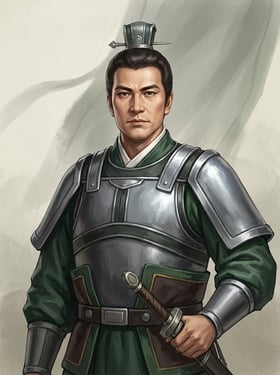
Historical Record
Man Chong, styled Boning, was a native of Changyi in Shanyang (present-day Juye, Shandong). From his early years he displayed a firm and resolute character. When Cao Cao took charge of Yanzhou, he recruited Man Chong as a retainer. Later, as magistrate of Xu, when a guest of the imperial kinsman and noble Cao Hong broke the law, Man Chong enforced the law impartially and was not swayed. Cao Hong wrote a letter pleading for clemency, but Man Chong did not heed him and swiftly executed the offender, winning Cao Cao's praise, who held that he "attended to the matter at hand and not to other considerations." c:5839 When the Grand Commandant Yang Biao was arrested and consigned to the county prison, the Prefect of the Masters of Writing Xun Yu, the Chamberlain of the Privy Treasury Kong Rong, and others requested that Man Chong not subject him to torture, but Man Chong insisted on interrogating him according to law. Having confirmed that Yang Biao had no other crime, Man Chong advised Cao Cao, pointing out that if the charge were unclear it might lose the people's confidence, prompting Cao Cao to pardon Yang Biao. c:5839
When Yuan Shao's power was at its height, in Runan Commandery many of Yuan Shao's disciples and former officials held troops in self-defense. Man Chong was appointed Administrator of Runan; he recruited five hundred men, stormed over twenty fortified walls, and lured to their deaths over ten chieftains who had not surrendered, swiftly pacifying Runan and gaining a population of twenty thousand households and two thousand troops, whom he returned to farming. c:5840 In the thirteenth year of Jian'an (208), Man Chong accompanied Cao Cao on the campaign against Jingzhou and afterward stayed to garrison Dangyang. As Sun Quan repeatedly harassed the eastern frontier, Man Chong was recalled to serve as Administrator of Runan and granted the rank of Marquis Within the Passes. When Guan Yu besieged Xiangyang, Man Chong assisted the General Who Conquers the South, Cao Ren, in garrisoning Fancheng. Facing the dire situation of the Seven Armies drowned and the city walls collapsing, the generals advised abandoning the city, but Man Chong overruled the multitude, pointing out that the mountain floods would soon recede, and that Guan Yu dared not advance rashly out of fear that the Wei army would cut off his rear; if the city were abandoned, the land south of the Hong River would no longer belong to the state. He urged Cao Ren to hold firm. Cao Ren adopted his words; Man Chong sank a white horse and swore an oath with the officers and men, and in the end, together with the relieving force under Xu Huang and others, drove back Guan Yu. c:2658
After Emperor Wen ascended the throne, Man Chong was promoted to General Who Displays Martial Might, and for his merit in defeating Wu at Jiangling was reassigned as General Who Calms the Waves, garrisoning Xinye. In one southern campaign, Man Chong anticipated that the Wu army would take advantage of a night wind to set fires, and made his defensive dispositions in advance, successfully crushing the invading enemy, and was thereupon advanced to Marquis of Nanxiang. In the third year of Huangchu (222) and the fifth year (224), Man Chong was successively granted the Staff of Authority and appointed General of the Front. c:2658 After Emperor Ming ascended the throne, Man Chong was advanced to Marquis of Changyi and made Inspector of Yu Province. In the second year of Taihe (228), he anticipated that Sun Quan intended to raid Xiyang and made his dispositions in advance, forcing Sun Quan to withdraw his troops. The following year, when Cao Xiu penetrated deep into Wu territory, Man Chong submitted a memorial warning that the road he was taking was "easy to advance along but hard to retreat from," and advising deep preparation, but Cao Xiu did not heed him and was ultimately defeated. Man Chong, as General of the Front, took over as commander supervising the military affairs of Yangzhou. He advised moving the city of Hefei thirty li to the west, so as to "draw the enemy onto level ground and cut off their route of return"; this plan was at first not adopted, but Man Chong memorialized again to argue it forcefully, and it was finally approved. In the first year of Qinglong (233), Sun Quan attacked the New City, and Man Chong set an ambush to drive back the Wu army. The following year, Sun Quan again attacked the city, and Man Chong recruited stalwart men to burn the siege engines with fire, shot dead Sun Tai, and forced the Wu army to withdraw. c:2660
Man Chong did not manage estates, and his household had no surplus wealth. In the second year of Jingchu (238), because of his age he was summoned back to court and promoted to Grand Commandant. The edict praised him as having "a single-minded devotion to public concerns, in the manner of Xingfu and Ji Zun," and granted him ten qing of land, five hundred hu of grain, and two hundred thousand cash, to honor his pure loyalty and frugal restraint. c:5843 In the third year of Zhengshi (242), Man Chong died, with the posthumous title Marquis Jing. His son Man Wei inherited his rank and rose to be Chamberlain of the Guards.
In the Novel
In *Romance of the Three Kingdoms*, Man Chong's image is further developed. He first appears in Chapter 10, recommended to Cao Cao by Liu Ye and engaged as a retainer in the army. c:5844 The novel emphasizes Man Chong's wisdom and loyalty. For example, when Cao Cao sought to win over Xu Huang, Man Chong volunteered, disguising himself as a common soldier to slip into Xu Huang's camp, and using the reasoning that "a good bird chooses its tree to roost in, and a wise minister chooses his lord to serve" persuaded Xu Huang to submit to Cao Cao. c:2661 This episode has no clear basis in the histories and is a prominent display by the novel of Man Chong's wisdom. When Xu Huang wished to kill Yang Feng and Han Xian as a gift of allegiance, Man Chong praised him as "a truly righteous man," further setting off Man Chong's discernment of men. c:12557
In the novel, Man Chong also served as magistrate of Xudu, c:5845 in charge of trying the case of Yang Biao. Cao Cao secretly ordered Man Chong to deal with Yang Biao, falsely accusing him of communicating with Yuan Shu. c:2663 This differs from the historical episode in which Man Chong interrogated Yang Biao impartially and pleaded on his behalf; in the novel he is depicted more as a faithful executor of Cao Cao's will. When Guan Yu besieged Fancheng, the novel also depicts in detail the episode of Man Chong advising Cao Ren to hold firm, basically consistent with historical fact, but adding the episode in which Cao Ren at first wished to abandon the city and flee, only to be persuaded by Man Chong—strengthening Man Chong's role as a pillar of stability at the critical moment. c:2665
In the novel, Man Chong also went as an envoy to the Southland to persuade Sun Quan to join forces with Cao Cao to attack Jingzhou. c:5847 In the time of Cao Rui, Man Chong took part in operations against Wu, once accompanying Cao Rui on a personal campaign against Hefei, and offered the plan of raiding and burning the Wu army's naval camp, winning a great victory. c:2666 These episodes further enrich Man Chong's image as an important general and strategist of Cao Wei, and although some details depart from historical fact, on the whole they preserve his characteristic of combining wisdom and valor.
Key Relationships
* Cao Wei (serves): Man Chong served the three generations of rulers Cao Cao, Cao Pi, and Cao Rui all his life, a major pillar of the Cao Wei regime. From his beginning as a retainer recruited by Cao Cao, he successively held the offices of magistrate of Xu, Administrator of Runan, General Who Displays Martial Might, General Who Calms the Waves, and General of the Front, finally rising to Grand Commandant; his loyalty and ability were deeply trusted and relied upon by the rulers of Cao Wei. c:5843
* Cao Ren (advises_in): When Guan Yu besieged Fancheng, Man Chong, as Cao Ren's adviser, forcefully urged Cao Ren to hold firm, ultimately repelling Guan Yu's attack and holding Fancheng. c:2665
* Sun Quan (fights_in): Man Chong fought repeatedly against Sun Quan and his subordinates. He anticipated Sun Quan's intent to raid Xiyang and made dispositions in advance to force his withdrawal c:2657; in the Battle of Hefei New City, he set an ambush to drive back Sun Quan, burned the siege engines with fire, and shot dead Sun Tai. c:2660 In the novel, he even went as an envoy to the Southland to persuade Sun Quan to deal with Liu Bei jointly. c:5847
* Guan Yu (enemy_of): In the Battle of Fancheng, Man Chong successfully withstood Guan Yu's fierce assault and was one of the key figures in driving back Guan Yu. c:2665
* Xu Huang (recruits_in): In the novel, Man Chong persuaded Xu Huang to surrender and submit to Cao Cao, displaying his outstanding powers of persuasion. c:2662 (unique to the novel)
Iconic Scenes
* Enforcing the law as magistrate of Xu, fearing no power or rank: While serving as magistrate of Xu, when a guest of Cao Hong broke the law, Man Chong enforced the law impartially, disregarded Cao Hong's plea, and swiftly executed the offender, winning Cao Cao's praise. In the Yang Biao case, he likewise insisted on interrogating according to law, displaying his firm and upright character. c:5839
* Forcefully advising at Fancheng, holding firm and repelling the enemy: When Guan Yu drowned the Seven Armies and Fancheng was in peril, the generals wished to abandon the city and flee. Man Chong overruled the multitude, analyzed the situation, persuaded Cao Ren to hold firm, sank a white horse and swore an oath with the officers and men, and in the end successfully held Fancheng and drove back Guan Yu. c:2665 This is the concentrated embodiment of Man Chong's combined wisdom and valor and his composure in crisis.
* Hefei New City, driving back Sun Quan by wit: In the defensive battle at Hefei New City, Man Chong anticipated Sun Quan's intent, set an ambush to drive back the Wu army, burned the siege engines with fire, and shot dead Sun Tai, repeatedly frustrating Sun Quan's attacks and effectively defending the eastern frontier of Cao Wei. c:2660
* Persuading Xu Huang to surrender: In *Romance of the Three Kingdoms*, Man Chong disguised himself as a common soldier and slipped into Xu Huang's camp, using the words "a good bird chooses its tree to roost in, and a wise minister chooses his lord to serve" to successfully persuade Xu Huang to submit to Cao Cao, displaying his outstanding eloquence and wisdom. c:2662 (unique to the novel)
* Incorrupt Grand Commandant, a household with no surplus wealth: Man Chong was an incorrupt official who did not manage estates and whose household had no surplus wealth. Cao Rui specially issued an edict praising his "pure loyalty and frugal restraint" and bestowed wealth upon him in commendation. c:5843 This reflects Man Chong's noble character and his selfless devotion to the state.
Portrait file
Character profile
- Character
- Man Chong was firm and resolute in purpose, brave and resourceful, strict in enforcing the law, and possessed little private wealth. A veteran general of Wei, he served as Grand Administrator of Runan, Inspector of Yu Province, General Who Conquers the East, and Grand Commandant.
- Manner of speech
- His manner of speech was sharply antithetical, first demolishing then building up, as in "It cannot be... it is not..." and "I wish... to make...." Decisive in offering strategy, he held that "The men of Wu will surely underestimate us, coming from afar, and will have made no defensive preparations."
- Life
- Man Chong, styled Boning, was a native of Changyi in Shanyang. In his youth he was a commandery Investigator, and served through the three reigns of Cao Cao, Cao Pi, and Cao Rui. He garrisoned Runan, Yu Province, and Yang Province for several decades, achieving notable success in defending against Wu along the Yangtze and Huai. In the second year of Jingchu he was summoned back to court to serve as Grand Commandant, and died in the third year of Zhengshi, with the posthumous title Marquis Jing.
- Anecdotes
- He was once appointed Prefect of Xu, charged with gathering intelligence on Yuan Shao. At the Battle of Fancheng, serving as Cao Ren's adviser, he dissuaded the abandonment of the city with the argument that "a sudden flood cannot last long," causing Cao Ren to hold firm.
Relationships
12 relationships
Quotes
26 recorded lines · 3 featured
「豈不聞『良禽擇木而棲,賢臣擇主而事』?遇可事之主,而交臂失之,非丈夫也。」
This line is a famous appeal to surrender, embodying Man Chong's ingenuity and his insight into talent.
「山水速疾,冀其不久。聞羽遣別將已在郟下,自許以南,百姓擾擾,羽所以不敢遂進者,恐吾軍掎其後耳。今若遁去,洪河以南,非復國家有也;君宜待之。」
This line displays Man Chong's strategic vision and resolve to hold firm during Guan Yu's Northern Campaign, with far-reaching influence on the course of the war.
「孫子言,兵者,詭道也。故能而示之以弱不能,驕之以利,示之以懾。此爲形實不必相應也。又曰『善動敵者形之』。今賊未至而移城却內,此所謂形而誘之也。引賊遠水,擇利而動,舉得於外,則福生於內矣。」
This line quotes The Art of War, embodying Man Chong's deep mastery of military strategy and his skill in the use of stratagems.
Chapters14 回 ▸
- 史ch.3ch.4ch.15ch.17ch.26
- 演ch.10ch.14ch.20ch.21ch.31ch.73ch.74ch.96ch.103
Relationship timeline10 条 ▸
Inner monologues · AI-generated3 段 ▸
- I am Man Chong, courtesy name Boning. Since my youth, my thoughts have been on border affairs rather than family wealth.
- I am Man Chong, courtesy name Boning. Whenever I think back to the beginning of my service as an official, I realize tha
- I remember that when I first entered service, I was no more than a minor official in a commandery. The realm was in turm
Life events5 ▸
- 0196-01-01 · LuoyangXu Huang Joins Cao Cao· Advisor
- 0229-01-01 · HefeiMan Chong Relocates and Builds the New Hefei City· Instigator
- 0234-01-01 · HefeiBattle of Hefei (234)· Commander
- 0234-01-01 · HefeiMan Chong Burns the Siege Equipment and Shoots Sun Tai· Commander
- 0241-01-01 · HefeiMan Chong's Defense of Huainan· Commander