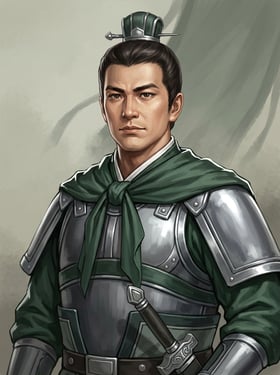
Historical Record
Jia Kui, styled Liangdao, was a native of Xiangling in Hedong. Clever from childhood, his grandfather once predicted he would surely become a general and orally transmitted to him tens of thousands of words of military teachings. Early in his career he served as a commandery clerk and held the post of Chief of Jiangyi. When Guo Yuan attacked Hedong, every city surrendered; only Jia Kui held firm at Jiangyi. As the city was about to fall, the elders of Jiangyi made a pact with Guo Yuan not to harm Jia Kui. After the city fell, Guo Yuan wished to induce Jia Kui to surrender and threatened him with troops, but Jia Kui was unmoved and angrily denounced Guo Yuan, nearly being beheaded. When the clerks and people of Jiangyi heard of it, they all mounted the walls and cried out, and in the end Jia Kui was spared.
Jia Kui was once recommended as a flourishing talent and made Magistrate of Mianchi. When Gao Gan rebelled, Zhang Yan wished to raise troops in response. Jia Kui feigned conspiracy with him and, exploiting Zhang Yan's trust, used the chance to repair the city's defenses, executed those plotting rebellion, and in the end held the city firm, repelling Zhang Yan. After Zhang Yan's defeat, Jia Kui left office on account of his grandfather's death. Later he was recruited by the Minister over the Masses as an aide and, in the capacity of a court gentleman for consultation, took part in the military affairs of the Director of Retainers. When Cao Cao campaigned against Ma Chao and reached Hongnong, he appointed Jia Kui Grand Administrator of Hongnong and greatly praised his administrative ability, saying, "If all the two-thousand-bushel officials of the realm were like Jia Kui, what worry would I have?".
When Cao Cao campaigned against Liu Bei, Jia Kui was ordered to go to Xiegu to observe the situation. On the way he encountered a transport officer escorting prisoners; pleading military urgency, Jia Kui executed only one serious offender and released all the rest. This won Cao Cao's approval, and he was appointed Grand Counselor of Remonstrance, jointly overseeing military planning with Xiahou Shang. After Cao Cao died at Luoyang, Jia Kui took charge of the funeral. At the time the heir Cao Pi was in Ye, the Marquis of Yanling, Cao Zhang, had not yet arrived, and the soldiers and people were restless from toil and illness. Jia Kui overruled the consensus, insisted on proclaiming the death, and pacified the Qing Province troops by issuing them provisions.
After Cao Pi was made King, he appointed Jia Kui Chief of Ye, later promoting him to Grand Administrator of Wei commandery. He reformed the conduct of officials and rooted out lawbreaking, making Yu Province a model for the realm to emulate, and was granted the rank of Marquis Within the Passes. In the second year of Taihe, Jia Kui was ordered to command four armies under Man Chong, Hu Zhi, and others, advancing from Xiyang straight toward Dongguan to rendezvous with Cao Xiu and Sima Yi. Cao Xiu, underestimating the enemy, advanced too deep and was defeated by the Wu army. Jia Kui foresaw the course of battle, deployed his generals to advance by land and water, and arrived in time at Jiashi, using a stratagem of decoy troops to force the Wu army to withdraw, and supplied Cao Xiu with provisions, allowing his army to recover. Even when gravely ill, Jia Kui's heart was still on the state, regretting that he had not been able to behead Sun Quan to repay the late emperor. After his death he was posthumously titled Marquis Su. The clerks and people of Yu Province carved a stone and erected a shrine for him. During the Qinglong era, Emperor Ming of Wei, Cao Rui, on his eastern campaign, deliberately entered Jia Kui's shrine to offer sacrifice and issued an edict commending his loyal merit.
In the Novel
In *Romance of the Three Kingdoms*, Jia Kui's portrayal centers on his upright integrity and his loyal wisdom, playing an important role especially at key historical turning points.
After Cao Cao's death, Cao Zhang hastened from Chang'an and asked where the late king's seal and ribbon were. Jia Kui replied gravely, "A family has its eldest son, a state has its heir apparent; the late king's seal and ribbon are not something for you, my lord, to ask about." He further demanded of Cao Zhang whether he had come to mourn or to contend for the throne, prompting Cao Zhang to abandon any thought of contending and surrender his military authority. This episode is also found in the histories, but the novel, through a few lines of Jia Kui's dialogue, further highlights his loyal courage and firm support for Cao Pi.
At the Battle of Shiting, Jia Kui issued a clear warning against Cao Xiu's underestimation of the enemy. When Eastern Wu's Zhou Fang feigned surrender, Jia Kui strongly remonstrated with Cao Xiu, pointing out that Zhou Fang cutting his hair to swear surrender was a ruse not to be trusted, and advised that Cao Xiu should not advance lightly but should attack from two sides together with him. Cao Xiu, however, would not heed Jia Kui's counsel; instead he angrily denounced Jia Kui for wishing to seize his glory and even wished to behead him. In the end Cao Xiu indeed fell for the ruse and was badly defeated by Lu Xun. At the critical moment, Jia Kui led his troops in time to Jiashi and, with a stratagem of decoy troops, saved Cao Xiu's life. In the novel, Jia Kui and Sima Yi were jointly ordered to assist Cao Xiu, but Sima Yi's judgment of Zhou Fang's feigned surrender was less firm than Jia Kui's, holding that "this too cannot be left unheeded, yet the opportunity also must not be missed" — differing from the histories, in which Jia Kui judged alone and rescued Cao Xiu. Through this contrast, the novel further highlights Jia Kui's far-reaching insight.
Key Relationships
* Guo Yuan (enemy_of): Holding firm at Jiangyi, Jia Kui refused to surrender to Guo Yuan and was nearly killed, displaying his upright and unyielding character.
* Zhang Yan (enemy_of): Jia Kui feigned conspiracy with Zhang Yan but in fact used his trust to execute the rebel party, held the city firm, and finally defeated Zhang Yan.
* Cao Zhang (rival_of): After Cao Cao's death, Jia Kui, with upright words, dissuaded Cao Zhang from his intent to contend for the throne, preserving Cao Pi's position as heir.
* Cao Wei (serves): Jia Kui was loyal to Cao Wei all his life; from commandery clerk to inspector, he made important contributions to Cao Wei's stability and development, winning the trust and commendation of three generations of rulers — Cao Cao, Cao Pi, and Cao Rui.
* Cao Xiu (rival_of): At the Battle of Shiting, Jia Kui and Cao Xiu fell into conflict over their differing judgments of the situation. Cao Xiu did not heed Jia Kui's counsel and was badly defeated; in the end Jia Kui, harboring no grudge, rescued Cao Xiu in time.
Signature Scenes
* Holding Jiangyi firm and denouncing Guo Yuan: When besieged by Guo Yuan at Jiangyi, Jia Kui would sooner die than yield, angrily denouncing the bandit and displaying his upright integrity. This act preserved his own honor and won the respect of the clerks and people of Jiangyi.
* Dissuading Cao Zhang and preserving the heir: After Cao Cao's death, faced with Cao Zhang, who held heavy troops and whose intentions were unclear, Jia Kui used grave words to dissuade him from contending for the throne, ensuring Cao Pi's smooth succession. This act, recorded in both the histories and the novel, embodies his loyalty and wisdom.
* Rescuing Cao Xiu at Shiting: At the Battle of Shiting, Jia Kui foresaw Zhou Fang's feigned surrender and strongly remonstrated with Cao Xiu, but was not heeded. After Cao Xiu's defeat, Jia Kui, harboring no grudge, led his troops to the rescue in time and used a stratagem of decoy troops to force the Wu army to withdraw, saving Cao Xiu and his army. This scene is portrayed even more dramatically in the novel, highlighting Jia Kui's foresight and magnanimity.
* Emperor Ming of Wei worshipping at Jia Kui's shrine: After Jia Kui's death, Emperor Ming of Wei, Cao Rui, personally went to his shrine to offer sacrifice and issued an edict commending his loyal merit, calling him one who "in life had loyal merit and in death was longed for — truly one who, though dead, does not perish" — reflecting Jia Kui's lofty standing and far-reaching influence in the Cao Wei regime.
Portrait file
Character profile
- Character
- Jia Kui was upright and firm by nature, possessed of far-reaching strategy, yet generous toward others; he once relieved Cao Xiu from peril. He could speak plainly with a stern countenance, settling great matters with a single word, and had the ability to detect deceit from the smallest signs, covering a retreat by cunning means.
- Manner of speech
- In speech Jia Kui showed his righteousness in times of danger, sternly rebuking treachery; he often spoke with a grave countenance, invoking great principle to win others over.
- Life
- As a child Jia Kui would play at drawing up ranks of troops, and his grandfather taught him the art of war by word of mouth. He served as Chief of Jiangyi, holding the city firmly, and later, by his strategy of 'swiftly seizing Pishi,' kept Guo Yuan detained for seven days, so that the commandery escaped defeat. He served as Administrator of Hongnong, and Cao Cao praised his ability. Later, as Inspector of Yu Province, he dismissed lawless officials and built irrigation works. He defeated Lü Fan at Dongpu, and after Cao Xiu's defeat set up decoy troops to come to the rescue.
- Anecdotes
- Jia Kui served as Inspector of Yu Province and General Who Establishes Might, and was a friend of Wang Ling in his youth. He was once ordered to bring Cao Zhang to submission, and strenuously argued that Zhou Fang's surrender was a ruse, citing the parable of 'Yao Li cutting off his own arm to assassinate Qing Ji' as an analogy.
Relationships
9 relationships
Quotes
14 recorded lines · 3 featured
「安有國家長吏爲賊叩頭!」
This line displays Jia Kui's loyal, unyielding integrity, a classic depiction of his character.
「太子在鄴,國有储副。先王玺绶,非君侯所宜問也。」
These words uphold the legitimate order of succession in Cao Wei, reflecting Jia Kui's political wisdom.
「吳人之言,反覆不一,未可深信。周魴智謀之士,必不肯降。此特誘兵之詭計也。」
This line shows Jia Kui's precise judgment of the enemy's situation, reflecting his military strategy.
Chapters5 回 ▸
- 史ch.15ch.28
- 演ch.79ch.96ch.111
Relationship timeline8 条 ▸
Inner monologues · AI-generated3 段 ▸
- I am Jia Kui, courtesy name Liangdao. My illness has now become grave, and my breath grows faint. Looking back on my lif
- I am Jia Kui, courtesy name Liangdao. Looking back on my life, all I have stood by is acting with care in the face of ev
- My name is Kui, and my courtesy name is Liangdao. I am from Xiangling, Hedong. I remember that when I was still a child,
Life events3 ▸
- 0202-01-01 · JiangyiJia Kui Defends Jiangyi Against Guo Yuan· Commander
- 0220-01-01 · LuoyangDeath of Taizu and Jia Kui's Management of the Funeral· Instigator
- 0228-01-01 · ShitingBattle of Shiting· Advisor